
The Honey Process refers to a method of post-harvest coffee processing in which the outer skin (exocarp) of the coffee cherry is mechanically removed, while some or all of the mucilage — the sticky, sugar-rich layer surrounding the coffee seed — is intentionally retained on the bean during the drying phase. The resulting beans, coated in this viscous residue, take on a tacky, amber-like appearance as they dry, giving rise to the method’s common name. The term derives from the Spanish word miel, meaning honey, used by Costa Rican farmers to describe the sweet, sticky mucilage coating.
The Honey Process occupies a position on the processing spectrum between the Washed (Wet) Process, in which all fruit matter is removed before drying, and the Natural (Dry) Process, in which the whole cherry is dried with all fruit layers intact. As such, it is often described as a hybrid or intermediate method. Depending on the degree of mucilage retained, it produces coffees that range in character from the clean brightness associated with washed coffees to the pronounced sweetness and body more characteristic of natural-processed coffees.
The process is also referred to under alternative names in different producing regions, including Pulped Natural (most commonly in Brazil) and Semi-Washed (used in parts of Indonesia and elsewhere), though these terms carry regional distinctions and are not fully interchangeable.
Definition
The Honey Process is formally defined as a coffee processing method in which:
- The cherry’s outer skin and pulp (exocarp and mesocarp) are removed via mechanical depulping immediately after harvest.
- Some or all of the mucilage (the pectin-rich, gelatinous layer adhering directly to the parchment) is left on the seed without being washed away.
- The mucilage-coated seeds, still enclosed in their parchment layer, are dried — typically on raised beds or concrete patios — until the target moisture content of approximately 11–12% is reached.
- The dried parchment and remaining dried mucilage are subsequently removed during milling before the green beans are sorted and prepared for export.
The defining characteristic distinguishing the Honey Process from related methods is the deliberate retention of mucilage through the drying stage, without the washing fermentation tanks standard to the Washed Process, and without the full-cherry drying that characterizes the Natural Process.
Origin and Historical Development
Pre-History and Antecedents (Pre-2000s)
The conceptual antecedent to what is now internationally recognized as the Honey Process existed in Brazil under the designation Pulped Natural, a method developed by Brazilian producers who removed the cherry’s outer skin prior to drying but retained varying degrees of mucilage on the bean. Brazilian processors used the terms semi-lavado (semi-washed) and cereja descascado (pulped cherry) to describe similar operations. The Pulped Natural method allowed Brazilian farms — operating in climates with seasonal water constraints — to produce coffees with richer body and sweetness than traditional washed lots while maintaining greater control than the natural process afforded.
Separately, in regions such as Sumatra, Indonesia, a method known as Wet-Hulled Processing (locally called Giling Basah) developed wherein beans are hulled at a higher-than-normal moisture content after partial drying, producing a distinct flavor profile through a different mechanism. While not identical to the Honey Process, the Wet-Hulled method illustrates the broader global lineage of hybrid processing approaches involving mucilage management.
Emergence in Costa Rica (Mid-2000s)
The contemporary Honey Process, as globally recognized and practiced in specialty coffee today, is attributed to Costa Rica in the mid-2000s. Costa Rica had, through the latter half of the twentieth century, been widely recognized as a pioneer of the Washed Process, owing to its modernized washing stations and wet-mill infrastructure. The country earned a reputation for producing clean, bright, consistent coffees through water-intensive wet processing.
In 2005, Oscar and Francisca Chacón, third-generation coffee producers operating the Las Lajas Micromill in Sabanilla de Alajuela near the Poás Volcano in Costa Rica’s Central Valley, made a pivotal decision. After years of delivering their harvested cherry to a cooperative at the prevailing market price, the Chacóns joined what came to be known as the “Micromill Revolution” — purchasing their own depulper and beginning to process and sell their own lots. Experimenting with mucilage retention during drying, they began producing coffees with flavors that distinguished them markedly from the region’s typical washed output. By the Chacóns’ own account, the early experimentation was exploratory rather than methodologically defined.
In 2006, producer Juan Ramón Alvarado of the Brumas Del Zurquí micromill won both first and second place in the Costa Rican specialty coffee competition Cosecha de Oro (Golden Harvest) with honey-processed coffees, bringing significant attention to the method within the country’s specialty sector.
The 2008 Earthquake and Institutional Adoption
A decisive catalyst in the wider adoption and formalization of the Honey Process came with the 2008 earthquake in Costa Rica, which caused severe structural damage and, crucially, imposed extreme water shortages on coffee-producing communities. The Costa Rican government implemented strict, legally binding water-conservation measures in response, effectively constraining the scale of water-intensive washed processing that had long been standard practice.
Faced with an operational crisis at the peak of their harvest season, producers including Oscar and Francisca Chacón looked to processing traditions in Africa and Brazil — where water-scarce environments had long necessitated lower-water methods — as references for adapting their own practices. The Chacóns and other producers modified their depulping and drying protocols, leaving mucilage on beans and managing the drying process with precision. The resulting coffees, initially met with skepticism by some buyers and cuppers who cited “unclean” or “wild” flavor profiles, gradually attracted attention and praise from specialty coffee purchasers for their complex sweetness and distinctive body.
Global Expansion (2010s–Present)
Following positive reception at specialty auctions and growing interest from roasters worldwide, the Honey Process spread beyond Costa Rica. At the 2013 Costa Rica Cup of Excellence, a honey-processed coffee from Valle Occidental earned a score of 90.75. Four years later, a honey-processed Geisha coffee sold at auction for $80.60 per pound. A 60-kilogram bag of honey-processed Geisha from Ethiopia was subsequently purchased by a consortium of Japanese buyers for more than $33,000.
Graciano Cruz, a pioneering producer from Panama, is credited with introducing honey processing to El Salvador, where producers — initially apprehensive — quickly mastered the technique. Salvadoran producer Jorge Raul Rivera, a three-time Cup of Excellence winner, attributes several of his competition placements to honey-processed Pacamara lots. The method subsequently spread to Guatemala, Vietnam, Myanmar, Peru, Uganda, and numerous other producing nations.
By the mid-2010s, the Honey Process had come to be regarded as one of the three primary processing categories in specialty coffee — alongside Washed and Natural — and was featured regularly at global coffee auctions, competitions, and trade events. It is today considered a standard offering in the specialty segment’s processing repertoire.
The Process: Step-by-Step Implementation
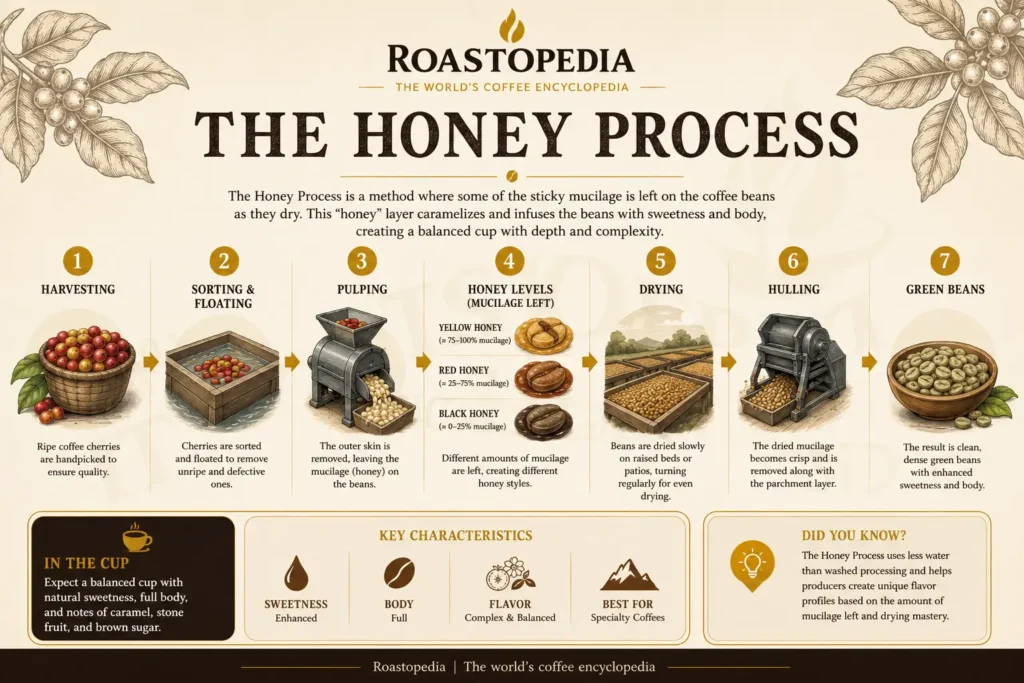
The Honey Process involves a structured sequence of operations from cherry harvest through green coffee preparation. The precise parameters at each stage — particularly the degree of mucilage retained and the drying regimen — determine the resulting flavor profile and the honey “color” classification assigned to the lot.
Step 1: Selective Harvesting
Coffee cherries are harvested selectively by hand or by machine, with emphasis placed on picking only ripe, fully red (or yellow, depending on cultivar) cherries. The quality and uniformity of the incoming cherry is of heightened importance in honey processing, as overripe or underripe cherries contribute undesirable fermentation compounds or flavor defects that are not masked by the washing stage that would occur in washed processing. Many premium honey processors, including Las Lajas, employ optical color-sorting technology to ensure that only the ripest cherries enter the processing stream.
Step 2: Mechanical Depulping
Immediately after harvest — typically within hours — the cherries are passed through a mechanical depulper, which strips the outer skin and pulp (exocarp and most of the mesocarp) from the seed. The depulper is calibrated to remove the skin while leaving the mucilage intact on the parchment-covered seed. Some facilities use specialized equipment such as the Penagos Aquapulper, a water-saving machine capable of precise mucilage management. Unlike the Washed Process, no fermentation tanks filled with water are used to break down and remove the mucilage.
Step 3: Mucilage Calibration
Immediately following depulping, processors may use demucilaging machines to remove specific percentages of the mucilage layer, depending on the intended honey classification. For White Honey lots, 80–100% of the mucilage is removed mechanically. For Yellow Honey lots, 50–75% is removed. For Red Honey lots, the mucilage removal is partial, leaving approximately 50% or more intact. For Black Honey lots, little to no mucilage is removed after depulping, leaving the bean in a state approaching that of a natural-processed coffee in terms of sugar contact, though the outer cherry skin has been removed.
Step 4: Drying on Raised Beds or Patios
The mucilage-coated seeds are spread in thin, even layers on raised African beds or concrete patios for solar drying. The management of the drying phase is among the most labor-intensive and technically demanding aspects of the Honey Process. Because the mucilage is highly susceptible to mold growth, uneven fermentation, and bacterial contamination, the beans must be regularly turned and raked to ensure uniform airflow and prevent clumping or spoilage.
The frequency of turning varies by classification: at Las Lajas, Black Honey lots are turned only once every 24 hours, while Yellow Honey lots are turned hourly. Red Honey lots are turned several times per day. Drying duration ranges from approximately 5–7 days for White Honey to 2–4 weeks or more for Black Honey, depending on ambient temperature, humidity, and airflow. Ideal drying conditions are warm, sunny, and low-humidity. Plastic-covered or shade-covered drying structures may be employed to moderate temperature extremes or protect against rainfall.
The target moisture content upon completion of drying is approximately 11–12%.
Step 5: Resting
Following primary drying, lots are typically rested in a controlled storage environment — still in parchment — for a period of days to weeks to allow moisture equilibration throughout the seed mass. This resting phase contributes to flavor stability and uniformity prior to milling.
Step 6: Milling, Sorting, and Grading
The dried parchment and residual dried mucilage are removed through hulling. The resulting green coffee beans are then sorted by size, weight, and quality, with defective beans removed mechanically and by hand. The sorted lots are graded and prepared for bagging and export.
Variations of the Honey Process
The Honey Process is not a single standardized protocol but rather a family of related techniques distinguished primarily by the percentage of mucilage retained on the bean during drying. The color nomenclature — White, Yellow, Red, and Black — serves as the predominant classification system in the specialty coffee trade, though no universally binding or formally regulated standards govern these designations. As a result, the color labels represent approximate ranges rather than precisely fixed parameters, and variation in their application exists between producers and regions.
White Honey
In the White Honey variant, 80–100% of the mucilage is removed after depulping, leaving only a minimal coating on the bean. The resulting dried beans are light in color. White Honey coffees most closely resemble washed coffees in cup profile, exhibiting clean, delicate flavors, lighter body, and subtle fruit character. The drying period is relatively short. This variant is often favored where consistency and clarity are prioritized.
Yellow Honey
Yellow Honey retains approximately 25–50% of the mucilage on the bean, with 50–75% removed. The beans turn yellow during drying as the residual mucilage caramelizes under sun exposure. Yellow Honey coffees display moderate sweetness and a mild fruitiness, with body and acidity balanced between washed and more mucilage-heavy variants. Drying time is moderate.
Red Honey
In Red Honey processing, a more substantial proportion of mucilage — typically around 50% or more — is retained on the bean after depulping. The beans take on a reddish, orange-brown coloration during drying, a result of both the quantity of caramelizing mucilage and the prolonged drying time. Red Honey coffees exhibit pronounced sweetness and a more developed fruit character than Yellow Honey, along with a fuller body and lower perceived acidity. The extended drying period (often 2–4 weeks) requires attentive management to prevent defect development.
Black Honey
Black Honey represents the extreme of the mucilage-retention spectrum. After depulping, minimal or no mucilage is mechanically removed; the bean is dried with essentially its full mucilage layer intact, approximating the sugar and fermentation dynamics of the Natural Process while differing in that the outer cherry skin has been removed. The beans take on a very dark, nearly black appearance during the long drying period, as the full mucilage caramelizes extensively. Black Honey coffees are characterized by deep sweetness, intense body, complex fruit notes, and low acidity. They require the longest and most labor-intensive drying management and carry the highest risk of defect.
Regional Terminological Variants
Pulped Natural (Brazil): The Brazilian Pulped Natural closely parallels the Yellow or Red Honey in terms of mucilage retention and drying dynamics, though Brazilian producers traditionally used distinct terminology and developed the method independently of the contemporary Costa Rican Honey Process nomenclature. Pulped Natural is produced in large volumes in Brazil and is a commercially significant category.
Semi-Washed (Indonesia): The term Semi-Washed is used in some Indonesian producing regions to describe processes involving partial mucilage removal, though it is also sometimes applied to the Wet-Hulled (Giling Basah) method, with which it should not be confused. The term’s inconsistent application across regions has contributed to labeling ambiguity in the trade.
Implementation Across Producing Regions
Costa Rica
Costa Rica is internationally recognized as the origin and primary center of Honey Process development in the modern specialty context. The country’s micromill system — in which small, independent producers process their own lots — facilitated early innovation and differentiation by honey category. Farms in the Central Valley, West Valley (including Valle Occidental), and Tarrazú regions produce honey-processed lots at multiple color grades. Las Lajas Micromill (Chacón family), Brumas Del Zurquí (Juan Ramón Alvarado), and numerous other operations have established Costa Rica’s global reputation in this processing category. The Costa Rican government’s water-conservation regulations continue to support the prevalence of lower-water processing approaches.
El Salvador
Honey processing was introduced to El Salvador by producer Graciano Cruz of Panama, following the Costa Rican model. Salvadoran producers adapted the method with notable success, with Jorge Raul Rivera of El Salvador achieving three Cup of Excellence first-place wins with honey-processed Pacamara lots. El Salvador has since become a recognized origin for quality honey-processed coffees, particularly from high-altitude farms.
Brazil
Brazil’s Pulped Natural — the antecedent and regional parallel to the Honey Process — continues to be produced at substantial commercial scale. The method is particularly prevalent in the Cerrado Mineiro, Sul de Minas, and Mogiana regions, where climatic conditions are suitable for sun drying. The Pulped Natural is typically equivalent in mucilage retention to Yellow or Red Honey categories.
Ethiopia
Ethiopia, while predominantly associated with Natural and Washed processing, has seen growing experimentation with honey-processed lots, particularly from producers and exporters seeking to differentiate micro-lots for the specialty market. Honey-processed Ethiopian Geisha coffees have achieved record prices at auction.
Other Producing Nations
The Honey Process has been adopted by producers in Guatemala, Panama, Mexico, Colombia, Peru, Vietnam, Myanmar, Uganda, and increasingly elsewhere. In each region, adaptation to local climate, infrastructure, and cultivar characteristics has resulted in distinct expressions of the method. Vietnam and Indonesia have seen particular interest in honey-processed Robusta (see Coffea canephora), a departure from the method’s original application to Arabica, driven by research into improving the commercial appeal of Robusta through specialty processing techniques.
Flavor Profile
Honey-processed coffees occupy a wide spectrum of cup characteristics, determined by mucilage retention level, drying conditions, cultivar, altitude, and post-processing handling. As a general characterization:
Sweetness is the most consistent hallmark of the honey-processed category, a result of sugars from the retained mucilage being absorbed into and caramelizing on the bean surface during drying. Notes commonly associated include brown sugar, stone fruit (peach, apricot), tropical fruit, chocolate, toffee, and dried fig, with the intensity of these characteristics increasing along the spectrum from White to Black Honey. Body tends to be medium to full, with White Honey displaying lighter body and Black Honey approaching the weight of a well-produced natural.
Acidity is generally moderate to low and described as soft rather than sharp, providing balance without the high-toned brightness typical of washed coffees. Fermentation character, if present, is generally mild and controlled in well-produced lots; excessive fermentation is considered a defect.
Criticism and Challenges
Lack of Standardized Labeling
The most consistently cited criticism of the Honey Process framework is the absence of universally agreed-upon, enforceable definitions for the color-based classification system. The categories of White, Yellow, Red, and Black Honey are industry conventions rather than formally regulated designations. As a result, the same label may be applied by different producers to coffees with substantially different mucilage retention levels, drying durations, or processing techniques. Buyers and consumers may encounter significant cup variation under the same honey label, creating challenges for procurement consistency and consumer education.
Production Risk and Defect Vulnerability
Honey processing is technically demanding and carries higher production risk than either the Washed or Natural processes under many conditions. The mucilage coating creates an environment vulnerable to mold growth, uneven fermentation producing acetic or butyric off-flavors, and pest pressure during the extended drying period. Adverse weather — particularly rain or high humidity during drying — can render an entire lot defective. The splotchy, uneven coloration of dried honey-processed beans has historically led some buyers to reject lots on visual grounds before cupping, creating a market access challenge for producers.
Climate and Infrastructure Dependency
Optimal honey processing requires sustained warm temperatures, low humidity, adequate solar exposure, and sufficient drying space during the harvest period. Producers in regions without consistent dry-season conditions during harvest face elevated risk of defects and inconsistency. The method also requires adequate infrastructure — raised beds, patio space, and mechanical depulpers — that represents a meaningful capital investment for smallholder producers.
Water Management
While the Honey Process significantly reduces water consumption compared to the Washed Process — with estimates suggesting a reduction of 60–70% in water use — it does not eliminate the need for water entirely. Depulping operations may require some water flow, and the residual mucilage removed at the demucilaging stage, if not properly managed, can contribute to localized methane emissions during decomposition and potential water pollution if discharged into waterways without treatment.
Market Saturation
Industry observers have noted that by the early 2020s, the Honey Process had transitioned from an innovative and premium differentiator to a widely practiced and increasingly expected offering in specialty coffee. As production expanded globally and honey-processed lots multiplied at auction, the pricing premium and market novelty associated with the category diminished relative to its peak in the early-to-mid 2010s. Some producers and analysts have characterized the honey category as having been “saturated,” with newer experimental methods such as carbonic maceration and koji fermentation attracting greater attention from buyers seeking differentiation.
Environmental Considerations
The Honey Process is broadly regarded as more environmentally sustainable than the Washed Process, primarily due to its reduced freshwater consumption. In regions experiencing water stress — including parts of Costa Rica, Central America, and East Africa — the shift toward honey processing has reduced pressure on local freshwater supplies and decreased the volume of wastewater effluent requiring treatment or disposal.
The energy requirements of honey processing are estimated to be lower than those of washed processing (which requires fermentation tank infrastructure and substantial water heating in some climates), though slightly higher than fully natural processing due to the mechanical depulping stage. Where electricity or fuel is consumed for artificial drying or temperature regulation, the environmental footprint increases correspondingly.
Mucilage removed during the demucilaging stage presents a byproduct management consideration. Research has explored the valorization of coffee mucilage as a source of pectin, bioethanol, fertilizer, or other value-added products, with some commercial operations implementing these approaches.
See Also
- Washed (Wet) Process — The predominant coffee processing method in which all fruit matter is removed prior to drying via fermentation and washing.
- Natural (Dry) Process — The oldest documented processing method, in which the whole cherry is dried intact before milling.
- Pulped Natural Process — The Brazilian antecedent to the Honey Process, involving skin removal and mucilage-on drying.
- Wet-Hulled Process (Giling Basah) — An Indonesian method involving hulling at elevated moisture content, producing distinctive flavor profiles.
- Anaerobic Fermentation Process — A processing method in which cherries or depulped seeds are fermented in sealed, oxygen-deprived vessels to develop specific flavor compounds.
- Carbonic Maceration Process — An experimental processing technique adapted from winemaking in which whole or depulped cherries are fermented under carbon dioxide in sealed containers.
- Koji Fermentation Process — An emerging specialty coffee processing method utilizing Aspergillus oryzae (koji mold) as a controlled fermentation agent during processing.
- Washed-Natural Hybrid Processes (Honey or Pulped Natural Processes) — A broader category encompassing regional and experimental processing methods combining elements of washed and natural techniques.
References
- Aswathi, K. N., & Murthy, P. S. (2024). Pulped Natural/Honey Coffee Process: An Innovative Approach. ScienceDirect. https://www.sciencedirect.com/science/article/abs/pii/S2949824424000624
- Aswathi, K. N., & Murthy, P. S. (2025). Eco-efficient robusta honey coffee process for energy and water footprint reduction: A life cycle assessment. ScienceDirect. https://www.sciencedirect.com/science/article/abs/pii/S0960308525000720
- Alliance for Coffee Excellence. (2013). Costa Rica Cup of Excellence Results. Alliance for Coffee Excellence.
- Bean & Bean Coffee Roasters. (2021). What is Honey Processed Coffee? Everything You Need to Know. https://beannbeancoffee.com/blogs/beansider/honey-processed-coffees
- Blue Bottle Coffee. (2024). All About Coffee from Costa Rica. Blue Bottle Coffee Lab. https://blog.bluebottlecoffee.com/posts/costa-rica-an-origin-of-micromills
- Café Britt. (2023). Exploring the Art of Honey Processing in Coffee. https://www.cafebritt.com/blogs/coffee-101/honey-processed-coffee-what-makes-it-so-special
- Daily Coffee News. (2017). Honey Process: Get to Know This Sweetheart of Specialty Coffee. https://dailycoffeenews.com/2017/12/04/honey-process-get-to-know-this-sweetheart-of-specialty-coffee/
- Driven Coffee. (2024). Costa Rican Coffee: Get To Know Your Coffee Origins. https://www.drivencoffee.com/blogs/blog/costa-rican-coffee-origins
- Espresso Outlet. (2025). Environmental Sustainability of Coffee Processing Methods. https://espressooutlet.com/blogs/news/environmental-sustainability-of-coffee-processing-methods
- FiXX Coffee. (2024). Honey Process Coffee — Definition & Meaning. https://fixxcoffee.com/blogs/glossary/honey-process
- Intelligence.coffee. (2022). Honey processing: Did the world steal Costa Rica’s coffee niche? https://intelligence.coffee/2022/08/honey-processing-costa-rica-coffee-niche/
- Lux Café Club. (2024). Honey Processed Coffee — The Untold Story of Your Morning Brew. https://www.luxcafeclub.com/blogs/news/honey-processed-coffee-the-untold-story-of-your-morning-brew
- Perfect Daily Grind. (2025). How honey processing is evolving in specialty coffee. https://perfectdailygrind.com/2025/01/how-honey-processing-is-evolving-in-specialty-coffee/
- Red Rooster Coffee. (n.d.). Costa Rica Las Lajas Black Honey — Process Description. https://www.redroostercoffee.com/products/costa-rica-las-lajas-black-honey
- ResearchGate. (2024). Pulped Natural/Honey Coffee Process: An Innovative Approach [Request PDF]. https://www.researchgate.net/publication/379348862_Pulped_NaturalHoney_Coffee_Process_An_Innovative_Approach
- Rock Creek Coffee Roasters. (2024). Costa Rican Coffee Guide: History, Flavor Profiles & Best Regions. https://rockcreekcoffee.com/blogs/blog/introduction-to-costa-rican-coffee-history-flavor-profiles-and-growing-regions
- Torque Coffees. (n.d.). Las Lajas, Red Honey — Costa Rica: Producer Notes. https://torque.coffee/products/las-lajas-red-honey-costa-rica
- United States Patent and Trademark Office. (n.d.). Process for obtaining honey and/or flour or coffee from the pulp or husk and the mucilage of the coffee bean (Patent No. 10010092). https://image-ppubs.uspto.gov/dirsearch-public/print/downloadPdf/10010092
- 787 Coffee. (2026). What Is Honey Process Coffee? Complete Guide. https://www.787coffee.com/blog/honey-process-coffee-explained