
Bacterial Blight of Coffee, also widely known as bacterial halo blight or coffee halo spot, is a foliar and stem disease of coffee caused by the Gram-negative bacterium Pseudomonas syringae pv. garcae (often abbreviated Psg).
First identified in Brazil in the mid-1950s, the disease has since become one of the most economically significant bacterial pathogens affecting Coffea arabica (Arabica) and, to a lesser but growing extent, Coffea canephora (Robusta). It causes necrotic, halo-ringed lesions on leaves and can progress to dieback of branches and, in severe outbreaks, death of young plants, making it a persistent concern in nurseries and high-altitude, wind-exposed plantations across the Coffee Belt.
Causal Agent and Taxonomy
The disease is caused by Pseudomonas syringae pv. garcae, a pathovar within the broader Pseudomonas syringae species complex, a group of Gram-negative, rod-shaped, fluorescent bacteria responsible for numerous economically important plant diseases worldwide.
The pathogen was originally described and named Pseudomonas garcae by Amaral, Teixeira, and Pinheiro in 1956, honoring the municipality of Garça, São Paulo, where it was first isolated. It was later reclassified as a pathovar of P. syringae following the revised nomenclature for plant-pathogenic bacteria proposed by Young, Dye, Wilkie, and colleagues in the late 1970s.
Taxonomically, Psg belongs to phylogroup 4 (PG4) of the P. syringae complex, distinguishing it from related coffee-associated pathovars such as P. syringae pv. tabaci (phylogroup 3, cause of bacterial leaf spot) and Pseudomonas cichorii (cause of bacterial leaf blight), with which Psg is sometimes collectively grouped under the general term “bacterial blight of coffee.”
Biochemically and pathogenically, isolates of Psg from Brazil and from East Africa (Kenya) have been shown to differ somewhat, suggesting the pathovar comprises at least two distinguishable strain groups. Recent molecular research has also linked the emergence and virulence of coffee-infecting P. syringae strains to the horizontal transfer of plasmid-encoded type III secretion system effectors, which help explain the pathogen’s capacity to overcome host defenses.
Host Range and Susceptibility
The primary and most extensively studied host is Coffea arabica, in which the disease has been responsible for major nursery and field losses in Brazil and East Africa. Coffea canephora (robusta) was long considered comparatively tolerant, but controlled inoculation studies screening thousands of robusta cultivars, botanical varieties, clones, and hybrids found that only a small fraction—around one percent—showed genuine resistance, revealing an alarming degree of susceptibility across robusta germplasm as well.
Susceptibility varies considerably by cultivar, age of plant tissue, and environmental stress; young, actively growing leaves and seedlings in nurseries are particularly vulnerable, and plants weakened by frost, wind damage, or nutrient stress show markedly higher disease incidence.
Symptoms and Part of the Plant Affected
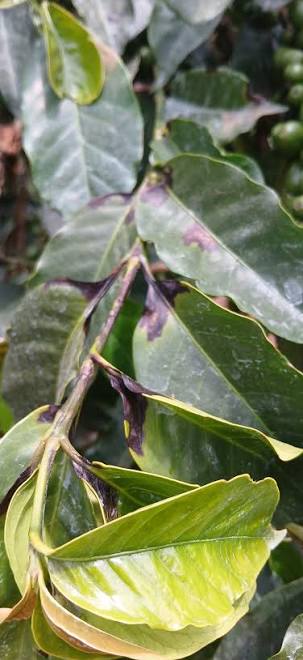
Bacterial blight of coffee primarily affects leaves, young shoots, branches, and, in severe cases, the apical meristem and main stem. Characteristic symptoms include:
- Leaf spots: small, dark, water-soaked necrotic lesions that enlarge and become surrounded by a pale yellow-green “halo,” giving the disease its common name.
- Coalescing lesions: individual spots can merge into larger necrotic patches, leading to premature leaf yellowing and defoliation.
- Dieback: infection of young branches and shoot tips causes blackening and death of terminal growth, often referred to in East Africa historically as “Elgon die-back” or “Solai die-back.”
- Stem and apical necrosis: in advanced infections, necrosis can extend into the main stem and kill the growing point, particularly in young nursery plants.
- Defoliation and plant collapse: heavily infected seedlings and young trees may lose most of their foliage and, in extreme cases, die outright.
Infection requires free water on the leaf surface for bacteria to penetrate, and bacteria typically enter through wounds caused by wind abrasion, pruning cuts, leaf-scars left by abscission, or natural openings such as stomata. Unlike some vascular pathogens, Psg does not colonize the plant systemically, so lesions tend to remain localized to the infected tissue and its immediate surroundings.
Life Cycle and Spread
Pseudomonas syringae pv. garcae survives on and in host tissue, including on symptomless plant surfaces as an epiphyte, and can also be seed-borne: research has demonstrated that seeds harvested from symptomatic coffee plants can carry viable inoculum capable of producing typical halo-blight symptoms in seedlings, implicating seed transmission as a means of introducing the pathogen into previously unaffected nurseries.
In the field, the bacterium is dispersed short distances primarily by wind-driven rain, which splashes bacterial cells from lesions onto healthy tissue and provides the moisture film needed for infection. Wounds from wind-whipping of leaves and branches, pruning, and mechanical damage create entry points, while cool, wet, windy conditions—especially at higher elevations—strongly favor disease development and spread. Because of this, poorly protected plantations lacking windbreaks in cool, high-altitude, high-rainfall zones tend to experience the most severe epidemics.
Historical Discovery
Bacterial blight of coffee was first described scientifically in 1955–1956, when Amaral, Teixeira, and Pinheiro identified the causal bacterium in coffee plantations in the county of Garça, in the state of São Paulo, Brazil, publishing their findings as “A bacterium causing halo blight of coffee.” For roughly the following seventeen years, the disease was regarded as a relatively minor, isolated problem.
This changed sharply in the mid-1970s: following severe frosts in the Brazilian state of Paraná, coffee plantations and nurseries recovering from frost damage experienced a marked upsurge in bacterial blight incidence between 1973 and 1975, elevating the disease from a minor curiosity to a recognized threat to Brazilian coffee production. The pathogen subsequently spread to, or was documented in, the states of São Paulo, Paraná, and Minas Gerais.
Arrival in the Americas, Africa and Asia
Because the disease was first identified in Brazil, its documented history effectively begins in the Americas, where it remains most intensively studied and economically important, particularly in São Paulo, Paraná, and Minas Gerais.
On the African continent, a similar or related disease had actually been recognized earlier under different names: outbreaks resembling bacterial blight were reported in Kenya as “Elgon die-back” as early as the 1930s, and later as “Solai die-back” in the 1970s, before formal identification linked these African outbreaks to P. syringae pv. garcae through comparative studies of Kenyan and Brazilian isolates.
The disease was subsequently confirmed in Ethiopia, where surveys in the 1990s found alarmingly high incidence—estimated at 70 to 80 percent in some areas—marking the first formal report of bacterial blight of coffee in that country, and in Uganda.
In Asia, bacterial halo blight of coffee has been documented in China. Its continued spread across multiple coffee-growing continents underscores its status as an emerging, rather than merely historical, threat to global coffee production.
Geographic Distribution within the Coffee Belt
Within the global Coffee Belt, bacterial blight of coffee shows a distribution shaped strongly by altitude and climate rather than latitude alone. It is most severe and best documented in:
- South America: particularly southeastern Brazil, in the states of São Paulo, Paraná, and Minas Gerais, especially in higher-altitude, wind-exposed, and irregular-topography coffee-growing regions.
- East Africa: Kenya, Ethiopia, and Uganda, where highland Arabica production zones above roughly 1,000 meters and subject to strong seasonal winds are particularly prone to outbreaks.
- East Asia: reported occurrence in China’s coffee-growing regions.
The disease’s association with cooler, high-elevation, and windy micro-climates means that within the Coffee Belt it tends to concentrate in mountainous Arabica zones rather than the lowland Robusta regions nearer sea level, although robusta germplasm has also proven susceptible under experimental conditions.
Economic and Social Impact
Bacterial blight of coffee is considered one of the most economically damaging bacterial diseases affecting coffee worldwide. Losses of up to 70 percent have been reported in nurseries and field plantings under favorable disease conditions, representing a severe threat to young plant stock in particular, where entire batches of seedlings can be lost before they ever reach productive maturity.
In Ethiopia, incidence estimates of 70 to 80 percent in affected areas illustrate how quickly the disease can become entrenched once introduced. Beyond direct yield loss, the disease imposes recurring costs on growers through the need for repeated chemical treatments, windbreak establishment, and replanting of nursery stock, while the difficulty and low field efficiency of chemical control make it a persistent, rather than easily solved, production challenge.
For smallholder farmers who depend on coffee as a primary source of income, outbreaks—especially following stress events like frost—can compound existing economic vulnerability and threaten household livelihoods in affected regions.
Control and Management
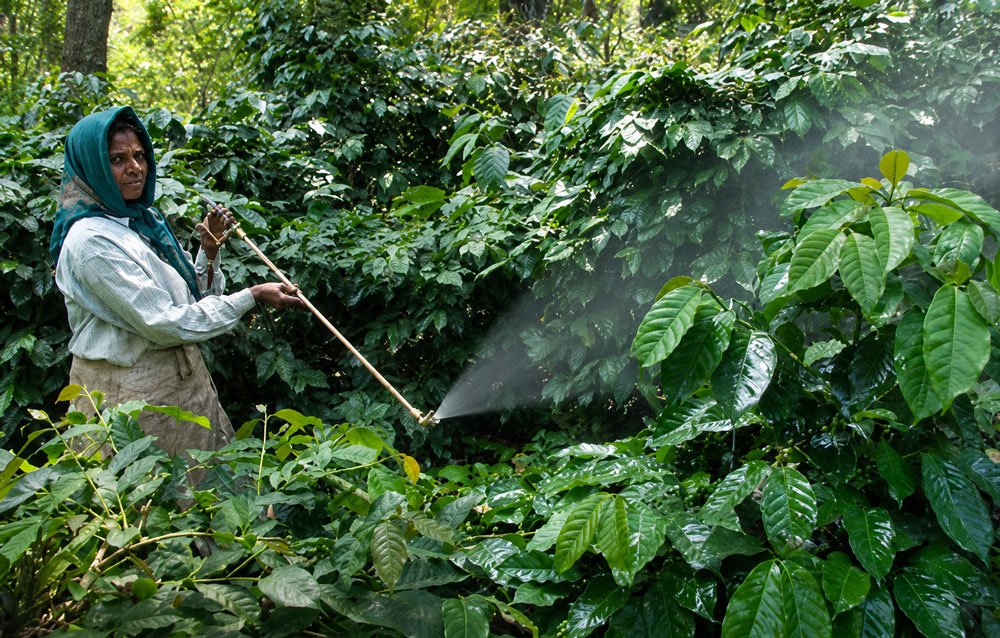
Because chemical control of bacterial blight under field conditions has historically proven difficult and inconsistently effective, management relies on an integrated combination of cultural, chemical, and genetic strategies:
- Windbreaks: since wind-driven rain and wind-caused wounds are major factors in infection and spread, establishing windbreaks around plantations is considered one of the most effective and widely recommended cultural controls, particularly in high-altitude, exposed sites.
- Resistant cultivars: breeding and screening programs have sought resistance sources within both Coffea arabica and Coffea canephora germplasm; the combined use of windbreaks and resistant cultivars is regarded as the most appropriate overall management strategy, especially given how few individual plants tested have shown natural resistance.
- Copper-based bactericides: rainfall-timed copper sprays have been used, particularly in Kenya, to suppress bacterial blight (often alongside coffee berry disease control programs), though efficacy in field conditions remains limited and environmental and resistance concerns exist with repeated copper or antibiotic (e.g., kasugamycin) use.
- Sanitation and nursery hygiene: given evidence of seed-borne transmission, using pathogen-free seed sources and maintaining strict nursery sanitation helps reduce introduction of inoculum into new plantings.
- Reduced planting density: because dense plantings and close plant spacing favor leaf-surface moisture retention needed for bacterial infection, wider spacing can help lower disease pressure.
- Emerging biological control research: more recent scientific work has explored the use of bacteriophages that specifically prey on P. syringae pv. garcae as a potential alternative to chemical bactericides, aiming to reduce reliance on copper and antibiotics.
Significance in Coffee History and Science
Bacterial blight of coffee occupies a distinctive place in coffee plant pathology as one of the relatively few major bacterial (as opposed to fungal) diseases of the crop, standing alongside conditions such as Bacterial Leaf Spot and Coffee Leaf Scorch within the broader category of coffee bacterial diseases.
Its documented resurgence in Brazil following frost damage in the 1970s illustrates how abiotic stress events can trigger latent or minor pathogens into major epidemics, a pattern of continuing interest to plant pathologists studying disease emergence. The disease has also served as a valuable case study in bacterial taxonomy and phylogenetics, with comparative work distinguishing Kenyan and Brazilian isolate strains contributing to a broader understanding of Pseudomonas syringae pathovar diversity.
More recently, research into the horizontal transfer of plasmid-encoded virulence factors in coffee-associated P. syringae strains has positioned the pathogen as a useful model for studying how plant pathogens acquire new virulence traits, connecting a historically regional coffee disease to wider questions in microbial evolution and emerging infectious disease.
See Also
- Brown Eye Spot (Cercospora coffeicola)
- American Leaf Spot (Mycena citricolor)
- Coffee Leaf Scorch (Xylella fastidiosa subsp. pauca)
- Coffee Wilt Disease (Fusarium xylarioides)
- Coffee Berry Disease (Colletotrichum kahawae)
- Coffee Leaf Rust (Hemileia vastatrix)
- Coffee Ringspot Disease (Coffee ringspot virus)
- Bacterial Leaf Spot (Pseudomonas syringae pv. garcae)
References
- Amaral, J.F., Teixeira, C., Pinheiro, E.D. (1956). “A bacterium causing halo blight of coffee.” Arquivos do Instituto Biológico, São Paulo, 21: 151–156
- Badel, J.L., Zambolim, L. (2019). “Coffee bacterial diseases: a plethora of scientific opportunities.” Plant Pathology, 68(3): 411–425
- Kairu, G.M. (1997). “Biochemical and pathogenic differences between Kenyan and Brazilian isolates of Pseudomonas syringae pv. garcae.” Plant Pathology, 46(2): 239–246
- Korobko, A., Wondimagegne, E. (1997). “Bacterial Blight of Coffee (Pseudomonas syringae pv. garcae) in Ethiopia.” In Pseudomonas Syringae Pathovars and Related Pathogens, Developments in Plant Pathology, vol. 9. Springer, Dordrecht
- Belan, L.L., et al. (2016). “Occurrence of Pseudomonas syringae pv. garcae in coffee seeds.” Australian Journal of Crop Science, 10(7): 1015–1021
- CABI Compendium. “Pseudomonas syringae pv. garcae (bacterial blight of coffee).” CABI Digital Library, Datasheet No. 44959
- McTavish, C., et al. (2024). “Pseudomonas syringae coffee blight is associated with the horizontal transfer of plasmid-encoded type III effectors.” New Phytologist
- Zoccoli, D.M., et al. (2011). Referenced in Coffee Leaf Rust Resistance: An Overview, in Genomic Designing for Biotic Stress Resistant Coffee. Springer