
Mocha, or mocha coffee, is a chocolate-flavored espresso beverage made by combining espresso, chocolate (usually in cocoa powder or chocolate syrup), and steamed milk, typically finished with a layer of milk foam or whipped cream. It is also known as caffè mocha, mochaccino, or mocaccino, and is generally treated as a sweetened, chocolate-forward variation of the caffè latte.
At a Glance
| Attribute | Detail |
| Also known as | Caffè mocha, mochaccino, mocaccino |
| Type | Espresso-based, milk and chocolate beverage |
| Origin | Modern form: Italy/United States (20th century); name origin: Yemen |
| Main ingredients | Espresso, cocoa or chocolate syrup, steamed milk |
| Serving temperature | Hot or iced |
| Typical serving size | 8–16 fl oz (240–475 ml) |
| Espresso shots | 1–2 |
| Related drinks | Caffè latte, cappuccino, moccacino |
What is Mocha?
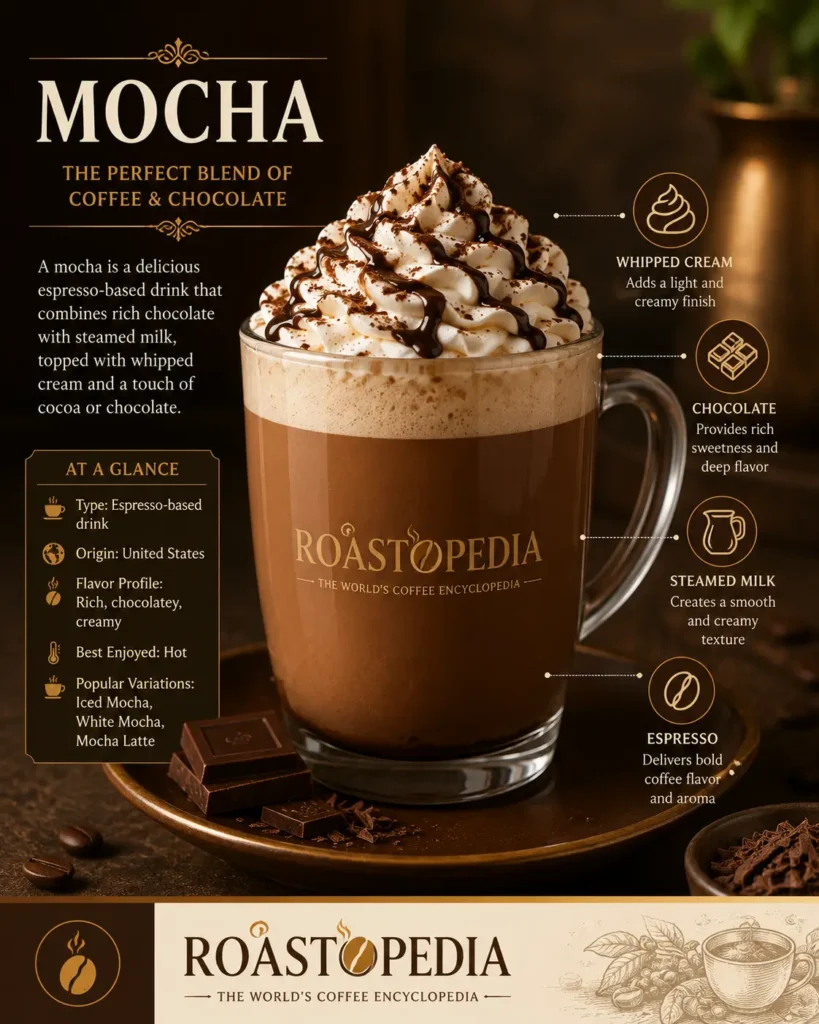
At its core, mocha sits between a caffè latte and a cup of hot chocolate. It shares the espresso-and-steamed-milk foundation of a caffè latte, but the addition of cocoa or chocolate syrup gives it a sweeter, dessert-like character that sets it apart from more coffee-forward drinks such as the cappuccino or macchiato. It should not be confused with the Moka pot, a stovetop brewing device with a similarly spelled name but an entirely separate origin.
Etymology
The name “mocha” traces back to the historic Yemeni port city of Mocha (also spelled Mokha or Al-Mukha), which served as the principal export hub for Yemeni and Ethiopian coffee from the 15th to the early 18th centuries.[1] Coffee shipped through this port became known simply as “Mocha coffee,” and the term eventually entered European languages as shorthand for high-quality Arabian coffee.[2] Only later, as the beans exported from the region were noted for a naturally chocolatey, spiced flavor note, did “mocha” come to describe the chocolate-and-coffee pairing recognized today.[3]
History
Coffee reached Yemen from Ethiopia by the 15th century, and the port of Mocha quickly became the world’s dominant marketplace for the crop, a role reinforced when the Ottomans took control of the region in 1538 and required passing ships to dock and pay duties there.[4] Dutch, British, and French trading companies all maintained factories at the port between the 17th and 18th centuries, and the coffee that moved through it — later associated with several regions within the coffee belt — became so closely identified with the location that “Mocha” functioned as a de facto brand name.[5]
The port’s dominance faded once the Dutch smuggled live coffee plants to Java and coffee cultivation spread to Latin America, and by 1839 European trading nations had relocated their operations to Aden, ending Mocha’s centuries-long monopoly.[6]
The chocolate-and-espresso drink now called mocha is a much later invention, emerging alongside the wider rise of espresso bar culture in 20th-century Italy and the United States, when cafés began pairing shots of espresso — measured and pulled much like the dosing principles used for standard espresso — with cocoa and steamed milk. The drink was popularized further by the American specialty-coffee boom of the late 20th century, when chains standardized the mocha as a menu staple alongside the latte and cappuccino.
Traditional Preparation
A classic mocha is prepared by lining a cup with chocolate syrup or a spoonful of cocoa powder, pulling one or two shots of espresso directly over it, and stirring the two together, sometimes with light agitation to fully dissolve the cocoa. Steamed milk is then poured in, and the drink is typically topped with a small amount of milk foam, whipped cream, or a dusting of cocoa or chocolate shavings.
Ingredients
- Espresso (one or two shots)
- Chocolate, in the form of cocoa powder, chocolate syrup, or melted chocolate
- Steamed milk
- Sugar (optional, particularly with unsweetened cocoa)
- Whipped cream or milk foam for topping (optional)
Characteristics
Mocha is defined by its balance of bitterness, sweetness, and richness. The espresso supplies coffee intensity and acidity, the chocolate contributes sweetness and a rounder, dessert-like body, and the steamed milk softens both elements into a smooth, drinkable whole. Compared with a plain caffè latte, mocha is heavier and sweeter; compared with hot chocolate, it retains a distinct coffee backbone. Well-made versions balance the cocoa so it complements rather than masks the espresso’s flavor.
Regional Variations
- White mocha — uses white chocolate instead of dark or milk chocolate, producing a milder, sweeter, and less bitter drink.
- Iced mocha — served cold over ice, often with chocolate syrup drizzled inside the cup.
- Mexican-style mocha — sometimes flavored with cinnamon or spiced sugar, echoing regional sweetened coffee traditions such as piloncillo coffee.
- Mochaccino — a term used in some markets interchangeably with mocha, though it can also describe a drink closer to a chocolate-dusted cappuccino; see the related moccacino entry for that distinction.
- Marocchino-adjacent variations — smaller, cocoa-dusted espresso-and-milk drinks in Italian cafés, such as the marocchino, share conceptual DNA with mocha despite differing in size and format.
Cultural Significance
Mocha occupies a distinctive place in coffeehouse culture as an approachable “gateway” espresso drink, often favored by those who enjoy coffee flavor without the full intensity of a straight espresso or Americano. Its dessert-like profile is considered a fixture on café menus year-round and especially popular in colder months, and its name continues to carry an echo of the historic Yemeni coffee trade that gave coffee itself much of its early global reach.
Comparison with Similar Drinks
| Drink | Espresso | Milk | Chocolate | Typical Character |
| Mocha | Yes | Steamed | Yes | Sweet, chocolate-forward |
| Caffè Latte | Yes | Steamed (large amount) | No | Mild, milk-forward |
| Cappuccino | Yes | Steamed + foam (equal parts) | No | Balanced, textured |
| Moccacino | Yes | Steamed | Often, lighter dusting | Cappuccino-like with cocoa accent |
| Macchiato | Yes | Small amount | No | Strong, coffee-forward |
Typical Specifications
| Specification | Typical Range |
| Espresso volume | 1–2 fl oz (30–60 ml) per shot |
| Chocolate/cocoa | 1–2 tbsp syrup or powder |
| Steamed milk | 6–10 fl oz (180–300 ml) |
| Total serving size | 8–16 fl oz (240–475 ml) |
| Caffeine content | ~95–150 mg (varies by shot count) |
| Calories (whole milk, sweetened) | ~200–350 kcal |
See Also
References
- Britannica, “Mocha | Yemen, Origin, History & Coffee Exports” — https://www.britannica.com/place/Mocha-Yemen
- Smithsonian Magazine, “Your Mocha Is Named After the Birthplace of the Coffee Trade” — https://www.smithsonianmag.com/smart-news/your-mocha-named-after-birthplace-coffee-trade-180965016/
- Perfect Daily Grind, “The History of Mocha Coffee & Yemeni Coffee Culture” — https://perfectdailygrind.com/2017/09/the-history-of-mocha-coffee-yemeni-coffee-culture/
- Wikipedia, “Port of Mokha” — https://en.wikipedia.org/wiki/Port_of_Mokha
- Wikipedia, “Mokha” — https://en.wikipedia.org/wiki/Mokha
- Britannica, “Mocha | Yemen, Origin, History & Coffee Exports” — https://www.britannica.com/place/Mocha-Yemen
- Wikipedia, “Espresso” — https://en.wikipedia.org/wiki/Espresso
- Wikipedia, “Caffè mocha” — https://en.wikipedia.org/wiki/Caffè_mocha
- Wikipedia, “List of coffee drinks” — https://en.wikipedia.org/wiki/List_of_coffee_drinks
- National Coffee Association, “Coffee FAQs” — https://www.ncausa.org/about-coffee/coffee-faqs
- Wikipedia, “Latte” — https://en.wikipedia.org/wiki/Latte
- Wikipedia, “Cappuccino” — https://en.wikipedia.org/wiki/Cappuccino
- Wikipedia, “Coffee” — https://en.wikipedia.org/wiki/Coffee
- Wikipedia, “Espressino” — https://en.wikipedia.org/wiki/Espressino