
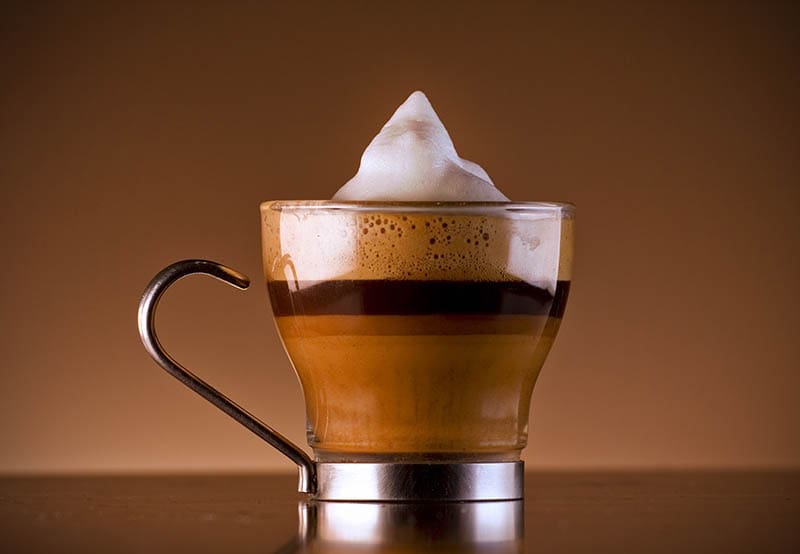
Marocchino (pronounced mah-roh-KEE-no) is a traditional Italian espresso-based coffee drink originating in the city of Alessandria, in the Piedmont region of northwestern Italy. It is composed of three core ingredients — a shot of espresso, unsweetened cocoa powder, and frothed milk — served in a small, transparent glass that showcases the drink’s characteristic layers.
Despite its name, which translates to “Moroccan” in Italian, the beverage has no connection to Morocco; the name derives from the distinctive brown color of a fine-grade leather historically associated with the region.
Etymology
The name marocchino refers to a type of high-quality leather produced by tanning goatskin or sheepskin, a craft with roots in the 16th century when it was used for bookbinding.
In Alessandria, this leather was used as an interior lining strip in the fedora hats manufactured by Borsalino, the renowned Italian hat company whose factory was located directly across from Bar Carpano, the establishment where the drink was first served.
Baristas and factory workers noted the visual resemblance between the warm brown hue of the leather strip and the color of the layered coffee drink, and the name took hold informally before entering common usage.
Some accounts attribute the naming to the bar’s owner, who referred to the drink as marocchino in conversation with Borsalino employees; others attribute it to the workers themselves, who in local Piedmontese dialect reportedly called out for a maruchën upon seeing the resemblance.
History
The Marocchino belongs to a lineage of Piedmontese coffee-and-chocolate drinks that dates to the 18th century. Its most direct ancestor is the Bicerin (bee-cheh-REEN), a layered hot beverage of espresso, thick hot chocolate, and heavy cream that has been served at the historic Caffè Al Bicerin in Turin since 1763.
The Bicerin itself descended from the older bavareisa, a drink enjoyed by Turin’s aristocracy made from coffee, chocolate, and cream. The Bicerin received official recognition as a traditional Piedmontese product from the Italian government in 2001 and was notably favored by Camillo Benso, Count of Cavour, as well as Ernest Hemingway.
The Marocchino emerged as a lighter, leaner evolution of this tradition — replacing the heavy cream and thick melted chocolate of the Bicerin with cocoa powder and microfoam milk, resulting in a shorter, more espresso-forward drink better suited to the rhythms of the modern Italian coffee bar.
Origin at Bar Carpano
There is broad consensus among Italian food historians and coffee sources that the Marocchino was created at Bar Carpano in Alessandria during the first half of the 20th century, with various sources dating its emergence to the 1930s through the post-World War II period.
The bar’s proximity to the Borsalino factory — one of Italy’s most storied manufacturing institutions — meant it served a steady clientele of hat workers, and the drink that would become the Marocchino was developed within this working-class, artisanal context. Bar Carpano is no longer in operation.
Preparation
A traditional Marocchino is assembled in a specific sequence designed to produce visible, distinct layers. The standard method is as follows:
- A small, thick-bottomed glass of approximately 70–80 ml is pre-warmed to help the drink retain its temperature and preserve the crema of the espresso.
- The bottom and interior walls of the glass are dusted with unsweetened dark cocoa powder, forming the aromatic base of the drink.
- A single shot of espresso — or, in some preparations, a ristretto for greater concentration and sweetness — is poured directly into the glass over the cocoa.
- A small quantity of frothed milk, textured to a compact, glossy microfoam similar to cappuccino foam, is spooned or poured gently over the espresso.
- A final dusting of cocoa powder is applied to the surface.
The drink must be served in a transparent glass, as the layered visual presentation is considered an integral part of the experience.
Traditionally, the layers are not stirred before serving; the drinker is expected to observe the stratification before mixing at their own discretion.
Regional Variations and Names
While marocchino is the standard name in Piedmont and across much of northern Italy, the drink circulates under different names in other regions:
- In parts of southern Italy, it is commonly called vetrino (meaning “small glass”) or espressino.
- In Turin, older usage sometimes conflates the marocchino with bicerin, though the two are now considered distinct drinks.
- In Alba, Piedmont — home of Ferrero SpA, the confectionery company that produces Nutella — the cocoa powder is frequently replaced with Nutella, adding hazelnut flavor to the drink.
Ingredient substitutions also vary by establishment. The cocoa powder may be replaced with hot chocolate powder, chocolate sauce, or melted dark chocolate, each of which increases sweetness and reduces bitterness.
Some preparations use a ristretto in place of standard espresso, and contemporary variations have introduced plant-based milks including oat, almond, and soy.
Distinction from Related Drinks
The Marocchino is often compared to the Bicerin and the cappuccino, though it is distinct from both.
Unlike the Bicerin, which uses melted chocolate and heavy cream and is served without stirring as a richly layered experience, the Marocchino is shorter, uses dry cocoa powder, and employs microfoam rather than cream.
Compared to a cappuccino, it is smaller in volume, contains cocoa, and prioritizes layered visual presentation in a glass over the milk-dominant texture of the cappuccino served in a ceramic cup.
The Marocchino also differs from a caffè macchiato in that the latter contains no chocolate element and uses a much smaller quantity of milk.
Cultural Significance
The Marocchino represents a convergence of Italian coffee culture, regional chocolate tradition, and artisanal manufacturing heritage. Its origin story — tied to a hat factory, a neighborhood bar, and a strip of brown leather — reflects the way Italian coffee drinks often emerge from intensely local, everyday contexts rather than from deliberate gastronomic invention.
The drink has spread from its Piedmontese origins across Italy. It is now found on the menus of specialty coffee shops internationally, where it is valued for both its balanced flavor and its visual elegance.
See Also
- Bicerin
- Cappuccino
- Caffè Macchiato
- Ristretto
- Espresso
- Caffè Latte
- Caffè Mocha
- Cortado
- Bavareisa
- Affogato
References
- Wikipedia contributors. “Marocchino.” Wikipedia, The Free Encyclopedia. https://en.wikipedia.org/wiki/Marocchino
- Gambero Rosso International. “Italians at the Coffee Bar: Regional Variations and the Traditions of Espresso Coffee.” Gambero Rosso International, February 15, 2023. https://www.gamberorossointernational.com/news/italians-at-the-coffee-bar-regional-variations-and-the-traditions-of-espresso-coffee/
- La Cucina Italiana. “Marocchino, the Italian Coffee Drink: History and Recipe.” La Cucina Italiana, September 18, 2019. https://www.lacucinaitaliana.com/italian-food/italian-dishes/marocchino-the-italian-coffee-drink-history-and-recipe
- Filicori Zecchini. “Marocchino Coffee: The History, the Name and the Recipe for Preparing It.” Filicori Zecchini Italia. https://filicorizecchini.com/en/blogs/macchia/il-caffe-marocchino-una-storia-curiosa-e-la-ricetta-per-prepararlo
- Filicori Zecchini USA. “Marocchino Coffee: The History, the Name and the Recipe for Preparing It.” Filicori Zecchini USA, September 8, 2022. https://filicorizecchini.us/blogs/news/marocchino-coffee-the-history-the-name-and-the-recipe-for-preparing-it
- Caffèlab. “Marocchino Coffee: History, Recipe, and Curiosities of an Italian Treat.” Caffèlab.com, May 21, 2025. https://caffelab.com/marocchino-coffee/
- Food After Fire. “Classic Italian Coffee — il Marocchino.” Food After Fire, February 20, 2019. https://foodafterfire.com/articles/classic-italian-coffee-il-marocchino/
- HomeGrounds. “Marocchino Coffee Recipe: A Glorious Italian Coffee Drink.” HomeGrounds, June 22, 2025. https://www.homegrounds.co/marocchino-coffee-recipe/
- WakaCoffee. “What Is Marocchino Coffee?” WakaCoffee, September 17, 2020. https://www.wakacoffee.com/blogs/coffeepedia/what-is-marocchino-coffee
- CoffeeAbout. “Marocchino Coffee (A Delicious Chocolaty Drink).” CoffeeAbout, October 5, 2025. https://coffeeabout.com/marocchino-coffee/
- Abide Coffeehouse. “Marocchino.” Abide Coffeehouse, August 26, 2025. https://abidecoffeehouse.com/drinks/marocchino/
- Alessandria Li Sòndria. “Il Marocchino, la bevanda nata in Alessandria.” Amis ad Lisòndria, June 26, 2016. https://alessandrialisondria.altervista.org/il-marocchino-la-bevanda-nata-alessandria/
- Cookist. “Marocchino: perché si chiama così e come si prepara il caffè nato ad Alessandria.” Cookist.it, September 5, 2023. https://www.cookist.it/marocchino-perche-si-chiama-cosi-e-come-si-prepara-il-caffe-nato-ad-alessandria/
- Eat Every Slice. “Marocchino: An Italian Coffee Classic.” EatEverySlice.com, March 30, 2025. https://www.eateveryslice.com/drinks/marocchino-2036/
- 787 Coffee. “What is Caffè Marocchino?” 787 Coffee, May 8, 2023. https://www.787coffee.com/drinks-explained-787-coffee/what-is-caffe-marocchino