
Affogato, also known as affogato al caffè, is a traditional Italian dessert consisting of a scoop of vanilla gelato or ice cream topped with a freshly brewed shot of hot espresso. The dessert is commonly referred to simply as an affogato and is also known in some contexts as affogato coffee or affogato cookie, depending on the product or adaptation being described. The contrast between the cold dairy base and the hot espresso is the defining characteristic of the preparation.
The term affogato means “drowned” in Italian, referring to the way the frozen dessert becomes partially immersed in the coffee when served. The contrast between the hot espresso and the cold gelato creates a distinctive combination of flavors and textures that has made the affogato a popular dessert in Italy and beyond.
Origin & History
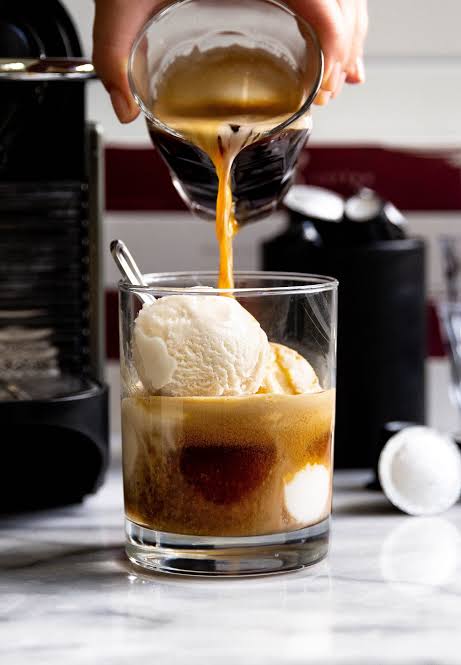
The Affogato is a relatively modern addition to the Italian coffee canon, emerging in the post-WWII era alongside the proliferation of the modern espresso machine and the industrialization of gelato production.
While “drowning” food in liquid is a long-standing culinary tradition in Italy, the specific marriage of espresso and vanilla gelato gained cultural prominence in the 1950s and 60s. It represents the “dolce vita” era of Italian gastronomy—a bridge between a post-meal digestive and a formal dessert.
While it is often classified as a dessert (al cucchiaio) outside of Italy, in its homeland, it remains a common afternoon pick-me-up or a conclusion to a long lunch.
Its international fame surged in the 1990s when global coffee chains and fine-dining establishments adopted it as a staple of minimalist Italian cuisine, though its roots remain firmly in the artisanal gelaterias of Rome and Florence.
Etymology
The term affogato is the past participle of the Italian verb affogare, which translates literally to “to drown.” In a culinary context, it describes the act of submerging a solid ingredient in a liquid to create a unified dish.
While the full name is caffè affogato (drowned coffee), the adjective has become the primary noun in global parlance. The term is also used in other Italian dishes, such as uova affogate (poached eggs), reinforcing the technical definition of the word as a method of preparation rather than a specific flavor profile.
The linguistic transition from an action to a specific menu item highlights how Italian culinary terms often define the relationship between ingredients rather than the ingredients themselves.
The Science of the Brew
The Affogato relies on a violent thermal contrast, a principle known in physics as a high-temperature gradient. The science centers on the interaction between the hot, pressurized extraction of espresso, typically ranging from 190°F to 200°F, and the frozen emulsion of gelato, which is maintained between 10°F and 15°F.
When the espresso is poured, it acts as a solvent that immediately begins to break down the sugars and fats in the gelato. This creates a micro-emulsion—a thick, velvety slurry where the coffee’s oils bind with the dairy fats.
Because gelato has a lower fat content and lower air incorporation (overrun) than American ice cream, it melts more slowly and maintains a denser structure, preventing the drink from turning into a thin, watery liquid and instead creating a rich, colloidal suspension.
Taste & Sensory Profile
The sensory experience of an Affogato is defined by successive contrast. The first note is the intense, bitter, and aromatic heat of the espresso, which provides a sharp olfactory stimulus. This is immediately followed by the cooling, creamy sweetness of the vanilla gelato.
As the two merge, the flavor transitions into a complex latte-like profile, but with significantly higher viscosity and body. The bitterness of the coffee, usually a medium-dark Italian roast, balances the high sugar content of the gelato, while the cold temperature suppresses the perceived bitterness of the caffeine, making the coffee notes appear more chocolatey and nutty.
The finish is long and creamy, characterized by a lingering sweetness tempered by the roasted acidity of the espresso.
Variations
While the classic Affogato strictly utilizes vanilla or fior di latte gelato, several regional and modern variations have gained traction within Italian coffee culture.
The Affogato Corretto introduces a splash of liquor, traditionally amaretto, grappa, or Sambuca, to add a layer of complexity and alcoholic warmth to the base. In southern regions, an Affogato al Cioccolato may be preferred, using dark chocolate gelato for a profile that mimics a dense mocha.
The Nocciolato variation features hazelnut gelato and is frequently garnished with crushed roasted hazelnuts to provide a textural counterpoint to the melting cream. Each variation must maintain the core ratio of one shot of espresso to one scoop of gelato to preserve the intended balance.
Notable Facts
One of the most critical but overlooked aspects of the Affogato is the “Gelato vs. Ice Cream” rule. Authentic Affogato must use gelato because the higher air content in American-style ice cream causes it to collapse and foam aggressively when hit by hot espresso, which destroys the delicate mouthfeel.
Furthermore, the container used is not merely aesthetic; traditionally, an Affogato is served in a small, thick-walled glass or a ceramic bowl that has been pre-chilled. This specific thermal management slows the melting process at the edges, allowing the consumer to control the ratio of liquid to solid throughout the experience.
Despite its deep roots in Italian cafe culture, the word “affogato” only gained official entry into major English dictionaries in the late 20th century, marking its transition from a regional specialty to a global icon.
See Also
The Affogato shares conceptual space with several other Italian and European coffee preparations. The Caffè con Panna is perhaps the closest relative, consisting of espresso topped with a generous dollop of whipped cream, though it lacks the frozen element and the melting transition of the Affogato.
Espresso Freddo, a shaken iced espresso, offers a similarly cold coffee experience but is typically served without dairy.
In Northern Europe, the Eiskaffee represents a more diluted version of the concept, featuring chilled brewed coffee rather than espresso, served in a tall glass with vanilla ice cream and whipped cream, often treated more as a milkshake than a concentrated coffee serve.