
The Long Black is a style of espresso-based coffee produced by pouring one or two shots of espresso or ristretto over hot water.
The drink is widely regarded as a signature beverage of the café cultures of Australia and New Zealand, where it evolved as a distinct alternative to the European Americano during the latter half of the twentieth century.
The drink is characterized by a preserved crema layer, a bold flavor profile, and a relatively modest volume, typically ranging between 100 and 130 milliliters. Scholars and industry observers have noted that the Long Black occupies a unique position in global coffee taxonomy — one that straddles accessibility and connoisseurship, appealing simultaneously to the casual drinker and the specialist.
Authorities on the subject have noted that the Long Black is not merely a recipe but a philosophy of extraction. The Specialty Coffee Association has acknowledged the drink as representative of Australasian coffee culture, distinguishing it from the Americano through both preparation sequence and resulting texture.
Country of Origin
The Long Black is attributed to the café cultures of Australia and New Zealand, with a preponderance of historical evidence pointing to urban café scenes in Sydney, Melbourne, and Wellington as the crucibles of its development.
It is broadly accepted among coffee historians that the drink emerged in the 1980s and 1990s, a period during which Italianate espresso culture, brought to both countries by post-war European immigrants, began to be interpreted and adapted by local baristas.
Critics have it that New Zealand’s claim to the Long Black is no less legitimate than Australia’s. Café historians in Wellington have argued that the country’s compact, innovation-driven coffee scene independently developed the preparation method during the same period. The debate remains diplomatically unresolved, with both nations claiming cultural ownership in equal measure.
Year of Idea / Invention
No single year has been definitively established as the birth year of the Long Black. Oral accounts from Australian and New Zealand baristas situate its emergence between approximately 1985 and 1995.
The drink gained broader recognition through the 1990s as specialty coffee culture matured in both countries, and by the early 2000s had become a standard menu item in cafés across Sydney, Melbourne, Auckland, and Wellington.
Coffee writer and historian Michael Allison observes that the Long Black was ‘not invented so much as it was arrived at — a natural consequence of baristas seeking to preserve espresso crema while offering a longer drink to customers accustomed to filtered or instant coffee.’
This characterization is broadly consistent with the historical record, which shows no patent, trademark, or documented singular act of creation.
Preparation Method
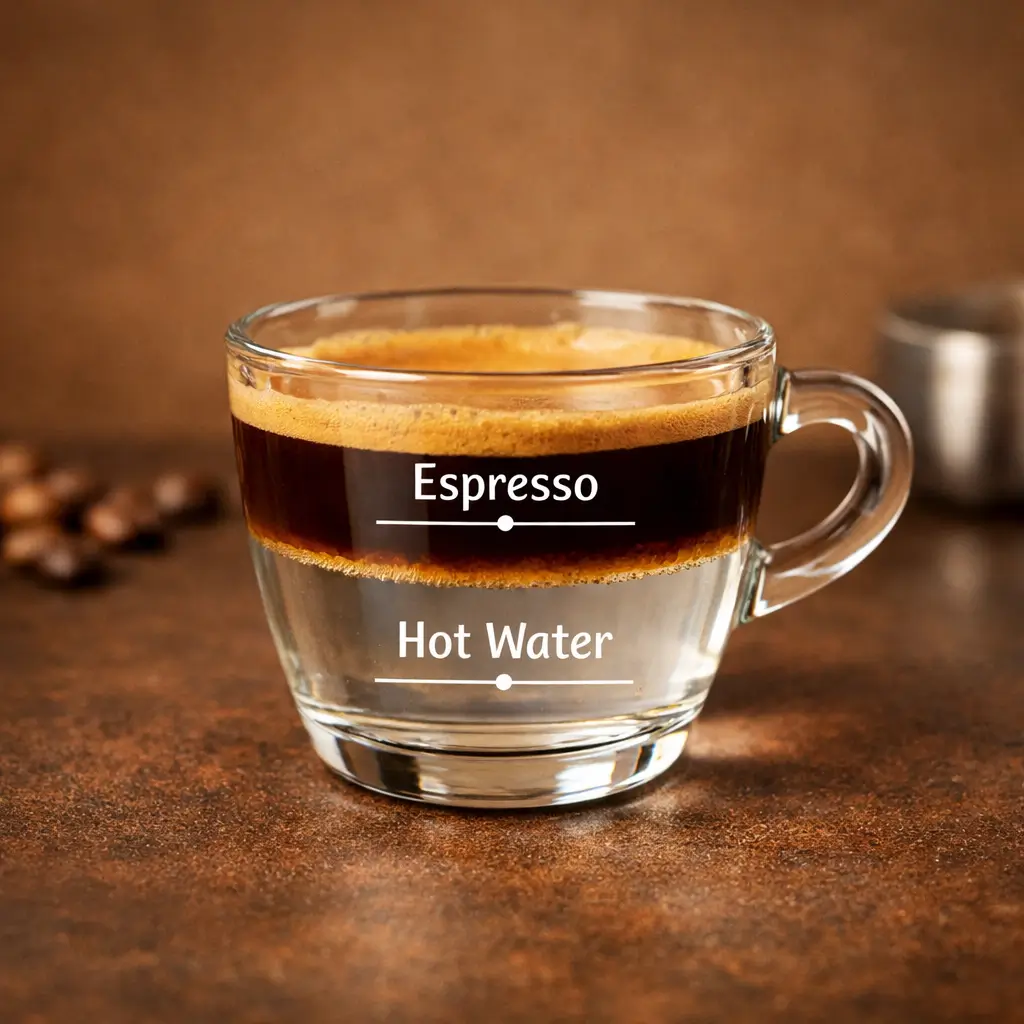
The preparation of a Long Black is distinguished from that of the Americano by a critical sequencing rule: the hot water is added to the cup first, and the espresso — typically a double shot, though a ristretto double is increasingly preferred — is poured directly over the water thereafter. This sequence is considered non-negotiable by industry practitioners, as it preserves the crema layer that would otherwise be destroyed by water poured on top of espresso.
Standard Procedure
1. Pre-heat the cup with boiling water, then discard. This step is frequently omitted in commercial settings but is regarded as best practice.
2. Fill the cup with approximately 90 to 100 milliliters of water at a temperature of 90 to 96 degrees Celsius. Water at or near boiling is considered by many practitioners to be too aggressive for optimal flavor integration.
3. Extract a double espresso or double ristretto (approximately 40 to 60 milliliters) directly over the water, ensuring the spout is close to the water’s surface to preserve crema.
4. Serve immediately, without stirring.
Points of Contention
Standardized preparation critics argue that there is no universal consensus on water temperature, shot volume, or cup size. Renowned Melbourne barista Kai Svensson remarks, “The Long Black is one of those drinks that reveal everything about a barista’s espresso philosophy — there is nowhere to hide.”
Detractors of strict sequencing, however, argue that in high-volume commercial environments, adherence to the water-first rule is often impractical, and that resultant quality differences are marginal in sub-specialty grade coffees.
Apparatus Used
The production of a Long Black requires a professional-grade espresso machine capable of delivering water at a consistent temperature and pressure — typically nine bars of pump pressure and between 90 and 96 degrees Celsius.
Semi-automatic or fully automatic espresso machines are used in commercial settings. The grinder is considered equally critical, as espresso extraction is highly sensitive to grind consistency; burr grinders are the industry standard.
Additional apparatus includes: a calibrated tamper –see tamping (typically 58 millimeters for standard portafilter baskets), a knock box for spent grounds, and pre-heated ceramic cups of between 150 and 200 milliliters capacity.
Some practitioners use a gooseneck kettle for precise water pouring, though commercial steam wands are more commonly used for this purpose in café environments.
Industry observers note that the quality of water — its mineral content and filtration — is a frequently underappreciated variable in Long Black production. Water that is too soft may produce a flat, lifeless cup, while overly mineralized water can introduce undesirable flavors.
Filtered water at 150 parts per million of total dissolved solids is considered an industry benchmark by the Specialty Coffee Association.
Taste Profile
The Long Black is characterized by a bold, concentrated flavor profile modulated by the diluting presence of hot water. When prepared correctly, it presents with a preserved crema of golden-brown hue, which contributes textural complexity and a subtle bitterness to the first sip.
The drink is commonly described as having notes of dark chocolate, roasted nuts, and dried fruit, though these descriptors vary significantly with the origin and roast level of the coffee used.
Prominent coffee educator Dr. Emma Barclay has stated that ‘the Long Black, at its best, is the closest a non-espresso drinker can come to experiencing the full aromatic complexity of a well-extracted shot without the intensity barrier of a pure espresso.’ This observation has been echoed across tasting notes from specialty coffee publications.
Critics, however, have been forthright about the drink’s shortcomings. Under poor preparation conditions — incorrect water temperature, over-extracted espresso (see extraction), or low-quality beans — the Long Black can present as harsh, astringent, and thin. The absence of milk means there is no buffer for extraction errors.
Australian food critic and writer Georgia Pemberton has observed bluntly that ‘a bad Long Black is one of the most unpleasant things a café can serve; there is simply no redemption on offer.’
Variations of the Drink
Several variations of the Long Black have been documented across café cultures:
Short Long Black: A reduced-volume version using approximately 60 to 70 milliliters of water, producing a more concentrated and intense flavor profile. Favored by experienced espresso drinkers seeking proximity to straight espresso without sacrificing crema preservation.
Iced Long Black: A cold adaptation in which chilled or room-temperature water is substituted for hot water, and ice is added to the cup. This variation has gained traction in warmer climates and during summer months. Industry commentary has been mixed; some baristas argue that cold dilution fundamentally alters the extraction chemistry, while others view it as a legitimate evolution of the drink.
Long Black with a twist: Some specialty cafés have introduced the addition of a strip of citrus peel — typically lemon or orange — placed on the rim of the cup, drawing on classical espresso romano traditions. This variation remains niche and is not considered canonical.
Filter Long Black: Emerging within the third-wave coffee movement, this variation substitutes the espresso shot with a concentrated pour-over or AeroPress extraction, resulting in a cleaner, less emulsified cup. Critics of this iteration argue that it constitutes a different drink entirely and should not share the Long Black name.
Notable Facts
The Long Black is frequently cited in international discussions of coffee culture as evidence that Australasia developed an independent and sophisticated espresso tradition outside of Italy and the United States.
Coffee journalist and author Scott Conroy has described the Australian coffee scene as ‘the only market outside Italy where espresso culture evolved organically rather than being imported wholesale,’ with the Long Black serving as Exhibit A.
The drink achieved international visibility in part through the global expansion of Australian-style café concepts during the 2010s. Cafés in London, New York, Tokyo, and Dubai began offering the Long Black on specialty menus, and the term began appearing in mainstream international coffee guides.
The Long Black is not without its critics in academic and culinary circles. Some food theorists have argued that the drink is a solution to a problem that espresso culture itself created — namely, the expectation of large-volume servings — and that its existence reflects cultural compromise rather than pure coffee philosophy.
Others have countered that such a reading is unnecessarily reductive, and that adaptation is the defining characteristic of all living culinary traditions.
It has been noted in trade publications that the Long Black is sometimes confused with the Americano by international visitors to Australian and New Zealand cafés, leading to order errors and occasional dissatisfaction.
Barista trainer and author Marcus Lim has recommended that café staff briefly explain the preparation distinction when the drink is ordered by unfamiliar customers.
Related Drinks
Americano (Caffè Americano): The closest functional relative of the Long Black, the Americano is produced by adding water to espresso rather than espresso to water. The reversed preparation results in the dissolution of the crema layer, producing a thinner texture and a less complex aromatic profile. The Americano is of Italian-American origin and is the dominant espresso-diluted drink in North American and European café culture.
Flat White: Another Australasian contribution to global coffee culture, the Flat White is produced with a double ristretto and a small volume of microfoam milk. It shares the Long Black’s emphasis on espresso concentration and is considered a companion drink in the Australasian café canon. Its origin is contested between Australia and New Zealand with the same unresolved energy as the Long Black.
Lungo: An Italian espresso preparation in which a greater volume of water is passed through the coffee grounds during extraction, producing a longer, more diluted shot. The Lungo differs from the Long Black in that dilution occurs within the extraction process itself, rather than being applied post-extraction.
Ristretto: A shorter, more concentrated espresso extraction that is frequently used as the base shot in Long Black preparation within specialty café settings. The ristretto produces a sweeter, denser shot by extracting a smaller volume through the same quantity of coffee grounds.
Black Eye / Red Eye: North American espresso-over-filter-coffee preparations that share the Long Black’s spirit of extending or intensifying espresso, though through fundamentally different means.