
Arabic Coffee, historically and regionally known as Qahwa (Arabic: قهوة, transliterated as qahwah), is a traditional, spiced, unfiltered hot beverage prepared from lightly roasted Arabica coffee beans. Uniquely distinguished by its greenish-yellow to golden hue, prominent herbal notes, and complete absence of sugar, it serves as a cornerstone of hospitality across the Arabian Peninsula and the wider Middle East.
Unlike most Western styles of coffee brewing that rely on darker roasts and pressurized extraction, traditional Arabic coffee is boiled in a dedicated, hourglass-shaped pot called a dallah and heavily spiced with green cardamom, saffron, cloves, and occasionally mastic or ginger. Recognizing its profound social role, UNESCO inscribed Arabic coffee on its Representative List of the Intangible Cultural Heritage of Humanity, affirming its position as an enduring symbol of generosity and communal bonding.
At a Glance
| Attribute | Specification |
| Origin | Yemen / Arabian Peninsula |
| Primary Bean Type | Coffea arabica (exclusively) |
| Roast Level | Ultra-light to medium (cinnamon roast) |
| Primary Spices | Cardamom, Saffron, Cloves, Ginger |
| Traditional Vessel | Dallah (pot) & Finjan (cup) |
| Flavor Profile | Herbal, bitter, highly aromatic, non-sweet |
| Companion Food | Dates, dried fruits, or sweet pastries |
Etymology
The English word coffee traces its linguistic lineage directly back to the Arabic term qahwah (قهوة). Historically, the word qahwah did not originally refer to a bean-based beverage; rather, it was a classical Arabic poetic term for wine, derived from the verb qahā (قها), which means “to lack hunger” or “to sate,” referencing the drink’s natural appetite-suppressant properties.
As Islamic scholars and Sufi mystics in the late medieval period adopted the energizing bean infusion to sustain long nightly prayer vigils, they transferred the term qahwah to this new stimulant. When the drink migrated through the Ottoman Empire, the word was adapted into the Turkish kahve, which eventually transitioned into the Italian caffè, the French café, and finally the English coffee.
History
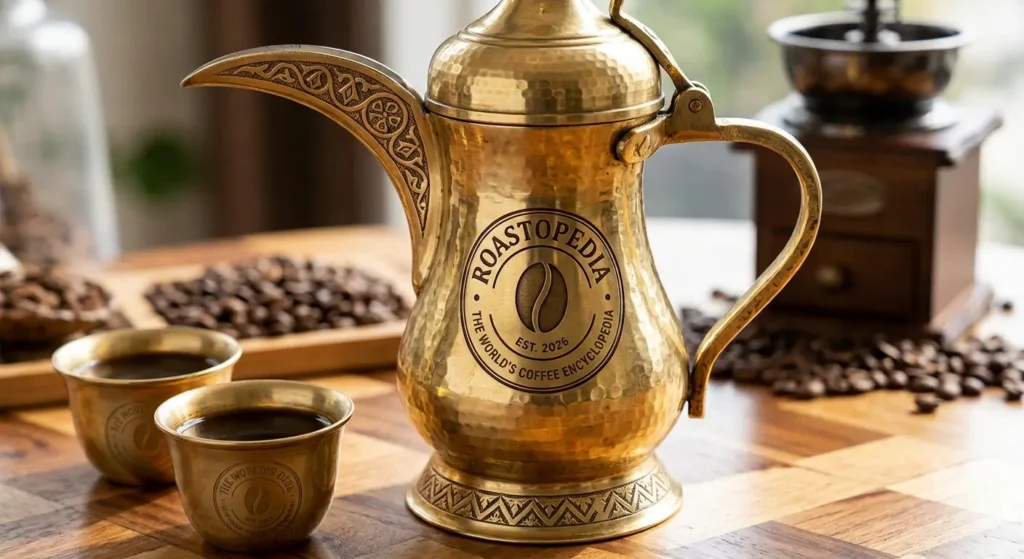
The history of Arabic coffee is inextricably bound up with the very origin of coffee consumption as a global phenomenon. While legendary accounts attribute the discovery of coffee to an 8th-century Ethiopian goatherder named Kaldi, the transition of the coffee plant from a raw berry to a brewed, hot beverage took place in the southwestern highlands of Yemen during the 15th century.
Sufi orders, particularly within the cities of Aden and Zabid, began roasting and boiling the seeds of the Coffea plant to induce wakefulness for dhikr (remembrance of God) and nocturnal worship. Yemen rapidly established a strict monopoly over the crop, funneling exports through the bustling Red Sea port of Mocha.
By the early 16th century, the beverage had traveled along trade routes to Mecca, Cairo, Damascus, and Baghdad. The rapid spread of qahwah sparked intense theological debates among Islamic scholars regarding its psychoactive properties, leading to brief bans in Mecca (1511) and Cairo (1532); however, these prohibitions were quickly overturned. In the mid-16th century, Syrian merchants opened the world’s first public coffeehouses in Istanbul, setting the stage for the global democratization of coffee.
Despite the subsequent global colonization and cultivation of coffee by European powers, the traditional method of roasting, spicing, and serving coffee in the Arabian Peninsula remained remarkably untouched by Western industrialization.
How to Make Arabic Coffee (Traditional Preparation)
Preparing traditional Arabic coffee is an exact, step-by-step ritual. The method relies on decoction—boiling the grounds directly in water without a paper filter—which yields a rich, sediment-heavy, yet thin-bodied brew.
1. Roast and Grind: Achieving the signature golden-green profile.
Lightly roast green Arabica beans over an open flame or stovetop pan until they reach a very pale, cinnamon-colored hue. Coarsely grind the roasted coffee bean along with whole green cardamom pods using a traditional mortar and pestle (mihbaj) or a dedicated coffee grinder.
2. Initial Decoction: Boiling the coffee grounds.
Bring fresh water to a boil inside the dallah. Add the coarsely ground coffee (typically 2-3 tablespoons per liter of water) and simmer gently over low heat for 10 to 15 minutes. This prolonged boiling extracts the coffee’s oils and caffeine without burning the light roast.
3. Spicing the Brew: Infusing aromatic depth.
Remove the pot from the heat. Stir in the freshly ground cardamom and optional spices like a pinch of saffron threads, crushed cloves, or ginger. Return the pot to the flame and let it simmer for an additional 2 to 3 minutes to infuse the volatile spice oils.
4. Clarification and Settling: Allowing the sediment to drop.
Remove the dallah from the heat source. Let it stand undisturbed for several minutes. This step is critical, as it allows the heavy coffee sediment (theg) to naturally settle to the bottom of the pot.
5. Traditional Service: Pouring into the finjan.
Slowly pour the clarified liquid from the dallah into tiny, handleless ceramic cups called finjan. Hold the pot high above the cups to aerate the beverage, taking care not to let the dregs slip into the cups.
Ingredients
- Green-Light Roasted Arabica Beans: Exclusively high-altitude Arabica coffee beans, such as the ancestral Bourbon cultivar or its dwarf mutation Caturra, lightly roasted to retain their natural herbal, grassy nuances.
- Cardamom (Heel): The primary flavoring agent, added in high proportions (often up to a 1:3 ratio of cardamom to coffee). It imparts a sweet, citrusy, and warming aroma.
- Saffron (Za’faran): Used in premium preparations to give the coffee its luxurious golden-orange color and a subtle earthy, floral undertone.
- Cloves (Mismar): Added in tiny quantities for a pungent, woody, and slightly medicinal bite.
- Water: Pure, soft water is preferred to let the subtle, light-roast flavors shine through.
Characteristics
Unlike Western espresso or drip coffee, Arabic coffee has an extremely light body, resembling an herbal tea or broth more than a heavy coffee.
- Color: Ranges from a pale, translucent greenish-yellow (highly characteristic of Najdi/Saudi preparations) to a rich, golden-amber (common in the Levant).
- Aroma: Deeply herbal, spicy, and medicinal, dominated heavily by cardamom and saffron rather than roasted cocoa or caramel notes.
- Taste Profile: Sharp, astringent, and complex. It is completely unsweetened, with the bitterness of the lightly roasted bean balanced by the natural sweetness of cardamom and the floral complexity of saffron.
- Caffeine Content: Moderately high. Because the beans undergo a very light coffee roast, they retain more caffeine by volume than darker roasts, and the prolonged boiling process maximizes caffeine extraction.
Regional Variations
While the core philosophy remains consistent, regional variations across the Middle East yield distinct sensory profiles:
- Saudi/Najdi Style: The lightest variation. It features an ultra-light, blonde roast yielding a yellow-green liquor, heavily spiced with cardamom and saffron, and is particularly popular in central Saudi Arabia.
- Gulf/Khaleeji Style: Typical of the UAE, Qatar, Kuwait, and Bahrain. It features a slightly darker (yet still light) roast, resulting in a golden-brown liquid with prominent cardamom, saffron, and occasionally a hint of rosewater.
- Yemeni Style (Qishr): A unique historical variation prepared not from the coffee bean itself, but from the dried husks of the coffee cherry (qishr), spiced with ginger and cinnamon to create a sweet, tea-like herbal infusion.
- Levantine Style (Jordan, Syria, Lebanon, Palestine): Features a medium-dark roast, occasionally spiced with cardamom, and brewed slightly thicker. It bridges the gap between traditional Gulf Qahwa and Turkish coffee.
Cultural Significance
In Arab society, Arabic coffee is far more than a simple beverage; it is a highly codified social ritual that governs hospitality, conflict resolution, and community life. The host must always prepare and serve the coffee personally or have their eldest son do so, pouring the liquid with the left hand holding the dallah and serving with the right hand holding the finjan.
The cup is filled only one-third full. Filling it to the brim is considered a subtle insult, implying that the host wants the guest to drink quickly and leave. Conversely, pouring only a small amount signals that the host wishes to continue refilling the cup, thereby extending the conversation. Guests typically drink between one and three cups. When they have had enough, they gently shake the finjan from side to side between the thumb and forefinger to indicate that they do not want another serving. Otherwise, the host will continue refilling it indefinitely.
Comparison with Similar Drinks
Because Arabic coffee is boiled and unfiltered, it is often confused with other Middle Eastern preparations like Buna or Turkish coffee, yet it remains distinct in its roasting, spicing, and serving styles:
| Feature | Arabic Coffee (Qahwa) | Turkish Coffee | Espresso |
| Roast Level | Ultra-light (Blonde/Cinnamon) | Medium to Dark | Dark |
| Grind Size | Coarse | Extremely Fine (Powder) | Fine |
| Spices | Heavy (Cardamom, Saffron, Cloves) | None (or occasionally Cardamom) | None |
| Filtering | Unfiltered (Sediment settled) | Unfiltered (Sediment in cup) | Filtered (Metal basket) |
| Sweetness | Always unsweetened | Sugar boiled with coffee | Sugar added after brewing |
| Body | Light, tea-like | Thick, heavy, and muddy | Concentrated, syrupy |
Unlike Western styles, such as a milk-forward caffè latte or a highly concentrated cortado, Arabic coffee relies on pure, un-emulsified water to carry its aromatic spices, resulting in zero milk integration.
Typical Specifications
Brewing traditional Najdi-style Arabic coffee at home will require one to follow these steps and specifications:
- Brewing Ratio: 1:16 (approx. 30g of coffee to 500ml of water)
- Grind Profile: Coarse (similar to kosher salt or coarse French press)
- Water Temperature: $100^\circ\text{C}$ (rolling boil)
- Extraction Time: 12 to 15 minutes of boiling
- Cardamom Ratio: 1:3 (1 part cardamom to 3 parts coffee grounds by volume)
- Serving Temperature: $80^\circ\text{C}$ to $85^\circ\text{C}$ inside the finjan
- Serving Vessel Volume: 20ml to 30ml per finjan
See Also
- Kapeng Barako
- Espresso
- Caffè Latte
- Cortadito
- Kahawa Tamu
- Kahawa Chungu
- Buna
- Percolator Coffee
- Moka Pot Coffee
References
- Al-Shahrani, S. A. (2024). Arab coffee trade from the 16th to the 19th century AD. Journal of Arts, 12(1), 109-126. https://doi.org/10.35696/arts.v12i1.1836
- Balobaid, A. S., Alarabi, R., & Abd Elazim, S. M. (2025). Improving Arabic coffee production through disease detection based AI frameworks. Yanbu Journal of Engineering and Science, 22(1), 1-15.
- Clarence-Smith, W. G. (2001). The spread of coffee in the pre-plantation era. Le Café avant l’ère des plantations coloniales, 17-28.
- Friis, I. (2015). Coffee and qat on the Royal Danish expedition to Arabia – botanical, ethnobotanical and commercial observations made in Yemen 1762–1763. Archives of Natural History, 42(2), 336-351. https://doi.org/10.3366/anh.2015.0283
- Hattox, R. S. (1996). Coffee and coffeehouses: The origins of a social beverage in the medieval Near East. University of Washington Press.
- Maspul, K. A. (2022). Coffee acculturation in Saudi Arabia: Diversifying local wisdom and strengthening sustainable economy in coffee value chain. EKOMA: Jurnal Ekonomi, Manajemen, Akuntansi, 1(2), 271-283. https://doi.org/10.56799/ekoma.v1i2.459
- Maspul, K. A. (2023). Exploring the fusion of specialty coffee for tourism growth in Makkah and Madinah. Advances in Tourism Studies, 2(1), 44-59.
- Rahma, A., Farida, I., & Marifatullah, A. (2019). Knowledge sharing over coffee: A history-based community in urban Jakarta. Proceedings of the 2nd International Conference on Culture and Language in Southeast Asia, 29-35. https://doi.org/10.2991/icclas-18.2019.29
- Sweis, A. (2024). Brewing national identity: Coffee consumption as a marker of cultural identity (Doctoral dissertation). University of Oklahoma.
- Temir, H. (2022). Arabic Qahwa and its serving as an element of cultural heritage. Harran İlahiyat Dergisi, 48, 112-127.
- Ukers, W. (1922). All about coffee. The Tea and Coffee Trade Journal Company.
- Yasin, J., Al-Mulla, A., & Abu-Zeid, M. (2013). Effect of traditional Arabic coffee consumption on the glycemic index of Khalas dates tested in healthy and diabetic subjects. Asia Pacific Journal of Clinical Nutrition, 22(4), 543-549.
- Zaimeche, S. (n.d.). The coffee trail: A Muslim beverage exported to the West. Foundation for Science, Technology and Civilisation. https://muslimheritage.com/uploads/Main%20-%20Coffee.pdf