
Kahawa Chungu is a strong, spiced, unsweetened black coffee deeply embedded in the social and cultural life of Kenya’s Swahili coast.
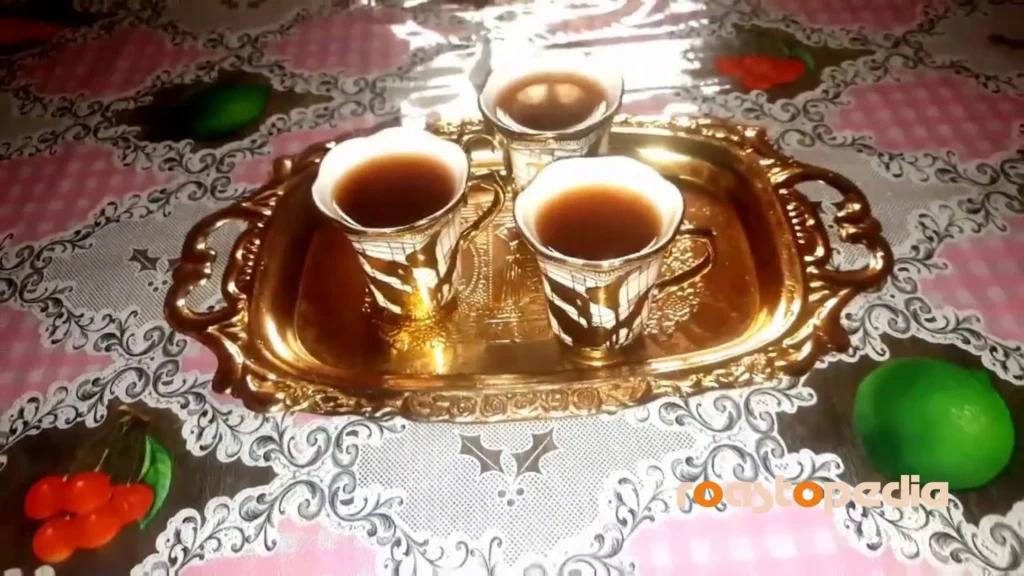
The name Kahawa chungu — Swahili for bitter coffee — refers to a brew made by simmering ground coffee with cloves, cardamom, cinnamon, and sometimes ginger and nutmeg in a tall brass kettle over a charcoal fire, then straining it and serving it in small ceramic cups.
Kahawa Chungu is not simply a drink. In coastal Kenya, it is a ritual of hospitality, a bond between men, and a tradition that predates the country itself.
Where the Drink Came From
The Swahili coast — the Indian Ocean-facing littoral stretching through present-day Kenya from Lamu in the north through Mombasa to Malindi — has been a meeting point of African, Arab, and Persian civilizations for over a thousand years.
Arab traders arrived aboard dhow vessels riding the monsoon winds, establishing trade routes that carried ivory, gold, and spices in both directions across the ocean. They also carried their food culture, their religion, and their coffee.
Coffee drinking was already deeply established in the Arab world by the time regular trade between the Arabian Peninsula and the East African coast was formalized.
The Swahili people — a Bantu-Arab hybrid civilization that emerged from centuries of intermarriage and cultural exchange — absorbed the coffee tradition from their Arab trading partners and shaped it into something distinctly their own. The spiced preparation that became Kahawa chungu reflects both its Arab lineage and the coastal spice-trade ecology.
Local historical tradition places the arrival of Arab coffee culture in Mombasa as far back as 1331, when the Moroccan explorer Ibn Battuta arrived on the coast aboard a dhow and documented a thriving, devoutly Islamic Swahili city already well-integrated into Indian Ocean trade networks.
While Ibn Battuta did not record coffee drinking specifically, he documented a people thoroughly enmeshed in Arab cultural life — the same civilization that carried coffee culture to the coast. The drink’s roots in this exchange are considered older than any surviving written record.
The Buli: A Monument to the Cup
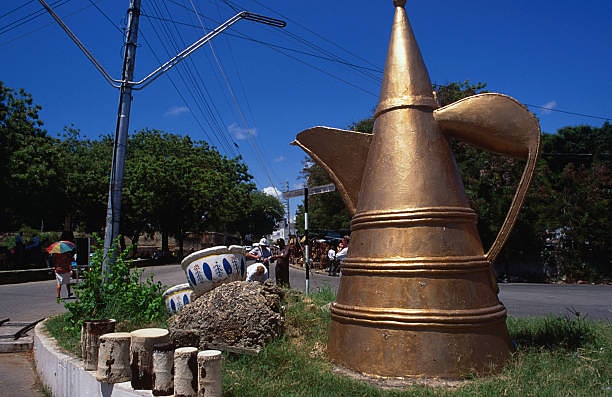
Outside the entrance to Fort Jesus in Mombasa’s Old Town stands a bronze-painted monument: a large brass kettle — locally called a buli — accompanied by five Arabian ceramic coffee cups.
Built in 1988 by local artists Ali Taher and Alawi, and designed with the assistance of a UN conservationist attached to the Fort Jesus Museum, the buli monument was conceived as a physical representation of the coffee-drinking culture of the Swahili coast.
The inscription identifies it as built by Burhan Ali Taher, and the National Museums of Kenya recognize the structure as a cultural marker — a metaphor, as the Museums put it, of the shared cup of coffee and its significance in bringing people together.
The original brass kettles the monument commemorates were made of bronze specifically for their capacity to retain heat and keep coffee hot for extended periods.
Those original vessels have largely disappeared from use, replaced by steel or aluminum pots, but the monument at Fort Jesus preserves their image at the center of Mombasa’s oldest public space.
The Maskani: Where the Coffee Lives
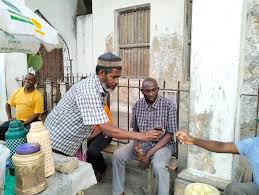
Kahawa chungu is not a domestic drink in the conventional sense. It is a street culture. Across coastal towns — Mombasa’s Old Town, Majengo, Bamburi, Kilifi, Malindi, Lamu, Watamu — men gather in the evenings at small outdoor coffee stations called maskani (similar to the ‘addas’ of the East), which translates roughly as bases or gathering points.
While men gather in the evenings and weekends to share Kahawa chungu, women and the younger generation sit at home enjoying the exact reverse – Kahawa tamu.
These are informal spaces: low benches, a charcoal stove, a brass or steel kettle, small ceramic cups, and a vendor who has spent the afternoon brewing.
The maskani is a social institution. Games of backgammon and bao — a traditional East African strategy board game — are played alongside the coffee. Conversations about marriage, family, neighborhood, and daily life unfold over cup after cup.
The tradition is predominantly male; women, with some exceptions among younger generations, have historically not frequented the outdoor maskanis, though they consume Kahawa chungu in domestic settings.
The drink is said by coastal communities to be an aphrodisiac — a belief widely held and openly discussed, contributing in part to its endurance as a male social ritual.
The cost of a cup has historically been extraordinarily low — as little as five Kenyan shillings, the equivalent of a few cents — which has made the maskani accessible across all economic levels and ensured that the tradition remained communal rather than exclusive.
Coffee vendors at a maskanis are a recognized figure in coastal community life, sometimes serving the same corner for decades.
The Kettle, the Fire, and the Method
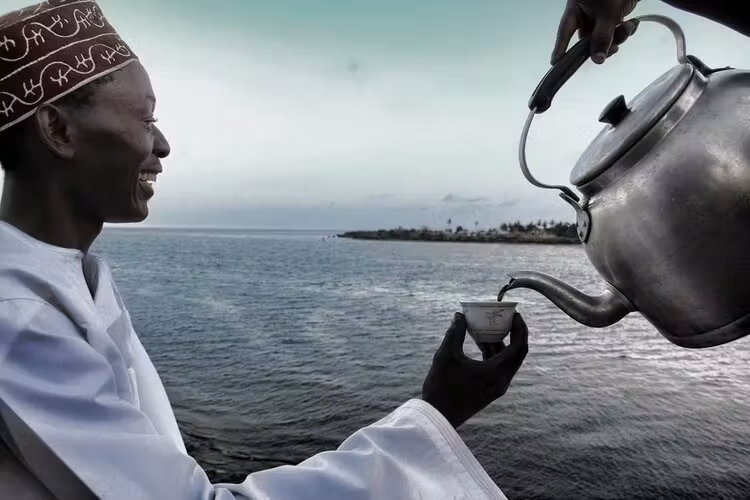
Kahawa chungu is a decoction — ground coffee and whole spices are added to cold water in the kettle, brought together to the boil over a charcoal jiko, then held at a low simmer for ten to fifteen minutes.
The long, slow simmer is what extracts and melds the flavors of the spices with the coffee, producing a brew that is simultaneously more bitter, more aromatic, and more complex than a standard boiled coffee.
The specific spice combination varies between brewers and between towns, but the core quartet is consistent: cardamom (iliki), cloves (karafuu), cinnamon (mdalasini), and ginger (tangawizi) — with nutmeg added by some households and omitted by others.
The kettle matters. The traditional buli is tall-necked and narrow-mouthed, which reduces evaporation during simmering and concentrates the brew. The narrow pour allows the vendor to fill small ceramic cups without disturbing the settled grounds.
After brewing, the liquid is strained through a fine sieve before serving — the grounds do not appear in the cup, distinguishing kahawa chungu’s preparation from Türk Kahvesi (Turkish coffee), where grounds settle in the vessel itself.
The finished coffee is served hot, in cups small enough to finish in a few sips, alongside halwa — a dense, sweet confection made from sugar, ghee, and starch — or dates. The sweetness of the accompaniment is the intended counterpoint to the bitterness of the coffee, a pairing that has been standard practice on the coast for as long as the drink has been documented.
The Spice Trade Connection
The spices in Kahawa chungu are not incidental. The East African coast was one of the world’s great spice trade corridors, and Zanzibar — the island just off the Tanzanian coast and closely linked to the Kenyan coast’s cultural history — was for centuries the world’s largest producer of cloves.
Arab merchants who arrived at Mombasa and Lamu carried spices as cargo; those same spices became embedded in the food and drink of the communities they traded with.
Cardamom originates in South Asia and reached the Swahili coast through the Indian Ocean trade. Cinnamon came from Ceylon — present-day Sri Lanka — through the same routes.
Cloves were so central to the Zanzibar-Mombasa trade axis that they remain one of the region’s defining flavor signatures. The cup of Kahawa chungu is, in a direct sense, a record of those trade routes — every spice in it arrived by sea.
Kahawa Chungu Today
The tradition is alive but under pressure. Older men continue to gather at the maskanis of Mombasa, Lamu, and Malindi in the evenings, maintaining a ritual that has outlasted Portuguese occupation, British colonialism, and six decades of Kenyan independence. The brew and the gathering around it remain consistent with what historical accounts describe from generations earlier.
The younger generation on the coast is largely not continuing the practice. Urbanization, the change in social habits, and the rise of modern café culture in Nairobi and Mombasa have drawn younger Kenyans toward espresso drinks and milk-based coffees rather than the bitter, spiced cup of their grandparents.
Several cultural commentators on the coast have noted this generational break with concern, recognizing that the maskani tradition carries social functions — conflict resolution, community bonding, mentorship — that no café can replicate.
Internationally, the flavor profile of Kahawa chungu has attracted commercial interest. The American brand Kahawa 1893 — founded to support East African women coffee farmers — cites Kahawa chungu as the direct inspiration for its African Spice blend, bringing the coastal tradition into the global specialty coffee market in a commercial form.
The drink has also been documented by the National Museums of Kenya as part of the country’s intangible cultural heritage, a formal acknowledgement of what the buli monument at Fort Jesus has been saying since 1988.