
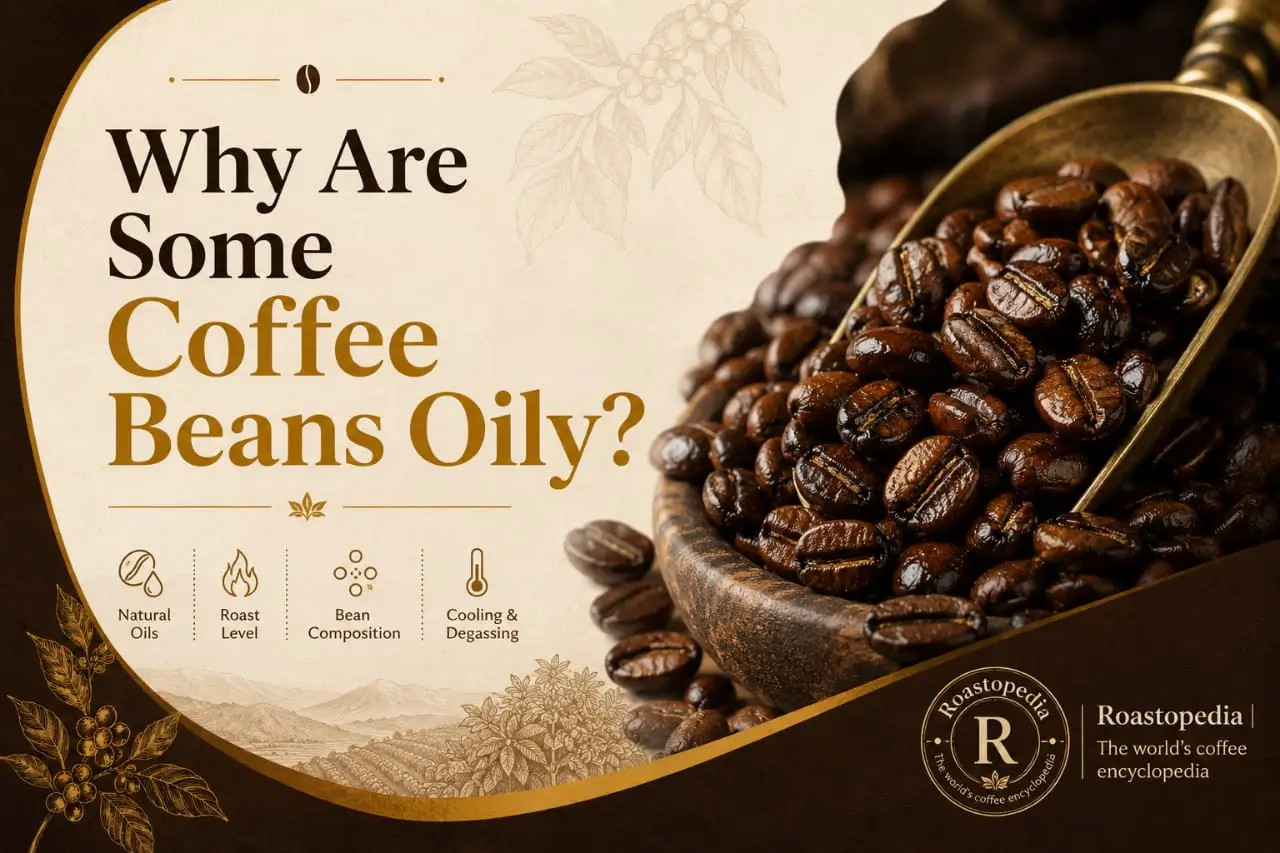
Some coffee beans—particularly dark roasts—develop an oily surface because the natural oils inside the bean migrate outward due to extended roasting and continue to emerge during storage.
Dark roasts are especially susceptible because prolonged exposure to high temperatures weakens the bean’s internal structure, allowing these oils to escape more easily. Other factors, including the coffee variety, the beans’ freshness, and storage conditions, can also influence how oily the beans appear.
Oiliness is not automatically a defect — it’s a visible marker of roast level, bean density, and how the coffee was processed.
The Real Cause: Oil Migration During Roasting
Every coffee bean carries a natural reserve of lipids, roughly 10-17% of its dry weight. In the unroasted, green coffee seed, those oils sit locked inside tiny structures within the cell walls. Roasting changes that. As internal temperature and pressure rise, the bean’s cellular structure weakens and grows more porous, and lipids are physically forced from the center of the bean toward its surface — a process called oil migration.
Lipidomic studies using imaging techniques such as MRI have confirmed this directly, showing measurable lipid movement from the bean’s endosperm to its exterior as roast degree increases. The longer and hotter the roasting process runs, the more pronounced this migration becomes, which is why oiliness tracks so closely with coffee roast level.
Roast Level is the Biggest Factor
Roast level explains most of the variation in bean oiliness. Light roasts are pulled from the roaster before the bean’s structure breaks down significantly, so oils stay largely trapped inside — these beans look dry and matte. As roasting pushes past first crack and into second crack, cell walls fracture further, porosity increases, and oil reaches the surface in visible droplets. This is why dark, French, and Italian roasts almost always look glossy, while a fresh light roast should not.
Roast defects can accelerate this too. Roasting beans darker than intended, or scorching them with too hot a charge temperature, can push oil to the surface faster than a controlled dark roast profile would, along with burnt, smoky flavor notes.
Origin, Variety, and Processing Also Play a Role
Roast level isn’t the only variable. The coffee cherry’s processing method, coffee plant variety, and growing altitude all influence how readily oil surfaces:
- Density and altitude: Beans grown at lower altitudes tend to be less dense, with a more porous cellular structure, which makes them prone to releasing oil sooner in the roast.
- Processing method: Naturally processed coffees, which retain more sugars from the fruit, often caramelize more aggressively and can show oil earlier than washed coffees.
- Species: Robusta and Arabica beans differ in lipid composition and behave somewhat differently under heat, which contributes to the oiliness differences roasters notice across origins.
- Single-farm and certified lots: This variability is one reason quality-focused buyers pay close attention to where a lot comes from — whether it’s a certified organic coffee or a single-farm estate coffee — since farm-level growing conditions shape how the beans will roast.
Is Oily Coffee a Sign of Quality — or a Problem?
Oiliness alone doesn’t tell you whether a coffee is good or bad; it mostly tells you how it was roasted. Oil on a fresh dark roast is expected and even desirable to drinkers who want a heavier body and bittersweet, chocolatey flavor.
But oil on a light or medium roast usually means something different: those beans typically aren’t roasted deeply enough to force oil to the surface during roasting, so if they look shiny, age and oxidation are the more likely explanation. In that case, oiliness is a freshness signal rather than a roasting outcome, and it often coincides with a flatter, staler cup.
Storage matters here. Roasted coffee continues to release carbon dioxide for days after roasting, a process known as degassing, and oils on the surface are more exposed to oxygen and light. Keeping beans in an airtight, opaque container and buying only what you’ll use within a few weeks helps preserve both the oils and the aromatic compounds they carry.
What Oily Beans Mean for Grinding and Brewing
Oily beans behave differently at the grinder and in the basket. Surface oil can cling to burrs, affecting grind size consistency over time, which is why grinders used heavily for dark roast need cleaning more often. Darker, oilier beans are also more brittle, so at an identical setting they produce a finer particle distribution than a lighter roast, changing extraction speed.
This has practical downstream effects for a barista pulling espresso. Uneven dosing or a puck disrupted by loose, oily fines increases the risk of channeling, where water finds a path of least resistance through the coffee bed instead of flowing evenly. That produces an inconsistent extraction yield — some parts of the puck under-extracted, others over-extracted — even when the recipe looks correct on paper. Adjusting grind size coarser and dialing in dose and distribution more carefully are the usual fixes when working with very oily beans.
The Bottom Line
Oily coffee beans are simply a visible record of the roasting process. Heat breaks down the bean’s internal structure, and natural lipids migrate outward — a process that intensifies with roast level, and is shaped further by the plant variety, processing, and growing conditions behind that particular lot. Oil on a dark roast is normal and often flavorful; oil on a light roast usually points to age rather than roasting. Either way, understanding why it happens makes it easier to store, grind, and brew the coffee well.
See Also
- Why Does Channeling Cause Uneven Espresso Extraction Results?
- The Role of Roast Level in Coffee Flavor Development
- How Soil, Altitude, and Climate Determine Coffee Flavor at Origin
- Does Grind Size Change Caffeine Extraction in Light Roast Coffee?
- Does Light Roast Coffee Have More Caffeine Than Medium Roast?
- How Water Temperature Affects Coffee Extraction
- How to Pull an Espresso Shot
References
- Williamson, S. & Hatzakis, E. — Quantitative lipidomics reveals the effects of roasting degree on arabica coffee beans lipid profiles, ScienceDirect (2024)
- Evaluating the effect of roasting on coffee lipids using a hybrid targeted-untargeted NMR approach in combination with MRI, ScienceDirect (2019)
- Evaluating the effect of roasting on coffee lipids using a hybrid targeted-untargeted NMR approach in combination with MRI, PubMed (2019)
- Revealing the dynamic changes of lipids in coffee beans during roasting based on UHPLC-QE-HR-AM/MS/MS, ScienceDirect (2023)
- Influence of roasting conditions on fatty acids and oxidative changes of Robusta coffee oil, ResearchGate (2012)
- Lipid Oxidation Changes of Arabica Green Coffee Beans During Storage, Semantic Scholar
- Perfect Daily Grind — Physical Changes Coffee Beans Experience During Roasting (2019)
- Perfect Daily Grind — Roast Defects & How to Recognise Them (2020)
- Perfect Daily Grind — Why Are Some Coffee Beans Harder to Grind Than Others? (2021)
- Perfect Daily Grind — Adjusting a Brewing Recipe to Your Coffee Roast Level (2019)
- Aldo’s Coffee Company — Why Are My Coffee Beans Oily? And Is It Bad? (2026)
- Kimbo Coffee USA — Why Are Some Coffee Beans Oily? A Closer Look (2026)
- Café William — Oily Coffee Beans: What It Means & When to Worry
- Femobook — Have Oily Coffee Beans Gone Bad? Why It Happens and How to Tell (2025)
- Pinup Coffee Co. — Why Is Coffee Oily? (2024)
- Barista Life — Coffee Bean Oil Content: Chemistry & Roasting Impact Guide (2025)