
Channeling causes uneven espresso extraction because water follows the path of least resistance through the coffee puck, over-extracting the grounds along the channel while bypassing the rest, leaving them under-extracted.
That path pulls solubles out almost instantly, over-extracting the coffee along it, while the denser coffee just beside it barely gets touched and stays under-extracted. Both faults happen in the same shot, at the same time, which is why channeled espresso so often tastes bitter and sour together rather than simply too strong or too weak.
Definition
Channeling is a fault in espresso brewing where water bypasses parts of the coffee puck instead of passing through it evenly. Water follows the path of least resistance, so it concentrates in low-density zones and rushes through them quickly. The result is a puck that is over-extracted in some areas and under-extracted in others, within the same shot.
What Are the Real Root Causes?
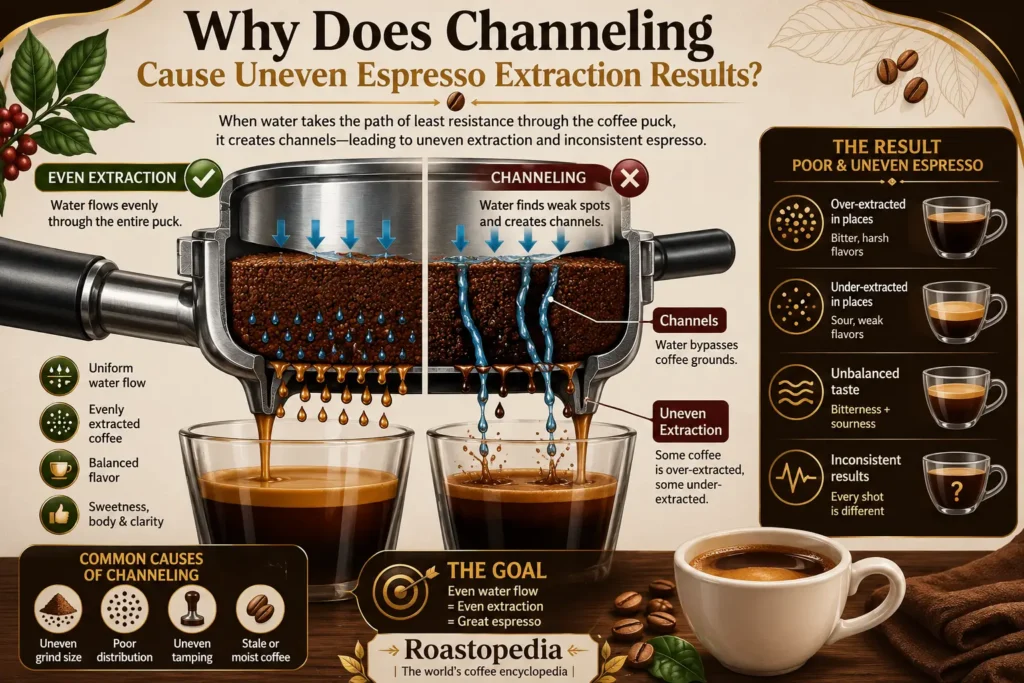
Channeling starts with any inconsistency in the puck’s density, and that inconsistency traces back to a small set of recurring mistakes in puck preparation. Distribution, tamping, grind, dose, and equipment condition are the five factors baristas check, in roughly that order of likelihood. Each is examined below.
Uneven Coffee Distribution
If grounds are not spread evenly across the portafilter basket before tamping, some zones end up denser than others. Water naturally favors the loosest zones once pressure is applied. This is considered the single most common cause of channeling.
Inconsistent Tamping
Tamping at an angle, or with uneven pressure across the puck, compresses one side more than the other. The looser side offers less resistance to water flow. Even a small tilt in the tamper can create a persistent channel.
Grind Size Issues
A grind that is too fine can cause water to seek out micro-cracks and crevices rather than permeate evenly, especially under pressure. A grind that is too coarse leaves large gaps between particles that act as ready-made channels. Both extremes disrupt uniform resistance across the bed.
Dose and Basket Mismatch
Overfilling a basket can cause the puck to press against the shower screen, cracking under pressure and creating escape routes for water. Underfilling leaves a shallow, loosely packed bed that is easily breached. Matching dose to the basket’s rated capacity keeps puck density consistent.
Equipment and Puck Integrity
Worn shower screens, dirty group heads, or residue buildup can distort water flow before it even reaches the puck. Stale or improperly stored beans can also extract unevenly. Equipment maintenance is therefore a secondary but real contributor to channeling.
How Channeling Produces Uneven Extraction
Once a channel forms, water exits through it far faster than through the rest of the bed. The coffee along that channel is stripped of solubles almost immediately, producing an over-extracted, bitter pocket. Meanwhile, the denser surrounding grounds are barely touched, remaining under-extracted and sour.
The final cup combines both faults simultaneously. Tasters often describe channeled shots as being bitter and sour or acidic at the same time, rather than simply “off” in one direction. This dual signature is a key diagnostic clue, since it is difficult to produce through grind or dose error alone.
Diagnosing Channeling
A bottomless portafilter (naked) is the standard diagnostic tool. Early, localized drips, visible gaps in flow, or a sudden jet or spray of water all indicate a channel has formed. Even without a naked portafilter, a shot that runs unusually fast, looks thin and watery, or tastes simultaneously sharp and flat is a strong indicator.
Extraction time is a secondary signal. Espresso that pulls significantly faster than expected for a given grind and dose often points to channeling rather than a genuinely coarse grind. Weighing the shot rather than judging by volume helps separate a true fast channel from normal variation.
Prevention
Even distribution before tamping is the primary defense. Tools such as a Weiss Distribution Technique (WDT) stirrer break up clumps and settle grounds uniformly, reducing density variation across the bed. Gently tapping the portafilter to release trapped air pockets is often used alongside WDT.
Tamping should be firm, level, and consistent from shot to shot. Calibrated or constant-force tampers remove pressure variability as a factor, since consistency matters more than the specific force applied. Aligning the tamper with the basket rim by feel helps keep the tamp level.
Grind size should be dialed in to produce a shot within the target time window, typically 25 to 32 seconds for most specialty espresso. Dose should match the rated capacity of the basket to avoid the packing failures described above. Regular cleaning of the group head, screen, and grinder addresses the equipment-related causes.
Summary
Channeling is fundamentally a resistance problem: any inconsistency in the puck’s density gives water an easier route through. Because that easier route extracts faster and more intensely than the surrounding coffee, the same shot ends up both over-extracted and under-extracted at once. Addressing distribution, tamping, grind, dose, and equipment maintenance together is the standard path to eliminating it.
See Also
References
- Barista Hustle. “P 3.05 – Channelling.” baristahustle.com
- Barista Hustle. “B1 3.02 – Channelling.” baristahustle.com
- Perfect Daily Grind. “What is channeling and how does it affect espresso extraction?” perfectdailygrind.com
- Clive Coffee. “Espresso Channeling: What It Is & How to Fix It.” clivecoffee.com
- Nucleus Coffee. “What is Espresso Channeling? How to Fix it!” nucleuscoffee.com
- Basic Barista. “What Is Channeling In Coffee? Avoid Channeling Espresso Shots.” thebasicbarista.com
- Keep Roasting. “The Ultimate Guide to Preventing Channeling in Espresso.” keeproasting.com
- Espresso Outlet. “How to Fix Channeling in Espresso Extraction: A Comprehensive Guide.” espressooutlet.com
- Coffeenatics. “Channeling in Espresso Extraction: Definition & How to Fix It.” thecoffeenatics.com