
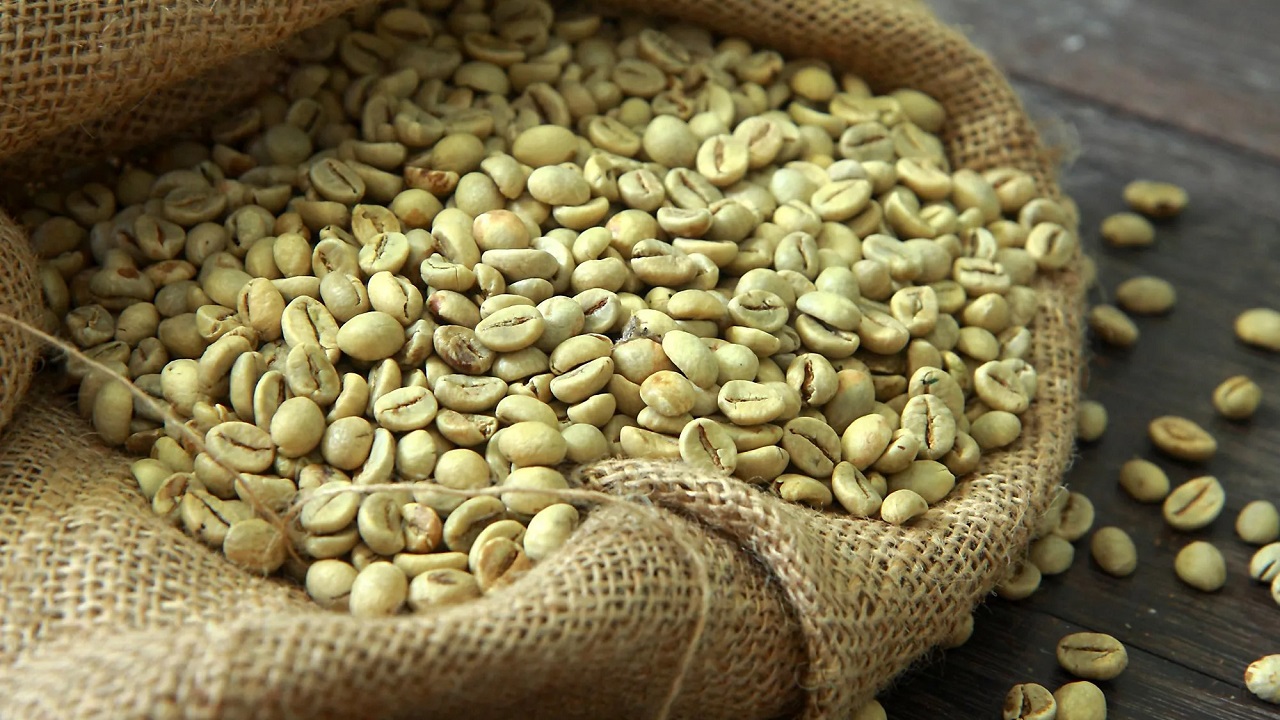
Green coffee does not “go stale” before roasting in the way roasted coffee does. It doesn’t develop the flat, cardboard-like staling that comes from CO2 loss and oil oxidation. Instead, unroasted green coffee slowly ages and loses quality over time — typically staying fresh for 6 to 12 months, and viable for 12 to 18 months, under proper storage (cool, dry, stable conditions with 10–12% moisture). Poor storage or extended time (past “current crop”) causes it to develop dull, papery, or woody off-flavors rather than true staleness.
What Really Happens
Green coffee does not “stale” or lose quality in the same way roasted coffee does, but it is not immune to aging. Roasted coffee staling is a fast process driven by the escape of carbon dioxide and the oxidation of aromatic oils, often noticeable within weeks. Green coffee (unroasted), by contrast, is a comparatively stable, low-moisture agricultural seed that can hold much of its quality for six months to a year or more under good conditions; most specialty coffee roasters consider green coffee to be fresh for six to 12 months.
However, green coffee is a living, hygroscopic product, and given enough time — or poor storage — it will slowly lose the chemical and physical characteristics that make for a bright, complex cup. Coffee professionals describe this decline as “aging” or, past a certain point, becoming “past crop,” rather than “going stale” in the strict sense reserved for roasted coffee.
Why Green Coffee Ages Differently Than Roasted Coffee
Roasted coffee staling is dominated by the loss of trapped carbon dioxide and the resulting oxidation of exposed compounds. Once coffee beans are roasted, they contain carbon dioxide that is released over time, with dark roasts able to emit up to 10 liters per kilogram, rapidly at first and then more gradually during a degassing period. That trapped carbon dioxide forms a protective barrier against oxidation, and once it dissipates, the essential oils and aromatic compounds that define flavor begin to degrade.
Green coffee has no such CO2 barrier to lose, but it is not chemically inert either. Traditional roasting and milling of green coffee is known to create staling of coffee aroma and taste, and green coffee itself may slowly oxidize over time.
Even before roasting, premature Maillard-type reactions in stored green beans can alter the bean’s chemical composition and diminish its eventual roast quality. In other words, aging is happening in the background of green coffee’s life, even though the bean looks, smells, and behaves very differently from a bag of week-old roasted beans.
Moisture Content and Water Activity: The Real Drivers
The single biggest factor in how (and how fast) green coffee changes over time is moisture. The International Coffee Organisation recommends that green coffee moisture stay between 8% and 12.5% from the time it is processed and shipped, with water activity kept between roughly 0.5 and 0.7.
Beans held within a safe water-activity range are essentially in a dormant, stable state, so controlling water activity is central to extending shelf life and preserving flavor.
Since 2004, the International Coffee Organization has permitted export moisture ranges from 8 to 12.5 percent, while the International Trade Centre’s 2021 Coffee Guide recommends 11 to 12 percent and warns that quality loss occurs below 10 percent. When beans drift outside this range in either direction, problems compound.
Excess moisture increases the risk of mold, microbial contamination, and structural degradation, while too little moisture causes beans to dry out, become brittle, and lose flavor compounds. The SCA’s standard allowable moisture content is 10–12 percent, and readings above 12 percent can cause a coffee to lose noticeable cupping points within just three months.
Storage Conditions That Accelerate Aging
Temperature, humidity, light, and oxygen exposure all interact with moisture to speed or slow the process. A usual range of 50–70% relative humidity with moderate, stable temperatures is the accepted industry standard, since high humidity encourages moisture reabsorption while low humidity causes drying out.
Research cited by the International Coffee Organization has found that cup quality remains stable for 200-plus days at 70% relative humidity, while fungal growth is inhibited at 60% and below.
Temperature swings are equally damaging. High storage temperatures are particularly harmful because fragile aromatic compounds can evaporate, and heat-driven moisture loss further erodes flavor complexity over time.
Keeping storage between roughly 15–20°C is generally recommended, since lower temperatures slow the chemical reactions that erode quality, while sudden fluctuations risk condensation and mold.
Packaging matters too. Traditional porous jute or burlap sacks make it hard to control moisture content, and green beans (coffee cherries) are porous and hygroscopic enough to absorb ambient odors as well as moisture. This is why many specialty importers and roasters now use hermetic, moisture-resistant liners inside traditional bags to stabilize water activity during long transit and storage periods.
Signs of Aged or “Past-Crop” Green Coffee
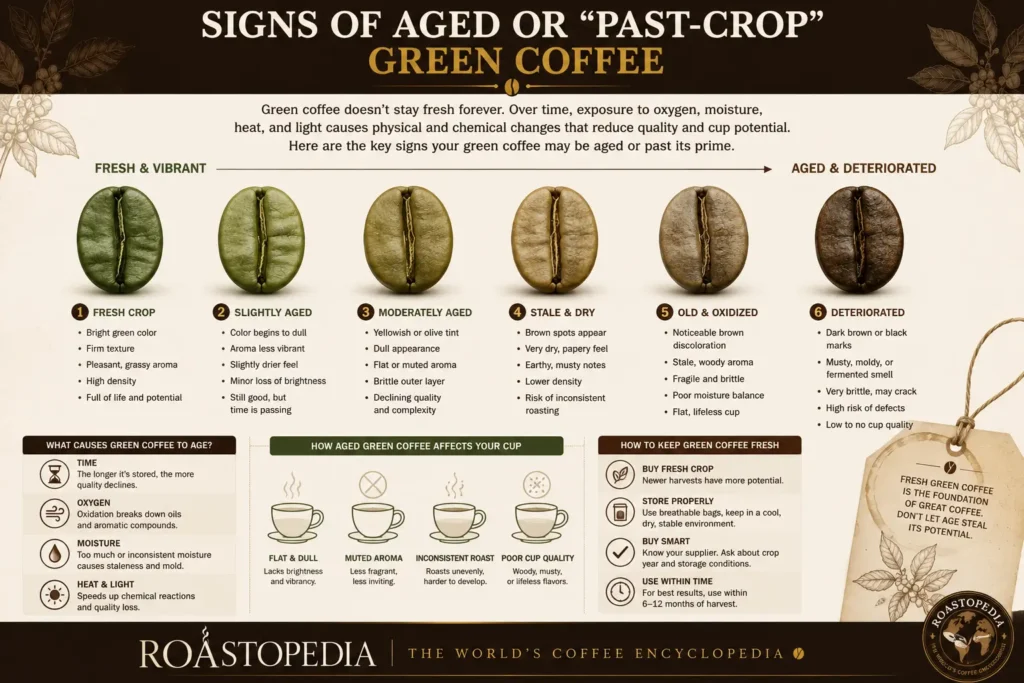
Coffee that has drifted past its freshness window develops recognizable off-notes rather than simply “going bad.” Papery, woody, or cucumber-like notes, grain- or cereal-like flavors, a “baggy” taste from the jute sack, and cardboard, straw, or hay characteristics are all reliable indicators that a coffee has aged beyond its prime. These faded qualities replace the vibrant traits — bright citrus acidity, sweet caramelized sugar notes, juicy fruit flavors, and delicate floral aromatics — that roasters prize in fresher lots.
Physically, aged beans may show a dull or faded green color, a dusty smell instead of a fresh grassy aroma, unusual brittleness, and less predictable roasting behavior.
How Long Does Green Coffee Actually Stay Fresh?
There is no universal expiration date, but there are useful benchmarks. The industry generally accepts an optimal freshness window of 6-12 months following harvest, after which coffee is typically classified as “past crop,” a designation signaling the loss of desirable sensory traits.
Green coffee beans can commonly be stored for approximately 12–18 months before quality loss becomes clearly noticeable, though for a lot to be marketed as “current crop,” storage time generally cannot exceed one year.
Some coffees are more resilient than others. Preliminary findings from studies conducted in Poland suggest that ideal storage conditions sit around 18–22°C with roughly 50% humidity, and some coffees — such as naturally processed Ethiopians or high-altitude anaerobic Colombians — can hold their character well beyond the typical 12–18 month window.
For especially rare or valuable lots, some roasters go further: freezing has been shown to slow the chemical kinetics of degradation, offering a viable option for archiving high-quality green coffee even for smaller operators.
Best Practices for Storage
The consensus across coffee-science and industry sources converges on a few practical rules: keep moisture near 10–12%, hold relative humidity around 50–65%, maintain a stable temperature (roughly 15–22°C), avoid direct light and strong odors, and use hermetic or otherwise moisture-controlled packaging rather than open-weave sacks for longer-term storage.
Because coffee farmers and roasters commonly store green beans for six months to a year before roasting, and because oxidation and packaging type measurably affect lipid stability during that period, packaging choice and monitoring are not optional extras but core parts of quality control.
Conclusion
Green coffee does not stale the way roasted coffee does — it lacks the trapped CO2 and freshly exposed oils that drive rapid post-roast decline — but it does age.
Moisture content, water activity, temperature, humidity, light, and packaging all determine how gracefully a lot holds its character over its six-to-eighteen-month working life.
Understanding and managing these variables is what separates a roaster who consistently gets a bright, vibrant cup from one who unknowingly roasts “past-crop” beans and wonders why the coffee tastes flat.
See Also
- The Role of Roast Level in Coffee Flavor Development
- How Soil, Altitude, and Climate Determine Coffee Flavor at Origin
- How Water Temperature Affects Coffee Extraction
- Does Light Roast Coffee Have More Caffeine Than Medium Roast?
- Does Grind Size Change Caffeine Extraction in Light Roast Coffee?
- Why Does Channeling Cause Uneven Espresso Extraction Results?
- How to Pull an Espresso Shot
References
- Specialty Coffee Association. “What is the Shelf Life of Roasted Coffee? A Literature Review on Coffee Staling.” sca.coffee, 2012 (updated 2025). https://sca.coffee/sca-news/2012/02/15/what-is-the-shelf-life-of-roasted-coffee-a-literature-review-on-coffee-staling
- Royal Coffee. “The Theory of Relative Humidity — Part 1 (Excerpts).” royalcoffee.com, 2025.
- Royal Coffee. “Green Coffee Storage Mistakes & Solutions.” royalcoffee.com, 2025.
- National Center for Biotechnology Information (NCBI/PMC). “Lipid Oxidation Changes of Arabica Green Coffee Beans during Accelerated Storage with Different Packaging Types.” PMC9563479, ncbi.nlm.nih.gov.
- Perfect Daily Grind. “How Long Does Green Coffee Stay Fresh For?” perfectdailygrind.com, 2023.
- Cropster. “Master Green Grading: A Coffee Roaster’s Guide.” cropster.com/blog-post, 2024.
- LeBrew Technology. “Moisture Content vs Water Activity: Two Key Factors in Green Coffee Storage.” lebrewtech.com, 2025.
- LeBrew Technology. “How Moisture Content Affects the Storage Quality of Green Coffee Beans.” lebrewtech.com, 2024.
- Espresso Outlet. “Effects of Storage Conditions on Green Coffee Bean Quality: Investigating the Impact of Temperature, Humidity, and Storage Duration on Physical and Chemical Stability.” espressooutlet.com, 2024.
- United States Patent and Trademark Office. “Apparatus and Method for Roasting Coffee Beans,” Patent No. 10,959,575. image-ppubs.uspto.gov.
- ICT Coffee. “How to Properly Store Your Green Coffee Beans Before Roasting.” ictcoffee.com, 2024.
- Bean Ground. “How Long Are Green Coffee Beans Good For? Shelf Life and Storage Explained.” beanground.com, 2026.
- International Coffee Organization. Coffee Quality-Improvement Programme (CQP) guidance on green coffee moisture and water activity, as cited in Perfect Daily Grind and Royal Coffee industry reporting. ico.org.