
In coffee, percolation is an extraction process in which brewing water continuously passes through a bed of coffee grounds rather than immersing them. As the water travels through the coffee bed, it dissolves soluble compounds and carries them into the brewing vessel. The efficiency of percolation is influenced by factors such as grind size, water temperature, flow rate, contact time, coffee bed depth, and turbulence.
Key Characteristics
- Water flows through the coffee bed rather than surrounding it.
- Extraction occurs continuously as fresh water enters and exits the coffee bed.
- Gravity, pressure, or both drive the movement of water.
- The brewing liquid is constantly renewed, creating a concentration gradient that promotes extraction.
- The process ends when the water has completely passed through the grounds.
Percolation-based brewing methods encompass a broad family of devices and techniques, ranging from the classic stovetop percolator pot and the electric drip machine to pour-over brewers, espresso machines, the moka pot, the siphon brewer, and various commercially deployed industrial extraction systems. What unites all of these methods is the defining characteristic of percolation: water in motion through a porous bed of coffee, continuously contacting fresher, less-saturated grounds.
The principles underlying coffee percolation intersect with concepts from physics, chemistry, and fluid dynamics — including solubility, diffusion, the Noyes-Whitney equation governing dissolution rates, and Darcy’s Law describing fluid flow through porous media. The balance of these forces determines the extraction yield, flavor clarity, strength, and overall cup quality produced by any percolation brew.
What is Percolation?
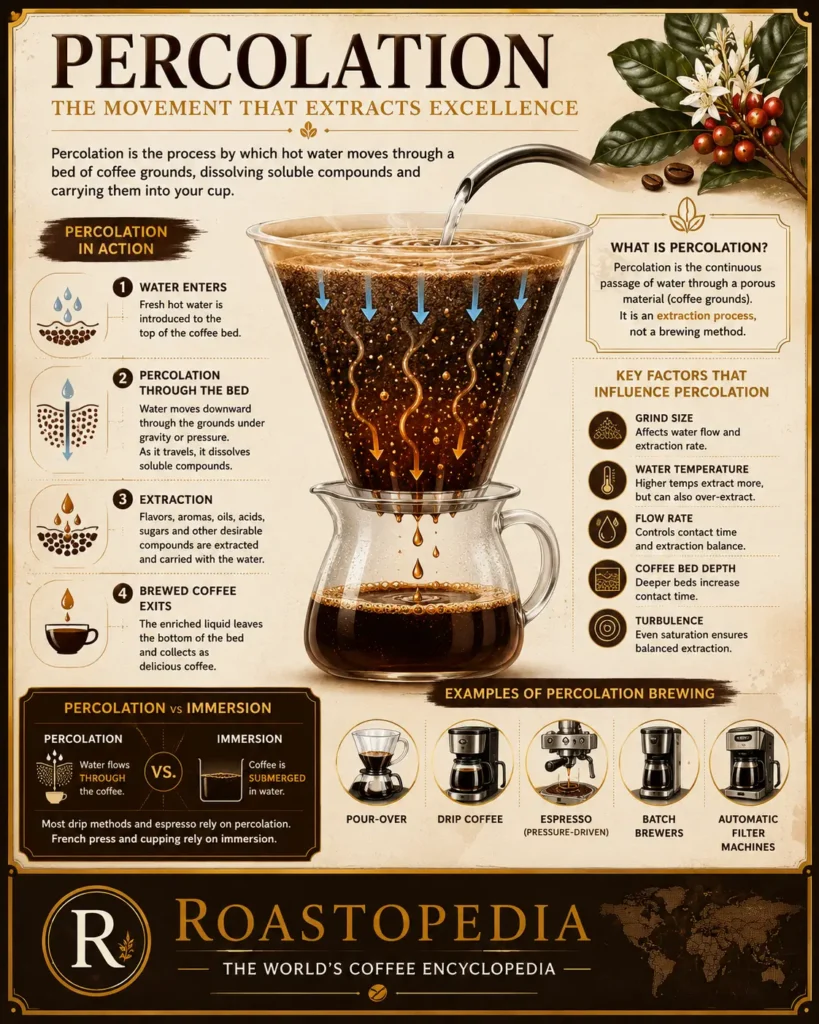
Percolation is derived from the Latin verb percolare, meaning “to strain” or “to filter through.” In the broadest scientific sense, percolation describes the movement of any fluid through a permeable solid medium. Applied to coffee, the term denotes the controlled passage of hot water through a mass of roasted and ground coffee, during which the water acts as a solvent, selectively dissolving volatile aromatic compounds, organic acids, simple sugars, caffeine, chlorogenic acids, and coffee oils from the surface and interior of each ground particle.
Unlike immersion brewing — where ground coffee sits in contact with a fixed body of water until an equilibrium of dissolved solids is approached — percolation continuously presents fresh, unsaturated water to the coffee bed. This dynamic keeps the concentration gradient between the water and the grounds high throughout the brew, driving rapid and efficient extraction. As a direct consequence, percolation brewing is more extraction-efficient per unit of water used but is also more sensitive to variables such as grind size, water flow rate, and the evenness of the coffee bed.
The physical components essential to any percolation system are: (1) a heat source or pressure mechanism to move water; (2) a bed of ground coffee through which water will flow; (3) a porous filter or screen to retain the spent grounds while allowing liquid to pass; and (4) a collection vessel for the finished brew. The configuration of these elements — and whether gravity or applied pressure drives the water — distinguishes one percolation method from another.
What is Percolation Rate?
Percolation rate, also referred to as flow rate in brewing contexts, is a quantitative measure of the speed at which liquid passes through the coffee bed during a percolation brew. It is conventionally expressed as a volumetric flow per unit of time (milliliters per second, or liters per minute in commercial settings), or as a linear velocity — the ratio of volumetric flow to the cross-sectional area of the coffee bed — measured in centimeters per minute.
In industrial coffee extraction for the production of soluble (instant) coffee, standard percolation rates are conventionally cited between 12 cm/min and 15 cm/min through the extraction columns. In artisanal pour-over brewing, a broadly accepted target for optimal extraction lies between approximately 3 and 4 minutes of total brew time for a standard 300–500 ml serving, implying a moderate flow rate calibrated to the grind size and dose used.
Percolation rate is determined by multiple interacting variables:
- Grind size: Finer grounds increase resistance to water flow, slowing the percolation rate. Coarser grounds reduce resistance and allow faster flow.
- Dose and bed depth: A greater mass of coffee in the brew basket increases bed resistance and slows flow.
- Water temperature: Higher temperatures reduce water viscosity slightly, modestly increasing flow rate.
- Applied pressure: In espresso machines, pressure of approximately 9 bars of pressure forces water through a compact puck of finely ground coffee at rates that would be unachievable under gravity alone.
- Filter type: Paper filters impose greater resistance than metal mesh filters, producing slower flow and finer filtration.
The relationship between percolation rate and flavor outcome is direct and critical. When the percolation rate is too fast — water moves through the grounds too quickly — extraction is incomplete, yielding an under-extracted brew that tastes sour, thin, and hollow. When the percolation rate is too slow — water dwells too long in the bed — extraction exceeds optimal levels, pulling out harsh, bitter compounds that dominate the finished cup. The target percolation rate for a given method and coffee is therefore the rate that achieves a balanced extraction yield, typically cited between 18% and 22% of the dry coffee mass for most filter brewing applications.
Origin and History
Early Precursors (Before 1800)
The earliest forms of coffee preparation employed rudimentary percolation. In Ethiopia and Yemen from at least the 15th century onward, roasted coffee was ground and combined directly with hot water, allowing gravity to settle the grounds while the liquid above was consumed — a primitive gravity filtration. In the Ottoman Empire and across the Arab world, finely ground coffee was boiled with water in a narrow-spouted pot called a cezve or ibrik, producing a strong, sediment-rich beverage in which partial percolation occurred as liquid was poured off. While these methods did not isolate the percolation process as a distinct principle, they represented the foundational understanding that water, when passed through or rested upon ground coffee, would carry away its soluble properties.
European coffee culture, which expanded rapidly through coffeehouses in the 17th century, similarly relied on boiling ground coffee with water — a method that produced inconsistent results and frequently bitter, over-extracted brews. The desire for a cleaner, more controlled extraction process drove the first deliberate engineering of percolation systems in the early 19th century.
Benjamin Thompson and Early Percolation Design (c. 1810–1814)
The first formally attributed percolation system for coffee is credited to Benjamin Thompson, an American-born British physicist and military officer who held the title Count Rumford. Working between approximately 1810 and 1814, Thompson devised a pot in which hot water was applied to coffee grounds held above the brew vessel, allowing gravity to pull the water through the grounds and into the collection chamber below. Thompson’s apparatus drew on Turkish-style brewing traditions but sought to separate the grounds from the finished liquid more cleanly. He expounded on his brewing philosophy in his 1813 essay “Of the Excellent Qualities of Coffee,” which outlined his methods and advocacy for coffee as a stimulating, healthful beverage.
Thompson’s design is generally considered a precursor to the percolator rather than the percolator itself, primarily because it lacked the central tube that would later enable the continuous recirculation of water through the grounds — the defining mechanical feature of the true percolator.
Joseph-Henry-Marie Laurens and the First Modern Percolator (c. 1819)
In approximately 1819, a Parisian tinsmith named Joseph-Henry-Marie Laurens constructed what is considered the first true percolator incorporating a central rising tube. Laurens’ design used heat applied to the base of a water-filled chamber to force hot water upward through a tube, where it was then directed over a bed of coffee grounds and allowed to drip back down into the lower chamber. The continuous cycling of water through the grounds — the hallmark of the true percolator — was achieved through this tube mechanism. Laurens’ invention established the core mechanical architecture that would remain the basis of stovetop percolator design for over a century.
James Nason and the First U.S. Patent (1865)
On December 26, 1865, the first United States patent for a stovetop coffee percolator was issued to James Nason of Franklin, Massachusetts. Nason’s patent codified the basic design of a percolator in American intellectual property law and contributed to the early commercial dissemination of the device within the United States. The Franklin Museum in Massachusetts maintains historical materials related to Nason’s original patent and his contribution to the development of the percolator.
Hanson Goodrich and the Modern Percolator (1889)
The percolator design that became the standard model for 20th-century household use is attributed to Hanson Goodrich, an Illinois farmer who filed U.S. Patent No. 408,707, granted on August 16, 1889. Goodrich’s design introduced a metal filter basket mounted on a vertical central tube within the percolator pot. Water heated in the base chamber was forced up the tube by steam pressure and thermal convection, where it dispersed over the coffee grounds in the basket, extracted their soluble compounds, and dripped back into the base chamber to be cycled again. Goodrich’s stated motivation was the production of a ground-free cup of coffee — a significant improvement in drinkability over the sediment-laden brews typical of the era.
Commercial Expansion and Electric Percolators (Late 19th – Mid-20th Century)
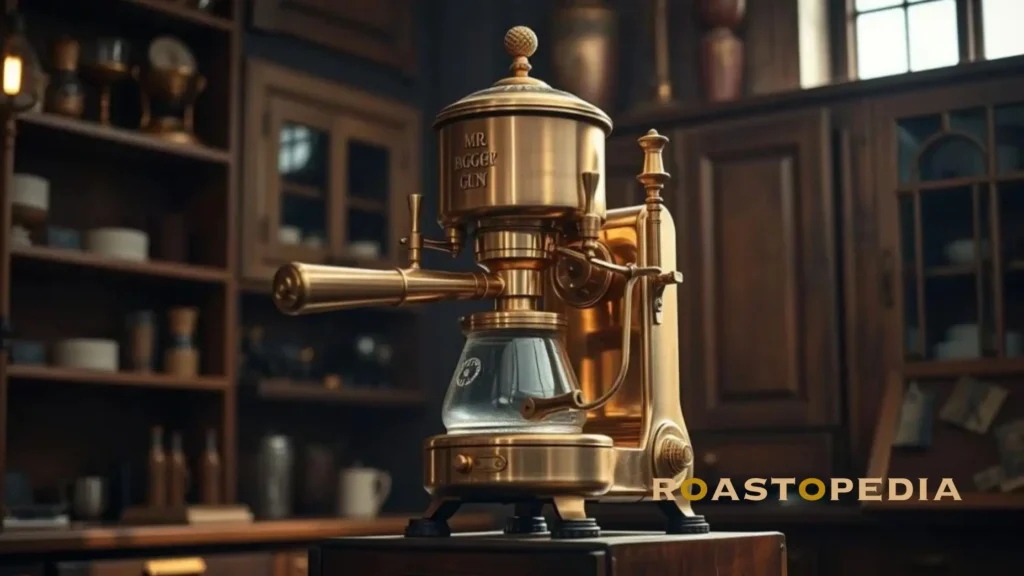
Following Goodrich’s patent, manufacturers including Landers, Frary and Clark, and later General Electric, began producing stovetop and subsequently electric percolators on a commercial scale from the late 19th century onward. Early models were often ornate in design, crafted in silver-plate or polished aluminum, and served as decorative table centerpieces as well as functional brewing devices. The development of the electric percolator — which automated the heating process and eliminated the need for a stovetop — further broadened the device’s adoption in American households.
The mid-20th century, particularly the post-World War II decades of the 1940s through the 1960s, marked the peak of the coffee percolator’s dominance in American domestic life. Electric percolators held over 50% of the household coffee brewing market share in the United States during the 1950s. The device was a fixture at breakfast tables, office settings, church gatherings, and roadside diners. The distinctive gurgling sound produced by the percolation cycle became, for many, synonymous with the preparation of morning coffee.
Decline of the Percolator (1970s–1990s)
The rise of the automatic drip coffee maker in the early 1970s precipitated a rapid decline in the percolator’s market share. Drip coffee makers largely replaced the percolator in American households during this period, primarily due to the percolator’s inherent tendency to over-extract coffee through the repeated cycling of already-brewed liquid back through the grounds at or above boiling temperature (100°C / 212°F), producing cups consistently characterized by bitterness and harshness.
The commercial introduction of Mr. Coffee — designed by former Westinghouse engineers and launched in the early 1970s — marked a decisive turning point. The Mr. Coffee machine used a single-pass drip mechanism, delivering water heated to approximately 93°C (200°F) over grounds exactly once before collection in a carafe below. By Christmas 1977, department stores in the United States were selling more than 40,000 Mr. Coffee units per day. By 1975, over one million units had been sold. The percolator’s market share fell from a dominant 50%+ in the 1950s to approximately 20% by the 1970s and as low as 5% by the 1980s.
General Electric ceased percolator manufacturing in the late 1970s. West Bend discontinued its percolator line in 1983. Sunbeam largely exited percolator production in the 1990s. General Foods discontinued its Max-Pax self-contained percolator filter rings in 1976, reflecting collapsing consumer demand. The rise of pod-based single-serve machines — led by Keurig from the late 1990s onward — further entrenched the percolator’s marginalization.
The Science of Coffee Percolation
Heat Transfer and Solubility
The science underlying coffee percolation involves the simultaneous operation of heat transfer, solubility, and diffusion. As hot water contacts the surface of each coffee ground particle, thermal energy drives the dissolution of soluble compounds present on and near the particle surface. Volatile aromatic compounds, organic acids (including citric, malic, and chlorogenic acids), simple sugars, and caffeine are extracted first, as they are the most readily soluble at brewing temperatures. Heavier, more complex compounds — including certain bitter polyphenols and degradation products of chlorogenic acids — require longer contact time and higher temperatures to extract.
Optimal brew water temperature for percolation is cited by the Specialty Coffee Association (SCA) as 90°C to 96°C (194°F to 205°F). Water below this range extracts too slowly and incompletely; water above this range — particularly at or above 100°C (212°F), as in a traditional percolator — extracts harsh, undesirable compounds at elevated rates and may chemically degrade volatile aromatics.
The Noyes-Whitney Equation and Concentration Gradient
The rate at which individual chemical compounds are extracted from coffee grounds during percolation is governed by the Noyes-Whitney equation, which states that the rate of dissolution of a solid into a liquid is proportional to the difference in concentration between the saturated solution at the solid’s surface and the concentration of that compound in the bulk liquid. In percolation brewing, this principle operates advantageously: because fresh, unsaturated water continuously enters the coffee bed, the concentration of dissolved solids in the water contacting the grounds remains low throughout brewing, maintaining a high gradient and sustaining rapid extraction across the full duration of the brew.
In contrast, in immersion brewing, the same body of water remains in contact with the grounds for the entire brew duration. As it accumulates dissolved solids, the concentration gradient between the water and the grounds gradually decreases, slowing extraction. As a result, percolation brews typically achieve a higher extraction yield (20%–23%) relative to immersion brews at comparable brew times.
Fluid Dynamics and Darcy’s Law
The movement of water through a coffee bed follows the principles described by Darcy’s Law, which relates the volumetric flow rate of a fluid through a porous medium to the pressure differential across the medium, the permeability of the medium, and the viscosity of the fluid. In practical coffee brewing terms, this means that the percolation rate is directly controlled by the grind size (which determines the permeability of the coffee bed), the depth and mass of the coffee bed (which affects pressure differential), and the temperature of the water (which affects viscosity). Inconsistencies in the coffee bed — caused by uneven grind distribution, channeling, or clumping — disrupt the uniform flow of water and produce localized zones of over- and under-extraction within a single brew.
Percolation in Major Brew Methods
Stovetop and Electric Percolators
The stovetop percolator operates by heating water in a base chamber until steam pressure and thermal convection force it up a central tube, over the grounds in a filter basket, and back into the base chamber for repeated cycling. The brewing cycle continues until the desired strength is reached — typically 7 to 10 minutes. The electric percolator automates this process, with a thermostat interrupting the cycle when the brew reaches a target temperature, reducing the risk of the most severe over-extraction. Both types use medium to coarse grinds to prevent grounds from passing through the basket perforations. Recommended water-to-coffee ratio is approximately 1 to 2 tablespoons of ground coffee per 180 ml (6 oz) of water.
Drip / Automatic Filter Coffee
Automatic drip coffee makers deliver a single pass of hot water over grounds held in a paper or metal filter basket, allowing gravity to draw the brew into a carafe below. The single-pass nature distinguishes drip brewing from percolator brewing: water contacts the grounds exactly once. Filter drip brewing was formally pioneered by Melitta Bentz, who patented the paper filter drip brewer in Germany in 1908. Modern SCA-certified drip machines are designed to deliver water at 90°C to 96°C at a controlled flow rate calibrated to achieve full saturation of the coffee bed and an extraction yield within the target range. Drip brewing is the most widely consumed coffee preparation method in the United States, used daily by approximately 41% of coffee drinkers as of 2025.
Pour-Over (Manual Filter Percolation)
Pour-over brewing is a manually controlled form of filter percolation in which a brewer pours hot water over grounds held in a cone or flat-bottom dripper equipped with a paper or metal filter. Common pour-over devices include the Hario V60, Chemex, Kalita Wave, and Origami Dripper. The pour-over method grants the brewer direct control over percolation rate, water distribution across the coffee bed, and brewing duration. A bloom pour — in which a small amount of hot water is first applied to saturate and degas the grounds — is a standard technique to expel carbon dioxide trapped in freshly roasted coffee, which would otherwise impede even water penetration. Total brew time for a standard 300–500 ml pour-over ranges from approximately 2.5 to 4 minutes.
Espresso
Espresso is a pressurized percolation method in which water at approximately 9 bars of pressure is forced through a compact puck of finely ground coffee in a portafilter basket. The result is a concentrated, 25–35 ml shot of highly extracted coffee produced in approximately 20 to 30 seconds. Espresso’s defining characteristics — a high concentration of dissolved solids, the presence of emulsified coffee oils (which paper filters in drip brewing would trap), and the formation of crema (a colloid of emulsified oils, carbon dioxide, and water) — are products of the pressurized percolation process. The first patent for an espresso machine was granted to Angelo Moriondo of Turin, Italy in 1884. Modern espresso machines operate with grind consistency, dose weight, tamping pressure, and water temperature as the primary variables governing extraction.
Moka Pot
The moka pot, invented by Alfonso Bialetti in 1933 and originally marketed under the name Moka Express, is a stovetop pressurized percolation device. Water placed in a sealed lower chamber is heated until vapor pressure forces it upward through a basket of finely ground coffee and into an upper collection chamber. The moka pot operates at a lower pressure than a true espresso machine (approximately 1 to 2 bars versus 9 bars) and produces a concentrated brew distinct from both espresso and drip coffee. In southern European countries — particularly Italy and Spain — the moka pot rapidly supplanted the traditional percolator by the end of the 1930s and remains the dominant domestic coffee preparation method in those regions.
Siphon / Vacuum Brewer
The siphon brewer, also known as the vacuum pot or vacpot, employs vapor pressure and vacuum to move water between two chambers. Water in a sealed lower globe is heated until steam pressure drives it upward into a connected upper chamber containing coffee grounds, where it brews by immersion. When the heat source is removed or reduced, the vapor in the lower globe condenses, creating a partial vacuum that draws the brewed liquid back down through a filter into the lower chamber, completing a percolation-style drawdown. The siphon brewer thus combines an initial immersion phase with a terminal percolation filtration, producing a brew with characteristics intermediate between the two extraction methods. Siphon brewers were developed in Germany in the 1840s and have maintained a dedicated following among specialty coffee enthusiasts, particularly in Japan, where they are associated with high-precision café brewing.
Cold Drip Percolation
Cold drip brewing is a form of percolation in which room-temperature or cold water is allowed to drip slowly through a bed of coarsely ground coffee over an extended period — typically 6 to 12 hours. The dramatically reduced water temperature slows extraction relative to hot percolation methods, requiring a longer contact time to achieve comparable dissolved solid concentrations. Cold drip brewing produces a smooth, low-acidity concentrate with a distinct flavor profile differing significantly from hot-brewed drip coffee or cold brew (which is an immersion method). Cold drip towers, characterized by their multi-chamber glass apparatus, are associated with specialty and artisanal coffee settings.
Industrial Percolation: Soluble Coffee Production
In the commercial production of soluble (instant) coffee, percolation is employed as a semi-continuous countercurrent extraction process. A series of four to six large vertical extraction columns, each packed with roasted and ground coffee at varying stages of extraction, is arranged in sequence. Hot water enters the column containing the most depleted grounds first, passes through progressively fresher columns, and exits the final fresh-stage column as a concentrated coffee extract containing 20% to 35% soluble solids by weight. This extract is then spray-dried or freeze-dried to produce soluble coffee powder or granules. Percolation rates in industrial applications are typically maintained at 12 to 15 cm/min, with flow rate adjustments used to control the concentration and insoluble-fraction content of the final extract.
Percolation vs. Immersion Brewing
The fundamental distinction between percolation and immersion brewing lies in the dynamic relationship between the water and the coffee grounds during extraction. In percolation, water continuously flows through the grounds; it is never in a static state of equilibrium with the coffee. In immersion, grounds are submerged in a fixed body of water that progressively saturates with dissolved solids until equilibrium is approached or the brew is separated.
Percolation brewing consistently produces cups characterized by greater clarity, brightness, and acidity, with cleaner flavor separation and a more pronounced aromatic profile. The continuous introduction of fresh water extracts lighter, more volatile compounds preferentially in the early stages of the brew, and heavier compounds in later stages, creating a sequential stratification of extracted flavors within the total brew volume.
Immersion brewing, by contrast, produces cups with fuller body, lower perceived acidity, and a more uniform extraction of flavor compounds across molecular weight ranges. The equilibrium extraction characteristic of immersion tends to mute subtle distinctions in flavor and produce a heavier, oilier mouthfeel — particularly in unfiltered methods such as the French press.
Percolation is generally regarded as more sensitive to grind size inconsistency, water distribution, and bed geometry than immersion brewing. Channeling — the formation of preferential flow paths through a non-uniform coffee bed — is a percolation-specific failure mode that produces simultaneously over-extracted (through the channel) and under-extracted (bypassed) zones in a single brew. Immersion methods are generally more forgiving of grind inconsistency because the static-water contact allows all particles, regardless of size and extended extraction time.
Adaptations and Variations
The category of percolation brewing has produced numerous adaptations designed to address specific flavor, convenience, or capacity requirements. Hybrid methods — combining elements of percolation and immersion — have gained significant attention in specialty coffee circles. The Clever Dripper, which allows grounds to steep in a sealed lower chamber before being released through a filter by gravity, represents an immersion-percolation hybrid. The AeroPress, when used in its standard configuration, permits an initial immersion phase followed by a pressurized percolation through a paper or metal filter.
In competitive and professional brewing contexts, specific pour-over techniques — including the 4:6 method developed by World Brewers Cup champion Tetsu Kasuya — manipulate the ratio and timing of poured water increments to systematically alter the extraction profile of a percolation brew, functioning as a deliberate calibration of sequential percolation phases within a single brew.
At the commercial and industrial scale, pressurized percolation has been adapted to produce highly concentrated coffee extracts for use in ready-to-drink (RTD) coffee beverages, coffee-flavored dairy products, and food manufacturing applications. Variations in temperature, pressure, and multi-stage extraction sequences allow industrial percolation processes to be tuned for specific flavor profiles and dissolved solid concentrations.
Criticism
The principal criticism historically directed at percolation brewing — and at the stovetop and electric percolator specifically — is its susceptibility to over-extraction. Repeated cycling of already-brewed liquid through the grounds at or above boiling temperature extracts bitter, harsh compounds that would not be released under optimal single-pass percolation conditions. Coffee brewed with a traditional percolator is particularly susceptible to over-extraction, producing cups characterized by high bitterness, reduced aromatic complexity, and a flat flavor profile relative to drip or pour-over alternatives.
Coffee professionals and baristas have pointed out that percolator brewing typically operates above the SCA-recommended maximum brewing temperature of 96°C (205°F), with water frequently reaching full boiling point (100°C / 212°F) in the base chamber. At these temperatures, thermally labile aromatic compounds degrade, and certain bitter Maillard reaction products are extracted at elevated rates.
A secondary criticism pertains to sediment. Without a fine-pore paper filter, particulate matter — including fine coffee particles that escape the perforated basket — passes into the finished cup, producing a gritty mouthfeel objectionable to many drinkers. Paper-filtered drip brewing eliminates this issue entirely, and the comparative cleanliness of drip coffee was cited explicitly as a selling point of early automatic drip machines.
A broader methodological criticism of percolation, advanced in the specialty and third-wave coffee community, holds that the sensitivity of percolation brewing to grind consistency, water distribution, and bed geometry makes it less forgiving and less reproducible than immersion brewing for non-expert home brewers. Coffee writer and educator James Hoffmann has noted that immersion brewing produces acceptable results across a wider range of grind sizes and variables than percolation, making it technically more accessible. However, this same sensitivity is also cited by percolation proponents as the source of its expressive potential: a precisely controlled pour-over can achieve flavor clarity and aromatic complexity that immersion methods cannot replicate.
Percolator enthusiasts and defenders maintain that the problems historically attributed to percolation are, in practice, problems of temperature control and cycle duration rather than inherent flaws of the percolation principle itself. With attentive heat management and a shorter brewing cycle, a stovetop percolator can produce a full-bodied, robust cup without the bitterness associated with uncontrolled over-extraction.
See Also
- Extraction
- Brew Ratio
- Immersion Brewing
- Grind Size
- Coffee Bloom
- Drip Coffee
- Origami Dripper
- Espresso
- Total Dissolved Solids (TDS)
References
- Wikipedia. “Coffee Percolator.” Wikimedia Foundation. Accessed 2026. https://en.wikipedia.org/wiki/Coffee_percolator
- Wikipedia. “Drip Coffee.” Wikimedia Foundation. Accessed 2026. https://en.wikipedia.org/wiki/Drip_coffee
- Thompson, Benjamin (Count Rumford). “Of the Excellent Qualities of Coffee.” Essay. 1813.
- Goodrich, Hanson. U.S. Patent No. 408,707: “Coffee Percolator.” Granted August 16, 1889. United States Patent and Trademark Office.
- Nason, James. U.S. Patent (December 26, 1865). Stovetop Coffee Percolator. United States Patent and Trademark Office.
- Colipse Coffee. “Percolator Coffee: Definition, How It Works, and Brewing.” Colipse.com. 2025. https://colipsecoffee.com/blogs/coffee/percolator
- Adams and Russell Coffee Roasters. “The Percolator: Best Coffees, Best Practices and A Journey Through Time.” AdamsandRussell.co.uk. 2026. https://www.adamsandrussell.co.uk/journal/the-percolator/
- ElevatingKitchen. “What Happened to Percolator Coffee? A Brewing History and Modern Revival.” ElevatingKitchen.com. April 2025. https://elevatingkitchen.com/what-happened-to-percolator-coffee/
- ITA Coffee. “Immersion vs Percolation: Coffee Extraction Physics.” ITACoffee.com. February 2026. https://www.itacoffee.com/immersion-vs-percolation-flavor-physics/
- Coffee ad Astra (Langlois, Jonathan). “Why Do Percolation and Immersion Coffee Taste So Different?” CoffeeAdAstra.com. July 2019. https://coffeeadastra.com/2019/07/16/why-do-percolation-and-immersion-coffee-taste-so-different/
- Espresso Outlet LLC. “Immersion vs. Percolation Coffee Brewing: A Comprehensive Comparison.” EspressoOutlet.com. September 2024. https://espressooutlet.com/blogs/news/immersion-vs-percolation-coffee-brewing-a-comprehensive-comparison
- Dmcoffee.blog. “The Science Behind Coffee Percolation: How Does it Work?” Dmcoffee.blog. August 2023. https://dmcoffee.blog/what-is-coffee-percolation/
- NPR / The Salt. “When Mr. Coffee Was The Must-Have Christmas Gift For Java Snobs.” NPR.org. December 16, 2016. https://www.npr.org/sections/thesalt/2016/12/16/505464932/when-mr-coffee-was-the-must-have-christmas-gift-for-java-snobs
- Kitchenzap. “The History of Electric Coffee Percolator.” Kitchenzap.com. July 2025. https://kitchenzap.com/the-history-of-electric-coffee-percolator/
- U.S. Patent No. 5,190,779: “Countercurrent Extraction of Coffee.” United States Patent and Trademark Office. Filed reference for industrial percolation rate data.
- Colipse Coffee. “20 Coffee Brewing Methods: Different Ways to Make Coffee at Home.” Colipse.com. August 2025. https://colipsecoffee.com/blogs/coffee/brewing-methods
- Corner Coffee Store. “When Was the Coffee Percolator Invented? History, Facts and FAQ.” CornerCoffeeStore.com. 2026. https://cornercoffeestore.com/when-was-coffee-percolator-invented/
- Barista Life. “Coffee Extraction Chart Chemistry: Science-Based Brewing Guide.” BaristaLife.co. August 2025. https://baristalife.co/blogs/blog/coffee-extraction-chart
- Biology Insights. “What Does Percolation Mean? From Water to Coffee.” BiologyInsights.com. January 2026. https://biologyinsights.com/what-does-percolation-mean-from-water-to-coffee/
- Specialty Coffee Association (SCA). “Water Quality Standards for Brewing Coffee.” SCA White Paper. Available: https://sca.coffee