
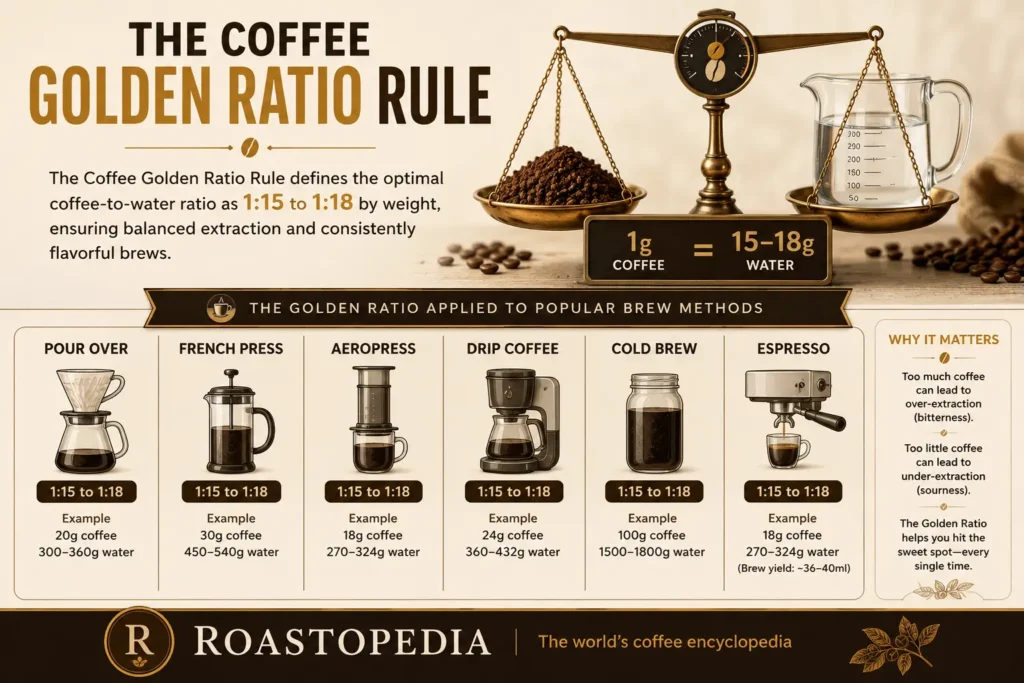
The Coffee Golden Ratio Rule (also referred to as the Golden Ratio for Coffee, the Coffee-to-Water Ratio Rule, or the Golden Cup Ratio) is a widely accepted brewing guideline stating that a well-balanced cup of coffee is produced when approximately one gram of ground coffee is combined with sixteen to eighteen grams of water — expressed as a 1:16 to 1:18 ratio by weight. The guideline is most commonly codified by the Specialty Coffee Association (SCA) as part of its Golden Cup Standard, which defines optimally brewed coffee as achieving a Total Dissolved Solids (TDS) concentration of 1.15–1.35% and an extraction yield of 18–22%. The rule is employed across a broad range of hot-water brewing methods, including drip, pour-over, French press, and batch brew, and serves as a foundational reference point in barista training, specialty coffee education, and home brewing instruction worldwide.
Definition
The Coffee Golden Ratio Rule defines the optimal proportion of ground coffee to water used in brewing. It is expressed as a mass-based ratio rather than a volume-based measurement, reflecting the understanding that coffee beans of different roast levels, densities, and origins occupy different volumes per unit of weight, making volume measurements inherently imprecise.
In the most widely cited formulation, the rule specifies 55 grams of coffee per liter of water (equivalent to 1:18.2), as established by the SCA’s Golden Cup Standard for filter or drip brewing. In everyday practice, most specialty coffee professionals and educators refer to the applicable range as 1:15 to 1:18, with 1:16 frequently cited as the practical midpoint best suited to a wide variety of coffees and brew methods.
The ratio operates in conjunction with two quantitative metrics derived from the Coffee Brewing Control Chart (BCC): total dissolved solids (TDS), which measures the concentration of soluble material in the brewed coffee, and percent extraction (PE), which measures the proportion of the original dry coffee mass that has dissolved into the water during brewing. At the golden ratio range of 1:16 to 1:18, a properly calibrated brewing process with correct temperature and grind size is expected to fall within the SCA’s ideal zone of 1.15–1.35% TDS and 18–22% extraction yield.
Origin and Historical Development
Early Twentieth-Century Brewing Practices (Pre-1950s)
Prior to the formalization of coffee-to-water ratio guidelines, brewing ratios across the world varied widely and were not standardized. In the United States during the early twentieth century, coffee was commonly brewed at concentrations as low as 14 grams per liter — regarded by European standards as extremely weak. In France, by contrast, ratios as high as 120 grams per liter were recorded in some commercial contexts. These divergent practices reflected regional taste preferences, cultural traditions, and the absence of any coordinated industry effort to define quality benchmarks for brewed coffee.
Coffee was widely prepared using boiling or near-boiling water poured over loosely measured grounds, with no standardized measurement of either the coffee dose (see Dosing) or the water volume. Quality was assessed purely through taste and informal experience rather than any quantitative framework.
The Coffee Brewing Institute and the Lockhart Research (1950s)
The scientific foundation for the Coffee Golden Ratio Rule was established through research conducted at the Coffee Brewing Institute (CBI), founded in 1952 through a collaboration between the National Coffee Association (NCA) and the Pan American Coffee Bureau. The CBI was established with the explicit goal of grounding the nascent coffee industry in empirical science, with a particular focus on the consumer experience of brewed coffee quality.
The CBI was directed from 1952 to 1964 by Ernest Earl Lockhart, a biochemist who had earned his PhD from the Massachusetts Institute of Technology (MIT) in 1938. Lockhart conducted a series of large-scale consumer preference studies to determine, systematically, what parameters produced coffee that ordinary drinkers preferred. His research used hydrometers to measure the density of brewed coffee and correlated TDS levels with consumer acceptability scores drawn from thousands of tastings.
In 1957, Lockhart published the findings of this research in a seminal paper titled “The Soluble Solids in Beverage Coffee as an Index to Cup Quality.” This publication introduced the Coffee Brewing Control Chart (BCC), a two-dimensional grid plotting TDS concentration against percent extraction, with an overlaid “Ideal–Optimal Balance” zone identifying the range of brewing parameters most preferred by consumers.
The chart defined the foundational numeric parameters that would later underpin what the coffee industry calls the Golden Ratio. A prior study conducted by the NCA’s brewing committee had defined the “region of optimal taste” as between 17.5 percent and 21.2 percent extraction; the Midwest Research Institute subsequently refined this range in 1957 to the 18–22% figure that remains in use today.
The CBI was dissolved in 1964 and was immediately succeeded by the Coffee Brewing Center (CBC), which shifted focus toward the foodservice industry. The CBC developed the first iteration of the Gold Cup Award, an industry recognition program for establishments brewing coffee within the established quality parameters, helping to disseminate the ratio guidelines through the commercial hospitality sector.
Adoption by the Specialty Coffee Association (1980s–2000s)
The Specialty Coffee Association of America (SCAA), founded in 1982, incorporated Lockhart’s Coffee Brewing Control Chart and the associated ratio guidelines into its educational and certification programs from the organization’s early years. The SCAA formalized the golden ratio guideline as 55 grams of coffee per liter of water — equivalent to approximately 1:18 by weight — as the standard for its Golden Cup certification. Under this standard, coffee achieving a TDS of 1.15–1.35% and an extraction yield of 18–22% was defined as meeting the ideal quality threshold.
The SCAA’s Golden Cup Standard became the most widely taught coffee quality benchmark in the English-speaking world. It was embedded in barista training curricula, used in professional certification examinations, and referenced in instructional materials distributed to coffee shops, roasters, and educators. The Gold Cup Award program, which certified commercial brewing equipment and cafe brewing practices against the standard, further anchored the 1:18 ratio in professional practice.
In 2017, the SCAA and the Specialty Coffee Association of Europe (SCAE) merged to form the unified Specialty Coffee Association (SCA), which continued to maintain and promote the Golden Cup Standard as part of its global educational framework.
Institutional Codification
The Coffee Golden Ratio Rule has been codified by several institutions, each with slightly varying parameters.
Specialty Coffee Association (SCA): The SCA’s Golden Cup Standard specifies 55 grams of coffee per liter of water (1:18.2) as the baseline recommendation for filter brewing. The standard targets a TDS of 1.15–1.35% and an extraction yield of 18–22%. The SCA has used the Coffee Brewing Control Chart as a foundational teaching tool since the 1980s and continues to base much of its core educational content on these parameters.
Coffee Brewing Institute (CBI): Lockhart and the CBI established the empirical framework — TDS measurement, percent extraction, and the Brewing Control Chart — that all subsequent institutional formulations have drawn from. The CBI’s work, published in 1957, is considered the primary scientific source for the golden ratio parameters.
National Coffee Association (NCA): The NCA, which co-founded the CBI and whose brewing committee produced the earliest version of the “optimal taste” extraction range (17.5–21.2%), has historically aligned its consumer-facing recommendations with the SCA’s Golden Cup Standard.
European Coffee Brewing Centre (ECBC): European standards bodies, including the ECBC and its Nordic affiliates, have adopted broadly similar ratio guidelines but have historically skewed toward slightly stronger brewing ratios — typically 1:14 to 1:16 — reflecting regional consumer preferences for more concentrated filter coffee.
Standard Parameters
The Coffee Golden Ratio Rule is typically applied within the following parameter set for standard hot-water filter brewing:
- Coffee dose: 55–60 grams per liter of water (SCA standard), or approximately 15–17 grams per 250 ml serving
- Water: 1 liter (1,000 ml / 1,000 g) for a full brew; 250 ml for a single serving
- Ratio: 1:16 to 1:18 by weight
- Water temperature: 92–96°C (197–205°F)
- Extraction yield: 18–22%
- Total Dissolved Solids (TDS): 1.15–1.35%
- Grind size: Medium (for drip/filter); adjusted per method
A kitchen or barista-grade scale measuring to 0.1-gram precision is recommended for applying the ratio accurately. Volume-based measurements — tablespoons, scoops, or manufacturer cup markings — are considered less reliable, as the volumetric density of coffee grounds varies with roast level, bean origin, and grind size.
Application by Brew Method
The golden ratio functions as a baseline across most hot-water brewing methods but requires adjustment depending on the extraction dynamics specific to each method.
Drip / Automatic Drip
The SCA’s Golden Cup Standard and the 1:18 ratio were originally calibrated specifically for automatic drip machines, which deliver water at precise, consistent temperatures and flow rates. For well-calibrated automatic drip equipment, a ratio of 1:17 to 1:18 is generally recommended. Many specialty practitioners favor 1:16 to 1:17 to achieve greater body and flavor presence in the cup.
Pour-Over
Pour-over methods — including the Hario V60, Chemex, and Kalita Wave — are typically brewed at 1:15 to 1:17. Manual pour-over introduces variability in water flow rate, pouring technique, and contact time compared to automatic machines. Most specialty pour-over recipes employ 1:16 as a starting point, with adjustments based on roast level, bean origin, and desired cup character. The Chemex, which uses a thicker proprietary filter that removes more oils, often benefits from a slightly stronger ratio of 1:15 to compensate for the increased filtration.
French Press
French press is a full-immersion method in which grounds remain in contact with water throughout the brew. Because immersion brewing tends to extract more efficiently per gram of coffee than gravity-drip methods, and because the metal mesh filter allows coffee oils and fine particles to pass through into the cup — adding body — most recommendations for French press fall at 1:14 to 1:15. This ratio is slightly stronger than the SCA’s standard, reflecting both the increased extraction efficiency of immersion brewing and consumer preference for the characteristic full body of French press coffee.
AeroPress
The AeroPress is the most versatile brewing device with respect to ratio, capable of operating across a range from approximately 1:6 to 1:17. In concentrate mode (1:6 to 1:10), the AeroPress produces an espresso-adjacent output intended to be diluted with water or milk. For standard single-serving filter-style brewing, a ratio of 1:15 to 1:17 is commonly used. The device’s designer, Alan Adler, originally specified a concentrate recipe of approximately 1:7 (14 grams of coffee to 100 grams of water), diluted to taste.
Cold Brew
Cold brew operates outside the parameters of the hot-water golden ratio. Because cold water extracts coffee solubles significantly more slowly and less efficiently than hot water — typically over a steeping period of 12 to 24 hours — cold brew recipes require a much higher coffee concentration. Cold brew concentrate is typically prepared at 1:4 to 1:8 and diluted with water or milk before serving, producing a final strength of approximately 1:10 to 1:15. Ready-to-drink cold brew is often prepared at 1:12 to 1:15 directly.
Batch Brew
Commercial batch brewing — the production of large volumes of brewed coffee in a single cycle, as commonly practiced in cafes and foodservice settings — follows the SCA Golden Cup Standard most closely. A ratio of 1:16 to 1:18 is standard for batch brewers, which are specifically engineered to maintain consistent water temperature and flow rate across large volumes.
Moka Pot and Turkish Coffee / Cezve
The golden ratio does not apply to Moka pot or Turkish coffee (Cezve) brewing. Both methods produce highly concentrated brews far outside the SCA’s TDS and extraction yield parameters. Moka pot and Cezve preparations are considered separate beverage categories with their own ratio conventions.
Variations
Several alternative formulations of the golden ratio coexist within the coffee industry, reflecting divergent practices across regions, institutions, and brewing communities.
- 1:15 (approximately 67g/L): Favored by many specialty cafes and baristas for its stronger body and more pronounced flavor presence. Widely regarded as the practical standard in high-volume specialty cafe settings, where customers are accustomed to fuller-bodied coffee. Competition brewing and award-winning cup evaluations have frequently shown preference for ratios in the 1:15 range.
- 1:16 to 1:17 (59–63g/L): The range most frequently cited as the “real-world” golden ratio by specialty coffee educators, roasters, and home brewing guides. Occupies a midpoint between the SCA’s conservative 1:18 and the stronger 1:15 commonly preferred in specialty cafe contexts.
- 1:18 (55g/L): The SCA’s formally defined Golden Cup Standard, calibrated for large-batch drip brewing. Most applicable to automatic drip machines and high-volume batch brewers; less commonly used for manual pour-over or specialty single-serve preparation.
- CoffeeGeek 1:14 ratio (7g per 100ml): A simplified ratio promoted by coffee educator Mark Prince for home brewers seeking a reliable starting point without precision scales. Slightly stronger than the SCA standard; suited to siphon and press pot brewing.
- Nordic/European standards (1:14 to 1:16): Scandinavian and northern European specialty coffee cultures historically favor slightly stronger ratios than the SCA standard, reflecting regional preferences for clean, concentrated filter coffee.
The variation between institutional standards and common professional practice reflects a broader tension in the coffee industry: the SCA’s 1:18 standard was designed to define a statistically preferred midpoint for a broad general consumer population, while practicing baristas and specialty roasters frequently find that their specific clientele and coffee profiles are better served at 1:15 to 1:17.
Adaptations and Modern Developments
Specialty Coffee and Third-Wave Adaptation
The emergence of third-wave coffee culture from the early 2000s onward brought renewed attention to the coffee-to-water ratio as a precision variable. Third-wave practitioners, emphasizing single-origin beans, lighter roast profiles, and scientific approaches to brewing, adopted the golden ratio as a foundational guideline while also adapting it to the demands of specific coffees. Lighter-roasted, denser beans — which are less soluble than darker-roasted counterparts — frequently require stronger ratios (1:15 to 1:16) or extended contact times to achieve the same TDS and extraction yield targets as darker roasts at 1:18.
Refractometry and TDS Measurement
The proliferation of affordable digital refractometers (see Refractometry) from the 2010s onward enabled baristas and home brewers to directly measure the TDS of brewed coffee and verify whether a given coffee-to-water ratio is producing results within the golden ratio’s target zone. This shift from ratio as a prescription to ratio as one variable within a verified extraction model has been characteristic of precision-focused specialty brewing.
The UC Davis Sensory and Consumer Brewing Control Chart (2017–2023)
Beginning in 2017, researchers at the UC Davis Coffee Center — supported by the Specialty Coffee Association, the Coffee Science Foundation, and funding from Breville — undertook a multi-year research project to update Lockhart’s 1957 Brewing Control Chart for the twenty-first century. The project produced three peer-reviewed papers over seven years, culminating in a study published in the Journal of Food Science in May 2023 (Guinard et al., 2023).
The resulting Sensory and Consumer Brewing Control Chart departed from Lockhart’s binary “ideal” vs. “non-ideal” framework, instead describing specific sensory attributes — bitterness, sweetness, acidity, body — associated with different regions of the TDS/extraction yield space. The new chart found that consumer preferences followed more complex patterns than the classic BCC indicated, with sweetness peaking at lower TDS and extraction values than the classic ideal zone, and bitterness peaking in the upper-right region as originally mapped by Lockhart.
The UC Davis chart redesignated the classic Lockhart ideal zone as the “classic standard” rather than the “ideal,” reflecting the researchers’ conclusion that the standard represents a historically validated midpoint rather than a universal optimum. The chart is intended to enable brewers to navigate toward specific flavor profiles rather than simply to produce coffee that falls within a predefined acceptable zone.
Criticism and Limitations
The Coffee Golden Ratio Rule, while broadly respected and widely taught, has attracted substantive criticism from specialty coffee practitioners, researchers, and educators, particularly since the 2010s.
Calibration for Large-Batch Drip Brewing
A recurring criticism is that the SCA’s canonical 1:18 ratio was derived from consumer preference studies conducted specifically in the context of large-batch automatic drip brewing. Critics, including coffee educator and researcher David Walsh of Marco Beverage Systems, have argued that this calibration makes the 1:18 standard poorly suited to manual single-serving brewing methods such as pour-over and AeroPress, where different extraction dynamics frequently produce underpowered, weak results at the standard SCA dose. This has led many practitioners to treat 1:16 or even 1:15 as the operative golden ratio for manual brewing.
Subjectivity of Taste
The SCA’s Golden Cup Standard is grounded in population-level consumer preference data — that is, it identifies the brewing parameters most preferred by the average consumer across large samples. Critics note that individual taste preferences vary substantially: some drinkers reliably prefer coffee outside the 1:15–1:18 range, either stronger or weaker, and no single ratio is universally optimal. SCA-funded research published in 2023 by the UC Davis Coffee Center acknowledged this limitation explicitly, finding that flavor perception is subjective and that no single ratio is best for all consumer types.
Interaction with Grind Size, Temperature, and Freshness
Ratio is one variable within a complex extraction system. Critics argue that treating the golden ratio as a primary quality target can be misleading when other variables — grind size, water temperature, bean freshness, and brew time — are not simultaneously controlled. A coffee brewed at exactly 1:16 with a mismatched grind size or incorrect water temperature may produce a result far outside the ideal TDS and extraction yield targets, while a coffee brewed at 1:14 with careful attention to other variables may produce an excellent cup.
Inapplicability to Certain Methods
The golden ratio is explicitly inapplicable to espresso, cold brew concentrate, Turkish coffee (Cezve), and Moka pot. For espresso, the applicable ratio is 1:2 (a 1:2 brew ratio of coffee to liquid yield, producing approximately 18–22% extraction at a TDS of 8–12%). Applying golden ratio parameters to these methods produces either severely under-extracted or inappropriately diluted results.
Volume vs. Weight Measurement
Consumer-facing presentations of the golden ratio have historically simplified the guideline to volumetric approximations — typically expressed as tablespoons per cup — to lower the barrier for home brewers. Critics note that volume measurements introduce significant imprecision because the volumetric density of ground coffee varies with roast level, grind coarseness, and humidity. The broadly cited guideline of “two tablespoons per six-ounce cup” produces results that may differ substantially from a weight-based 1:16 ratio, depending on these variables.
See Also
- 15-15-15 Coffee Rule
- 30-Second Espresso Rule
- Golden Cup Standard
- Extraction
- Extraction Yield
- Coffee Brew Methods
- Grind Size
- Brewing Temperature Rule
- Four-Minute French Press Rule
References
- Lockhart, E. E. (1957). The Soluble Solids in Beverage Coffee as an Index to Cup Quality. Coffee Brewing Institute, National Coffee Association.
- Guinard, J.-X., Frost, S., Batali, M., Cotter, A., Lim, L. X., & Ristenpart, W. D. (2023). A new Coffee Brewing Control Chart relating sensory properties and consumer liking to brew strength, extraction yield, and brew ratio. Journal of Food Science, 88(5), 2168–2177. https://doi.org/10.1111/1750-3841.16531
- Specialty Coffee Association. (n.d.). Golden Cup Standard. Retrieved from https://sca.coffee
- Specialty Coffee Association. (n.d.). Brewing Fundamentals Research. SCA Brewing Research. Retrieved from https://sca.coffee/brewing-research
- Frost, S., Batali, M., Guinard, J.-X., & Ristenpart, W. D. (2018). Demystifying, Updating & Expanding the Brewing Control Chart. SCA News, Expo 2018 Lecture. https://scanews.coffee/podcast/40/
- Frost, S., et al. (n.d.). Towards a New Brewing Chart. 25 Magazine, Issue 13, Specialty Coffee Association. https://sca.coffee/sca-news/25/issue-13/towards-a-new-brewing-chart
- UC Davis Coffee Center. (n.d.). UC Davis Coffee Center Contributes Research to New Brewing Control Chart. UC Davis College of Engineering. https://engineering.ucdavis.edu/news/uc-davis-coffee-center-contributes-research-new-brewing-control-chart
- Marco Beverage Systems. Walsh, D. (2015). Gold Cup History & Future. Marco Beverage Systems Ltd. https://marcobeveragesystems.com/gold-cup-history-future/
- Bladyka, E. (n.d.). The Coffee Brewing Institute and the Origins of the Gold Cup Standard. The Specialty Coffee Chronicle / SCA.
- Giuliano, P. (2024). Why the New Coffee Brewing Control Chart is a Big Deal. Fresh Cup Magazine. https://freshcup.com/why-the-new-coffee-brewing-control-chart-is-a-big-deal/
- Global Coffee Report. (2025). The Coffee Brewing Control Chart 2.0. GCR Magazine. https://www.gcrmag.com/the-coffee-brewing-control-chart-2-0/
- Counter Culture Coffee. (n.d.). Coffee Basics: What is TDS? Counter Culture Coffee Blog. https://counterculturecoffee.com/blogs/counter-culture-coffee/coffee-basics
- Coffee Chronicler. (2023). It’s Time to Retire the “Golden Cup” Standard. The Coffee Chronicler. https://coffeechronicler.com/its-time-to-retire-the-golden-cup-standard/
- Methodical Coffee. (2025). Coffee-to-Water Ratio: The Ultimate Guide to Brewing Ratios. Methodical Coffee Blog. https://methodicalcoffee.com/blogs/coffee-culture/coffee-to-water-ratio-the-ultimate-guide-to-brewing-ratios
- Bean & Bean Coffee Roasters. (2023). Using Coffee Brew Ratios to Create Your Perfect Cup. Bean & Bean Blog. https://beannbeancoffee.com/blogs/beansider/using-coffee-brew-ratios-to-create-your-perfect-cup
- Achilles Coffee Roasters. (2026). The Golden Ratio: Finding the Right Coffee-to-Water Balance. Achilles Coffee Roasters Blog. https://achillescoffeeroasters.com/blogs/specialty-coffee-blog/the-golden-ratio-finding-the-right-coffee-to-water-balance
- PubMed / National Library of Medicine. (2023). Guinard et al. — A new Coffee Brewing Control Chart. PubMed. https://pubmed.ncbi.nlm.nih.gov/36988107/
- Etkin Design. (2022). What Are the SCA’s Ideal Cup Standards? Etkin Coffee Blog. https://etkincoffee.com/blogs/news/what-are-the-scas-ideal-cup-standards-and-how-to-achieve-them
- CoffeeGeek. Prince, M. (2024). One to Fourteen: The CoffeeGeek Ratio for Good Coffee Brewing. CoffeeGeek. https://coffeegeek.com/blog/techniques/one-to-fourteen/