
A cezve (also spelled džezva or called an ibrik in some regions) is a small, long-handled pot traditionally used to brew Turkish coffee — one of the oldest and most culturally significant methods of coffee preparation in the world.
It is typically made from copper or brass (though stainless steel and ceramic versions exist), features a narrow neck that widens at the top to allow foam to bloom without spilling, and comes in various sizes measured by the number of cups it can brew, usually ranging from one to six.
The brewing process involves combining very finely ground coffee (almost powder-like) with cold water and sugar directly in the cezve, then slowly heating the mixture over low heat — traditionally over hot sand — until a rich, dense foam rises to the surface, a step repeated two to three times to develop a deep, full-bodied flavor.
The resulting coffee is poured directly into a small cup and served unfiltered, meaning the grounds settle at the bottom and are left undrunk, often accompanied by a glass of water and a small sweet like Turkish delight.
The cezve is not just a brewing tool — it is a cultural artifact central to the coffee traditions of Turkey, the Middle East, the Balkans, and North Africa, and in 2013, Turkish coffee brewed in a cezve was inscribed on UNESCO’s Intangible Cultural Heritage list.
Wait, is it the same as an Ibrik?
Mostly yes. In the West, people often call it an Ibrik, but if you were in Turkey or the Middle East, an Ibrik is actually a tall pitcher used for pouring water, while the Cezve is the specific little pot used for the coffee.
Origin & History
The cezve, as a specialized tool, emerged from the sophisticated culinary infrastructure of the 16th-century Ottoman Empire. Specifically, it was refined within the Topkapı Palace kitchens in Istanbul to serve the Sultan’s private court. Earlier Yemeni methods relied on large-scale steeping in bulkier vessels for communal religious rituals.
Imperial coppersmiths recognized the need for a vessel that provided rapid thermal responsiveness for individual portions. By the mid-1500s, the “Cezveci-başı” (Chief Coffee Maker) became a titled position within the Sultan’s staff. This role oversaw the maintenance of the palace’s extensive copper inventory and brewing rituals.
The transition from bulk boiling to individual cezve extraction changed the fundamental chemistry of the drink. Smaller volumes allowed for the fine-tuning of temperature, leading to the discovery of micro-foam preservation. This technical leap effectively separated the Ottoman “whipped” coffee style from the flatter infusions of the South.
Etymology
The word cezve descends from the Arabic jadhwa, which translates literally to a “glowing coal” or “burning ember.” This linguistic root highlights the tool’s essential requirement: it must be physically immersed in fire. Over the centuries, the name became synonymous with the specific pot used for this high-heat immersion.
In Western regions, the term ibrik is often used interchangeably with cezve, though this is technically incorrect. Ibrik comes from the Persian ābrēz, meaning a water pitcher or a spouted vessel for pouring. In authentic Ottoman terminology, an ibrik has a spout and lid, while a cezve is open-mouthed.
Regional linguistics further track the migration of the tool across the Levant and the Balkans. In the Arab world, it is often called a rakwa or kanaka, depending on the specific dialect. Each of these terms refers to the same fundamental equipment, regardless of minor regional stylistic changes.
The Science of the Build
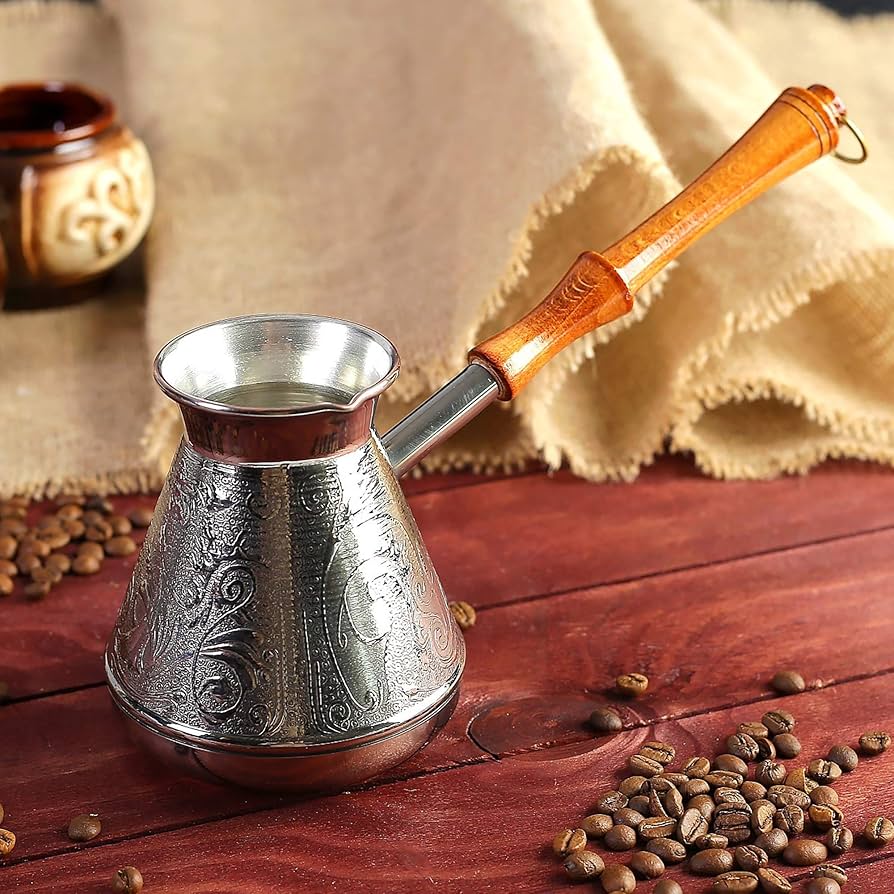
The cezve is a masterpiece of thermal engineering, designed as a “conical frustum” (a cone with the top sliced off). This shape is not decorative; it creates a natural thermal chimney that accelerates heat from base to neck. The wide bottom provides a large surface area for heat absorption from volcanic sand or embers.
High-density C11000 Electrolytic Tough Pitch Copper (ASTM B152) is the standard material for professional vessels. Copper has a thermal conductivity rate of approximately 400 W/m·K, which is nearly twenty times that of stainless steel. This allows the barista to manipulate the coffee’s temperature with millisecond precision, preventing over-extraction.
The inward-tapering neck acts as a physical pressure regulator for the rising gases and steam. As the coffee heats, CO2 bubbles are forced through a smaller aperture, increasing their density. This creates the thick, insulating layer of micro-foam known as kaimak (cream), which is essential for flavor preservation.
| Technical Specification | Attribute Detail | Performance Impact |
| Primary Material | C11000 Pure Hammered Copper | Provides instantaneous heat response. |
| Interior Lining | Food-grade Molten Tin (Hand-wiped) | Protects the brew from copper oxidation. |
| Vessel Wall Gauge | 1.5mm – 2.0mm | Minimizes hot spots and prevents scorching. |
| Volume Capacity | 80ml – 350ml | Optimized for single, double, or triple doses. |
| Neck-to-Base Ratio | Approximately 0.65 : 1 | Compresses foam for maximum density. |
| Handle Material | Cast Bronze or Sand-cast Brass | Acts as a heat sink to protect the hand. |
Metallurgy & Lining
The internal lining of a cezve is arguably its most critical technical component. While copper is the perfect conductor, it is reactive to the organic acids found in coffee. Untinned copper can leach metallic ions into the brew, creating a sour, “tinny” taste and potential toxicity.
Traditional coppersmiths use a “hand-wiped” tinning process, applying molten tin (Sn) to the pre-heated copper surface. Tin is non-reactive and provides a smooth, silver-like finish that prevents the coffee from sticking. In competition-grade pots, 99% pure silver is used as a lining because it is even more conductive than copper.
A hand-hammered finish is another essential metallurgical trait of a high-quality cezve. Hammering “work-hardens” the copper, making it significantly more durable and resistant to warping under high heat. Furthermore, the thousands of small dimples increase the exterior surface area, enhancing the pot’s ability to absorb heat from sand.
Migration & Adoption
As the Ottoman Empire expanded, the cezve became the primary coffee tool of Eastern Europe and North Africa. In Greece, it evolved into the briki, which often features a slightly wider mouth and a more pronounced pouring lip. In Bosnia, it became the džezva, where it is often paired with a specialized copper tray set (tabla).
The tool reached the Arab world, where it co-existed with the dallah, a larger, spouted pitcher. While the dallah was used for long-steep infusions, the rakweh (Levantine cezve) was reserved for the stronger, quicker Ottoman style. This migration established the cezve as the universal symbol of coffee across three continents.
Even in regions where espresso eventually dominated, the cezve remained a domestic staple. Its adoption into the UNESCO list of Intangible Cultural Heritage confirms its status as a foundational piece of human technology. Today, it is used by third-wave specialty roasters who appreciate its ability to showcase origin-specific flavor profiles.
Uses & Importance
The cezve is the only brewing device that is technically “limitless” because it does not use a filter. By leaving the coffee grounds in the liquid, the tool preserves every volatile oil and aromatic compound. This results in a body and mouthfeel that is physically impossible to achieve with paper or metal filters.
Its importance also stems from its role as a social and diplomatic “equalizer.” In traditional Middle Eastern and Balkan culture, serving coffee from a cezve is an act of profound hospitality. The quality of the foam produced by the pot is often used as a metric for the host’s skill and care.
Furthermore, the cezve is critical for the preparation of specialized spiced coffees common in the Levant. Cardamom, cinnamon, or mastic can be added directly into the pot, allowing their oils to emulsify with the coffee during the heating phase. This “integrated infusion” is a unique capability of the cezve’s open-chamber design.
Role & Why it Matters
In a world of automated machines, the cezve represents the survivor of manual, “slow” coffee culture. It matters because it requires the barista to remain in a constant state of observation. There is no “set and forget” with a cezve; the user must watch the foam rise to the millisecond.
The vessel also matters because it bridges the gap between ancient alchemy and modern science. Fluid dynamics experts are now studying the same principles of convection and surface tension that 16th-century smiths used. It is a rare example of a tool that was “perfected” five hundred years ago and has required no structural changes since.
The cezve is the primary tool for the “World Cezve/Ibrik Championship,” proving its relevance in competitive arenas. It allows for the expression of “terroir” in ways that other methods might strip away. By maintaining the full body of the coffee, it provides the most honest representation of the roasted bean.
Variations
The Greek briki is often made of brass and features a shorter, sturdier handle for high-volume café use. In the Levant, the rakweh frequently includes a lid or a significantly longer, curved handle for desert brewing over open pits. Armenian versions, known as srjep, are often elaborately decorated with religious and floral motifs.
Modern specialty variations have introduced the “double-spouted” rim to allow for more precise foam distribution. High-end makers like Soy Turkiye have introduced ergonomic bronze handles that remain cool to the touch even after multiple brews. Some contemporary pots are now made of heavy-duty ceramic or laboratory-grade glass to provide a purely visual experience.
There is also a significant variation in the “sand-bath” (kumda kahve) equipment used alongside the pot. Traditional sand-baths were copper boxes filled with volcanic sand, which holds heat longer than standard quartz sand. Modern electric sand heaters now allow baristas to control the depth of heat by varying how deeply the cezve is nested.
Notable Facts
UNESCO officially recognized Turkish Coffee Culture and Tradition, specifically highlighting the equipment, as Intangible Cultural Heritage in 2013. A genuine, hand-hammered cezve is so durable that it is often passed down as a family heirloom through multiple generations. The long handle is designed with a specific upward slant to ensure the center of gravity stays low while pouring.
Professional baristas use a “depth of nesting” technique where they move the pot up and down in the sand to control the rise. Historically, the best cezves were made from “spent” copper from old cannons, believed to be of higher purity. Because the coffee is never filtered, a single brew from a cezve can contain up to 500 individual flavor compounds.
One of the most famous historical figures associated with the tool was the 17th-century traveller Evliya Çelebi, who documented the cezve’s use across the empire. He noted that the best pots were found in the coppersmiths’ market of Damascus. Today, that same market—along with Gaziantep’s—continues to produce thousands of pots using identical 17th-century techniques.
People & Regions
The city of Gaziantep in Turkey is considered the global capital of traditional coppersmithing for coffee equipment. Generations of smiths here have preserved the nakış (hammering) technique that differentiates a specialty pot from a mass-produced one. Similarly, the Baščaršija district in Sarajevo is the heart of Balkan džezva craftsmanship.
In these regions, coppersmithing is more than a trade; it is a hereditary guild system known as lonca. The “Masters of the Hammer” ensure that every pot meets the required metallurgical thickness. This regional expertise is why professional baristas still source their pots from small workshops in Turkey and Bosnia rather than large factories.
Modern figures like Turgay Yıldızlı have brought the cezve into the global specialty spotlight. By winning world championships, these baristas have forced the industry to reconsider the cezve as a precision tool. This has led to a resurgence of interest in Istanbul and Athens, where young baristas are reclaiming their historical equipment.
Related Equipment
The tava is a shallow, long-handled pan used to roast small amounts of green beans immediately before brewing. Because the cezve requires an ultra-fine grind, beans must be fresh and brittle to be pulverized correctly. The tava ensures the oils are active and ready for extraction in the pot.
The havan (mortar) or kahve değirmeni (manual mill) is the necessary companion for any cezve user. These tools are built to achieve a “flour-like” consistency that modern electric grinders often struggle to reach. Historical brass mills are still prized for their ability to generate the high torque needed for this specific grind.
Finally, the fincan is the small, handleless porcelain cup used for serving the final product. A high-quality fincan has thin walls to allow the coffee to cool slightly while the foam remains trapped on top. The relationship between the cezve’s pouring lip and the fincan’s rim is a critical part of the final sensory presentation.
Adoption & Importance
The global specialty coffee movement has adopted the cezve as a way to explore historical brewing styles. It allows roasters to present their beans in a high-density, high-impact format that stands apart from pour-over or espresso. This “new” adoption is actually a return to the foundations of coffee preparation.
The importance of the cezve today is its role in “de-automating” the coffee experience. It forces a connection between the heat source, the water, and the barista that machines cannot replicate. By preserving the human element of “watching the rise,” the cezve ensures that coffee remains an art form rather than just a commodity.
Ultimately, the cezve matters because it is the most efficient way to extract the true soul of a coffee bean. It requires no electricity, no paper, and no complicated parts—just metal and fire. As long as people value the ritual of hospitality, the cezve will remain the most significant piece of equipment in the coffee world.