
Immersion cold brew is a variation of cold brew in which coarsely ground coffee is fully submerged in cold or room-temperature water for an extended period, typically between 12 and 24 hours, before being filtered and served.
Definition
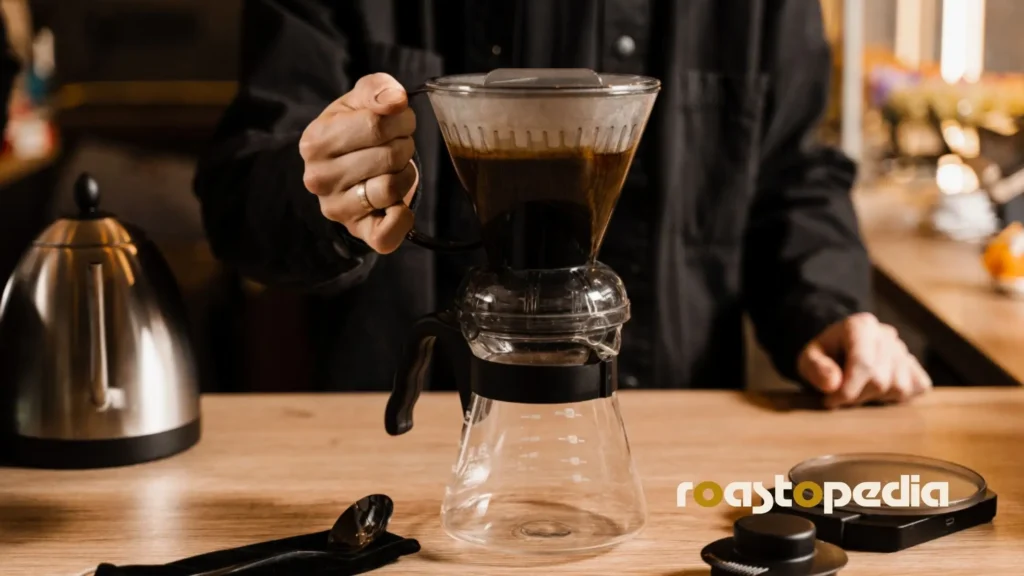
Immersion cold brew is defined by full-contact extraction: ground coffee remains completely submerged in water for the entire duration of the brew cycle. The water stays static around the grounds throughout the process. This distinguishes immersion cold brew from cold drip, where water passes through the grounds gradually by gravity.
Etymology
The word “immersion” derives from the Latin immersio, meaning the act of plunging or dipping into a liquid. In coffee, it describes the complete submersion of grounds in water throughout the entire brewing cycle. The term gained industry-wide standardization following the commercial success of the Toddy Cold Brew System, patented in 1964.
History & Origins
The immersion method is the oldest form of cold brew extraction. Dutch traders introduced cold-steeping to Japan in the early 1600s, adapting cold tea-steeping techniques already practiced by the Japanese. The Dutch method was essentially an immersion steep — coffee grounds left in full contact with cold water over time — developed primarily for practical use aboard trading ships where open flame was a fire hazard.
The method traveled from Japan through maritime trade routes, appearing in Cuba by the 1930s and in Peru by the mid-20th century.
In 1964, Todd Simpson, a chemical engineering graduate of Cornell University, encountered cold-extracted coffee in Peru and returned to the United States to develop and patent the Toddy Cold Brew System — the first commercially standardized immersion cold brew device, and the product that brought the method into mainstream use.
Description
Immersion cold brew produces a beverage that is chemically distinct from both hot-brewed coffee and cold drip. Cold water in full contact with the grounds over an extended period extracts a different compound profile, yielding lower titratable acidity, reduced bitterness, and a heavier, silkier mouthfeel.
The color ranges from deep amber to near-black depending on brew ratio and steep time. Aroma is more muted than that of hot coffee due to reduced evaporation of volatile organic compounds at low temperatures.
“Cold Brew” is an umbrella term for any coffee extracted with cold or room-temperature water. Within this category, there are two primary methods: Percolation (Slow-Drip) and Immersion. In most commercial contexts, when people say “Cold Brew,” they are referring to the Immersion method because it is the industry standard.
The table below provides a thorough comparison between the general category (as it is commonly understood) and the specific immersion process.
| Feature | Cold Brew (Common Category Term) | Immersion Cold Brew (Specific Method) |
| Taxonomy | A broad beverage category including all cold-water extraction techniques. | A specific technical methodology within the cold brew category. |
| Extraction Mechanism | Can be Percolation (water passing through) or Immersion (water soaking grounds). | Strictly Static Infusion; the grounds and water remain in a single vessel together. |
| Saturation State | Varies; in percolation, fresh water constantly enters. In immersion, water stays the same. | Full Saturation: Every coffee particle is completely submerged in the total water volume. |
| Diffusion Process | In percolation, it is driven by a constant concentration gradient. | In immersion, it is driven by Equilibrium; extraction slows as the water fills with solutes. |
| Solubility Profile | Can range from tea-like (Slow-Drip) to heavy (Immersion). | Focuses on high-molecular-weight compounds, producing lower acidity and higher sweetness. |
| Filtration Necessity | Always required, but the medium (paper, metal, felt) depends on the sub-method. | Mandatory & Intensive: Requires separating a large volume of sludge from the liquid concentrate. |
| Primary Industry Use | Used as a marketing term for ready-to-drink (RTD) cans and bottles. | Used as the operational standard for coffee shops (e.g., Toddy or Filtron systems). |
| Factual Accuracy | Often used loosely to describe any cold coffee that isn’t iced hot coffee. | A precise technical term for coffee made by steeping grounds in a vat of water. |
Preparation & Process
Coarsely ground coffee — comparable to a French press grind — is combined with cold or room-temperature filtered water at a ratio typically between 1:8 and 1:15 by weight. A 1:8 to 1:10 ratio produces a concentrate for dilution; a 1:15 ratio yields a ready-to-drink brew.
The mixture is stirred to ensure full saturation of the grounds, then sealed and steeped for 12 to 24 hours either in a refrigerator at 4°C or at room temperature. After steeping, the brew is filtered through paper, metal mesh, or felt to remove all grounds. The resulting liquid is stored refrigerated in a sealed container for up to two weeks.
Key Characteristics
Immersion cold brew exhibits significantly lower titratable acidity than hot-brewed coffee. The Toddy system reports 67% less acid than conventional hot-brew methods.
Research published in Scientific Reports confirms that caffeine concentrations in cold brew coarse grind samples are substantially higher than those in hot-brew counterparts, though overall caffeine content varies based on brew ratio.
The industry standard brew ratio ranges from 80 to 100 grams of coffee per litre of water. Brewing at 4°C produces a cleaner, lighter cup, while brewing at room temperature yields higher acidity, deeper color, and greater bioactive content. Peak flavor quality is best within the first seven days of refrigerated storage, with a maximum shelf life of two weeks in a sealed container.
Common Misconceptions
Immersion cold brew and iced coffee are frequently treated as interchangeable, but they are chemically distinct beverages. Iced coffee is brewed hot and then cooled; immersion cold brew is never exposed to heat during extraction, producing a beverage with lower acidity and a fundamentally different flavor profile.
A common assumption holds that longer steeping always improves the brew. Extraction of key compounds reaches near-equilibrium within the first few hours for certain acids, and steeping beyond 24 hours does not improve flavor. It may instead introduce harsh, over-extracted notes.
It is also widely assumed that cold brew must be served cold. The Toddy system was originally developed to produce a low-acid concentrate intended for hot consumption. Immersion cold brew concentrate diluted with hot water fully retains the smooth, low-acid character of the cold extraction process.
Related Terms
Cold Brew, Cold Drip (Kyoto-style Cold Brew), Toddy System, Brew Ratio, Extraction Yield, Coffee Concentrate.