
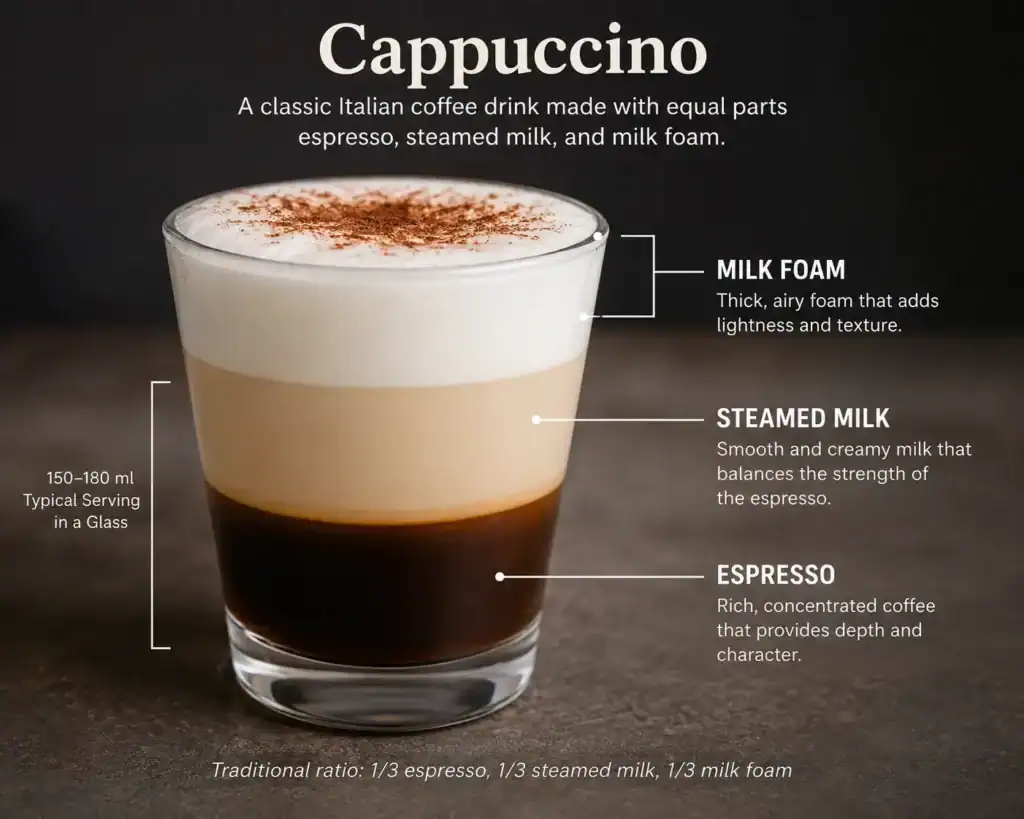
A cappuccino is a coffee beverage prepared with espresso and milk, traditionally consisting of approximately equal parts espresso, steamed milk, and milk foam.
Originating in Italy, it is among the most widely recognized espresso-based drinks in the world and has become a central feature of modern café culture.
The beverage is characterized by its balanced combination of coffee intensity, milk sweetness, and velvety texture, resulting in a drink that emphasizes both the flavor of espresso and the sensory qualities of aerated milk.
Although cappuccino is now consumed globally and produced in numerous variations, its traditional form remains closely associated with Italian coffee culture. The drink occupies an important place in the history of espresso beverages and has influenced the development of numerous modern coffee preparations, including the latte, flat white, and flavored milk-based espresso drinks.
Etymology
The name cappuccino is derived from the Italian word cappuccio, meaning “hood,” and is linked to the Capuchin friars, a branch of the Franciscan religious order established in the 16th century. The friars were known for wearing distinctive brown robes with pointed hoods.
The connection between the beverage and the religious order is generally attributed to color. Early coffee-and-milk drinks exhibited a reddish-brown hue resembling the color of the Capuchin habit.
The term was originally applied to beverages whose appearance evoked the robes of the friars before becoming associated specifically with the modern espresso-based drink.
The word entered broader European usage through Austrian and Italian coffee traditions and eventually became standardized internationally as the name of the beverage known today.
Historical Development
The origin of cappuccino can be traced to earlier coffee-and-milk preparations consumed in Central Europe and Italy. During the eighteenth and nineteenth centuries, coffee houses throughout the Austro-Hungarian Empire served beverages combining coffee with cream, milk, or whipped cream.
One notable precursor was the Kapuziner, a Viennese coffee drink consisting of coffee mixed with cream and sugar until it achieved a color resembling the robes of Capuchin monks.
The development of the modern cappuccino became possible with the invention and refinement of espresso machines in Italy during the late nineteenth and early twentieth centuries. Early espresso technology produced concentrated coffee, but the texture and consistency of milk foam remained limited.
Following the Second World War, advances in espresso machine design allowed baristas to generate greater pressure and more stable steam production. These technological improvements made it possible to create the finely textured milk foam that became a defining characteristic of cappuccino.
By the 1950s and 1960s, the beverage had become firmly established in Italian cafés.
The international spread of cappuccino accelerated during the late twentieth century. The growth of specialty coffee culture, multinational coffee chains, and independent espresso bars introduced the beverage to consumers across Europe, North America, Asia, Oceania, Africa, and Latin America (see the Coffee Belt).
Today, cappuccino is regarded as one of the foundational espresso beverages and remains a benchmark for evaluating barista skill.
Composition and Preparation
Traditional cappuccino consists of three primary components: espresso, steamed milk, and milk foam. A standard preparation begins with one or two shots of espresso extracted (see extraction) into a cup. Steamed milk is then poured over the espresso, followed by a layer of aerated milk foam.
The classical Italian interpretation emphasizes balance rather than volume. In many traditional cafés, the beverage is served in a cup ranging from approximately 150 to 180 milliliters. The resulting drink presents a harmonious relationship between coffee strength and milk sweetness.
Milk texture plays a critical role in cappuccino preparation. Proper steaming introduces microscopic air bubbles into the milk, creating what is commonly referred to as microfoam. This texture contributes to the beverage’s creamy mouthfeel and supports decorative pouring techniques known as latte art.
Although whole milk is traditionally preferred due to its balance of fat and protein, alternative milk products such as oat, soy, almond, and coconut milk are increasingly used in contemporary cafés.
Characteristics and Sensory Profile
Cappuccino is distinguished by its layered structure and balanced sensory attributes. The espresso provides bitterness, acidity, aroma, and body, while the milk contributes sweetness and creaminess (see crema). The foam enhances texture and influences the perception of flavor by moderating the intensity of the espresso.
A well-prepared cappuccino typically exhibits aromas of roasted coffee, chocolate, caramel, nuts, and toasted grains, depending on the coffee’s origin and roast profile. The flavor may range from bright and fruity to rich and chocolate-like.
The beverage is generally lighter in texture than many cream-based coffee drinks yet denser and more structured than a latte. Its foam layer also serves as an insulating barrier, helping to retain heat while providing a distinctive drinking experience.
Traditional Consumption
In Italy, cappuccino has historically been associated with breakfast and morning consumption. It is commonly enjoyed alongside pastries such as cornetti and is traditionally consumed before late morning.
Ordering a cappuccino after a substantial meal is often considered unconventional within traditional Italian coffee culture, where espresso is generally preferred later in the day.
Outside Italy, consumption patterns differ considerably. Cappuccino is frequently consumed throughout the day and may accompany meals, desserts, or social gatherings. These variations reflect the adaptation of Italian coffee traditions to local customs and preferences.
Cultural Significance
Cappuccino occupies a prominent position in global coffee culture. It is often regarded as an introductory espresso beverage because the milk softens the intensity of the coffee while preserving much of its character. For many consumers, it serves as a gateway to specialty coffee appreciation.
The beverage has become an enduring symbol of café life and urban social interaction. Its presence in literature, cinema, advertising, and popular culture reflects broader associations with leisure, sophistication, and contemporary coffeehouse culture.
Within the specialty coffee movement, cappuccino has acquired additional significance as a standard for evaluating espresso quality and milk-steaming technique. Barista competitions frequently include cappuccino preparation as a core component of judging criteria.
The drink has also contributed to the global dissemination of Italian culinary traditions. Alongside espresso, latte, and macchiato, cappuccino is among the most internationally recognized Italian food and beverage terms.
Cappuccino and Latte Art
The rise of specialty coffee culture during the late twentieth and early twenty-first centuries transformed cappuccino into a prominent medium for latte art. By carefully pouring steamed milk into espresso, baristas create designs such as hearts, rosettas, tulips, and swans.
Although decorative patterns do not directly affect flavor, they demonstrate technical precision in espresso extraction and milk texturing. Latte art has become a significant aspect of contemporary café culture and is frequently associated with high-quality cappuccino preparation.
Regional and International Variations
As cappuccino spread worldwide, numerous regional adaptations emerged.
In some European countries, larger servings containing additional milk became common.
North American interpretations often feature larger cup sizes than traditional Italian versions. Flavored syrups such as vanilla, caramel, hazelnut, or chocolate are frequently added.
The iced cappuccino developed as a cold alternative suited to warmer climates. In some regions, the term refers to blended coffee beverages, while in others it denotes chilled espresso combined with milk foam.
Dry cappuccino contains less steamed milk and a thicker foam layer, producing a stronger coffee flavor. Wet cappuccino contains more steamed milk and less foam, creating a creamier texture closer to that of a latte.
In parts of Europe and North America, powdered chocolate or cocoa may be sprinkled over the foam. Some cafés additionally use cinnamon, nutmeg, or other spices as garnish.
Relationship to Other Coffee Drinks
Cappuccino belongs to a broader family of espresso-and-milk beverages. It is closely related to the latte, flat white, cortado, macchiato, and piccolo latte. The principal distinctions involve the ratio of espresso to milk, serving volume, and milk texture.
Compared with a latte, a cappuccino generally contains a higher proportion of foam and a smaller total volume. Compared with a flat white, it possesses a more pronounced foam layer. Compared with a cortado, it contains significantly more aerated milk.
These distinctions, while sometimes blurred by regional practices, remain important within specialty coffee terminology.
Modern Role in Specialty Coffee
In the contemporary coffee industry, cappuccino remains one of the most influential espresso beverages. It is commonly featured in cafés ranging from traditional Italian establishments to third-wave specialty coffee shops.
Coffee professionals frequently use cappuccino as a measure of consistency because successful preparation requires competence in espresso extraction, milk chemistry, steaming technique, and beverage presentation.
The drink continues to evolve alongside advances in coffee roasting, brewing technology, and dairy alternatives. Despite these innovations, its essential identity—a balanced combination of espresso, steamed milk, and foam—has remained largely unchanged.
Legacy
Cappuccino is among the most significant coffee beverages in modern history. Emerging from European coffee traditions and shaped by advances in espresso technology, it has become a global cultural icon.
Its enduring popularity reflects its ability to combine the intensity of espresso with the sweetness and texture of milk in a form that appeals to a wide range of coffee drinkers.
More than a simple coffee preparation, cappuccino represents the intersection of culinary tradition, technological innovation, café culture, and the continuing global evolution of coffee consumption.
See Also
- Espresso
- Caffè Latte
- Flat White
- Cortado
- Macchiato
- Piccolo Latte
- Mocha
- Vienna Coffee
- Café au Lait
- Breve
- Gibraltar
- Freddo Cappuccino
- Espresso Con Panna
- Long Black
- Americano
- Ristretto
- Lungo
- Marocchino
- Café Cubano
- Red Eye Coffee
References
- Ukers, William H. All About Coffee. Tea and Coffee Trade Journal Company, 1922.
- Pendergrast, Mark. Uncommon Grounds: The History of Coffee and How It Transformed Our World. Basic Books, 2019.
- Morris, Jonathan. Coffee: A Global History. Reaktion Books, 2018.
- Illy, Andrea and Riccardo Illy. Espresso Coffee: The Science of Quality. Academic Press, 2015.
- Davids, Kenneth. Espresso: Ultimate Coffee. St. Martin’s Press, 2012.
- Schomer, David. Espresso Coffee: Professional Techniques. Espresso Vivace Publications, 2014.
- Hoffmann, James. The World Atlas of Coffee. Mitchell Beazley, 2023.
- Weinberg, Bennett Alan and Bonnie Bealer. The World of Caffeine. Routledge, 2001.
- Standage, Tom. A History of the World in Six Glasses. Walker Publishing, 2005.
- Thurston, Robert W. Coffee: From Bean to Barista. Rowman & Littlefield, 2013.
- Wild, Antony. Coffee: A Dark History. W. W. Norton & Company, 2005.
- Tucker, Catherine. Coffee Culture: Local Experiences, Global Connections. Routledge, 2017.
- Smith, Andrew F. The Oxford Encyclopedia of Food and Drink in America. Oxford University Press, 2013.
- Han, Byung-Duk. The Economics of Coffee. Routledge, 2020.
- International Coffee Organization. Coffee Development Reports. Various editions.
- Specialty Coffee Association. Coffee Standards and Protocols. Various editions.
- Ellis, Aytoun. The Penny Universities: A History of the Coffee-Houses. Secker & Warburg, 1956.
- Topik, Steven and Allen Wells. Global Coffee Economy in Africa, Asia, and Latin America. Cambridge University Press, 2010.