
Latte art is the practice of creating visual patterns on the surface of an espresso-based coffee beverage by pouring steamed milk into a shot of espresso, or by manipulating the surface foam with a tool after pouring. The technique relies on the interaction between crema — the reddish-brown foam layer produced during extraction — and finely textured milk foam known as microfoam.
Latte art is most commonly associated with the caffè latte, from which it derives its name, but it is also applied to cappuccinos, flat whites, and other milk-based espresso drinks. The discipline combines elements of espresso preparation, milk texturing, and controlled pouring or etching, and is widely regarded within specialty coffee culture as an indicator of a barista‘s technical skill.
Etymology
The term “latte art” is a compound of two words: “latte,” derived from the Italian caffè latte, meaning “milk coffee,” and “art,” referring to the decorative visual patterns produced during the pour. The phrase entered common usage in English-language coffee terminology during the late twentieth century, as the practice spread from independent espresso bars into broader café culture.
While the Italian language contributed the base terminology for the beverage, the specific compound term “latte art” is understood to be an English-language construction, reflecting the technique’s development and popularization primarily outside Italy.
History
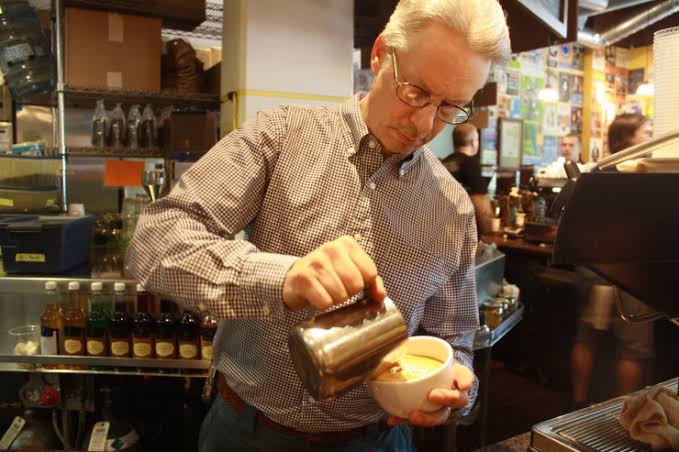
Decorative pouring on espresso-based drinks developed independently in multiple regions following the spread of espresso machines and the refinement of milk-steaming technology. Early forms of surface decoration are documented in Italy, where crema-topped espresso drinks provided a canvas for simple designs, though the practice was not systematized or widely named at the time.
The modern discipline of latte art, characterized by consistent free-pour patterns such as the heart and rosetta, is most closely associated with developments in the United States during the 1980s.
In Seattle, Washington, barista cum roaster David Schomer, founder of Espresso Vivace, is widely credited with popularizing and refining latte art techniques. Schomer attributed early development of “velvet foam,” a precursor term for microfoam, to fellow Seattle barista Jack Kelly of Uptown Espresso in 1986. By the late 1980s, the heart pattern had become an established signature at Espresso Vivace, and Schomer’s subsequent publications and training materials helped standardize free-pour technique for a wider audience of baristas.
The growth of specialty coffee culture during the late twentieth and early twenty-first centuries accelerated the spread of latte art beyond Seattle and the Pacific Northwest. Independent cafés, competitive barista events, and international training programs contributed to the rapid diversification of patterns and pouring techniques. The formal recognition of latte art as a competitive discipline, through events such as the World Latte Art Championship, further formalized technique standards and expanded the vocabulary of recognized designs.
Principles of Latte Art
Latte art depends on the physical properties of two liquids: espresso topped with crema, and milk aerated into microfoam. The formation of a pattern requires a density and viscosity contrast between the two liquids sufficient to allow the milk to displace or float upon the crema in a controlled manner.
Design formation is governed by the angle of the pouring vessel, the height of the pour above the cup surface, the rate of milk flow, and the point at which the pouring stream contacts the drink’s surface. A stable base layer is typically established before a finishing pour introduces the visible design near the end of preparation.
Essential Components

Espresso
Espresso forms the foundational layer of any latte art drink and supplies the crema layer necessary for pattern contrast. A well-extracted shot, produced through consistent dosing and appropriate grind size, yields a stable, moderately thick crema that resists premature dissipation. Extraction faults such as channeling or over-extraction can produce thin, uneven, or bitter crema that undermines both the visual and flavor qualities of the finished beverage.
Milk
Milk contributes both the physical medium for the design and the sweetness that balances espresso’s bitterness. Whole milk is traditionally preferred for latte art due to its fat and protein content, which supports the formation of stable, fine-bubbled foam. Alternative milks, including oat, soy, almond, and coconut varieties, are increasingly used in specialty coffee settings, though their differing protein and fat structures require adjusted steaming approaches to achieve comparable microfoam texture.
Microfoam
Microfoam is milk that has been aerated to produce microscopic, evenly distributed air bubbles rather than large, visible bubbles. This texture gives steamed milk a glossy, paint-like consistency that can be poured with precision and holds its shape on the drink’s surface. Microfoam quality is widely regarded as the single most important variable in latte art execution, since even a well-controlled pour cannot compensate for improperly textured milk.
Equipment Used
Latte art requires several pieces of standard espresso equipment. An espresso machine equipped with a group head and steam wand is necessary for producing both the espresso shot and the steamed milk. A stainless-steel milk pitcher, typically featuring a narrow spout for directional pouring control, is used to steam and pour the milk.
Cups with rounded, sloped walls are generally preferred over straight-sided vessels, as the curvature assists in shaping symmetrical designs. For etching and designer techniques, additional tools such as thin picks, skewers, or specialized etching pens are used to manipulate the foam surface after pouring, sometimes in combination with food-safe coloring agents such as chocolate syrup or cocoa powder.
Milk Steaming and Texturing
Milk steaming begins with cold milk, which provides a longer working window before the milk reaches its optimal serving temperature. The steam wand tip is submerged just below the milk’s surface to introduce air during an initial “stretching” phase, expanding the milk’s volume and creating microfoam.
The wand is then positioned deeper into the pitcher to create a rotating vortex, which distributes the incorporated air evenly and breaks down larger bubbles into a fine, uniform texture.
Steaming is typically stopped once the milk reaches a temperature range associated with optimal sweetness and mouthfeel, generally cited as being between approximately 55 and 65 degrees Celsius (roughly 130 to 150 degrees Fahrenheit), after which the pitcher is tapped and swirled to further refine texture and eliminate residual large bubbles before pouring.
Pouring Techniques
Pouring technique governs how the textured milk interacts with the espresso to form a visible pattern. A pour generally begins from a moderate height with a thin, controlled stream directed into the center of the cup, which allows the milk to sink beneath the crema and build volume without immediately surfacing.
As the cup fills, the pitcher is lowered closer to the drink’s surface, and the increased proximity, combined with adjustments in flow rate and pitcher movement, causes the milk to float on top of the crema and form the visible design. Variables such as pouring speed, wrist rotation, and lateral or oscillating pitcher movement determine the specific shape and complexity of the resulting pattern.
Major Styles of Latte Art
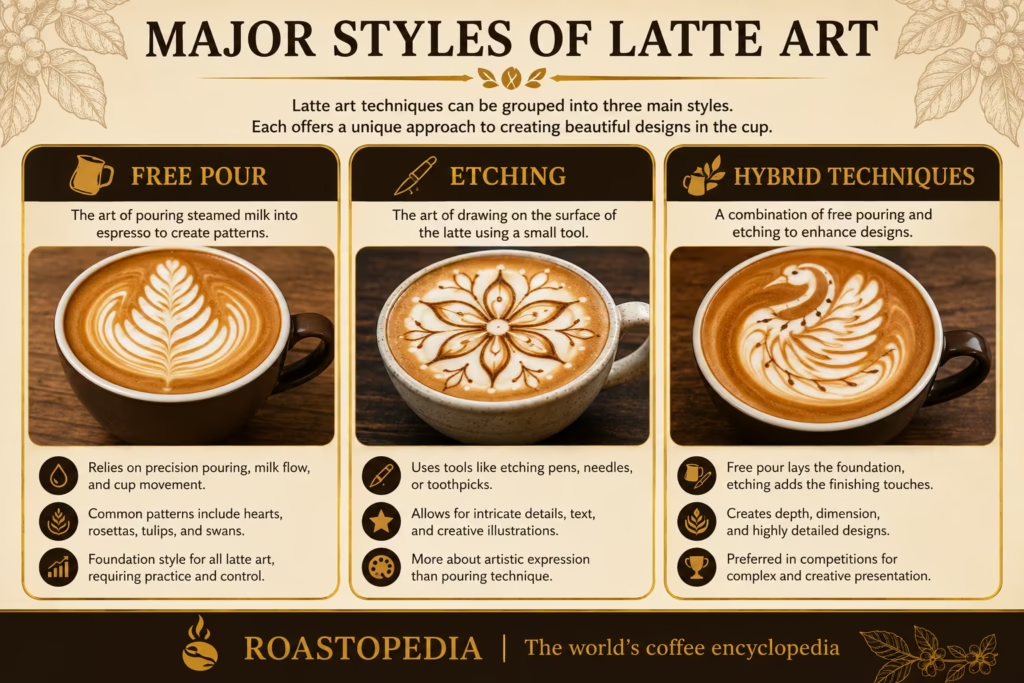
Free Pour
Free pour is the technique of forming a design solely through the controlled pouring of milk into espresso, without the use of additional tools. Patterns are shaped entirely by the pitcher’s angle, height, flow rate, and movement. Free pour is considered the foundational latte art technique and is the primary method evaluated in most competitive settings.
Etching
Etching involves manipulating the surface foam after the milk has been poured, typically using a thin tool such as a pick or skewer to drag foam and crema into decorative shapes. Etched designs often incorporate additional elements, including drizzled syrup or powdered toppings, and allow for more intricate or figurative imagery than free pour alone typically permits.
Hybrid Techniques
Hybrid techniques combine free pour with etching or other decorative elements, using a poured base pattern as the foundation for further surface detailing. This approach is common in competitive and designer latte art, where a free-poured rosetta or tulip base may be refined or embellished with etched lines, additional colors, or layered pours.
Common Latte Art Patterns
Heart

The heart is widely regarded as the simplest and most fundamental latte art pattern. It is formed by pouring milk into the center of the cup to create a circular white dot, then moving the pitcher directly through the dot toward the front of the cup while raising it, which draws the shape into a heart form.
Rosetta

The rosetta, sometimes referred to as a “fern” or “leaf” pattern, is produced through a side-to-side wiggling motion of the pitcher combined with a steady backward movement across the cup. The technique creates a series of layered, leaf-like folds that are pulled into a defined point at the finish of the pour.
Rosetta Variations
Numerous variations of the base rosetta technique exist, including multi-layered rosettas, symmetrical double rosettas poured from both sides of a cup, and combined rosetta-tulip hybrids. These variations are frequently used in competitive latte art to demonstrate advanced pitcher control and pattern complexity.
Tulip

The tulip pattern is created by pouring a sequence of separate dots, or “stacks,” of milk directly on top of one another rather than in a continuous stream, with each successive pour pushing the previous layers forward and slightly outward to form a stacked, petal-like design.
Swan

The swan is a more advanced free-pour design that extends the rosetta technique, typically finishing with an etched or shaped neck and head added after the base pattern is poured, giving the overall design the appearance of a swan’s body and neck.
Ripple

The ripple pattern, sometimes described as a “wave” design, is produced through rapid, controlled side-to-side pitcher movements during the finishing pour, creating a series of undulating lines across the surface of the drink.
Factors Affecting Latte Art Quality
Several variables influence the clarity and consistency of latte art. Milk freshness and fat content affect foam stability, while steaming technique determines microfoam texture and bubble uniformity. Espresso quality, including crema thickness and stability, directly affects the contrast necessary for a visible pattern.
Cup shape [1], pouring angle [2], pour height [3], and the barista’s control over flow rate [4] and timing [5] further determine the final result. Environmental factors, such as ambient temperature and the freshness of the espresso shot at the time of pouring, can also influence outcomes.
Common Mistakes and How to Avoid Them
Frequently observed errors include over-steaming milk [1], which produces large, unstable bubbles rather than fine microfoam, and under-steaming [2], which fails to generate sufficient foam volume for a defined pattern. Pouring too quickly [3] can wash out the crema entirely, producing a uniformly pale drink with no visible contrast, while pouring too slowly [4] can result in a thin, sputtering stream that introduces unwanted bubbles.
Inconsistent pitcher angle [5] or height [6] during the finishing pour is commonly cited as a cause of asymmetrical or poorly defined designs. These issues are generally addressed through repeated practice, attention to milk temperature and texture before pouring, and deliberate control of pouring speed and pitcher position.
Latte Art Competitions
Latte art is recognized as a formal competitive discipline within the specialty coffee industry. The World Latte Art Championship (WLAC), organized by World Coffee Championships under the Specialty Coffee Association, is the primary international competition in the field. National champions compete by pouring and etching designs on espresso-based drinks for panels of certified judges, who evaluate visual attributes, pattern replication, contrast, and technical execution.
The WLAC recognizes distinct categories, including free-pour designs shaped solely through pitcher control and designer patterns that permit etching tools and coloring agents. Similar national and regional competitions operate in numerous countries, often serving as qualifying events for the world championship.
Latte Art in Specialty Coffee Culture
Within specialty coffee culture, latte art functions as both a visual signifier of quality and a practical training benchmark. Because a clean, well-defined pattern requires properly extracted espresso and correctly textured milk, cafés and training programs frequently use latte art as an informal quality-control measure for evaluating barista proficiency.
The discipline has also contributed to the broader visual identity of specialty coffee, appearing prominently in café marketing, social media, and customer-facing presentation, alongside its role in professional barista training and competition.
Learning and Skill Development
Latte art skill development typically progresses through a structured sequence, beginning with milk-steaming fundamentals before advancing to basic free-pour patterns such as the heart. Consistent practice with the same milk volume, cup size, and pouring rhythm is commonly recommended to build muscle memory before attempting more complex designs such as the rosetta or tulip.
Many specialty coffee training programs, barista certification courses, and independent cafés offer structured latte art instruction, and the widespread availability of video tutorials has further supported self-directed learning outside formal training environments.
Myths and Misconceptions
Several misconceptions surround latte art. One common belief holds that latte art patterns indicate a superior-tasting beverage; while a defined pattern does suggest properly extracted espresso and correctly textured milk, the presence of a pattern does not, by itself, guarantee superior flavor.
Another misconception is that latte art requires expensive or specialized equipment; while precision pitchers and etching tools can aid technique, basic free-pour patterns can be produced with standard espresso equipment and practice.
A further misunderstanding is that latte art is a purely decorative skill unrelated to overall barista competence; in practice, the ability to consistently reproduce a pattern reflects control over multiple interconnected variables, including extraction, milk texturing, and timing, making it a recognized indicator of technical proficiency within the specialty coffee industry.
See Also
- Cappuccino
- Barista
- Flat White
- Dosing
- Portafilter Basket
- 30-Second Espresso Rule
- Moka Pot
- Agitation
- 2026 World Latte Art Championship
- History of the World Latte Art Championship
References
- Wikipedia. “Latte Art.” https://en.wikipedia.org/wiki/Latte_art
- Wikipedia. “Microfoam.” https://en.wikipedia.org/wiki/Microfoam
- Wikipedia. “Espresso Vivace.” https://en.wikipedia.org/wiki/Espresso_Vivace
- Perfect Daily Grind. “Microfoam: How Much Should Each Milk-Based Coffee Drink Have?” https://perfectdailygrind.com/2024/01/microfoam-milk-coffee-latte-art/
- Espresso Academy. “Latte Art for Beginners: History, Techniques and a Complete Guide to the Basic Patterns.” https://espressoacademy.it/en/corsi-en/latte-art-for-beginners-history-techniques-and-a-complete-guide-to-the-basic-patterns/
- Crema Coffee Roasters. “A Guide to Pouring Latte Art.” https://crema-coffee.com/pages/latte-art-guide
- Starbucks at Home. “How to Make Latte Art at Home.” https://athome.starbucks.com/how-to-guide/how-make-latte-art-home