
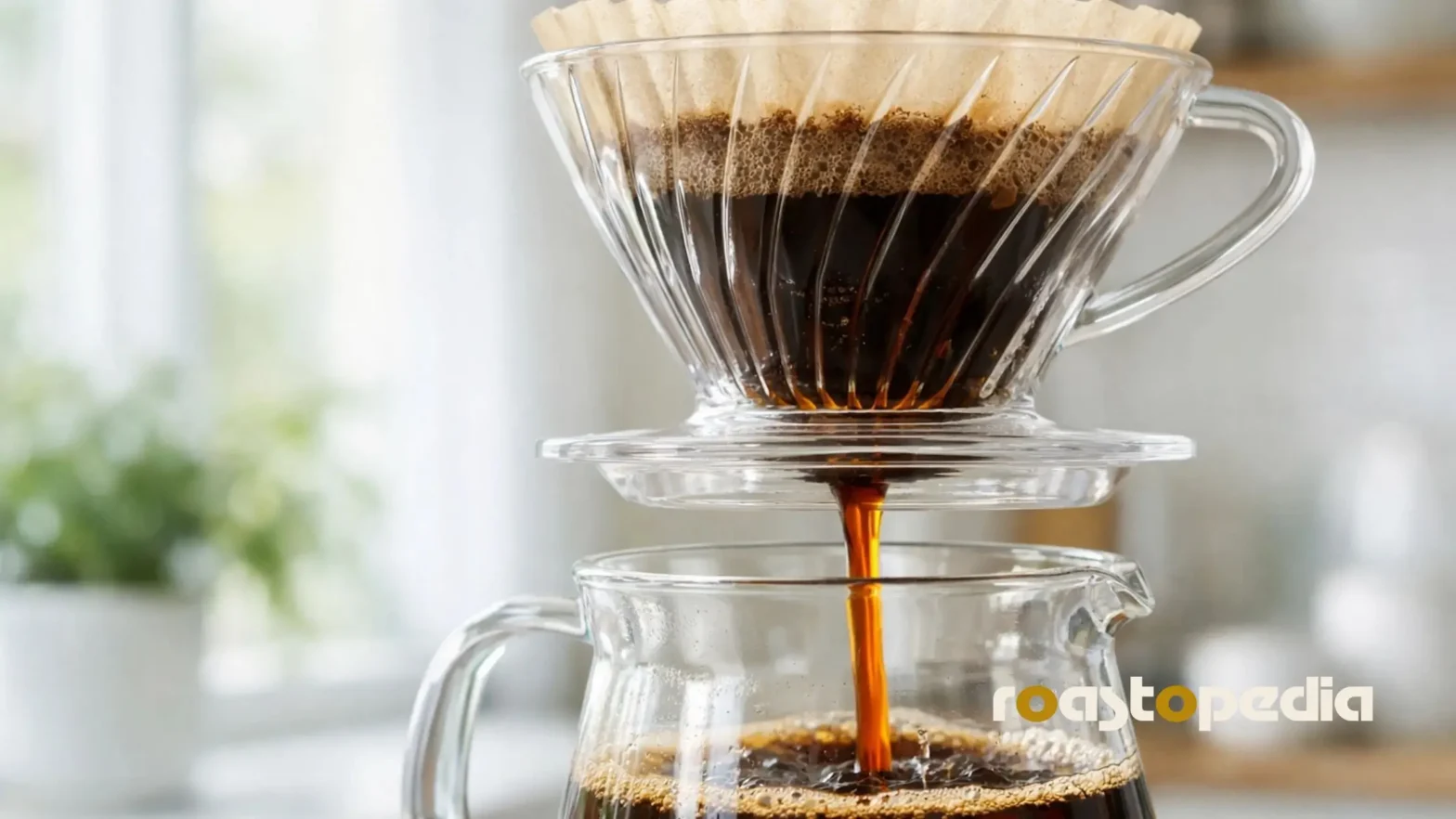
Most V60 brews finish their drawdown within 30 to 90 seconds after the final pour, with approximately 45 to 75 seconds often considered a normal range for many recipes.
However, there is no single ideal drawdown time because the rate at which coffee drains depends on factors such as grind size, coffee dose, filter type, pouring technique, and the characteristics of the coffee itself.
Rather than chasing a specific number, brewers generally use drawdown time as an indicator of whether water is flowing through the coffee bed as intended. An unusually fast drawdown may suggest insufficient resistance, while an excessively slow drawdown can indicate restricted flow caused by fine particles, grinder inconsistency, or excessive agitation.
Understanding V60 Drawdown Time
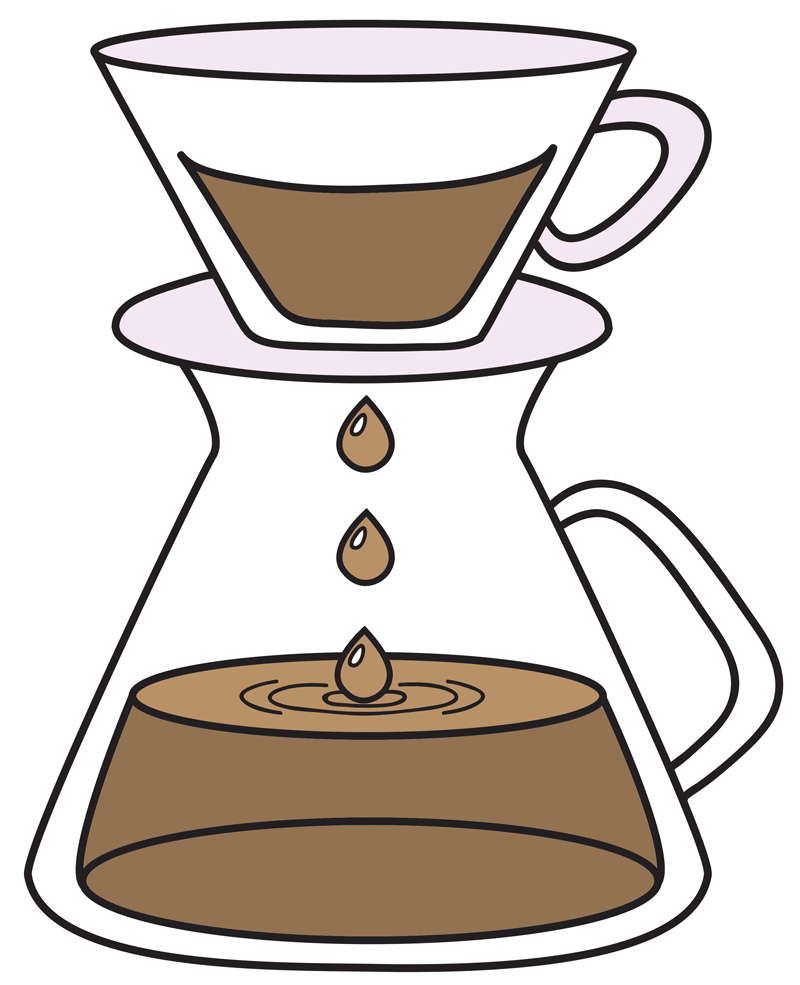
In V60 brewing, drawdown time refers to the period between the completion of the final pour and the moment the brewer effectively stops dripping.
For example, consider a brew in which:
- Bloom ends at 0:45
- Final pour ends at 2:15
- Dripping stops at 3:00
In this case:
- Active pouring phase: 2:15
- Drawdown time: 45 seconds
- Total brew time: 3:00
Many coffee drinkers mistakenly use drawdown time and contact time (brew time) interchangeably. In reality, drawdown time is only one component of the overall brewing process.
What is a Normal V60 Drawdown Time?
The following ranges are commonly observed in V60 brewing:
| Drawdown Time | Interpretation |
| Under 30 seconds | Often considered unusually fast |
| 30–60 seconds | Common range for many recipes |
| 60–90 seconds | Normal for finer grinds or larger brews |
| Over 90 seconds | Often indicates restricted flow |
| Over 2 minutes | Usually suggests excessive resistance within the coffee bed |
These ranges should be viewed as guidelines rather than strict standards. A coffee that tastes excellent may fall outside these numbers.
Why Drawdown Time Varies
No two V60 brews are exactly alike. Several variables influence how quickly water exits the brewer.
Grind Size
Grind size is typically the most important factor affecting drawdown.
A finer grind creates smaller gaps between particles, increasing resistance to water flow and extending drawdown time. A coarser grind allows water to move more freely and generally shortens drawdown.
Coffee Bed Fines
Coffee grinders produce a mixture of particle sizes.
The smallest particles, known as fines, can migrate toward the filter and partially block water pathways. As fines accumulate, drawdown often slows significantly.
This explains why two coffees ground to the same apparent size may exhibit very different drainage behavior.
Filter Paper
Different V60 filter papers can produce different flow rates.
Variations in paper thickness, manufacturing process, and permeability may alter how quickly liquid passes through the brewer.
Pouring Technique
Aggressive pouring introduces turbulence into the slurry.
Excessive agitation can redistribute fines throughout the coffee bed, sometimes increasing resistance and prolonging drawdown. Gentler pouring often produces more predictable flow characteristics.
Coffee Dose
Larger coffee doses create deeper beds.
As water must travel through a thicker layer of coffee, resistance generally increases and drawdown becomes longer.
Is a Faster Drawdown Better?
Not necessarily.
A rapid drawdown may indicate that water is passing through the coffee bed before sufficient extraction has occurred. Such brews can taste sour, sharp, or underdeveloped.
However, some modern recipes intentionally encourage faster flow rates to emphasize clarity and acidity. The resulting cup may still be highly desirable.
The ultimate measure of success remains flavor rather than adherence to a target drawdown time.
Is a Slower Drawdown Better?
Again, not necessarily.
A longer drawdown increases the opportunity for extraction, but excessively slow drainage can contribute to bitterness, astringency, and muted flavor definition.
Very slow drawdowns are frequently associated with:
- Excessive fines production
- Overly fine grind settings
- Clogged filter pores
- Excessive agitation
- Dense coffee beds
When Should You Adjust Your V60 Drawdown Time?
Drawdown time should not be adjusted in isolation. Instead, it should be evaluated alongside the taste of the finished coffee.
If a brew drains very quickly and produces a cup that tastes sour, thin, or under-extracted, grinding finer may help slow the drawdown and increase extraction. Conversely, if a brew drains unusually slowly and produces excessive bitterness or astringency, a coarser grind may improve flow and balance.
However, experienced brewers often caution against making changes solely to reach a predetermined drawdown target. The goal is not to achieve a specific number on a timer but to produce the best possible flavor from a given coffee.
Drawdown Time and Total Brew Time
One of the most common sources of confusion among V60 users is the distinction between drawdown time and total brew time.
A recipe may specify a total brew time of three minutes, but this does not mean the drawdown itself lasts three minutes.
Consider the following example:
| Brewing Stage | Time |
| Bloom Phase | 0:00–0:45 |
| Main Pours | 0:45–2:15 |
| Drawdown Phase | 2:15–3:00 |
| Total Brew Time | 3:00 |
In this example, the drawdown time is only 45 seconds, even though the total brew time is three minutes.
Understanding this distinction can help brewers diagnose brewing issues more accurately and communicate recipes more precisely.
Signs Your V60 Drawdown is Too Fast
The following observations may indicate that drawdown is occurring too quickly:
- Water disappears rapidly after the final pour.
- The coffee bed offers little resistance to flow.
- The brew finishes well ahead of the recipe target.
- The resulting coffee tastes sour, thin, or underdeveloped.
- Sweetness and body appear limited.
Possible causes include:
- Grind size that is too coarse.
- Insufficient coffee dose.
- Excessively fast pouring.
- Low production of fines.
Signs Your V60 Drawdown is Too Slow
A slow drawdown is often characterized by:
- Water remaining above the coffee bed long after pouring ends.
- Extended dripping from the brewer.
- Noticeable stalling near the end of the brew.
- Bitter, drying, or overly heavy flavor characteristics.
Common causes include:
- Grind size that is too fine.
- Excessive fines production.
- Aggressive agitation.
- Deep coffee beds.
- Filter blockage.
Should You Chase a Specific Drawdown Time?
Most brewing professionals would answer no.
Drawdown time is best viewed as a diagnostic metric rather than a brewing objective. Two V60 brews can exhibit identical drawdown times while producing noticeably different flavor profiles due to differences in coffee variety, roast level, water chemistry, or pouring technique.
For this reason, drawdown time should be interpreted within the broader context of extraction and sensory evaluation.
Conclusion
For most V60 brews, a drawdown time of approximately 30 to 90 seconds after the final pour is considered normal, with 45 to 75 seconds commonly observed in many recipes. Nevertheless, there is no universally correct drawdown duration.
The most useful approach is to treat drawdown time as a measure of how water moves through the coffee bed rather than as a target to be achieved. When paired with taste evaluation, drawdown time becomes a valuable tool for diagnosing grind settings, flow resistance, and overall brewing performance.