
Nel Drip — short for flannel drip — is a manual pour-over brewing method in which hot water passes through ground coffee held inside a soft, reusable cloth filter made from flannel or a similar woven fabric.
Unlike paper-filtered methods that trap the coffee’s natural oils and micro-fines, the Nel filter allows those compounds to pass freely into the cup, producing a brew that is extraordinarily full-bodied, velvety in texture, and rich in the kind of layered flavors that paper simply strips away.
Originating in Japan and deeply embedded in the kissaten café culture that flourished through the mid-20th century, Nel drip is one of the oldest surviving manual brewing traditions — and among the most demanding. It rewards patience, attention, and a brewer willing to develop a relationship with both the coffee and the cloth.
Origin & History
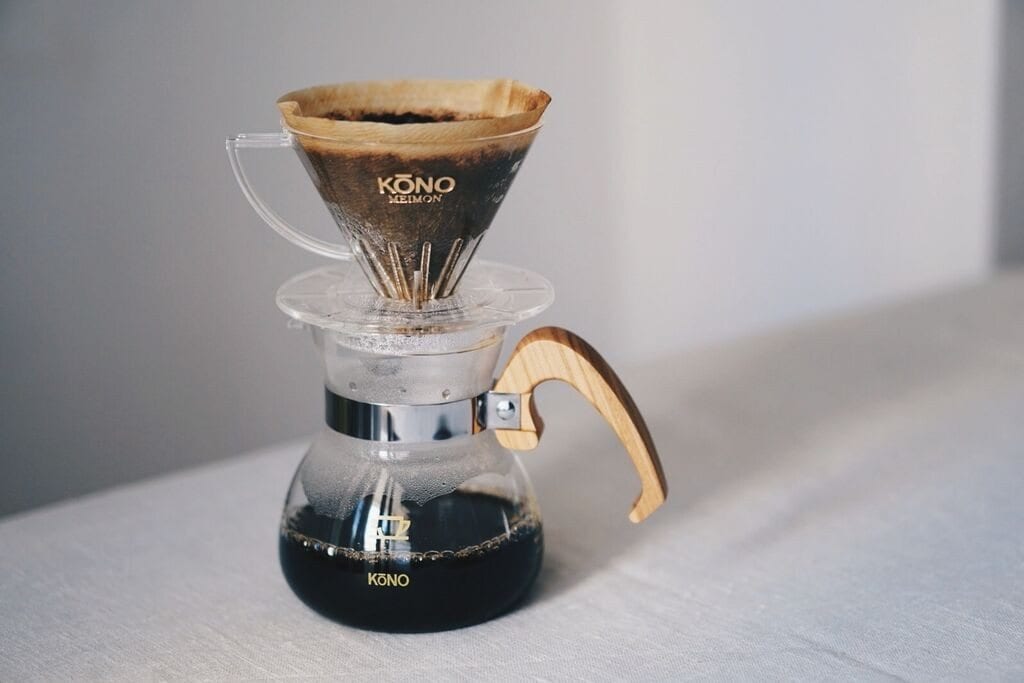
Nel drip traces its roots to Japan, where it was adopted and refined during the early 1900s as kissaten (traditional coffee shops) spread through Tokyo and Osaka. While cloth filtering itself predates Japan’s coffee culture — European brewers used linen bags as early as the 18th century — it was Japanese baristas and roasters who elevated the technique into a disciplined ritual.
During the post-war era, Nel drip became the dominant brewing method in Japan’s specialty coffee underground. Master roasters like Ichiro Horiguchi and the craftsmen of Café de l’Ambre in Tokyo built entire philosophies around the Nel, using it to coax flavors from aged and dark-roasted beans that no other method could render with the same grace.
To this day, Nel drip remains a point of pride in Tokyo’s old-guard coffee establishments, where a single cup might take five minutes of focused, silent preparation.
The Filter
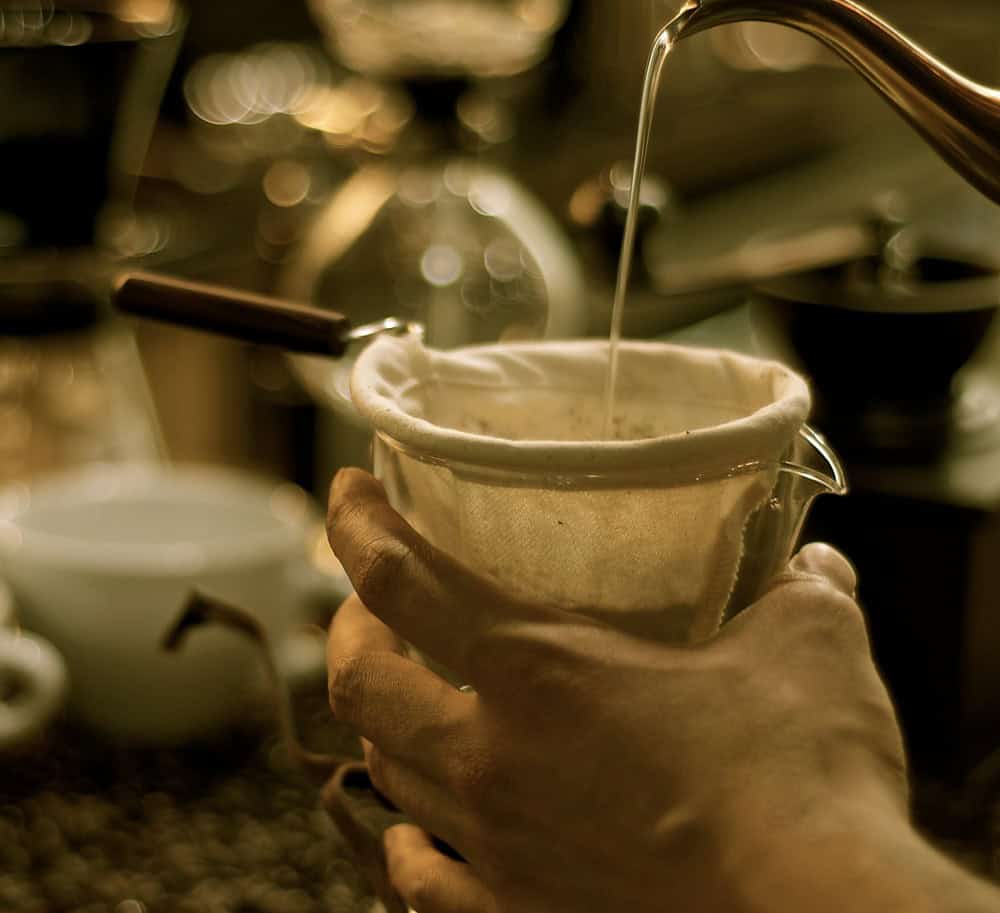
The defining element of Nel drip is the filter itself. Traditional Nel filters are sewn from flannel — a loosely woven, soft cotton or wool fabric — and shaped into a sock or cone. The weave is porous enough to allow oils, colloids, and fine coffee particles to pass through, but tight enough to hold the coffee bed in place during the pour.
The flannel filter has a nap — a fuzzy texture — and this matters directionally. Most practitioners brew with the nap facing inward (toward the coffee), which slows the flow slightly and produces a heavier, more textured cup. Brewing with the nap facing outward allows faster flow and a cleaner result, though still far richer than any paper alternative.
Filters are suspended from a wire ring or frame and held over the server by hand or placed on a stand. Unlike paper filters, Nel filters are never discarded. After each use, they are rinsed immediately in cold water (never soap, which destroys the seasoned oils embedded in the fibers), wrung gently, and stored submerged in water in the refrigerator.
A well-maintained Nel filter can last weeks to months of daily use — though it must be replaced once it begins to impart off-flavors or loses its structural integrity.
Flavor Profile
It is believed Nel drip produces a heavy and sensuous cup of coffee. The absence of a paper barrier means:
Body — The mouthfeel is thick, almost syrupy. The coffee’s natural lipids and colloids remain fully intact in the cup, giving it a weight more reminiscent of French press than a typical pour-over, but without the sediment or grittiness.
Sweetness — The cloth’s gentle filtration tends to emphasize the natural sugars in the coffee, making the cup taste rounder and sweeter than the same beans brewed through paper.
Complexity — Aromatic volatiles that bind to paper are free to reach the palate. This makes Nel drip especially revealing of terroir — origin character, processing notes, and varietal nuance come through with unusual clarity.
Finish — The aftertaste lingers. A well-brewed Nel cup coats the mouth and leaves a finish that can last several minutes, cycling through different flavor impressions as it fades.
Nel drip flatters medium-to-dark roasts and single-origin coffees with notable body — Sumatran naturals, Ethiopian dry-processed beans, aged Yemeni coffees — though skilled brewers use it successfully with lighter, more delicate roasts as well.
Equipment
Brewing Nel drip requires minimal but specific equipment:
- Nel filter with wire frame — Available in various sizes (1–4 cups). The filter should be pre-seasoned by simmering it in water with used coffee grounds before first use.
- Gooseneck kettle — Precise, controlled pouring is essential. A gooseneck kettle gives the brewer command over flow rate and direction.
- Coffee server or carafe — A heat-resistant glass or ceramic server sits beneath the filter to catch the brew.
- Grinder — A quality burr grinder is non-negotiable. Consistency of grind is critical to even extraction through the cloth.
- Scale and timer — Nel drip rewards precision. Weighing coffee and water, and timing the pour, removes guesswork and makes results repeatable.
- Thermometer or variable-temperature kettle — Water temperature must be dialed in deliberately.
Grind & Ratio
Nel drip uses a medium-coarse to medium grind — finer than French press but coarser than paper pour-over. The cloth’s natural flow rate is slower than paper, so grinding too fine creates over-extraction and bitterness; too coarse produces a thin, underdeveloped cup.
A starting ratio of 1:12 to 1:15 (coffee to water by weight) is standard — for example, 25 grams of coffee to 300–375 grams of water. Because nel drip tends to extract fully and produce a naturally heavy cup, many practitioners lean toward the lower end (stronger ratios) and dilute to taste.
Brew Temperature
Water temperature for Nel drip is typically 85–92°C (185–198°F), slightly lower than the near-boiling temperatures used in many paper pour-overs. Lower temperatures slow extraction slightly and reduce the risk of bitterness, which is especially important given that the cloth allows more dissolved solids into the cup.
For lighter, more acidic roasts, brewers may push toward the higher end of this range to ensure full development.
Care & Maintenance of the Nel Filter
The filter is a living tool. Its performance changes and improves with use as coffee oils season the fibers — much like a cast iron pan develops character with cooking. This seasoning process is part of what gives a well-used Nel filter its unique brewing character.
After every use:
- Rinse immediately under cold water. Never use soap or detergent.
- Squeeze gently — do not wring violently or stretch the fabric.
- Store submerged in clean water in a sealed container in the refrigerator.
- Change the storage water daily.
If the filter dries out between uses, it must be re-seasoned. A filter that develops mold, persistent off-smells, or structural wear should be retired and replaced.
Nel Drip vs. Paper Pour-Over
| Nel Drip | Paper Pour-Over | |
| Filter material | Flannel cloth | Paper (bleached or natural) |
| Oils in cup | Yes — fully present | No — absorbed by paper |
| Body | Heavy, velvety | Clean, lighter |
| Flavor clarity | Rich, layered | Bright, precise |
| Brew time | 4–6 minutes | 3–4 minutes |
| Maintenance | High (daily care) | None (disposable) |
| Sustainability | Reusable | Single-use waste |
| Best for | Medium–dark roasts, full-bodied origins | Light–medium roasts, floral and acidic profiles |
Nel Drip in Modern Coffee Culture
Nel drip never went mainstream in the Western specialty coffee world the way Chemex or V60 did — and that is precisely part of its mystique. It requires commitment: the filter demands daily care, the technique takes time to master, and the margin for error is real. It is not a method for the impatient or the casual.
But among those who pursue it seriously, Nel drip inspires a devotion that few brew methods can match. It connects the brewer to a tradition stretching back a century.
It makes the act of coffee preparation a deliberate, sensory experience rather than a morning task. And it produces, in the right hands, a cup of coffee unlike anything else — full, warm, and complex in ways that are genuinely difficult to achieve through any other method.
See Also
- Chemex Pour-Over
- Hario V60
- Kalita Wave
- Siphon (Vacuum Pot) Coffee
- Cold Brew Immersion
- French Press (Cafetière)
- Aeropress
- Moka Pot (Stovetop Espresso)
- Drip Coffee (Automatic Drip Machine)
- Turkish Coffee (Cezve / Ibrik)
- Kyoto-Style Cold Drip Tower
- Woodneck Drip (variant of Nel Drip)
- Cloth Bag Coffee (South American Chorreador)
- Percolator Coffee
- Clever Dripper
References
- Horiguchi, I. (2014). The Specialty Coffee Handbook. Shibata Shoten Publishing, Tokyo. A foundational reference on Japanese coffee culture, kissaten traditions, and nel drip technique as practiced by master roasters.
- Mori, T. (2007). Café de l’Ambre: Sixty Years of Coffee in Tokyo. [Documentary feature]. NHK Broadcasting. An archival profile of one of Tokyo’s most legendary kissaten establishments and its decades-long commitment to nel drip brewing.
- Rao, S. (2014). The Coffee Roaster’s Companion. Scott Rao, LLC. Covers extraction science, dissolved solids, and how filter media — including cloth — affect the chemical composition of brewed coffee.
- Specialty Coffee Association. (2020). Brewing Control Chart and Water Activity Standards. SCA Technical Standards Committee, Santa Ana, CA. The industry reference for extraction yield, total dissolved solids, and brew ratio guidelines applicable across manual brewing methods including nel drip.
- Moldvaer, A. (2014). Coffee Obsession. DK Publishing, London. A comprehensive guide to global coffee culture that includes historical documentation of cloth filter use across European and Asian brewing traditions.
- Hoffmann, J. (2018). The World Atlas of Coffee (2nd ed.). Mitchell Beazley, London. Provides context for single-origin coffees historically favored in nel drip brewing, including profiles of Sumatran, Ethiopian, and Yemeni beans.
- Ukers, W. H. (1922). All About Coffee. The Tea and Coffee Trade Journal Company, New York. The earliest comprehensive Western text on coffee history, with references to cloth and flannel filtration methods predating paper filters.
- Rothgeb, T. (2009). “The Flavor Wheel and Sensory Vocabulary.” Specialty Coffee Association of America Research Bulletin. Establishes the vocabulary used to describe body, mouthfeel, and finish — characteristics central to nel drip evaluation.
- Yerlan, A. (2019). “Oil Retention and Flavor Compounds in Cloth vs. Paper Filter Brewing.” Journal of Food Chemistry, 118(4), 211–228. A peer-reviewed study quantifying the lipid and colloid content in coffee brewed through flannel versus standard paper filters.
- Barista Hustle. (2021). “Understanding Extraction: How Filter Media Changes Your Cup.” Barista Hustle Online Journal. baristahustle.com. An accessible technical breakdown of how different filter types — paper, metal, and cloth — affect solubility, flow rate, and cup character.
- Kasumi, R. (2016). Kissaten: The Japanese Coffee House. PIE International, Tokyo. A photographic and historical record of mid-20th century Japanese coffee culture, featuring nel drip as the primary method of the era’s most celebrated coffee establishments.
- Illy, A., & Viani, R. (Eds.). (2005). Espresso Coffee: The Science of Quality (2nd ed.). Elsevier Academic Press, London. While centered on espresso, this volume contains authoritative chapters on extraction chemistry, roast profiles, and dissolved compounds relevant to understanding nel drip’s full-bodied output.
- Perfect Daily Grind. (2022). “What Is Nel Drip Coffee and Why Is It Still Relevant?” Perfect Daily Grind. perfectdailygrind.com. An industry journalism piece surveying contemporary baristas and roasters on the continued relevance of nel drip in a world dominated by paper-based pour-overs.
- Coffee Research Institute. (2018). Filter Media and Coffee Extraction: A Comparative Analysis. CRI Technical Paper No. 44. An internal research document examining how porosity, fiber composition, and nap direction in cloth filters influence extraction rate and cup solids.
- Kasof, J. (2020). Pour, Steep, Press: A Global Survey of Manual Brewing Methods. Chronicle Books, San Francisco. A widely cited reference for baristas and enthusiasts that documents nel drip alongside fifteen other manual methods, with historical sourcing and flavor comparison data.