
The Phin filter (Vietnamese: phin cà phê) is a small, single-serving gravity drip brewing device of Vietnamese origin, traditionally constructed from stainless steel or aluminum.
The Phin filter coffee equipment consists of four components: a perforated brewing chamber that sits directly atop a cup or glass, a gravity press plate that rests on the surface of the coffee grounds to regulate water flow, a lid that traps heat during brewing and doubles as a drip tray when inverted, and a base ring that secures the device to the rim of the vessel below.
Hot water is poured into the chamber and passes — slowly, by gravity alone — through the compacted coffee and the perforated base, dripping directly into the cup beneath. There is no paper filter, no cloth, and no applied pressure; the Phin is pure gravity drip at its most elemental.
Historically inseparable from Vietnamese café culture and the country’s tradition of dark-roasted robusta coffee served over sweetened condensed milk, the Phin is one of the most widely used individual-serve brewing devices in the world — and one of the least documented in Western coffee literature.
Origin & History
The Phin filter entered Vietnam during the French colonial period, which spanned from the mid-19th century through 1954. French colonists introduced both coffee cultivation and early drip brewing apparatus to the region, and Vietnamese craftsmen and traders adapted these tools into the compact, stackable, individually portioned form that persists to this day.
Coffee cultivation took root particularly in the Central Highlands — in provinces such as Đắk Lắk, Lâm Đồng, and Gia Lai — where the climate and elevation proved hospitable to both Coffea robusta and, to a lesser extent, Coffea arabica.
By the early 20th century, the Phin had become the domestic and commercial brewing standard across urban and rural Vietnam alike. Café culture in Hanoi and Saigon (now Ho Chi Minh City) was organized almost entirely around the device.
Street vendors, sidewalk coffee stalls, and formal café establishments all served coffee brewed in individual Phins, placed atop the glass at the table and left to drip while the customer waited — a deliberate, unhurried ritual built into the rhythm of daily life.
The device survived the upheaval of the Vietnam War, reunification, and the economic reforms of Đổi Mới (1986) that opened Vietnam to international trade.
Today, Vietnam is the world’s second-largest coffee producer by volume, surpassed only by Brazil, and the Phin remains its most emblematic brewing tool — present in every household, every street café, and every overseas Vietnamese community from Paris to Los Angeles.
Design & Construction
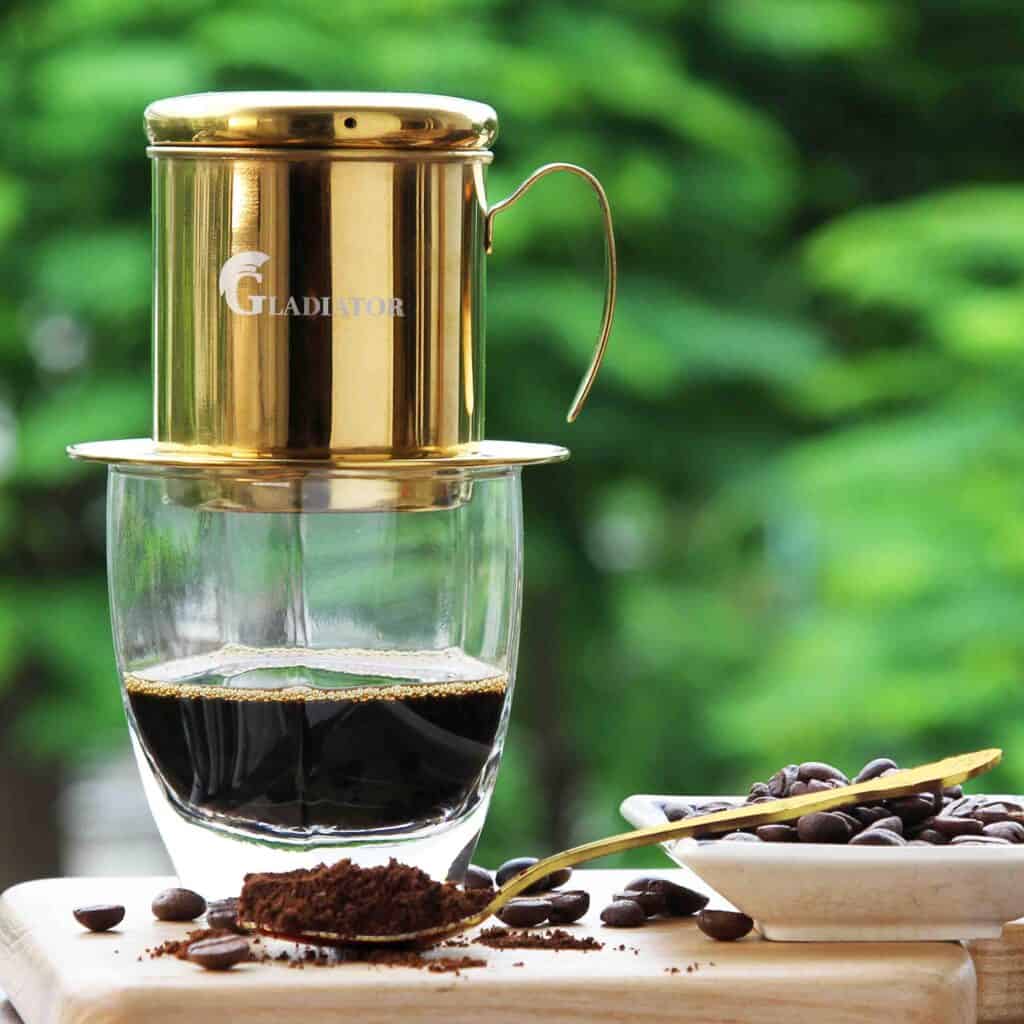
The Phin’s design is deceptively simple and has remained largely unchanged for over a century. Standard components include:
The Chamber — A cylindrical or slightly tapered brewing body, typically 50–150 ml in internal capacity, with a flat perforated base through which brewed coffee drips. Chambers are most commonly fabricated from stainless steel, though older models in aluminum and brass remain in use.
The perforation pattern of the base — hole diameter, density, and arrangement — directly influences drip rate and extraction character, and varies meaningfully between manufacturers.
The Gravity Press Plate (Tầng lọc) — A flat, perforated disc that is placed on top of the ground coffee inside the chamber after filling. It rests under its own weight — there is no screw mechanism in traditional Phin designs, though screw-press variants do exist and allow the brewer to exert variable pressure on the grounds.
The press plate compacts the coffee bed uniformly, slowing the drip rate and ensuring even saturation. Its weight and perforation pattern are calibrated to the chamber size.
The Lid — A domed or flat cover that sits atop the chamber during brewing, retaining heat and preventing aromatic loss. When the brew is complete, the lid is inverted, and the spent chamber is placed on top of it, preventing drips from reaching the table.
The Base Ring — A flat ring that rests on the rim of the cup or glass below, stabilizing the chamber during brewing. In some designs, the chamber and ring are integrated into a single piece.
The Phin is available in sizes ranging from roughly 3 cl to 15 cl, calibrated for single servings. It is inexpensive, durable, dishwasher-safe, and requires no consumables beyond the coffee itself.
Coffee & Roast Tradition
The Phin is historically paired with Vietnamese robusta coffee, often blended with small quantities of arabica, Coffea liberica (locally called cà phê mít), or Coffea excelsa — a diversity of species unusual in global coffee commerce.
These blends are roasted dark, frequently to what Western roasters would classify as a Full City Plus or French roast, and are sometimes processed with butter, salt, or sugar during roasting in a technique called tẩm rang, which imparts a characteristic caramelized, slightly savory edge to the cup.
The robusta-dominant profile means the Phin produces coffee with significantly higher caffeine content than typical arabica brews, as well as greater bitterness, lower acidity, and a heavier, earthier body.
These characteristics are not incidental — they are precisely calibrated to the traditional Vietnamese serving format, in which the concentrated brew is poured over a generous measure of sweetened condensed milk (sữa đặc), creating cà phê sữa nóng (hot) or cà phê sữa đá (iced), the latter served over crushed or cubed ice in a tall glass.
In contemporary specialty coffee contexts, the Phin is also used with single-origin arabica and arabica-robusta blends at lighter roast levels, producing a cup with greater floral and fruit complexity while retaining the device’s characteristic slow-dripped richness.
Flavor Profile
The absence of paper filtration in Phin brewing means coffee oils and colloids pass freely into the cup, producing a brew that is notably heavier in body than paper-filtered drip coffee.
The slow drip rate — often 4 to 8 minutes for a single serving — results in extended contact time between water and grounds, contributing to deep extraction of roast-derived flavor compounds.
Body — Full and coating, with a viscosity that distinguishes it clearly from automatic drip or pour-over methods using paper filters.
Bitterness — More pronounced than in most brewing methods, particularly with dark-roasted robusta blends. This bitterness is considered a desirable characteristic in Vietnamese coffee culture, where it is balanced by the sweetness of condensed milk rather than mitigated in the brewing process itself.
Earthiness & Depth — Robusta-dominant Phin brews carry chocolate, tobacco, cedar, and dark caramel notes that are rarely found in arabica-only preparations. Specialty arabica Phin brews, by contrast, exhibit more nuanced fruit and floral registers.
Sweetness — Inherent sweetness in the coffee itself is modest at dark roast levels but is amplified significantly when served with condensed milk, producing a cup with a rich, dessert-like quality.
Aroma — The lid-covered brewing process preserves aromatics within the chamber during extraction, releasing them fully when the lid is lifted — a sensory moment that experienced drinkers anticipate.
Equipment & Materials
The Phin requires no electricity, no paper filters, no special kettle, and no scale — though precision-minded brewers use all of the above. Core equipment includes:
Phin filter — Sized to match the desired serving volume. A 6–8 cl Phin is standard for a single concentrated serving; larger models suit diluted or milk-based preparations.
Cup or glass — Traditionally a small ceramic demitasse or a heat-resistant glass tumbler. For cà phê sữa đá, a tall glass is standard, with condensed milk layered at the bottom before the Phin is positioned.
Hot water source — Near-boiling water is standard in traditional practice. Specialty applications use variable-temperature kettles to fine-tune extraction.
Burr grinder — For consistent results, a medium-fine grind is preferred, though pre-ground Vietnamese coffee blends (notably Trung Nguyên and Vinacafé brands) are the historical norm and remain widely used.
Grind, Ratio & Extraction
The Phin performs best with a medium to medium-fine grind — finer than pour-over but not as fine as espresso. Grind consistency directly affects drip rate: too fine, and the press plate compacts the grounds into a near-impermeable bed, extending brew time beyond 10 minutes and risking over-extraction (see extraction); too coarse, and water passes too quickly, producing a thin, underdeveloped cup.
A standard ratio falls between 1:7 and 1:10 (coffee to water by weight), producing a concentrated brew intended to be consumed as-is or extended with milk or ice. This ratio is significantly stronger than Western drip coffee norms and reflects the traditional expectation that the Phin produces a concentrate rather than a full-volume beverage.
Brew time under normal conditions ranges from 4 to 8 minutes, depending on grind size, press plate weight, and water temperature. A brew that finishes in under 3 minutes is likely ground too coarsely or underfilled; one that exceeds 10 minutes suggests over-compaction or too fine a grind.
Cultural Significance
The Phin is not merely a brewing device — it is a cultural artifact encoding Vietnamese relationships with time, hospitality, and daily ritual. In a country where coffee is consumed slowly, often outdoors, on small plastic stools at sidewalk stalls, the Phin’s unhurried drip pace is not a limitation to be engineered around but a feature that structures the pace of the morning. Waiting for the Phin to finish is part of the experience.
The device also carries a democratic accessibility that defines its cultural role. Unlike espresso machines or precision pour-over setups, the Phin requires no investment beyond a few dollars, no technical training, and no consumables. It is equally at home in a rural kitchen, a Hanoi street stall, and a diaspora household in Houston or San Jose.
In the Vietnamese diaspora across the United States, France, Australia, and beyond, the Phin functions as a cultural touchstone — a portable, durable connection to home that requires nothing more than hot water and coffee to activate.
Its growing visibility in Western specialty coffee contexts has introduced the device to a new audience, though its representation in English-language coffee literature remains disproportionately thin relative to its global reach.
The Phin in the Global Specialty Coffee Movement
The early 21st century brought renewed Western interest in the Phin, driven partly by the mainstreaming of Vietnamese-American café culture and partly by the specialty coffee world’s expanding attention to robusta as a serious, terroir-expressive species rather than a commodity filler.
Roasters and importers began sourcing single-origin Vietnamese robusta from the Central Highlands with documented farm provenance, and baristas experimented with Phin brewing using lighter roast profiles and arabica varietals to demonstrate the device’s range.
Coffee competitions, including events organized under the Specialty Coffee Association, have featured Phin-brewed entries in recent years, lending the method additional visibility. Vietnamese coffee entrepreneurs — both in Vietnam and in the United States — have launched premium Phin-focused brands that reframe the device and its associated coffee culture as objects of design and gastronomy rather than simple utility.
The Phin’s combination of zero waste (no paper filters), low cost, single-serve precision, and profound cultural depth positions it well within contemporary conversations about sustainability, equity, and diversity in specialty coffee.
Comparison with Related Methods
| Phin Filter | Nel Drip | Chemex | Automatic Drip | |
| Filter type | Perforated metal | Flannel cloth | Paper | Paper |
| Serving size | Single (concentrated) | Single to multi | Multi | Multi |
| Oils in cup | Yes | Yes | No | No |
| Brew time | 4–8 min | 4–6 min | 4–5 min | 6–10 min |
| Cultural origin | Vietnam | Japan | United States | Germany / USA |
| Roast affinity | Medium–dark, robusta | Medium–dark | Light–medium | Light–medium |
| Equipment cost | Very low | Low–moderate | Moderate | High |
| Consumables | None | Filter (reusable) | Paper filters | Paper filters |
See Also
- Nel Drip (Flannel Drip)
- Chorreador (Costa Rican Cloth Drip)
- Chemex Pour-Over
- Hario V60
- Kalita Wave
- Cold Brew Immersion
- Kyoto-Style Cold Drip Tower
- French Press (Cafetière)
- Moka Pot (Stovetop Espresso)
- Siphon (Vacuum Pot) Coffee
- Cà Phê Trứng (Vietnamese Egg Coffee)
- Turkish Coffee (Cezve / Ibrik)
- Percolator Coffee
- AeroPress
- Clever Dripper
References
- Ukers, W. H. (1922). All About Coffee. The Tea and Coffee Trade Journal Company, New York. The foundational Western reference on global coffee history, with documentation of early colonial-era drip brewing apparatus introduced to Southeast Asia.
- Trung Nguyên Coffee Group. (2018). Vietnamese Coffee Culture: Origins and Identity. Trung Nguyên Legend Publishing, Buôn Ma Thuột, Vietnam. An institutional history of Vietnam’s coffee industry, covering robusta cultivation in the Central Highlands and the cultural centrality of the Phin brewing method.
- International Coffee Organization. (2023). Coffee Report: Vietnam Production and Export Data. ICO Statistical Report No. 71, London. Confirms Vietnam’s status as the world’s second-largest coffee producer and documents the robusta-dominant composition of Vietnamese coffee output.
- Hoffmann, J. (2018). The World Atlas of Coffee (2nd ed.). Mitchell Beazley, London. Profiles Vietnamese coffee origins, robusta varietals, and the cultural context of the Phin filter within Southeast Asian coffee traditions.
- Specialty Coffee Association. (2021). Diversity of Species: Robusta, Liberica, and Excelsa in Specialty Context. SCA Research Report, Santa Ana, CA. Examines the renewed specialty coffee interest in non-arabica species, including Vietnamese robusta as a terroir-expressive single-origin product.
- Rao, S. (2014). The Coffee Roaster’s Companion. Scott Rao, LLC. Provides extraction science underpinning Phin performance, including the role of grind consistency, contact time, and dissolved solids in gravity-drip brewing without paper filtration.
- Nguyen, A. (2006). Into the Vietnamese Kitchen: Treasured Foodways, Modern Flavors. Ten Speed Press, Berkeley, CA. Documents the role of cà phê sữa đá and the Phin filter within the broader landscape of Vietnamese culinary and domestic culture.
- Moldvaer, A. (2014). Coffee Obsession. DK Publishing, London. Includes an entry on Vietnamese coffee and the Phin among its survey of global manual brewing traditions.
- Barista Magazine. (2022). “The Phin Goes Global: How Vietnamese Coffee Culture Is Reshaping the Third Wave.” Barista Magazine, February 2022. baristamagazine.com. A feature-length examination of Phin visibility in American and European specialty coffee markets.
- Perfect Daily Grind. (2021). “Understanding the Phin: Vietnam’s Most Important Coffee Tool.” Perfect Daily Grind. perfectdailygrind.com. A widely circulated editorial providing technical and cultural context for a Western specialty coffee audience.
- Illy, A., & Viani, R. (Eds.). (2005). Espresso Coffee: The Science of Quality (2nd ed.). Elsevier Academic Press, London. While espresso-focused, contains authoritative chapters on coffee oil retention, dissolved solids, and the sensory implications of metal versus paper filtration.
- Food and Agriculture Organization of the United Nations. (2020). Coffea canephora: Agronomy, Genetics, and Quality Potential. FAO Agricultural Services Bulletin, Rome. Foundational scientific reference for robusta coffee, the species central to Phin brewing tradition.
- Vu, L. T. (2019). “Cà Phê and Identity: Coffee Drinking as Cultural Practice in Contemporary Vietnam.” Asian Studies Review, 43(2), 215–231. A peer-reviewed sociological study of coffee culture in Vietnam, with specific analysis of the Phin as a material object encoding social ritual and national identity.
- Nguyen, T. P., & Hoang, M. L. (2020). “Extraction Efficiency and Sensory Profile of Coffea canephora Brewed via Gravity Drip Without Paper Filtration.” LWT — Food Science and Technology, 134, 110187. A quantitative study comparing extraction yield, caffeine content, and sensory attributes of robusta brewed through the Phin against other common methods.
- Coffee Research Institute. (2019). Single-Serve Gravity Drip Devices: A Technical Comparison. CRI Technical Paper No. 51. Benchmarks the Phin filter against other single-serve gravity drip systems including the Hario V60 and Kalita Wave, measuring flow rate, extraction yield, and cup solids across standardized brewing conditions.
- Kasof, J. (2020). Pour, Steep, Press: A Global Survey of Manual Brewing Methods. Chronicle Books, San Francisco. Documents the Phin alongside fourteen other manual methods, with historical sourcing and cross-cultural flavor comparison.