
Coffee roasting transforms dense, grassy-smelling green coffee into the aromatic brown beans used for brewing. Within that transformation, roast level is the single biggest variable a roaster controls, and no distinction matters more to everyday drinkers than the split between light roast and dark roast.
The two ends of the spectrum are not just different colors of bean — they are different chemical outcomes, different flavor systems, and, in many cases, different brewing philosophies. This article compares light and dark roasts across roasting chemistry, flavor, caffeine, body, and brewing behavior, and points to further reading for each concept along the way.
What “Roast Level” Actually Means
Here’s a comparison table detailing the differences and similarities between the two coffee roast levels.
| Feature | Light Roast | Dark Roast |
|---|---|---|
| Roast Level | Roasted for the shortest time, typically ending around the first crack. | Roasted longer, often beyond the second crack. |
| Bean Color | Light brown | Dark brown to nearly black |
| Surface Appearance | Dry with little or no visible oil | Often shiny due to surface oils |
| Flavor Profile | Bright, fruity, floral, and more origin-driven | Bold, smoky, chocolatey, caramelized, and roast-driven |
| Acidity | Higher and more noticeable | Lower and more subdued |
| Bitterness | Lower | Higher due to increased caramelization and roasting compounds |
| Sweetness | Can have delicate natural sweetness | More caramelized sweetness with roasted notes |
| Body (Mouthfeel) | Light to medium | Medium to full-bodied |
| Origin Characteristics | Preserves the coffee’s unique regional and varietal flavors | Origin characteristics become less pronounced as roast flavors dominate |
| Aroma | Floral, citrus, berry, and tea-like | Toasted nuts, cocoa, smoke, spice, and dark chocolate |
| Caffeine (by Bean) | Slightly more caffeine because beans are denser | Slightly less caffeine because beans lose more mass during roasting |
| Caffeine (by Weight) | Nearly identical to dark roast | Nearly identical to light roast |
| Density | Denser and harder beans | Less dense and more brittle beans |
| Grind Difficulty | Requires slightly more grinding effort | Easier to grind due to brittleness |
| Best Brewing Methods | Pour-over, Chemex, V60, AeroPress, filter coffee | Espresso, French press, Moka pot, cold brew |
| Ideal For | Drinkers seeking complexity, acidity, and terroir | Drinkers preferring bold, rich, and low-acidity coffee |
| Common Tasting Notes | Citrus, berries, apple, stone fruit, jasmine, honey | Dark chocolate, cocoa, toasted nuts, molasses, caramel, smoke |
| Perceived Strength | Often tastes lighter despite similar caffeine | Often tastes stronger because of its bold flavor |
| Popularity | Favored by specialty coffee enthusiasts | Common in traditional and commercial coffee markets |
Key takeaway: Light roast emphasizes the coffee bean’s natural origin flavors, acidity, and complexity, while dark roast highlights roast-derived flavors such as chocolate, caramel, and smokiness, with a fuller body and lower perceived acidity.
Every batch of coffee begins as green coffee, which is roasted inside a drum or fluid-bed roastery machine under controlled heat. As beans absorb heat, they pass through a predictable sequence of physical and chemical stages: an initial drying phase that drives off residual moisture, followed by browning reactions, and finally audible cracking as internal pressure builds and releases.
The coffee roast level is essentially a snapshot of how far along this sequence a batch was allowed to travel before the beans were pulled and cooled.
- Light roast beans are removed early, generally right around or just past the first audible crack.
- Dark roast beans are left in significantly longer, often through and past the second crack, when oils are pushed to the surface, and the bean’s original character is largely overwritten by roast-derived flavor.
Because this single variable cascades into so many downstream differences, roast level is often treated as the primary axis for classifying coffee — more influential to the final cup than even the coffee’s origin in many cases.
The Chemistry Behind the Color
The visual and flavor differences between light and dark roasts come from a handful of well-studied reactions that unfold at different temperatures:
- The Maillard reaction begins early in roasting, when sugars and amino acids combine to produce the first roasted, toasty, bread-like aromatics.
- Caramelization kicks in as sucrose within the bean breaks down under heat, generating sweetness and, eventually, bitterness the longer it progresses.
- Pyrolysis — the most intense stage — dominates in darker roasts, breaking down cell structures and generating the smoky, carbon-forward, sometimes ashy notes associated with very dark coffee.
- Melanoidins, the brown pigmented compounds formed throughout roasting, accumulate more heavily in darker beans and contribute to their fuller body and darker color.
The audible markers of this progression — first crack and second crack — function as the roasting industry’s informal mile markers. Light roasts are typically dropped at or shortly after first crack; dark roasts are carried well into or past second crack, by which point the bean’s cell walls have fractured enough to force oil to the surface.
Flavor and Aroma Differences
Because light and dark roasts stop the same chemical reactions at very different points, they taste like different products even when brewed from identical beans.
Light roasts retain more of the green coffee’s original character — the flavors shaped by terroir, variety, and processing. Expect brighter acidity, more pronounced floral or fruit-forward aroma, and a lighter body, since less sugar has caramelized into heavier, syrupy compounds. This is why light roasts are the standard choice for showcasing single-origin coffee and are the preferred style at most specialty coffee roasters and in professional cupping sessions, where origin character is the point of evaluation.
Dark roasts move flavor generation away from the bean’s origin and toward the roast itself. Origin-specific notes fade under the weight of roast-derived bitterness, smokiness, and heavier, chocolate- or char-like flavors. Body typically increases, sweetness shifts from bright to caramelized and bittersweet, and acidity drops substantially — one reason dark roast is often marketed as “smooth” or “bold” despite containing more bitter compounds by volume.
Physical and Visual Differences
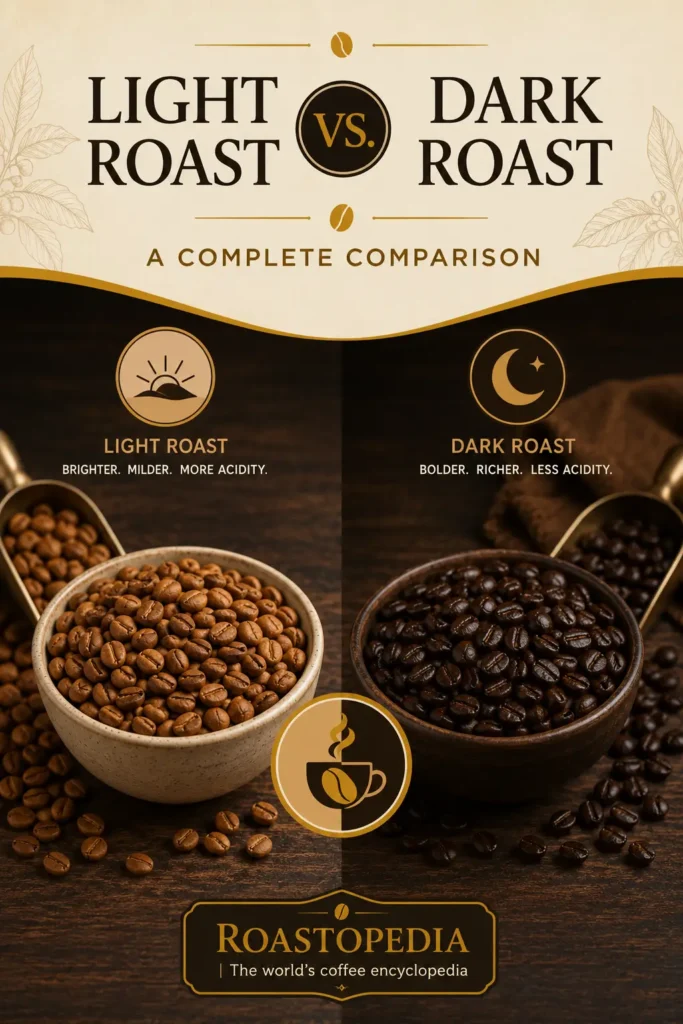
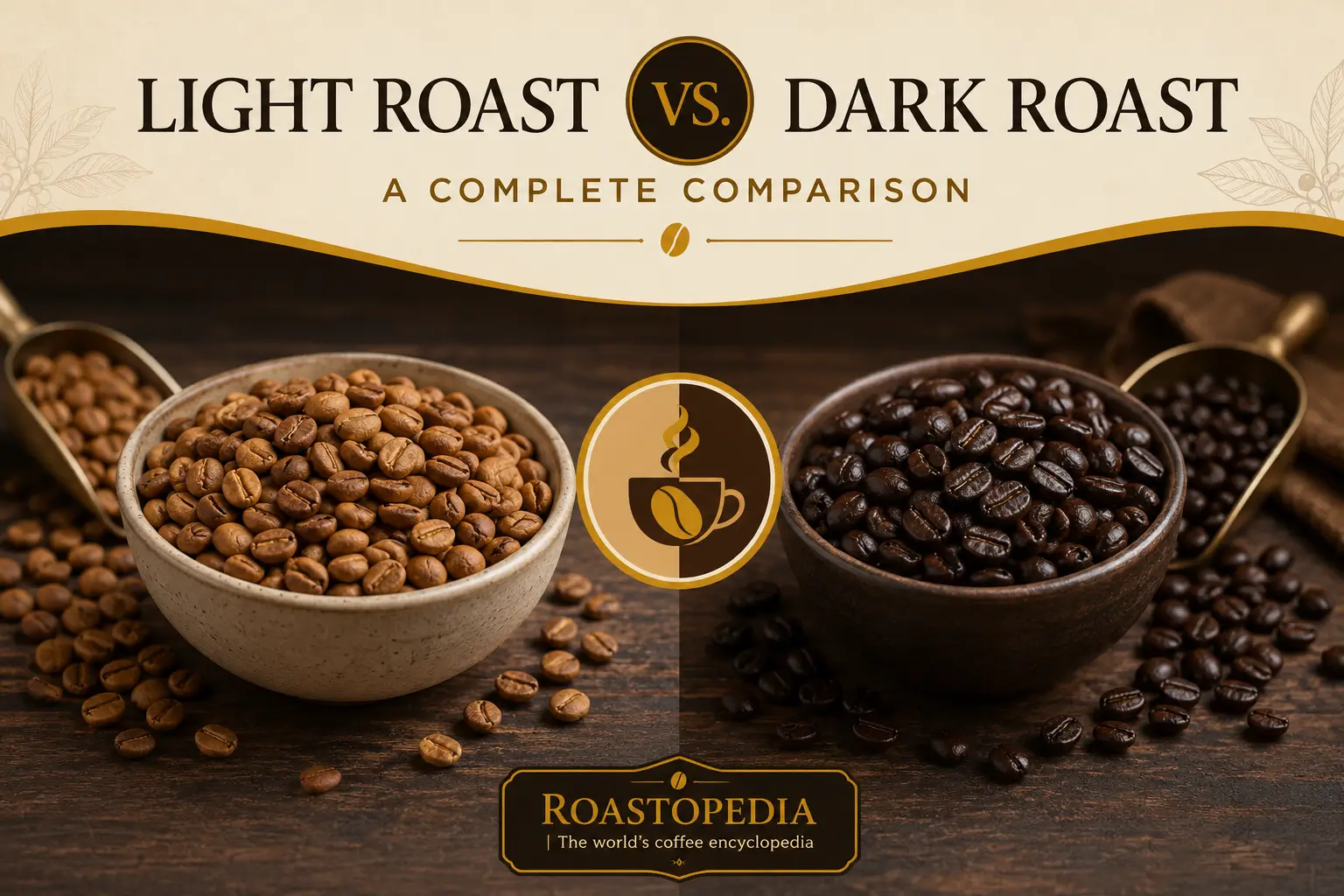
The most obvious way to tell light and dark roasts apart is by looking at them. Light roast beans are dry, matte, and light tan to medium brown. Dark roast beans are noticeably darker and often glossy with surface oil, because the fractured cell walls of a deeply roasted bean allow oils to migrate outward.
Dark roasts also lose more mass and volume during roasting, since prolonged heat exposure drives off more moisture and organic material, meaning a given weight of dark roast beans will occupy noticeably more volume than the same weight of light roast beans. Roast level also affects how much chaff — the papery silverskin shed from the coffee bean — is released during roasting and how much it darkens.
Caffeine Content: A Common Myth
One of the most persistent misconceptions is that dark roasts contain more caffeine than light roasts because they taste stronger. In reality, roasting, together with grind size, slightly reduces caffeine content the longer beans are exposed to heat, meaning light roasts retain marginally more caffeine by weight than dark roasts.
However, because dark roast beans lose more mass and expand in volume, a scoop measured by volume rather than weight can flip that relationship.
Brewing Considerations
Roast level changes how beans behave during brewing, which is why light and dark roasts often call for different equipment settings rather than one universal recipe.
- Extraction: Dark roasts are more porous and soluble, so they extract faster and can turn bitter or over-extracted if brewed too long or too fine. Light roasts are denser and less soluble, generally requiring a finer grind size, hotter water, or longer contact time to extract fully.
- Water temperature: Many brewers use slightly cooler water for dark roasts to avoid accentuating bitterness, and hotter water for light roasts to compensate for their lower solubility.
- Degassing: Roast level affects how much carbon dioxide is trapped inside the bean, which in turn affects how coffee blooms and how quickly it can be brewed after roasting.
- Crema: In espresso specifically, roast level influences crema volume and stability, with darker roasts generally producing thicker, more persistent crema due to higher surface oil content.
Which Roast Is “Better”?
Neither roast level is objectively superior — the right choice depends on what a drinker values. Light roasts prioritize transparency: they let the coffee’s origin, variety, and processing speak for themselves, which is why they dominate specialty and competition coffee.
Dark roasts prioritize consistency and boldness: they minimize the influence of any single origin, smooth out defects, and deliver a familiar, heavier-bodied cup that performs reliably across large-scale blends. Many coffee professionals view the “light vs. dark” debate less as a hierarchy and more as two different tools suited to two different goals.
See Also
- Why Are Some Coffee Beans Oily?
- Does Light Roast Coffee Have More Caffeine Than Medium Roast?
- Does Grind Size Change Caffeine Extraction in Light Roast Coffee?
- The Role of Roast Level in Coffee Flavor Development
- How Water Temperature Affects Coffee Extraction
- Why Does Coffee Require Degassing Before Brewing?
- Why Does Espresso Crema Disappear So Quickly Sometimes?
- Why Does Green Coffee Lose Quality During Storage?
References
- Illy, Andrea; Viani, Rinantonio. Espresso Coffee: The Science of Quality. Academic Press.
- Clarke, R. J.; Macrae, Ronald. Coffee: Chemistry. Elsevier Applied Science.
- Davids, Kenneth. Coffee Roasting: A Guide for Home and Craft Roasters. Coffee Enterprises.
- Rao, Scott. The Coffee Roaster’s Companion. Scott Rao Publishing.
- Hoffmann, James. The World Atlas of Coffee: From Beans to Brewing. Mitchell Beazley.
- Specialty Coffee Association (SCA). Coffee Roasting and Sensory Standards.
- Farah, Adriana. Coffee: Production, Quality and Chemistry. Royal Society of Chemistry.
- Lingle, Ted R. The Coffee Cupper’s Handbook. Specialty Coffee Association.