
Astringency is a tactile sensory sensation characterized by dryness, roughness, puckering, or a tightening feeling in the mouth following the consumption of coffee. Unlike taste attributes such as sweetness, bitterness, sourness, or saltiness, astringency is primarily a mouthfeel phenomenon resulting from interactions between certain coffee compounds and proteins present in saliva. It is most commonly perceived on the tongue, gums, cheeks, and roof of the mouth, where it creates a sensation often described as drying, chalky, coarse, or slightly abrasive.
In coffee evaluation, astringency occupies a complex position. Mild levels may contribute to structure and perceived intensity, particularly in some darker roasts and traditional brewing styles. Excessive astringency, however, is generally regarded as a brewing defect or sensory imbalance, often associated with over-extraction, poor-quality green coffee, roast defects, or undesirable processing characteristics.
Astringency is frequently confused with bitterness.
Etymology
The term astringency originates from the Latin adstringere, meaning “to bind tightly” or “to draw together.” This linguistic origin reflects the sensation’s defining characteristic: the apparent tightening or contracting of tissues within the mouth.
In food and beverage science, astringency refers to the drying sensation caused by compounds that interact with salivary proteins. The term is used across numerous products, including tea, wine, cacao, unripe fruits, and coffee.
Distinguishing Astringency from Taste
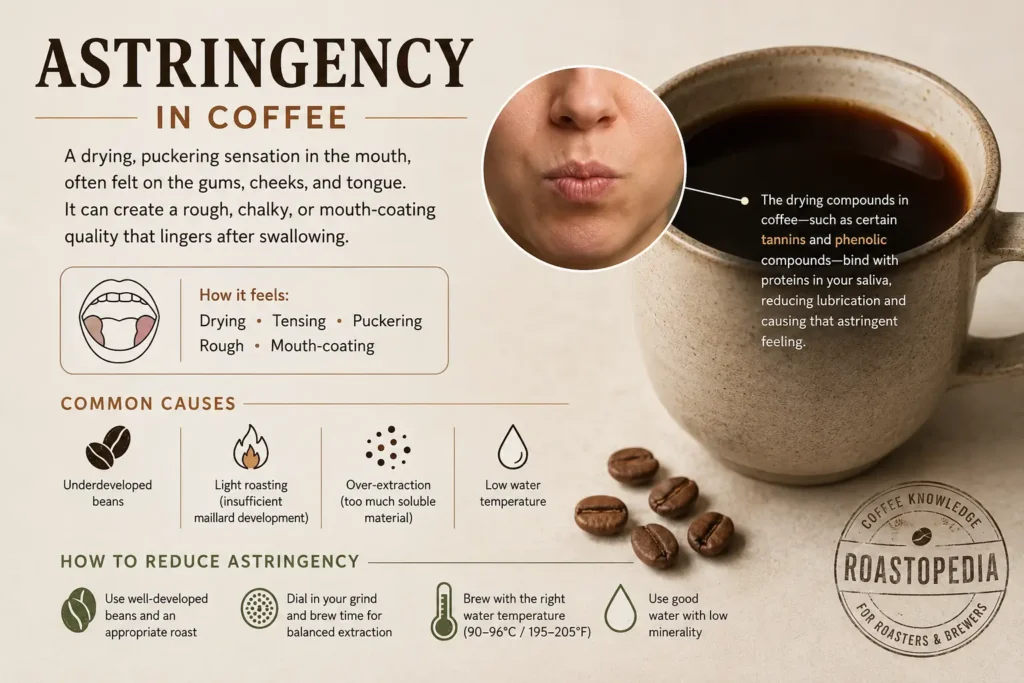
One of the most common misconceptions in coffee evaluation is the belief that astringency is a taste.
Scientifically, astringency is classified as a trigeminal sensation, meaning it is perceived through tactile and neurological mechanisms rather than through taste receptors. Whereas taste buds detect bitterness, astringency results from physical and chemical interactions occurring within the oral cavity.
This distinction is important because one coffee may be highly bitter without being astringent, while another may be astringent despite only moderate bitterness.
Typical descriptors associated with astringency include:
- Drying
- Puckering
- Chalky
- Rough
- Coarse
- Grainy
- Sandpapery
- Mouth-tightening
These sensations often linger after swallowing and may become increasingly noticeable as the coffee cools.
The Scientific Basis of Astringency
Astringency arises primarily when certain compounds bind to proteins in saliva.
Saliva normally contains lubricating proteins that help maintain a smooth sensation within the mouth. When astringent compounds interact with these proteins, the proteins can precipitate or lose their lubricating effectiveness. As lubrication decreases, friction between oral surfaces increases, creating the characteristic drying and roughening sensation.
Several classes of compounds may contribute to coffee astringency, including:
- Polyphenols
- Chlorogenic acid derivatives
- Certain tannin-like compounds
- Melanoidins
- Over-extracted plant materials
- Defect-related compounds
The intensity of astringency depends on both the concentration of these compounds and individual sensory sensitivity.
Early Human Encounters with Astringency
Long before the scientific understanding of astringency emerged, coffee drinkers recognized the sensation through experience.
In the centuries following coffee’s spread from the Horn of Africa and the Arabian Peninsula (see The Coffee Belt), consumers often described certain coffees as harsh, drying, woody, or rough. While these observations lacked modern scientific terminology, they represented early attempts to identify what is now recognized as astringency.
Traditional coffee cultures frequently developed roasting and brewing techniques that reduced unpleasant drying sensations, even without understanding the underlying chemistry.
Astringency in Early Coffee Science
The scientific study of coffee chemistry expanded significantly during the nineteenth century.
Researchers investigating coffee composition identified numerous organic acids, phenolic compounds, and roasting products that influenced flavor and mouthfeel. Although bitterness received much of the early attention, scientists increasingly recognized that some undesirable sensations could not be explained by taste alone.
By the early twentieth century, food scientists studying tea, wine, and coffee began examining the relationship between plant polyphenols and oral dryness. These investigations provided the foundation for the modern understanding of astringency.
The Rise of Sensory Science
During the latter half of the twentieth century, sensory evaluation became increasingly sophisticated.
Researchers developed standardized tasting protocols capable of distinguishing flavor, aroma, taste, and mouthfeel attributes. As coffee cupping evolved into a more systematic discipline, astringency became recognized as a distinct sensory characteristic rather than a variation of bitterness.
Professional tasters learned to identify astringency separately from:
- Bitterness
- Sourness
- Acidity
- Body
- Aftertaste
This distinction improved communication among producers, roasters, and quality-control professionals.
Astringency and Coffee Extraction
One of the most important developments in modern coffee science has been the recognition of astringency’s relationship to extraction.
During brewing, water dissolves compounds from coffee grounds in a relatively predictable sequence. Desirable compounds such as fruit acids, sugars, aromatic substances, and many flavor-active molecules are generally extracted earlier in the brewing process.
As extraction progresses beyond optimal levels, less desirable compounds may begin dissolving in greater quantities. These compounds can contribute drying, woody, harsh, or astringent sensations.
For this reason, excessive extraction is frequently associated with elevated astringency.
Common causes include:
- Excessively fine grind size
- Prolonged brew times
- Excessive agitation
- Very high brewing temperatures
- Uneven extraction
- Excessive contact time
The resulting coffee may feel dry and rough despite possessing acceptable strength or aroma.
Astringency and Roast Development
Roasting also plays a significant role in the perception of astringency.
Underdeveloped roasts may preserve compounds that contribute vegetal, woody, or drying sensations. Conversely, poorly executed dark roasts can produce harsh roasting byproducts that enhance rough mouthfeel characteristics.
Proper roast development (see Coffee Roast Level) seeks to balance sweetness, acidity, bitterness, and body while minimizing undesirable astringent qualities.
Roasters often evaluate astringency as part of routine quality control because it can reveal developmental flaws that may not be immediately apparent through aroma alone.
Astringency and Coffee Processing
The processing methods used after harvest can influence the likelihood of astringency appearing in the final cup.
Coffee cherries contain numerous polyphenolic compounds within their skins, pulp, mucilage, and seeds. Improper processing may increase the presence of compounds associated with harshness and dryness.
Factors that can contribute include:
- Over-fermentation
- Improper drying
- Poor storage conditions
- Immature cherries
- Defective beans
- Mechanical damage
Conversely, carefully executed processing often produces cleaner sensory profiles with lower levels of undesirable astringency.
Sensory Identification of Astringency
Experienced coffee tasters often identify astringency through its physical effects rather than its flavor.
Several practical indicators include:
Drying of the Tongue
The tongue may feel less lubricated after swallowing.
Tightening of the Cheeks
The inner cheeks may appear to contract or feel slightly puckered.
Rough Mouthfeel
The coffee may leave a coarse sensation resembling fine sandpaper.
Lingering Dryness
The drying effect often persists longer than bitterness or acidity.
Reduced Salivation
The mouth may feel unusually dry, prompting a desire to drink water.
These sensations frequently become more noticeable during comparative tasting sessions.
Astringency in Different Brewing Methods
Astringency can occur in virtually any brewing method, though certain brewing variables may increase its likelihood.
Espresso
Channeling, excessive shot times, and over-extraction can produce pronounced astringency.
Pour-Over Brewing
Very fine grinding, excessive turbulence, or prolonged drawdown times may increase drying sensations.
Immersion Brewing
Extended steeping periods can encourage extraction of compounds associated with astringency.
Percolation Brewing
Uneven extraction and excessive contact time may contribute to harsh mouthfeel characteristics.
The brewing method itself is not usually the direct cause; rather, astringency emerges from how extraction is managed within that method.
Astringency in Professional Coffee Evaluation
Modern sensory protocols recognize astringency as an important quality indicator.
Professional cuppers assess not only flavor and aroma but also tactile attributes affecting overall drinking experience. Excessive astringency is generally considered undesirable because it can mask sweetness, reduce perceived clarity, and create an imbalanced cup profile.
However, context remains important. Certain coffees may exhibit mild astringency without being considered defective, particularly when balanced by sweetness, acidity, and body.
The goal is not necessarily the complete absence of astringency but rather its appropriate integration within the overall sensory experience.
Astringency in Contemporary Coffee Science
Today, astringency remains an active area of research within coffee chemistry and sensory science.
Advances in analytical techniques have improved understanding of the compounds responsible for mouth-drying sensations and their interactions with saliva. Researchers continue to investigate how cultivation, processing, roasting, grinding, and brewing influence the perception of astringency.
As specialty coffee increasingly emphasizes precision and sensory literacy, the ability to identify and manage astringency has become an essential skill for coffee professionals. Its study highlights the fact that coffee quality extends beyond flavor alone and encompasses the full sensory experience of the beverage.
See Also
- Bitterness
- Acidity
- Body
- Mouthfeel
- Aftertaste
- Extraction
- Extraction Yield
- Over-Extraction
- Under-Extraction
- Total Dissolved Solids (TDS)
- Channeling
- Turbulence
- Agitation
- Brew Ratio
- Roast Development
- Chlorogenic Acids
- Coffee Processing
- Cupping
- Sensory Analysis
- Flavor Profile
References
- Illy, Andrea; Viani, Rinantonio. Espresso Coffee: The Science of Quality. Academic Press.
- Clarke, R. J.; Macrae, Ronald. Coffee: Chemistry. Elsevier Applied Science.
- Clarke, R. J.; Vitzthum, O. G. Coffee: Recent Developments. Blackwell Science.
- Farah, Adriana. Coffee: Emerging Health Effects and Disease Prevention. Wiley-Blackwell.
- Belitz, Hans-Dieter; Grosch, Werner; Schieberle, Peter. Food Chemistry. Springer.
- Lawless, Harry T.; Heymann, Hildegarde. Sensory Evaluation of Food: Principles and Practices. Springer.
- SCAA (Specialty Coffee Association of America). Coffee Cuppers Handbook.
- Lingle, Ted R. The Coffee Cupper’s Handbook. Specialty Coffee Publications.
- Sunarharum, Wenny B.; Williams, David J.; Smyth, Heather E. “Complexity of Coffee Flavor: A Compositional and Sensory Perspective.”
- Buffo, Roberto A.; Cardelli-Freire, Cristina. “Coffee Flavour: An Overview.”
- Navarini, Luciano; Rivetti, Dario. Research on coffee extraction and sensory quality.
- Specialty Coffee Association (SCA). Coffee Sensory Standards and Evaluation Protocols.
- ISO 5492. Sensory Analysis — Vocabulary.
- Lee, L. W.; Cheong, M. W.; Curran, P.; Yu, B.; Liu, S. Q. Research on coffee sensory attributes and chemistry.
- Esteban-Díez, Inmaculada; González-Sáiz, José M.; Pizarro, Concepción. Studies on coffee quality assessment and sensory characterization.