
Devebatmaz Kahvesi — a highly concentrated, viscous Turkish coffee specialty from the Gaziantep region — represents perhaps the most extreme concentration achievable within the Türk Kahvesi brewing tradition. Its name is a literal boast about its density.
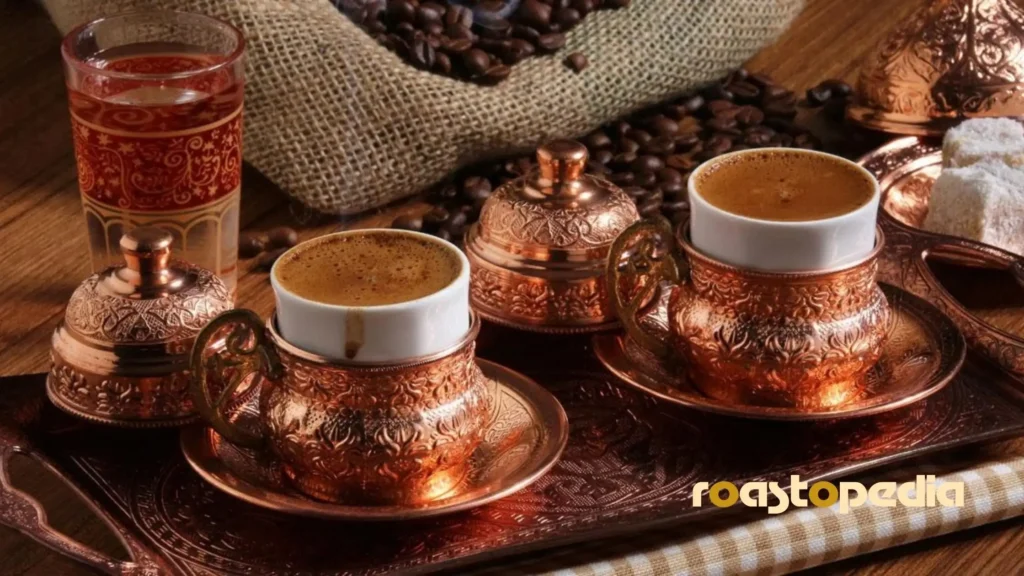
The drink is associated with the coffee culture of southeastern Turkey, where strong, reduced preparations like Mirra similarly valorize intensity over volume.
Gaziantep’s coffee culture is among the most deeply rooted in Turkey; the city has been a significant coffee trade and preparation hub since the early Ottoman period, and its culinary traditions — including coffee — have been recognized in UNESCO’s Creative Cities of Gastronomy program.
Devebatmaz is simultaneously a beverage and a cultural artifact, asserting Gaziantep’s identity as a place of superlative culinary intensity.
Etymology
Deve means camel in Turkish; batmaz is the negative form of batmak, which means “to sink,” “to submerge,” or “to become bogged down.”
Devebatmaz, therefore, translates literally as “a camel would not sink in it” — an idiom meaning the liquid is so thick and dense that even a camel (the heaviest beast of burden in the Ottoman Near Eastern imagination) could walk on its surface without sinking.
The compound name is a hyperbolic expression of extreme viscosity, functioning as both a product description and a cultural brag about the coffee’s supernatural concentration. It belongs to a tradition of folkloric exaggeration in Ottoman-Anatolian food naming conventions.
The Science of the Brew
Devebatmaz Kahvesi is prepared by dramatically reducing the standard water-to-coffee ratio and extending the brewing time.
A standard Türk Kahvesi uses approximately 7–10 grams of coffee per 60 ml of water (~1:6–1:8 ratio). Devebatmaz uses ratios reported as low as 1:3 or 1:2 — producing a brew whose total dissolved solids (TDS) may reach 8–12%, approaching the consistency of a thin syrup.
Viscosity increases non-linearly with TDS; at these concentrations, surface tension is measurably altered.
Melanoidins — high-molecular-weight brown polymers formed during roasting and extended brewing — are present at elevated concentrations, contributing both to color depth and viscosity. The caffeine content per milliliter is extremely high, though the serving size is correspondingly tiny (20–40 ml).
Taste & Sensory Profile
Devebatmaz Kahvesi is almost syrup-like in consistency, coating the inside of the cup and clinging to the lips. Flavor is overwhelmingly concentrated — intensely bitter, roasted, with charred wood and dark chocolate notes pushed to their extreme.
Sweetness, if added, integrates completely into the syrupy body. Acidity is fully suppressed by the reduction. The aftertaste is extraordinarily long-lasting — some drinkers report the bitterness and roast character persisting for 20–30 minutes.
Aroma is powerful and fills the room even from a small cup. It is not a drink for casual consumption; it is an experience of coffee at its physiological and culinary maximum.
Variations
Pure Devebatmaz (black, no additions), Şekerli Devebatmaz (with sugar integrated pre-brew), Cardamom Devebatmaz (spiced version), and modern café adaptations that present Devebatmaz as a “coffee shot” experience analogous to espresso, served in shot glasses alongside water and Turkish delight.
The reduction can be achieved via single extended brewing or by layered additions of water over prolonged heat.
Notable Facts
The camel metaphor in the name is specifically interesting because camels were a standard unit of burden measurement in Ottoman commerce — their carrying capacity was so well-established that “camel-load” was a recognized unit of weight in market regulation.
Using a camel as the standard against which to measure the coffee’s density was not random hyperbole but a deliberate reference to the most understood weight benchmark in the regional economy.
Gaziantep hosts an annual food festival (Gastronomy Festival) where Devebatmaz Kahvesi preparation is demonstrated as a heritage skill.
Modern food scientists who have analyzed traditional recipes estimate that achieving the folkloric “camel doesn’t sink” consistency would require a TDS of roughly 20%+ — far beyond what is practically achievable through boiling alone, making the name definitively metaphorical.
Related Drinks
Mirra, Türk Kahvesi, Süvari Kahvesi, Ristretto (espresso analogue for concentrated coffee), Greek Sketo (strong, unsweetened coffee).