
Baraka is the third and final pour of the Ethiopian coffee ceremony, brewed from grounds that have already yielded two previous extractions — Abol and Tona.
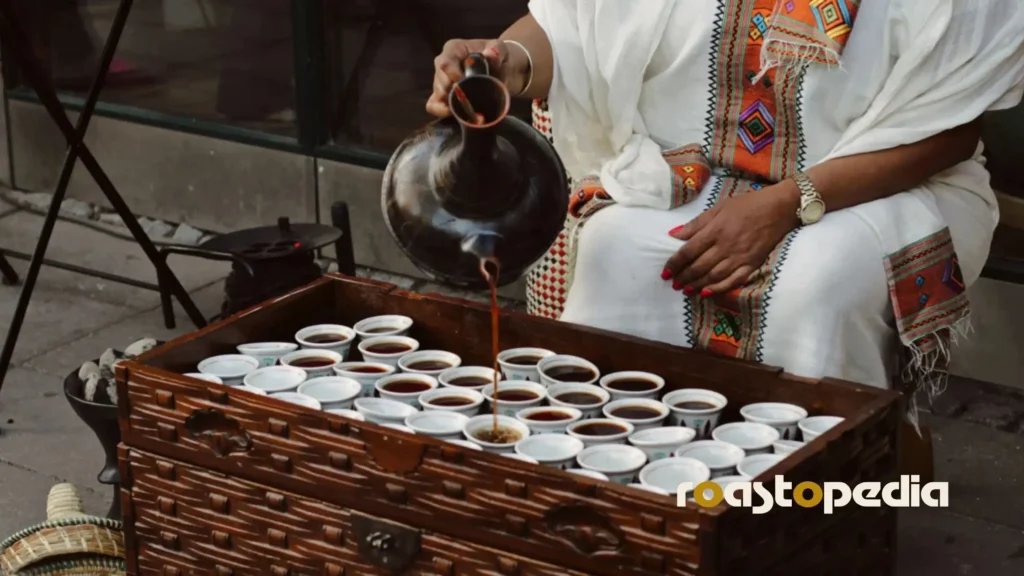
It is the lightest, mildest, and most spiritually significant of the three cups, and its name — meaning ‘blessing’ in both Amharic and Arabic — encodes the ceremony’s culminating moment of benediction and farewell.
To receive Baraka is to receive the host’s blessing; to leave before Baraka is considered in many Ethiopian communities a gesture of disrespect or, at minimum, an interruption of social completeness.
The concept of blessing embedded in Baraka connects the Ethiopian coffee ceremony to a broader Islamic and Christian theological framework shared across Ethiopia’s religiously diverse population.
Ethiopia is home to the Ethiopian Orthodox Tewahedo Church — one of the oldest Christian denominations in the world, established in the fourth century CE — as well as a significant Muslim population concentrated in the east and southeast.
The word ‘baraka’ itself is Arabic in origin and is used in Islamic religious discourse to denote divine blessing or grace. Its adoption into the nominally Orthodox Christian coffee ceremony reflects the centuries of coexistence and cultural exchange between Ethiopia’s religious communities.
Etymology
The word ‘baraka’ enters the Ethiopian lexicon from Arabic, where it carries the meaning of divine blessing, sanctified abundance, or spiritual grace. In Islamic tradition, ‘barakah’ is a quality believed to be transmitted through sacred objects, holy persons, and specific ritual acts.
Its use as the name for the third coffee pour suggests that early practitioners of the ceremony understood the closing cup as a vehicle of transmitted blessing — from host to guest, from the ceremony’s spiritual dimension to its participants’ daily lives.
The same word, in variant spellings, appears in Hebrew (‘berakhah,’ meaning blessing) and in Swahili and many other languages influenced by Arabic trade contact.
The Science of the Brew
Baraka is produced by a third addition of water to the jebena and a third boil of substantially depleted grounds. By this stage, the grounds have yielded most of their readily soluble caffeine, chlorogenic acids, and dissolved solids. Baraka’s caffeine content is estimated at 20–40% of Abol’s concentration — approximately equivalent to a weak cup of drip coffee or a strong cup of black tea.
Despite its diminished concentration of primary coffee compounds, Baraka retains a meaningful portion of the coffee’s phenolic antioxidants, which are released at different rates across multiple extractions.
Some volatile aromatic compounds, particularly those associated with the Maillard reaction products from roasting, re-volatilize during the third boil, ensuring that Baraka retains a recognizable coffee aroma even as its intensity diminishes. The result is a cup that is chemically distinct from Abol and Tona rather than simply a weaker version of either.
Taste & Sensory Profile
Baraka is light, warm, and subtly coffee-flavored — more evocative of coffee than assertively coffee in character.
Bitterness is minimal; what remains is a gentle roasted warmth with a clean, slightly sweet finish that needs little or no added sugar. The body is thin, the color a translucent amber, and the aroma is mild but recognizably coffee-derived.
The sensory experience of Baraka is as much about context as content: consumed at the close of a ceremony that has already delivered two progressively lighter cups, Baraka’s mildness feels like a deliberate resolution rather than a deficiency. It is the coffee equivalent of a final, quiet note after a sustained musical movement — its restraint is intentional and meaningful.
Variations
In some communities, Baraka is prepared with fresh grounds added to the depleted jebena, producing a final cup of full strength — a practice that contradicts the ceremony’s traditional philosophy of diminishing intensity but reflects regional preferences for consistency across all three rounds.
In Harari households, Baraka is sometimes infused with dried ginger root during the third boil, adding a warming finish to the ceremony’s closing cup. A small number of contemporary Ethiopian cafes in Addis Ababa have adapted Baraka as a menu item — offering a deliberately light coffee infusion as a standalone drink for guests who want a minimal caffeine experience.
Obscure & Fascinating Facts
The distribution of Baraka at the ceremony’s close is accompanied in many communities by a specific verbal exchange: the host says ‘tena yistilign’ (‘may it give you health’) and the guest responds ‘betam ameseginalhu’ (‘I thank you very much’). This formulaic exchange, repeated over the same grounds that have been brewing since the ceremony began, creates a verbal ritual as consistent and preserved as the drink itself — a spoken complement to the three-pour structure that some anthropologists classify as one of Ethiopia’s oldest documented oral formulas.
Ethiopian Diaspora communities in the United States, Israel (home to a community of Ethiopian Jews known as Beta Israel), and Europe have adapted the three-pour ceremony in varying ways. Some communities collapse all three pours into a single extended serving; others preserve the structure meticulously as an act of cultural continuity. In Israel, the coffee ceremony practiced by Beta Israel communities has been studied as a form of cultural memory transmission — one of the most durable vectors of Ethiopian identity in diaspora settings.
Related Drinks
- Abol — the first and strongest pour, beginning the ceremony that Baraka concludes
- Tona — the second pour, the conversational middle of the ceremony
- Jebena Coffee — the overarching brewing method and ceremony of which Baraka is the final expression
- Kuti — a related concept of final re-extraction, sharing Baraka’s philosophy of complete use