
The cowboy kettle method is a traditional, filter-free approach to brewing coffee outdoors, typically over an open fire or camp stove. Preparation involves bringing water to a boil, incorporating coarsely ground coffee directly into the kettle, and introducing a small quantity of cold water at the end of the brew to encourage grounds to settle before the beverage is poured.
Historically associated with the American frontier and the cattle drives of the 19th century, the method prioritizes utility, thermal retention, and high-volume output over the precision of modern extraction standards.
The process is unique for its lack of a physical filtration medium, relying instead on gravitational sedimentation and chemical additives—most notably cold water or eggshells—to clarify the resulting beverage.
Origin & History
Cowboy kettle brewing emerged as a survivalist adaptation during the expansion of the American West (c. 1860–1890). While the practice of boiling grounds is ancient, dating back to 15th-century Sufi monasteries in Yemen, the American iteration was defined by the specific logistical constraints of the trail.
Coffee was considered a primary ration, often more accessible than potable water, and served as the central stimulant for trail bosses and “vaqueros” alike. Trail boss George Duffield famously recorded in 1866 that his men remained in the saddle for sixty consecutive hours during storms, sustained primarily by “hasty rations” of bread and coffee.
Patency & Lineage
The method descends from the “boiled coffee” traditions of Europe, particularly Scandinavian and Turkish styles, but evolved toward larger-scale preparation.
Unlike the Turkish cezve, which produces a viscous, foam-heavy concentrate, the cowboy method utilizes a larger “kettle” or “pot” to produce a more diluted, drinkable infusion. The lineage of the equipment transition from heavy cast iron to lighter, more durable materials like tinned iron and eventually graniteware followed the broader industrialization of kitchenware in the mid-to-late 19th century.
Migration & Adoption
The method migrated from the early exploration parties of the 1840s to the structured cattle drives of the post-Civil War era. It was during this period that Arbuckle Brothers Coffee introduced the “Ariosa” roast, which became the standard for trail brewing.
To prevent spoilage and improve the clarification of the brew, Arbuckle’s coated their beans in a glaze of egg white and sugar. This technical innovation allowed cowboys to clarify their kettle brew without carrying fresh eggs, as the albumen in the coating acted as a fining agent when the beans were boiled.
How the Equipment Works and How Long It Takes to Brew Coffee
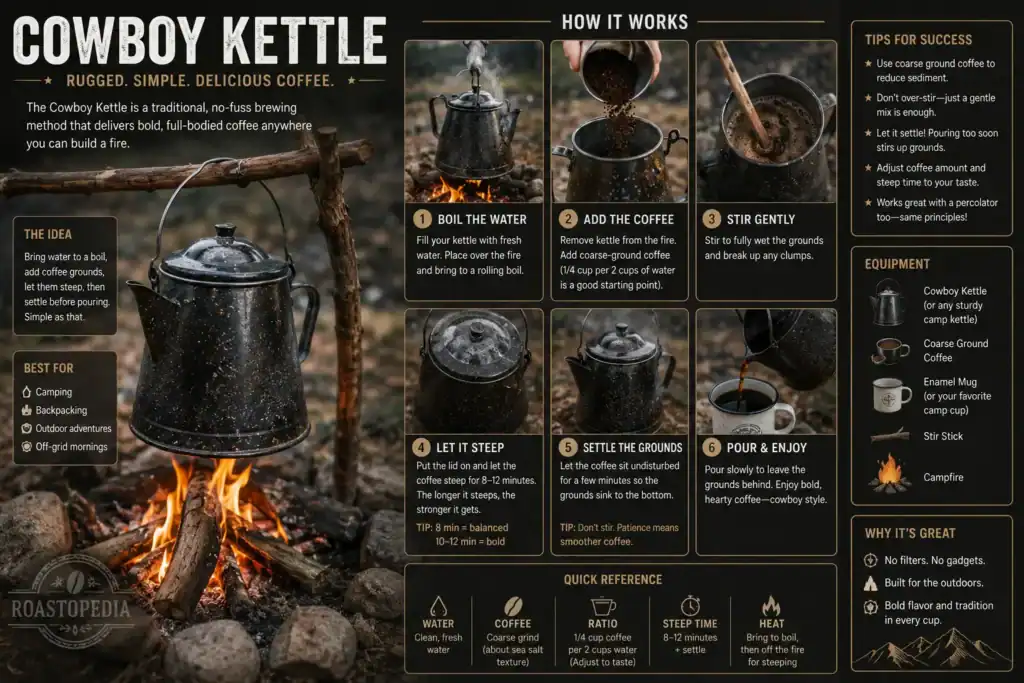
Cowboy brewing equipment operates on the principle of thermal mass and convective currents. The kettle, typically constructed from high-conductivity materials like tinned iron or enamel-coated steel, facilitates rapid heat transfer from an open flame to the water.
Once the water reaches a boil and grounds are added, the suspension undergoes “passive agitation” as thermal energy causes the grounds to circulate. Total brewing time typically ranges from 4 to 6 minutes of active immersion, followed by a 2-minute “clarification phase” where the heat is removed.
During this phase, the absence of active boiling allows the grounds to succumb to gravity, settling into the lower reservoir of the pot.
Uses & Importance
In the context of the frontier, the coffee pot was the most significant piece of “kitchen furniture.” It served not only as a brewing vessel but as a heat source and a communal focal point. For ranchers like Charles Goodnight, who is credited with inventing the chuckwagon, the coffee pot was kept on the fire perpetually.
The brew provided the necessary caloric and psychological boost for laborers working in extreme weather conditions. Strong coffee was often the only luxury available on the trail, leading to a culture where “weak” coffee was derisively termed “dehorned belly wash.”
Role & Why It Matters
Cowboy brewing matters technically as the precursor to the modern French Press (patented in 1929). Both methods utilize full immersion, yet the cowboy method lacks the mechanical plunger, necessitating alternative methods for grounds management. It represents the “primitive” end of the extraction spectrum, where the variables of temperature and time are managed through physical observation rather than precision instruments.
Technical Specifications
| Feature | Specification |
| Extraction Method | Full Immersion / Decantation |
| Typical Grind Size | Extra Coarse (1500–2000 microns) |
| Standard Pot Material | Graniteware (Enamel-coated steel) or Tinned Iron |
| Capacity Range | 3 to 5 Gallons (standard trail size) |
| Ideal Water Temp | 93°C – 98°C (post-boil) |
| Brewing Duration | 4 to 6 minutes |
| Clarification Agents | Cold water, eggshells, or salt |
Variations
Techniques for settling grounds vary by region and necessity. The “Cold Water Trick” involves pouring a small amount of cold water into the top of the hot kettle; the sudden temperature change increases the density of the suspended grounds relative to the hot liquid, causing them to sink rapidly.
Another common variation is the use of crushed eggshells. The calcium carbonate in the shells acts as a pH buffer, neutralizing the bitterness of over-extracted acids common in boiled brews, while the proteins in the attached albumen bind to the grounds to aid sedimentation.
Notable Facts
- Arbuckle’s Ariosa coffee was so ubiquitous that “Arbuckle’s” became a synonymous term for coffee in the American Southwest.
- Teddy Roosevelt was a documented enthusiast of strong coffee, reportedly consuming up to a gallon per day, often prepared in large-batch trail styles.
- The “sinker” method involved swinging the pot in a 360-degree vertical circle to use centrifugal force to drive the grounds to the bottom, though this was more common in folklore than in daily practice.
Associated People & Regions
- Charles Goodnight (Texas): The legendary cattleman who revolutionized trail logistics and was known for his preference for “scalding hot” coffee.
- John Wesley Powell (Colorado River): His 1869 expedition journals frequently mention the reliance on boiled coffee during the exploration of the Grand Canyon.
- The American Great Plains: The geographic heart of the cowboy brewing tradition.
Related Equipment
- Chuckwagon: The mobile kitchen where the large-scale brewing occurred.
- Graniteware Pot: Recognizable by its blue or white speckled enamel, it became the iconic vessel for the method due to its resistance to rust and ease of cleaning.
- Tripod: A wrought-iron stand used to suspend the kettle over a campfire.
Adoption & Modern Impact
Today, cowboy brewing is primarily preserved by the outdoor recreation and “glamping” communities as a nostalgic or survivalist skill. Its technical principles—immersion extraction without paper filtration—remain the foundation for coffee cupping, the industry-standard method for evaluating coffee quality.
While modern baristas prioritize precision, the fundamental physics of the cowboy kettle remain a cornerstone of coffee science.
See Also
- French Press Brewing
- Turkish Coffee Extraction
- Coffee Cupping (SCA Standard)
- Percolation Methods
- Scandinavian Egg Coffee
- Campfire Cooking Techniques
References
- Duffield, G. (1866). Diary of a Trail Boss. Texas State Historical Association.
- Goodnight, C. (1936). Charles Goodnight: Cowman and Plainsman. Houghton Mifflin.
- Arbuckle Brothers. (1873). The Story of Arbuckle’s Ariosa Coffee. Corporate Archive.
- Roosevelt, T. (1913). Theodore Roosevelt: An Autobiography. Macmillan.
- Pendergrast, M. (1999). Uncommon Grounds: The History of Coffee and How It Transformed Our World. Basic Books.
- Abbott, E. C. (1939). We Pointed Them North: Recollections of a Cowpuncher. University of Oklahoma Press.
- Dary, D. (1981). Cowboy Culture: A Saga of Five Centuries. Alfred A. Knopf.
- Goodrich, J. (2012). The Frontier Coffee House. Journal of Western History.
- Rybczynski, W. (2000). One Good Turn: A Natural History of the Screwdriver and the Chuckwagon. Scribner.
- Hoffmann, J. (2014). The World Atlas of Coffee. Mitchell Beazley.
- Rao, S. (2008). The Professional Barista’s Handbook. Scott Rao Publishing.
- Sostre, J. (2006). The Complete Idiot’s Guide to Coffee and Tea. Alpha Books.
- Smith, A. F. (2004). The Oxford Encyclopedia of Food and Drink in America. Oxford University Press.
- Powell, J. W. (1875). The Exploration of the Colorado River and Its Canyons. Government Printing Office.
- National Cowboy & Western Heritage Museum. (2021). Technical Evolution of Trail Equipment. Museum Archives.
- Smithsonian Institution. (1995). The American West: Objects and Icons. Smithsonian Press.