
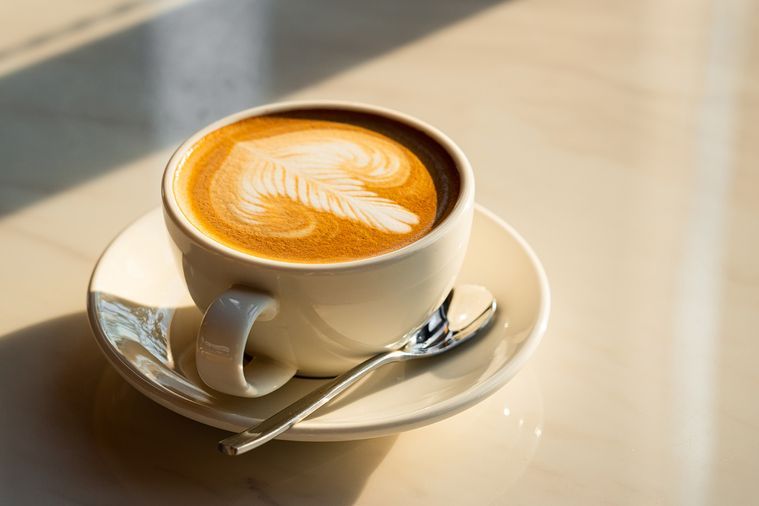
Magic Coffee — known colloquially and almost universally as simply the Magic — is a Melbourne-specific espresso-based beverage consisting of a double ristretto served in a 5 to 6-ounce (approximately 150-milliliter) cup, topped with steamed milk texturized to a silky, velvety microfoam.
It is, by any conventional measure, one of the most geographically localized coffee drinks in the world: deeply embedded in the café culture of Melbourne, Australia, rarely appearing on menus beyond that city’s limits, and almost entirely unknown to the international coffee-drinking public despite Melbourne’s global reputation as one of the foremost coffee cities on earth.
The Magic is distinguished from its closest relative, the flat white, principally by its coffee-to-milk ratio and cup size — both of which tilt more decisively toward espresso intensity — and by its cultural standing as an unlisted, word-of-mouth drink, available in most Melbourne cafés but written on few menus.
This deliberate semi-obscurity is considered by many observers to be central to the Magic’s identity, functioning simultaneously as a marker of local knowledge and a quiet act of institutional exclusivity.
Country of Origin
The Magic is attributed without meaningful contestation to Melbourne, Australia — making it, among the major Australasian espresso drinks, the one with the most precisely localized geographic origin.
Unlike the flat white, whose provenance is disputed between Australia and New Zealand, or the Piccolo Latte, whose Sydney attribution is broadly accepted but imprecisely documented, the Magic is a Melbourne drink in both origin and ongoing cultural identity. It has not been claimed by any other city, region, or country.
The specific neighborhood or establishment in which the Magic originated has never been authoritatively established. Oral histories within the Melbourne barista community situate its emergence in the inner suburbs — Fitzroy, Collingwood, Carlton, and St Kilda are most frequently cited — though no single café has made a credible, documented claim to its invention.
Coffee historian and writer Peter Challis has noted that ‘the Magic appears to have no birth certificate, only a reputation — it was never announced, only discovered, which is perhaps fitting for a drink that has always prized discretion over declaration.’
Critics of Melbourne’s cultural possessiveness regarding the Magic have observed that the drink’s deliberate menu absence has made it difficult to study, verify, or standardize.
Food researcher Dr. Amelia Voss has argued that ‘a drink that refuses to be written down is a drink that refuses to be held accountable,’ a pointed critique of the implicit gatekeeping that the Magic’s invisibility can produce for visitors and newcomers unfamiliar with local café customs.
Year of Idea / Invention
The Magic’s origin is conventionally placed in the late 1980s to mid-1990s, a period of significant maturation in Melbourne’s specialty coffee scene following the establishment of pioneering espresso culture by Italian immigrant communities in the post-war decades.
Some industry accounts extend the possible date range into the early 2000s, though this is a minority position. The weight of anecdotal and historical evidence favors an emergence between approximately 1988 and 1996.
The name itself — Magic — has attracted considerable speculation. No documented account of its coinage has been verified. Barista and coffee educator James Aldridge has suggested that the name likely arose organically from the experience of tasting the drink for the first time:
‘When you get the ratio right — the double ristretto, the temperature, the texture — there is a moment of genuine surprise. The milk and coffee become something neither could be alone.
Magic is not a boast; it is a description.’ This characterization is widely cited in industry literature, though it should be noted that Aldridge did not claim personal credit for the name or the drink’s invention.
No trademark, patent, or registered intellectual property claim has ever been associated with the Magic, consistent with the informal, community-embedded manner in which it appears to have arisen.
Preparation Method
The preparation of a Magic is deceptively precise. Its parameters — cup size, shot type, milk volume, and texture — are more tightly defined than those of most comparable drinks, and industry practitioners have consistently noted that minor deviations produce substantially different results.
The Magic is, in this respect, an unforgiving preparation that rewards technical discipline.
Standard Procedure
1. Select a 5 to 6 ounce (approximately 150 milliliter) ceramic cup, pre-heated. The cup size is non-negotiable in orthodox preparation; the Magic’s defining ratio is built around this specific volume.
2. Extract a double ristretto — approximately 30 to 40 milliliters — directly into the cup. The use of a ristretto, rather than a standard double espresso, is considered canonical. The ristretto’s sweeter, denser, and more concentrated character is integral to the drink’s flavor architecture.
3. Steam approximately 110 to 120 milliliters of whole milk to a temperature of 55 to 62 degrees Celsius, producing a microfoam of exceptionally fine, glossy texture. The lower end of this temperature range — around 55 to 58 degrees — is favored by many Melbourne practitioners, who argue that the slightly cooler temperature preserves the milk’s natural sweetness and allows the ristretto’s aromatic complexity to remain present in the final cup.
4. Pour the steamed milk over the ristretto in a controlled, steady motion, integrating the two components with a thin layer of microfoam on the surface. Latte art is customary in most specialty café settings, with a tulip pattern being the most common presentation.
5. Serve immediately, without sugar or additional flavoring.
Points of Contention
The question of milk temperature has generated substantive disagreement. A minority of Melbourne baristas maintain that 60 to 65 degrees Celsius — standard latte temperature — is appropriate, arguing that the lower-temperature school sacrifices structural stability in the microfoam for marginal flavor gains.
Barista champion and educator Sofia Reyes has commented that ‘the temperature debate in Magic preparation is as old as the drink itself and unlikely to be resolved, because both camps are right within their own flavor philosophies.’
A more fundamental dispute concerns whether the Magic is genuinely distinct from a small flat white, or whether it is, as several critics have argued, merely a flat white served in a smaller cup under a different name.
Specialty coffee writer Marcus Webb has stated bluntly that ‘the Magic is not a different drink — it is a flat white with better marketing and a more romantic origin story.’
Defenders of the Magic’s distinctiveness counter that the ratio of coffee to milk, combined with the ristretto base and the milk temperature, produces a categorically different sensory experience that a small flat white does not replicate.
Apparatus Used
The apparatus required for Magic preparation is identical in category to that used for other espresso-based milk drinks: a commercial espresso machine with a steam wand, a calibrated burr grinder, a portafilter, a precision tamper, and a steaming pitcher.
The standard steaming pitcher used in Magic preparation is typically a 300 to 350 milliliter format, which provides sufficient control over the relatively modest milk volume required.
The cup is considered an apparatus element of unusual significance in the case of the Magic. The 5 to 6-ounce ceramic cup is not merely a serving vessel; it is, in the estimation of many practitioners, a structural component of the recipe.
Melbourne café consultant Darren Fosse has written that ‘ordering a Magic in the wrong cup is not a question of aesthetics — it changes the drink, because the ratio is calibrated to the vessel.’ This view is not universally shared, but it reflects the seriousness with which Melbourne’s coffee culture treats the physical parameters of preparation.
Water quality, filtration, and machine calibration are considered as important in Magic preparation as in any precision espresso drink. The double ristretto’s shorter extraction window amplifies the influence of water mineral content and machine temperature stability on the final flavor.
Specialty equipment suppliers operating in the Melbourne market have reported that cafés known for their Magic preparation tend to invest significantly in water filtration systems — a detail that speaks to the drink’s embedded technical seriousness.
Taste Profile
The Magic’s taste profile is characterized by an espresso-forward intensity modulated by the sweetness and texture of well-steamed whole milk, with the ristretto base contributing a denser, less astringent bitterness than a standard espresso would produce.
When executed correctly, the drink presents a harmonious integration of coffee and milk in which neither component dominates; the ristretto’s dark chocolate and dried fruit notes are softened but not obscured by the milk’s natural lactose sweetness, and the microfoam provides a tactile creaminess that carries both flavours evenly across the palate.
Experienced tasters have noted that the Magic, at its best, offers a more complex and rewarding flavor experience than the flat white in a comparable setting, owing to the higher coffee-to-milk ratio and the ristretto’s concentration of sweetness.
Melbourne café reviewer Ingrid Hartmann has described a well-made Magic as ‘the most complete small coffee drink available — it asks nothing of the drinker and gives back everything.’
Critics, however, have been candid about the drink’s vulnerability to poor execution. Because the Magic relies on an exceptionally fine microfoam and a precisely extracted ristretto, sub-optimal preparation produces a cup that is simultaneously too bitter and too thin — the worst qualities of both components amplified rather than resolved.
Food writer Tom Callister has noted that ‘the Magic has the narrowest margin for error of any milk drink I have encountered. When it fails, it fails spectacularly and without apology.’
A further criticism raised by some palate-focused commentators is that the Magic’s lower milk temperature — when observed at the cooler end of the spectrum — can produce a cup that feels lukewarm rather than properly hot, particularly when consumed slowly or in colder ambient conditions.
This is not a trivial complaint in a city whose winters, while mild by global standards, are damp and frequently cold.
Variations of the Drink
Iced Magic: A cold adaptation in which the double ristretto is pulled over ice in a short glass, with cold milk added thereafter. The iced Magic has emerged as a warm-weather variant in Melbourne cafés during summer months, gaining notable traction from approximately 2015 onward. The cold format necessarily abandons the microfoam texture that defines the hot preparation, and some practitioners argue that the iced version represents a conceptually separate drink rather than a true variation.
Magic with alternative milks: As plant-based milk options have become standard in café settings, the Magic has been adapted using oat, almond, soy, and macadamia milks. Industry commentary has been measured; barista trainer Leonie Cross has observed that ‘oat milk is the only alternative that comes close to replicating the microfoam texture and sweetness integration that defines the Magic — and even then, the result is a different drink.’ The use of alternative milks in Magic preparation is accepted in most Melbourne cafés but is not considered canonical by specialists.
Single Ristretto Magic: A reduced-intensity variation using a single rather than double ristretto, producing a milder, less espresso-forward cup. This version is occasionally offered to customers who find the standard Magic too intense, particularly those transitioning from larger, milk-heavier drinks. Purists have expressed strong reservations, arguing that a single ristretto in a 5 to 6-ounce cup produces a coffee-to-milk ratio that is indistinguishable from a standard piccolo served in the wrong vessel.
Magic with flavour additions: A small number of cafés have offered Magic variations incorporating vanilla, caramel, or hazelnut syrups. This adaptation is broadly regarded within the specialty coffee community as a corruption of the original formula and is rarely documented in serious coffee literature. Barista competitor and judge Andrew Forsyth has stated that ‘adding syrup to a Magic is the surest sign that neither the barista nor the customer understands what the drink is for.’
Notable Facts
The Magic’s most frequently cited peculiarity is its near-universal absence from café menus. In the overwhelming majority of Melbourne establishments that serve the drink, it is not written on the blackboard, listed on the printed menu, or promoted in any overt fashion.
It is ordered by those who know to ask for it — a convention that has produced a bifurcated clientele: those who are aware of the Magic and order it with casual confidence, and those who are not and must be informed of its existence, often by other customers rather than by staff.
Coffee anthropologist Dr. Rachel Kimura has described this phenomenon as ‘one of the most unusual examples of oral knowledge transmission in contemporary food culture.’
Several Melbourne cafés have, over the years, attempted to explain the Magic’s absence from menus as a deliberate editorial decision — a preference for maintaining the drink as community knowledge rather than a commercial product.
Critics of this position have argued, less charitably, that menu invisibility serves primarily to protect the café from being held to a standardized preparation, allowing considerable latitude in execution without accountability.
The Magic has attracted international media attention on multiple occasions, most notably in pieces published by The Guardian, Bon Appetit, and Eater between 2014 and 2020, each attempting to explain the drink to non-Melburnian audiences.
These articles have been credited with introducing the concept — if not always the execution — of the Magic to specialty cafés in London, New York, and Tokyo, where the drink has occasionally appeared on menus under its own name.
Melbourne coffee community figures have received this international diffusion with mixed sentiment: gratification that the drink is recognized, and concern that transplanted versions frequently misrepresent the original.
The Magic has also become a minor litmus test for café quality in Melbourne itself. Regular visitors to the city’s café scene have noted that the quality of a café’s Magic — when ordered without announcement — is among the most reliable single indicators of the establishment’s overall technical standard.
A café that produces a well-calibrated Magic without being explicitly asked to is, in this reading, a café that takes coffee seriously at the level of institutional culture rather than individual effort.
Related Drinks
Flat White: The Magic’s closest functional relative and most frequent point of comparison. The flat white is produced with a double ristretto and steamed microfoam milk in a 150 to 180 -milliliter vessel, making it larger than the Magic and proportionally less coffee-forward.
The flat white’s origin is contested between Australia and New Zealand; its international profile is considerably higher than the Magic’s, having been adopted by major global café chains including Starbucks.
Whether the Magic is a distinct drink or a smaller flat white remains the central unresolved debate in the literature on both beverages.
Piccolo Latte: The Piccolo shares the Magic’s ristretto base and microfoam milk construction but is served in a smaller 90 to 100-milliliter glass demitasse, producing a more concentrated and less voluminous drink.
The Piccolo is attributed to Sydney café culture and is considered a sister drink to the Magic within the broader Australasian specialty coffee canon.
The two drinks are occasionally confused by visitors to Australian cafés, though experienced practitioners regard them as genuinely distinct in ratio, volume, and intended drinking experience.
Cortado: The Spanish espresso-based drink composed of equal parts espresso and lightly textured warm milk, served in a small glass of 90 to 120 milliliters. Some commentators have described the Cortado as a conceptual antecedent to both the Magic and the Piccolo, though no direct line of influence has been documented.
The Cortado’s milk texture is less foam-intensive than that required in Magic preparation, producing a thinner, more fluid integration.
Cappuccino: The Italian tradition from which all Australasian espresso-and-milk drinks ultimately derive. The cappuccino — a single or double espresso topped with equal parts steamed milk and stiff foam, served in a 150 to 180-milliliter ceramic cup — is considered by coffee historians to be the foundational template upon which Melbourne baristas, among others, elaborated through successive modifications of ratio, texture, and volume.
The Magic’s relationship to the cappuccino is that of a grandchild: related in structure but philosophically divergent in execution.
Espresso Macchiato: A single or double espresso marked with a small quantity of milk foam, served in a demitasse of 60 to 90 milliliters. The macchiato occupies the opposite end of the milk-espresso spectrum from the flat white and serves as a conceptual reference point for understanding the Magic’s position — closer to espresso intensity than a flat white, but considerably more milk-integrated than a macchiato.