
Abol is the first of three sequential pours that constitute the Ethiopian coffee ceremony — the ‘bunna ceremony’ or ‘jebena buna.’
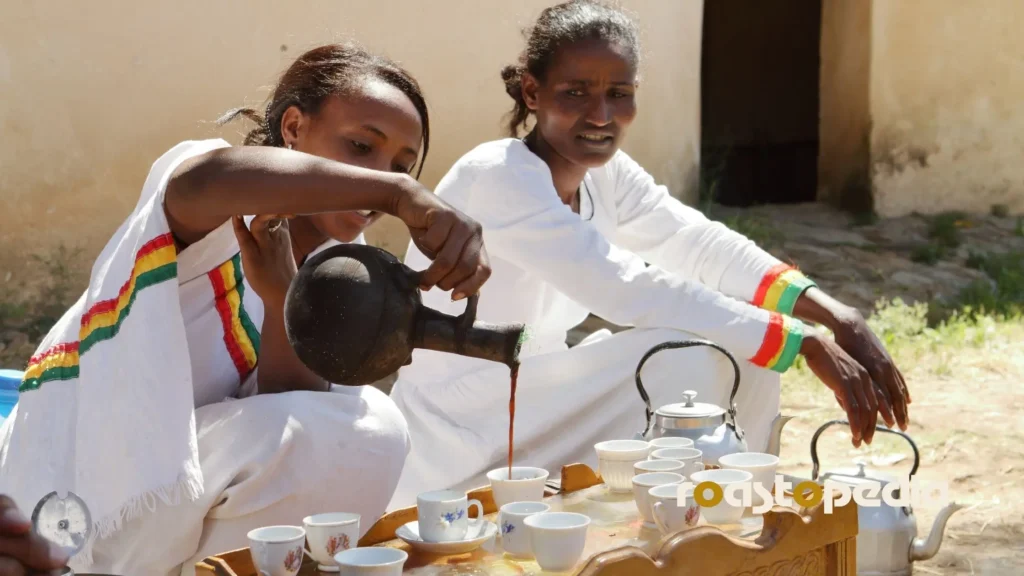
It is the strongest, most concentrated, and most symbolically significant of the three rounds, and its consumption marks the formal commencement of the ceremony. The three-pour structure of the Ethiopian coffee ceremony is documented in sources dating to at least the 18th century, and oral tradition attributes its origin to the Oromo people of the Kaffa region, where coffee was first cultivated.
The three pours — Abol, Tona, and Baraka — are not simply sequential cups of the same coffee but are understood as distinct phases of a single continuous social and spiritual event. Abol is the moment of welcome; to be present for Abol is to be a full participant in the ceremony. Arriving after Abol has been served is considered a social discourtesy in many Ethiopian communities. The ceremony itself is one of the most enduring unbroken social institutions in the world, practiced daily in millions of Ethiopian households and now recognized by UNESCO as an Intangible Cultural Heritage of Humanity (2024).
Etymology
The word ‘Abol’ derives from the Amharic root associated with first, beginning, or primary. It is linguistically related to words meaning ‘head’ or ‘top’ in several Semitic and Cushitic language families represented in the Ethiopian linguistic landscape. In Tigrinya-speaking communities, the first pour is sometimes called ‘Arbol’ — a phonological variation of the same root. The name directly encodes its ceremonial status: Abol is the coffee of primacy, the cup that sets the social register for what follows.
The Science of the Brew
Abol is produced from the initial brew in the jebena — fresh grounds combined with cold water and brought to a boil over charcoal for 15–20 minutes. This first extraction yields the highest concentration of dissolved solids: caffeine, chlorogenic acids, lipids (cafestol and kahweol), and Maillard reaction products from the roasting process. The total dissolved solids (TDS) in Abol typically fall in the range of 2.5–4.0%, placing it in the concentration range of a strong espresso ristretto when adjusted for the longer extraction time.
Cafestol and kahweol — diterpene compounds extracted from unfiltered coffee — are present in significant quantities in Abol. These compounds are known to elevate LDL cholesterol levels with regular consumption; however, they also demonstrate anti-inflammatory and potential hepatoprotective effects in laboratory studies. The clay stopper of the jebena filters particles but does not remove these lipid compounds, which remain in the final cup.
Taste & Sensory Profile
Abol is intense, thick, and boldly bitter. The high extraction concentration produces a cup with pronounced roasted bitterness, full body, and a lingering, slightly resinous finish. Sugar is commonly added — one to two teaspoons per small cini cup — but even heavily sweetened, Abol retains its assertive character.
The aroma at the moment Abol is poured is the ceremony’s sensory climax: the first pour from a jebena that has been sealed over hot coals releases a concentrated burst of volatile aromatic compounds that fills the room. This aromatic moment, combined with the frankincense smoke typically burning nearby, creates the multisensory signature of the Ethiopian coffee ceremony.
Variations
Regional variation in Abol centers on the degree of roast and the type of additions. In Tigray province, Abol is sometimes served with a pinch of salt rather than sugar. In Harari communities, a small cardamom pod may be placed in the cini cup before Abol is poured, infusing the cup with spice during drinking. In some Gurage households, a teaspoon of niter kibbeh is added to Abol specifically — reserving the butter addition for the strongest pour as a mark of particular honor.
Notable Facts
The caffeine content of Abol has been estimated by researchers at Jimma University in Ethiopia to be meaningfully higher than that of a standard espresso shot when accounting for the longer extraction time, larger serving volume (60–80 ml versus 25–30 ml for espresso), and the re-boiling method, which maximizes caffeine solubility at 100°C. Ethiopian adults who participate in the full three-pour ceremony daily consume a caffeine load from Abol alone that rivals or exceeds a double espresso.
In some Ethiopian Orthodox Christian communities, Abol is not consumed during fasting periods (which can total over 200 days per year for observant practitioners), yet the ceremony itself continues — the host prepares and serves Abol for guests while abstaining personally, an act of hospitality that places social obligation above personal religious observance.
Related Drinks
- Tona — the second pour of the ceremony, made from re-boiled grounds
- Baraka — the third and final pour, meaning ‘blessing’
- Jebena Coffee — the overarching ceremony and method of which Abol is the first expression
- Buna — the general Ethiopian term for coffee, of which Abol is the strongest ceremonial form