
South Indian Filter Coffee is a milk-based decoction coffee, produced by passing hot water through finely ground coffee packed inside a two-chambered stainless-steel filter, then blending the resulting concentrate with boiled milk and sugar. Millions across Tamil Nadu, Karnataka, Kerala, and Andhra Pradesh know the drink simply as kaapi. Regional kitchens attach their own labels to their filter coffee, including Madras filter coffee, Mylapore filter coffee, and Kumbakonam degree coffee, though the underlying brewing and serving methods remain largely unchanged.
Origin & History
Coffee reached India centuries before the filter itself existed, arriving through a route historians still debate. According to enduring folklore, a Sufi pilgrim named Baba Budan smuggled seven green coffee seeds out of Yemen during the seventeenth century, hiding them in his robes because green beans could not legally leave the Arabian Peninsula. He planted the seeds in the Chandragiri hills of Karnataka, a range now called Baba Budan Giri in his honour.
Plantations spread gradually across the hill tracts of Coorg, Chikmagalur, and the Nilgiris under colonial administration during the nineteenth century. Filtered, milk-and-sugar coffee as a household ritual only crystallized in the early twentieth century, decades after cultivation began. Nationwide popularity followed in the 1940s, when the Coffee Board of India opened cooperative-run Indian Coffee Houses that carried the drink far beyond its southern heartland.
Etymology
Kaapi descends phonetically from the English word coffee, which itself travelled through Ottoman Turkish kahve and Italian caffè before reaching English. Turkish speakers had borrowed the term from Arabic qahwah, a word medieval lexicographers once used for wine and for anything believed to dull appetite. Tamil pronunciation lacks the “ph” sound found in coffee, so speakers substituted “pi,” producing kaapi as a natural phonetic adaptation rather than a wholly new coinage.
Degree coffee, a prized regional variant, has its own contested name. One account traces “degree” to the lactometer, once nicknamed a “degree meter,” which vendors used to verify that milk had not been diluted before brewing. Another theory holds that “degree” evolved from tikeri, a local rendering of chicory, drifting through digory before settling into its present form.
The Science of the Brew
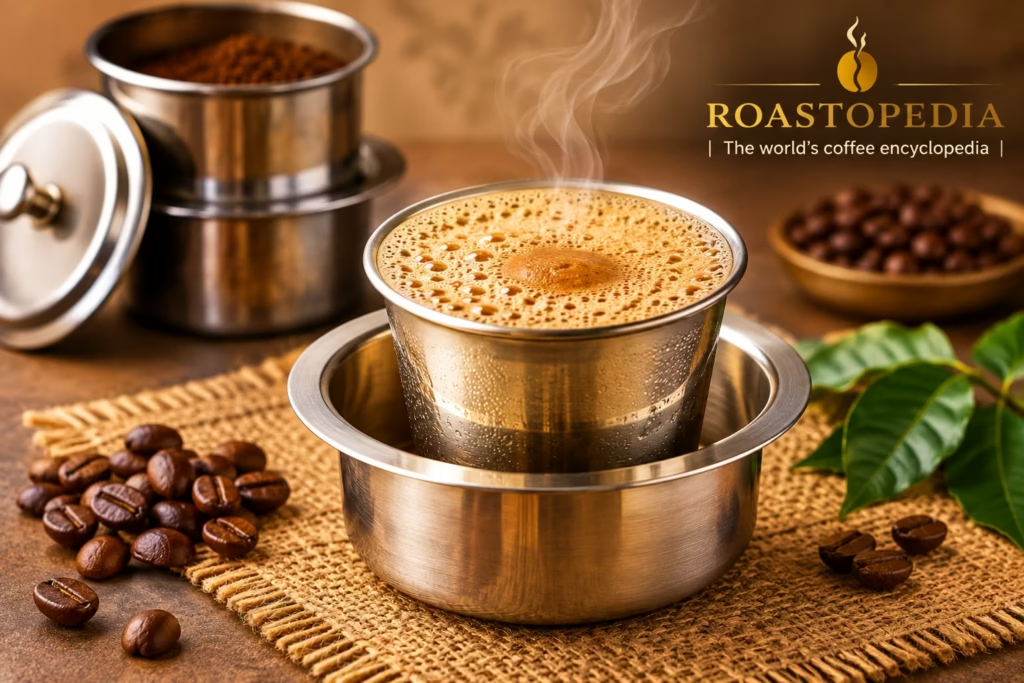
Extraction inside the traditional filter relies on slow percolation rather than pressure or immersion. Hot water sits above a bed of coffee and chicory grounds, held down by a perforated disc called an “umbrella,” and gravity alone pulls it through pin-sized holes over ten to twenty minutes. That extended contact time draws out oils, melanoidins, and soluble solids far more thoroughly than a quick pour-over, producing a syrupy infusion with far higher body than drip coffee.
Chicory root, roasted until it resembles dark coffee, plays a genuine chemical role rather than a purely economic one. Inulin inside the root swells when wet, slowing water flow through the grounds and extending extraction time still further. Its caramel-like compounds also round out coffee’s inherent bitterness, which is why blends commonly run between eighty and ninety percent coffee against ten to twenty percent chicory.
Frothing depends on repeated aeration, not on any mechanical steamer. Pouring the mixed decoction, milk, and sugar back and forth between a tumbler and its dabara saucer from a height introduces fine air bubbles into the liquid. Tamil speakers call this foam norai, and its presence signals a well-made cup as clearly as its aroma does.
Taste and Sensory Profile
A properly brewed cup delivers concentrated bitterness balanced against the natural sweetness of boiled milk, with chicory contributing a faintly woody, almost roasted-vegetable undertone. Body sits notably heavier than filter coffee brewed elsewhere, closer to a diluted espresso than to American drip coffee. Sugar is folded in during brewing rather than stirred in afterward, so sweetness reads as integrated rather than added on top.
Aroma carries caramelized, faintly smoky notes drawn from the dark roast typically used for South Indian blends. Robusta beans, common in these blends, contribute a heavier, crema-like mouthfeel and lower acidity than Arabica-dominant brews. Served hot in a narrow steel tumbler, the coffee cools slightly as it travels between vessels, arriving at a drinkable temperature by the time it reaches the lips.
Variations
Degree coffee stands as the most celebrated regional variant, historically defined by unadulterated cow’s milk verified with a lactometer. Kumbakonam, a temple town in Tamil Nadu, lends its name to a particularly strong, thick rendering of the drink that many enthusiasts treat as a distinct style in its own right. Mysore filter coffee, by contrast, tends toward a milder, more balanced cup shaped by the coffee grown in the surrounding Karnataka hills.
Pure filter coffee omits chicory entirely, appealing to drinkers who prefer coffee’s unmodified flavor and full caffeine content. Some households fold in ground cardamom, clove, or a trace of pepper, producing a lightly spiced cup closer in spirit to older coffeehouse traditions of the Mughal era. Outside India, a related pulled-coffee style developed among South Indian migrant communities in Malaysia and Singapore, sharing the same aeration technique but a sweetened condensed-milk base.
How to Make South Indian Filter Coffee

South Indian Filter Coffee is traditionally prepared by first brewing a concentrated coffee decoction in a metal South Indian Filter Coffee Maker and then combining the decoction with hot, boiled milk and sugar. The characteristic flavor and strength of the beverage depend on the coffee blend, grind size, coffee-to-water ratio, brewing time, milk proportion, and the amount of sugar used.
Ingredients
For approximately two servings:
- 3 tablespoons (about 18–20 g) of South Indian filter coffee powder, preferably a medium-fine grind
- 120 ml hot water
- 240 ml full-fat milk
- 2–4 teaspoons sugar, adjusted to taste
A traditional coffee blend often contains Arabica or Robusta coffee, sometimes with a proportion of roasted chicory. Chicory contributes additional body, bitterness, and a distinctive roasted character to the finished beverage.
Equipment
The traditional method requires a South Indian metal coffee filter consisting of two main chambers, a perforated upper chamber and a lower chamber that collects the brewed decoction. A small pressing disc and lid are also used. A saucepan or milk pot is required for heating the milk, while a stainless-steel tumbler and a small metal davara are traditionally used for serving.
1. Prepare the Coffee Filter
Separate the upper and lower chambers of the coffee filter. Place the perforated pressing disc inside the upper chamber, ensuring that it sits properly above the perforated base.
Add approximately 3 tablespoons of freshly ground filter coffee to the upper chamber. Do not tamp the coffee firmly. Lightly level the grounds so that the hot water can pass through the bed at a controlled rate.
The grind should generally be finer than that used for a French press but somewhat coarser than a typical espresso grind. Coffee ground too finely can restrict water flow and produce an excessively bitter decoction, while coffee ground too coarsely may produce a weak and under-extracted brew.
2. Add the Hot Water
Bring approximately 120 ml of water to a boil. Allow it to settle briefly after boiling rather than pouring it onto the coffee at a violently boiling temperature.
Slowly pour the hot water into the upper chamber until it is nearly full. Place the lid on the filter immediately.
The water gradually passes through the coffee bed and extracts soluble compounds from the grounds. The resulting liquid collects in the lower chamber as a dark, concentrated coffee decoction.
3. Allow the Decoction to Brew
Leave the filter undisturbed for approximately 10–15 minutes, although brewing time can vary according to the coffee grind, filter design, quantity of coffee, and desired strength.
A properly brewed decoction should be dark, concentrated, and aromatic. It should have considerably greater strength than coffee intended to be consumed on its own because it will subsequently be diluted with hot milk.
Avoid repeatedly opening the filter during brewing, as disturbing the coffee bed can affect the flow of water and extraction.
4. Heat the Milk
While the decoction is brewing, heat approximately 240 ml of full-fat milk in a saucepan.
Traditionally, the milk is brought close to a boil. It should be thoroughly heated and steaming before being combined with the coffee. The milk contributes sweetness, body, and a creamy texture that balance the intensity and bitterness of the coffee decoction.
5. Combine the Decoction, Milk, and Sugar
Place 30–60 ml of the prepared coffee decoction into each serving tumbler, depending on the desired strength.
Add approximately 120 ml of hot milk to each serving. The traditional beverage generally contains considerably more milk than coffee decoction, although the proportions vary between households, cafés, and regions.
Add sugar according to taste and stir thoroughly until it dissolves.
The final drink should have a strong coffee aroma, a rich and creamy body, and a balanced combination of bitterness, sweetness, and roasted flavors.
6. Froth and Aerate the Coffee
One of the most recognizable aspects of traditional South Indian Filter Coffee service is the pouring technique used with the stainless-steel tumbler and davara.
Transfer the coffee repeatedly between the tumbler and davara from a moderate height. This movement aerates and mixes the beverage while creating a layer of fine foam on the surface.
The pouring should be controlled rather than excessively vigorous. Traditionally, the coffee may be transferred several times until it is thoroughly mixed, adequately cooled for drinking, and covered with a light layer of froth.
7. Serve
South Indian Filter Coffee is traditionally served hot in a stainless-steel tumbler placed inside or alongside a shallow metal davara. The davara provides a convenient vessel for mixing, cooling, and aerating the coffee.
The coffee is generally consumed soon after preparation while the milk is still hot and the characteristic aroma and froth are at their best.
Brewing Variables
The character of South Indian Filter Coffee can be adjusted by changing several variables. Increasing the quantity of coffee powder or reducing the amount of brewing water produces a stronger decoction. A longer brewing time can increase extraction, although excessively prolonged extraction may contribute undesirable bitterness. The quantity of milk determines the body and intensity of the finished beverage, while sugar modifies its perceived bitterness and sweetness.
The coffee blend itself is also significant. Arabica-based blends tend to provide greater aromatic complexity, whereas Robusta can contribute greater body, intensity, and crema-like foam. Chicory, when included, adds body and a characteristic roasted, slightly bitter note.
Traditional Preparation Ratio
There is no single universally prescribed ratio for South Indian Filter Coffee. Household and café recipes differ considerably. A practical starting point is approximately 1 part concentrated coffee decoction to 2–4 parts hot milk, with sugar added according to preference.
The most important distinction is that the coffee filter produces a concentrated decoction, rather than a ready-to-drink cup of coffee. The decoction is subsequently diluted and transformed into the finished beverage through the addition of hot milk and sugar.
Notable Facts
Karnataka alone produces more than seventy percent of India’s coffee, with Coorg and Chikmagalur ranking among the country’s most significant growing regions. The metal filter device itself likely descends from percolators described in nineteenth-century cookbooks, including one Madras publication dating to 1878, predating the drink’s popular association with the twentieth century.
Chicory’s presence in Indian coffee owes less to Indian invention than to a Scottish import: a bottled coffee-chicory essence called Camp Coffee, first sold in the late nineteenth century, shaped how South Indian households first understood blended coffee.
Genetic studies on Indian Arabica populations have found unusually little variation among plants, a pattern consistent with cultivation descending from a very small original stock. Researchers examining this evidence have noted it lends unexpected weight to the seven-seed legend surrounding Baba Budan. World War II, and the coffee-supply disruptions it caused, is widely credited with cementing chicory’s place in the standard South Indian blend.
Related Drinks
Turkish coffee shares filter coffee’s goal of high body without pressure, though it relies on fine grounds boiled directly in water rather than percolated through a filter. Vietnamese coffee uses a strikingly similar small metal filter and pairs its decoction with sweetened condensed milk instead of fresh boiled milk. Ethiopian coffee ceremony brews, made in the plant’s original home region, share filter coffee’s ritual of slow, communal preparation but differ entirely in equipment and serving style.
Camp Coffee, the bottled Scottish essence that shaped South Indian tastes, remains a still-produced link between the two traditions. Kopi tarik, its Southeast Asian descendant, continues the same tumbler-pouring technique across Malaysia and Singapore today. Espresso, though built on entirely different technology, invites the most frequent comparison drinkers make, given how closely a small cup of filter coffee decoction can resemble a shot in strength and density.