
Coffee Ringspot Disease is a viral disease of Coffea arabica and other coffee species, caused by the Coffee ringspot virus (CoRSV). The disease is named for its distinctive concentric ring-shaped lesions that appear on leaves, berries, and occasionally twigs. Unlike fungal threats such as Coffee Leaf Rust or Coffee Berry Disease, CoRSV is not spread by wind-borne spores but by a microscopic mite, making it one of the more unusual pathogens catalogued among coffee diseases.
Causal Agent and Taxonomy
Coffee Ringspot Disease is caused by the Coffee ringspot virus (CoRSV), a short, bacilliform (rod-shaped) virus measuring roughly 40 nm by 100–110 nm. It carries a negative-sense, single-stranded RNA genome split into two segments: RNA1, which encodes structural proteins including the nucleocapsid, phosphoprotein, a putative cell-to-cell movement protein, matrix protein, and glycoprotein; and RNA2, which encodes the RNA-dependent RNA polymerase used to replicate the virus.
CoRSV belongs to the family Rhabdoviridae and is the type member of the genus Dichorhavirus, a group of nuclear, bipartite, negative-strand RNA plant viruses transmitted exclusively by Brevipalpus mites. The International Committee on Taxonomy of Viruses (ICTV) formally recognizes the species under the name Coffee ringspot dichorhavirus. Close relatives in the same genus include orchid fleck virus and citrus leprosis virus N, which share the same distinctive nuclear replication strategy and mite-vectored transmission.
Host Range and Susceptibility
The principal host of CoRSV is Arabica, and field surveys of Brazil’s major arabica-growing regions have found the virus present at essentially every location sampled, across all commercial cultivars regardless of cherry color. This near-universal presence suggests that little effective resistance exists within commonly used arabica germplasm.
Beyond coffee, CoRSV has an unusually broad experimental and natural host range for a plant rhabdovirus. It has been mechanically transmitted to indicator plants such as Chenopodium amaranticolor, C. quinoa, Beta vulgaris (beet), and Alternanthera tenella, producing local lesions and, in the chenopods, systemic infection.
Natural surveys have also detected the virus in dozens of ornamental plant species across many families, as well as in succulents such as the panda plant (Kalanchoe tomentosa) and bear’s paw (Cotyledon tomentosa), and in weedy hosts like Myriopus paniculatus. This wide host range means that ornamental plantings and weeds growing near or within coffee farms can serve as reservoirs that sustain mite populations and the virus between coffee growing seasons.
Symptoms and Part of the Plant Affected
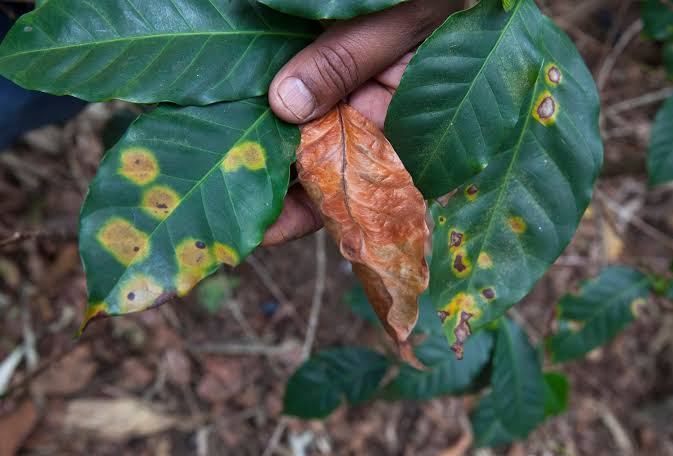
The hallmark symptom of the disease is the appearance of concentric ringspots, often accompanied by an irregular “oak leaf” pattern, on the upper surface of coffee leaves. Lesions can also develop on berries and, less commonly, on twigs. Interestingly, tissue within the ringspot lesions sometimes remains green even as the surrounding leaf senesces, a feature that helps distinguish the disease in the field.
In severe cases, infected plants suffer premature leaf and fruit drop, and heavily affected orchards can show intense defoliation. Because the virus remains confined to localized lesion tissue rather than spreading systemically through the plant, symptoms tend to be patchy rather than uniform across an individual coffee tree, and the virus has historically proven difficult to purify for laboratory study as a result.
Life Cycle and Spread
CoRSV is not seed-borne. It is instead transmitted by tiny mites of the genus Brevipalpus (family Tenuipalpidae), most notably Brevipalpus phoenicis, along with B. papayensis and B. yothersi, which have also been confirmed as vectors. Transmission occurs in a persistent, propagative manner, meaning the virus actually replicates within the mite’s body once acquired, though it does not pass from a female mite to her offspring (transovarial transmission does not occur).
Within the plant, CoRSV replicates in the cell nucleus, where infected cells develop a characteristic electron-lucent nuclear inclusion alongside arrays of bacilliform viral particles, some budding through the inner nuclear membrane. Reported transmission efficiency of the virus by B. phoenicis is around 24%.
Because the mite vector is wingless and disperses mainly by crawling, wind, or contact between plants, disease spread within a plantation tends to occur gradually outward from initial infection foci, accelerated wherever alternate host plants sustain large mite populations nearby.
Historical Discovery
Coffee Ringspot Disease was first documented in Brazil in 1939, when the plant pathologist A. Bitancourt described the condition in coffee plantations. Decades later, in 1981, researchers led by C. M. Chagas provided a more detailed characterization of the virus associated with the disease.
The formal identification of CoRSV as a distinct virus, and its eventual placement in the newly proposed genus Dichorhavirus alongside related mite-transmitted pathogens, followed extensive electron microscopy and molecular work carried out primarily by Brazilian and collaborating international researchers through the 1990s and 2000s.
Arrival in Latin America
Coffee Ringspot Disease is fundamentally a New World disease, first recorded and still centered in Brazil, where it remains most prevalent in the state of Minas Gerais. Its spread beyond Brazil has been documented within the Americas rather than to other continents:
- Brazil — the origin of the disease (1939) and still its epicenter, especially in Minas Gerais.
- Costa Rica — severe ringspot and “oak leaf” symptoms were confirmed in Coffea arabica cv. Catuai in the San Gabriel de Desamparados area in August 2000, marking the first report of a CoRSV-like virus in the country and raising concern about its potential spread across Central America.
To date, there are no confirmed reports of CoRSV establishing itself in the coffee-growing regions of Asia or Africa, distinguishing it from more globally distributed coffee pathogens such as Coffee Leaf Rust. Its dependence on a specific mite vector, rather than airborne spores, likely limits its natural long-distance spread compared to fungal diseases.
Geographic Distribution within the Coffee Belt
Within the global Coffee Belt, Coffee Ringspot Disease is concentrated in the coffee-growing zones of South and Central America. Brazil’s Minas Gerais region, one of the world’s largest arabica-producing areas, carries the highest recorded incidence, with virtually all surveyed farms showing infection. Costa Rica represents the disease’s documented northern limit within the Americas.
Because the virus depends entirely on Brevipalpus mite populations, its distribution tends to track closely with regions that combine coffee cultivation with warm, humid conditions favorable to the mite vector and with nearby ornamental or weed hosts that sustain mite numbers between seasons.
Economic and Social Impact
Although historically considered a comparatively minor disease relative to major threats like Coffee Leaf Rust or Coffee Wilt Disease, Coffee Ringspot Disease has caused significant localized yield losses in parts of Minas Gerais, where recent epidemics led to intense defoliation and fruit drop.
Beyond outright yield loss, studies have shown that CoRSV infection can influence the quality of the harvested beans and the resulting beverage, adding a quality-control dimension to its economic impact beyond simple crop loss.
The disease also imposes indirect costs. Because control depends on managing the mite vector rather than the virus itself, growers face the recurring expense of acaricide applications, and the related citrus industry in Brazil is estimated to spend over US$100 million annually combating the same genus of mite vector on citrus crops.
Concerns about the disease’s spread into Central America, first raised after its Costa Rica detection, highlighted the risk it could pose to smallholder coffee economies throughout the region were it to become established more broadly.
Control and Management
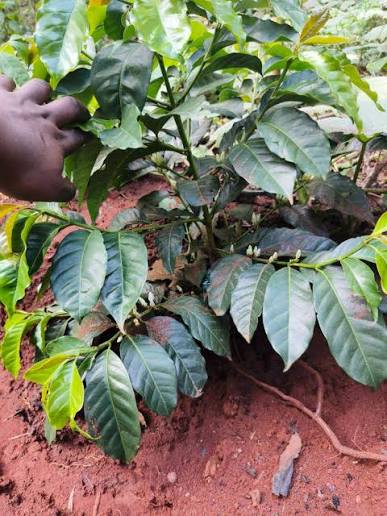
Managing Coffee Ringspot Disease is complicated by the fact that there is no direct treatment for the virus itself; control instead centers on suppressing its Brevipalpus mite vector. Recommended approaches include:
- Acaricide applications targeted at Brevipalpus mite populations, though effectiveness is limited by the high cost of repeated treatments and the potential for the mites to develop resistance over time.
- Removal or management of alternate hosts, including ornamental plants and weeds near coffee plots, which can otherwise sustain mite populations and act as viral reservoirs.
- Monitoring and early detection, since lesions remain localized rather than systemic, allowing growers to identify and manage infection foci before they expand.
- Cultural practices such as adjusting intercropping choices, since some companion or shade species have been observed to host large mite populations that elevate local infection pressure.
Because surveys have found little resistance among commercially used arabica cultivars, breeding for genetic resistance remains an area of ongoing research rather than an available field solution.
Significance in Coffee History and Science
Coffee Ringspot Disease holds a notable place in plant virology as one of the best-studied members of the Dichorhavirus genus, a group of pathogens unified by their unusual biology: nuclear replication, a bipartite negative-sense RNA genome, and exclusive transmission by Brevipalpus mites rather than insects.
Research on CoRSV, alongside related viruses like citrus leprosis virus, has helped scientists understand this entire class of mite-borne plant pathogens, which also threaten citrus, passion fruit, and ornamental crops.
The disease’s discovery in 1939 and its subsequent characterization trace a broader arc in coffee pathology, from early field-based descriptions of symptoms to modern molecular genomics capable of sequencing its RNA segments and mapping its open reading frames.
Its documented spread from Brazil into Costa Rica also serves as a case study in how mite-vectored plant viruses can move between coffee-growing regions, informing biosecurity and quarantine considerations for coffee-producing countries elsewhere in the Coffee Belt.
See Also
- Brown Eye Spot (Cercospora coffeicola)
- American Leaf Spot (Mycena citricolor)
- Coffee Wilt Disease (Fusarium xylarioides)
- Coffee Berry Disease (Colletotrichum kahawae)
- Coffee Leaf Rust (Hemileia vastatrix)
References
- Bitancourt, A. O. “Coffee Ringspot Disease.” Biológico 5:33, 1939.
- Chagas, C. M., Kitajima, E. W., and Rodrigues, J. C. V. “Coffee Ringspot Virus Vectored by Brevipalpus phoenicis (Acari: Tenuipalpidae) in Coffee.” Experimental and Applied Acarology 30:203–213, 2003.
- Ramalho, T. O., et al. “Occurrence of Coffee Ringspot Virus, a Brevipalpus Mite-Borne Virus in Coffee, in Costa Rica.” Plant Disease 86(5):564, 2002.
- Dietzgen, R. G., Kuhn, J. H., Clawson, A. N., Freitas-Astua, J., Goodin, M. M., Kitajima, E. W., Kondo, H., and Wetzel, T. “Dichorhavirus: A Proposed New Genus for Brevipalpus Mite-Transmitted, Nuclear, Bacilliform, Bipartite, Negative-Strand RNA Plant Viruses.” Archives of Virology 159:607–619, 2014.
- Boari, A. J., Figueira, A. R., Neder, D. G., Santos, R. C., Nogueira, N., and Rossi, M. L. “Coffee Ringspot Virus (CoRSV): Influence on the Beverage Quality and Yield of Coffee Beans.” Summa Phytopathologica 32:192–194, 2006.
- American Phytopathological Society (APS) Journals. “Detection and Survey of Coffee Ringspot Virus in Brazil.” Archives of Virology, Springer Nature.
- Kitajima, E. W., and Chagas, C. M. “Coffee Ringspot Disease: A Review.” Summa Phytopathologica, 2009.
- PubMed / U.S. National Library of Medicine. “Coffee Ringspot Virus Vectored by Brevipalpus phoenicis (Acari: Tenuipalpidae) in Coffee.”