
Vienna coffee is a hot coffee beverage consisting of strong brewed coffee or espresso, topped with whipped cream rather than steamed milk foam. The use of whipped cream in place of milk foam distinguishes it from milk-based coffee drinks such as the caffè latte and flat white, giving the beverage a richer texture and a more dessert-like character.
What is a Vienna Coffee?
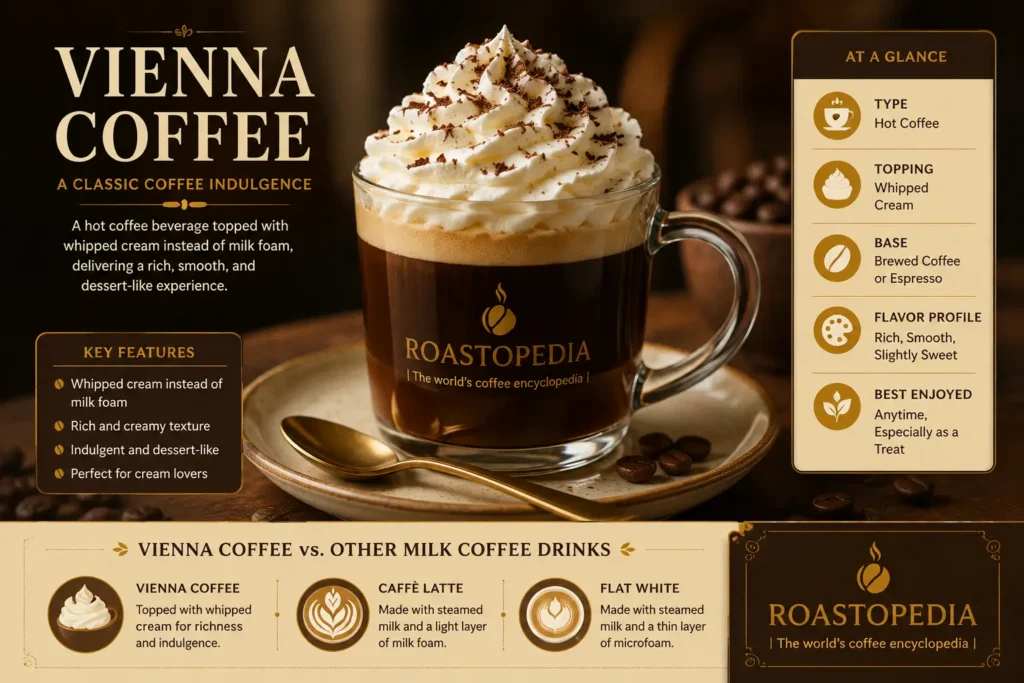
Vienna coffee is a coffee beverage traditionally associated with the coffee culture of Vienna, Austria. In its most widely recognized international form, it consists of strong brewed coffee or espresso topped with a generous layer of whipped cream, which serves as an alternative to milk or steamed milk. The drink is frequently garnished with cocoa powder, ground cinnamon, grated chocolate, or chocolate shavings, although these additions vary by region and establishment.
The term Vienna coffee is used inconsistently across countries and does not refer to a single standardized recipe. Outside Austria, it commonly describes coffee served with whipped cream, whereas in Austria, the beverages most closely associated with Vienna’s historic coffeehouses are the Einspänner, a black coffee topped with whipped cream and traditionally served in a glass.
Vienna coffee is also associated with Wiener Melange, an espresso-based drink prepared with steamed milk and milk foam. Consequently, many versions marketed internationally as “Vienna coffee” differ from those traditionally served in Vienna.
The beverage may also appear under alternative names, including Viennese coffee, café Viennois, and Kaffee Wien, depending on the language, region, or café.
Vienna Coffee at a Glance
| Attribute | Detail |
| Also known as | Viennese coffee, café Viennois, Kaffee Wien |
| Origin | Vienna, Austria (concept popularized abroad in the 20th century) |
| Base | Strong brewed coffee or espresso |
| Defining feature | Topped with whipped cream, no milk foam |
| Typical toppings | Whipped cream, cinnamon, cocoa powder, chocolate shavings |
| Serving vessel | Glass or mug, sometimes with a tall handle |
| Closest Austrian relative | Einspänner |
| Caffeine level | Moderate to high, depending on base coffee |
| Typical serving size | 150–240 ml (5–8 fl oz) |
| Best served | Hot, immediately after the cream is added |
Etymology
The name is a straightforward geographic reference: the drink is styled after the coffee culture of Vienna, Austria’s capital and the birthplace of the modern European coffeehouse. Interestingly, “Vienna coffee” as a whipped-cream drink is more of an export invention than a term native Viennese baristas actually use.
In Vienna’s own coffeehouses, you’re far more likely to hear Einspänner, Melange, or Kleiner Brauner ordered by name; “Vienna coffee” or “Viennese coffee” is the label that stuck once the concept traveled to American diners and European cafés outside Austria, where it became a catch-all term for cream-topped coffee.
The word Einspänner itself, for context, comes from the German for a one-horse carriage, a nod to the coachmen who supposedly drank a version of the beverage while working. Melange, meanwhile, borrows the French word for “mixture,” reflecting its blend of espresso, steamed milk, and foam.
History
Vienna’s relationship with coffee stretches back to the late 17th century. Coffee first appeared in official Habsburg court records in the 1640s, but the city’s coffeehouse tradition is popularly traced to the aftermath of the second Ottoman siege of Vienna in 1683.
According to a well-worn (and only partly verified) legend, retreating Ottoman forces left behind sacks of coffee beans, and a Polish-Ukrainian officer and interpreter named Georg Franz Kolschitzky used his knowledge of Ottoman customs to claim and brew them, eventually opening one of the city’s earliest coffeehouses. A competing account credits an Armenian merchant, Johannes Deodat, with opening Vienna’s first true coffeehouse in 1685.
Whichever origin story is closer to the truth, Viennese coffeehouses multiplied fast over the following century, becoming meeting points for writers, composers, and revolutionaries. By the 19th century, cafés such as Café Central and Café Griensteidl were hosting the likes of Sigmund Freud, Gustav Klimt, and Leon Trotsky, cementing coffee’s role in the city’s intellectual life. The custom of enriching coffee with cream rather than milk foam grew out of this same coffeehouse culture, and it’s this style — rather than any single named recipe — that later travelers and menu writers abroad began shorthand-labeling “Vienna coffee.”
The tradition’s cultural weight was formally recognized in 2011, when UNESCO added Viennese coffeehouse culture to its list of Intangible Cultural Heritage, describing the café as a place “where time and space are consumed, but only the coffee is found on the bill.”
Ingredients
- Strong brewed coffee or espresso (1–2 shots, or roughly 90–120 ml)
- Heavy or whipping cream, lightly whipped (30–60 ml)
- Optional sweetener (sugar or simple syrup, to taste)
- Garnish: ground cinnamon, cocoa powder, or chocolate shavings
Unlike milk-based drinks such as the cappuccino or cortado, no steamed milk or microfoam is involved — cream is whipped separately and added cold or room-temperature so it holds its shape on the surface.
Traditional Preparation
A classic Vienna-style coffee is built in three simple stages:
- Brew the base. A shot or two of espresso, or a small pot of strong drip coffee, is prepared and poured into a warmed glass or mug — much like the base used for a long black or doppio, just without dilution from extra water.
- Add the cream. Freshly whipped, lightly sweetened cream is spooned or piped generously on top so it floats rather than mixes in, similar to how cream sits atop an Irish coffee.
- Finish and garnish. A dusting of cinnamon, cocoa powder, or grated chocolate is added just before serving, both for aroma and presentation.
The drink is meant to be sipped through the cream, letting it melt gradually into the hot coffee below, rather than stirred together beforehand.
Characteristics
Vienna coffee is rich, slightly sweet, and visually dramatic thanks to its tall dome of cream. The flavor profile leans dessert-like: the bitterness of dark-roasted coffee is softened by the fat and sweetness of the cream, while the cinnamon or cocoa garnish adds warm, spiced or bittersweet top notes. Texturally, it’s meant to be layered rather than blended — a spoonful of cool cream followed by a sip of hot coffee — which is part of what distinguishes it from foam-based drinks like the moccacino or caffè latte.
Regional Variations
- Einspänner (Austria): The closest true Viennese relative — black coffee in a glass, topped with whipped cream, traditionally unsweetened and unspiced.
- Wiener Melange (Austria): A milkier, foam-topped alternative more comparable to a mild cappuccino, sometimes finished with cocoa.
- Franziskaner (Austria): A Melange with an added dollop of whipped cream for extra richness.
- Kaffee Wien / café Viennois (Germany, France, and beyond): The exported, cream-and-cinnamon version most commonly served under the “Vienna coffee” name outside Austria.
- American diner-style Vienna coffee: Often features drip coffee, canned or aerosol whipped cream, and a heavier hand with cinnamon or chocolate syrup, closer to a coffee dessert than a café order.
- Mazagran-adjacent iced versions: Some modern cafés serve a chilled take on Vienna coffee, layering cold brew with whipped cream over ice, echoing the way a mocha is sometimes served cold.
Cultural Significance
In Vienna, coffee is inseparable from the city’s identity. The Viennese coffeehouse has functioned for centuries as a kind of public living room — a place to read newspapers, hold long conversations, or simply sit for hours over one drink and a glass of water, without pressure to order more. This unhurried, communal ritual is precisely what earned Viennese coffeehouse culture its 2011 UNESCO Intangible Cultural Heritage listing, and it’s the backdrop against which cream-topped coffees like the Einspänner and its “Vienna coffee” descendants became emblematic of the city abroad.
Even though the whipped-cream version served internationally is a looser, more commercialized interpretation, it still carries the association with Vienna’s old-world café elegance, marble tables, and Thonet chairs whenever it appears on a menu far from Austria.
Comparison with Similar Drinks
| Drink | Topping | Base | Region of origin |
| Vienna coffee | Whipped cream | Espresso or brewed coffee | Austria (export style) |
| Einspänner | Whipped cream | Espresso | Austria |
| Cappuccino | Milk foam | Espresso | Italy |
| Caffè Latte | Steamed milk, light foam | Espresso | Italy |
| Irish coffee | Whipped cream | Filter coffee + whiskey | Ireland |
| Affogato | Ice cream | Espresso | Italy |
| Mocha | Whipped cream (optional) | Espresso + chocolate | Italy/US |
Vienna coffee sits closest to Irish coffee in structure — both use cream rather than foam — but skips the alcohol, and it differs from the Einspänner mainly in that it’s more likely to be sweetened and spiced when served outside Austria.
Typical Specifications
- Serving size: 150–240 ml (5–8 fl oz)
- Coffee-to-cream ratio: Roughly 2:1 coffee to whipped cream by volume
- Caffeine content: Approximately 95–150 mg per serving, depending on the base coffee used
- Calories: Roughly 80–150 kcal per serving, mainly from the cream and any added sugar
- Serving temperature: Hot (coffee), with chilled or room-temperature cream on top
- Common vessel: Tall glass or ceramic mug, sometimes with a handle for warmth insulation
See Also
References
- Wiener Melange – Wikipedia (https://en.wikipedia.org/wiki/Wiener_Melange)
- Einspänner – Wikipedia (https://en.wikipedia.org/wiki/Einsp%C3%A4nner)
- Viennese Coffee House Culture – Wikipedia (https://en.wikipedia.org/wiki/Viennese_coffee_house_culture)
- Viennese Coffee House Culture – Austrian Commission for UNESCO (https://www.unesco.at/en/culture/intangible-cultural-heritage/inventory/element/viennese-coffee-house-culture)
- From Melange to Einspänner: Austrian Coffee at a Glance – Österreich Institut (https://www.oesterreichinstitut.com/en/austrian-coffee-types-what-are-melange-einspaenner-co/)
- Types of Viennese Coffee – EasyCityPass (https://easycitypass.com/en/blog/easy-insider/types-of-viennese-coffee-discover-the-diversity-of-viennese-coffee-culture)
- Viennese Coffee Culture – Fischer’s, Marylebone (https://www.fischers.co.uk/news/viennese-coffee-culture/)
- Melange Is the Viennese Cappuccino With a Lighter Coffee Roast – Tasting Table (https://www.tastingtable.com/1355287/melange-viennese-cappuccino-light-coffee-roast/)
- 13 Different Kinds of Coffee Found in Vienna’s Coffeehouses – Vienna Würstelstand (https://viennawurstelstand.com/article/13-different-kinds-of-coffee-found-in-viennas-coffeehouses/)
- Traditional Coffee Types in Vienna – Visiting Vienna (https://www.visitingvienna.com/eatingdrinking/food/coffee-glossary/)
- Viennese Coffee Recipe: A Must-Try Austrian Espresso Drink – Home Grounds (https://www.homegrounds.co/viennese-coffee-recipe/)
- Viennese Coffee House Guide – Vollpension Vienna (https://www.vollpension.wien/en/coffee-house-guide/)
- Vienna: Where Coffeehouse Culture Originated – VBT Vacations (https://www.vbt.com/blog/vienna-coffeehouse-culture-originated)
- Vienna Shines – Coffee Consulate (https://coffee-consulate.com/en/blog/vienna-shines)
- The History of Coffee, Part Two – Boom Coffee (https://boombros.com/the-history-of-coffee-part-two/)
- 7 of the Best European Cities for Coffee Lovers – AOL (https://www.aol.com/articles/7-best-european-cities-coffee-080000980.html)