
Tona is the second sequential pour of the Ethiopian coffee ceremony, served after Abol from the same jebena of grounds that have been re-boiled with added water. It occupies the middle position in the ceremony’s three-act structure — between the powerful opening of Abol and the closing blessing of Baraka — and is understood as the phase of conversation, community, and sustained engagement. Where Abol marks arrival and welcome, Tona marks settledness: guests who receive Tona are guests who are staying.
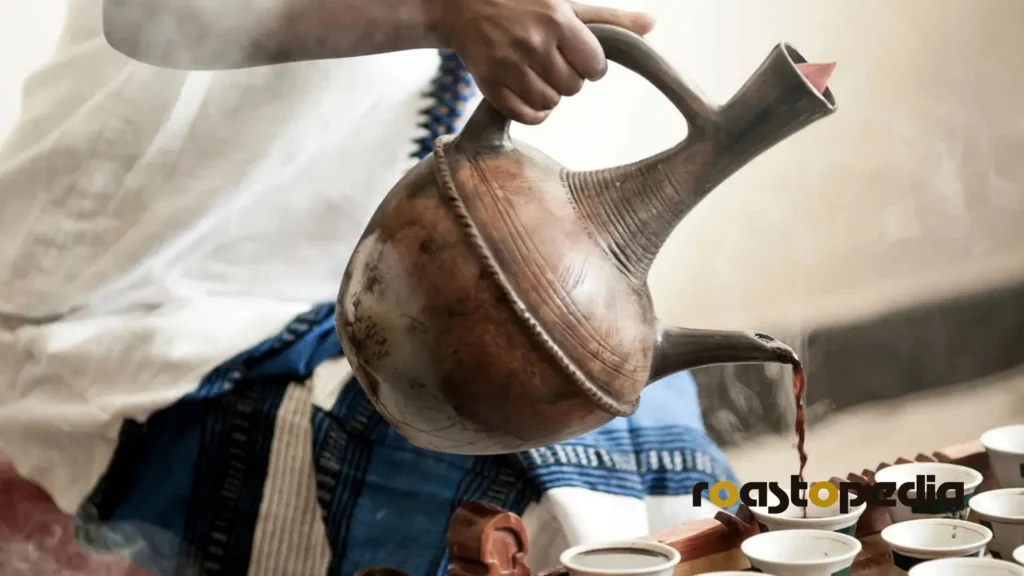
The three-round structure of the Ethiopian coffee ceremony is believed to have originated among the Oromo and Amhara communities of Ethiopia’s highland regions, though the practice has spread to virtually all ethnic communities within the country. The deliberate progression from strong to mild mirrors a philosophy of prolonged hospitality — the ceremony is designed to resist the hurry of modern life, and Tona, as the middle pour, embodies this resistance most fully. A ceremony that serves only Abol is a shortened ceremony; the presence of Tona signals an unhurried host.
Etymology
The word ‘Tona’ in Amharic carries connotations of continuation and the middle state. Some linguistic scholars connect it to roots meaning ‘second’ or ‘to repeat,’ consistent with its position as a re-extraction of the same grounds used for Abol. In Tigrinya, the second pour of the ceremony is sometimes called ‘Kalai’ — meaning ‘again’ or ‘another’ — which directly encodes the idea of repetition. The naming of each pour as a distinct entity rather than simply ‘cup one’ and ‘cup two’ reflects the ceremony’s insistence that each stage is a qualitatively different experience, not merely a diluted version of what came before.
The Science of the Brew
To produce Tona, water is added to the jebena after Abol has been poured — replenishing the volume extracted — and the vessel is returned to the coals for a second boil. The grounds, having already surrendered their most soluble compounds in the Abol extraction, now yield a second infusion lower in caffeine, chlorogenic acids, and dissolved lipids, but still containing significant volatile aromatic compounds and phenolic substances.
The reduction in caffeine is proportional to the first extraction’s efficiency. Studies on multiple-extraction brewing methods suggest that a second boil of the same grounds yields approximately 40–60% of the caffeine of the first extraction, depending on grind size, water temperature, and extraction time. The ratio of desirable aromatic compounds to bitter compounds shifts in Tona’s favor: many of the compounds responsible for harsh bitterness are highly soluble and disproportionately extracted in the first brew, leaving Tona with a more balanced, less aggressive cup.
Taste & Sensory Profile
Tona is gentler, cleaner, and more nuanced than Abol. The bitterness is present but softened; the body is lighter; and the aromatic compounds that were overwhelmed by Abol’s intensity become more perceptible. Depending on the beans’ origin, Tona may reveal fruit-forward or floral notes — particularly in Yirgacheffe or Guji beans — that were obscured by Abol’s roasted dominance.
The color is noticeably lighter than Abol — ranging from deep amber to a warm mahogany — and the cup produces less crema-like surface film. Many participants in the ceremony describe Tona as the most drinkable of the three pours: intense enough to be satisfying, approachable enough to drink slowly and without the bracing preparedness that Abol demands.
Variations
In some communities, the second brew is extended by adding fresh grounds to the existing spent grounds in the jebena, producing a Tona that is stronger than a pure re-extraction would yield. This practice, while not universal, reflects regional preferences for maintaining coffee strength across all three pours. In Harari ceremonies, Tona is the pour most commonly accompanied by popcorn (a traditional ceremony snack in Ethiopia), kurse (a bread), or injera with honey — the pairing of Tona with food reflecting its role as the social centerpiece of the ceremony.
Notable Facts
The three-pour structure of the Ethiopian coffee ceremony has been analyzed by anthropologists as a structural parallel to three-act dramatic form: Abol establishes the premise and stakes, Tona develops the action through conversation and community, and Baraka provides resolution and closure. This parallel is likely not coincidental — the ceremony’s three-act structure evolved over centuries in communities that understood prolonged social gathering as a form of communal storytelling.
In some rural communities, the grounds are not discarded after Baraka but are used a fourth time — boiled again with water and served without a ceremonial name to children or elderly guests who cannot tolerate full-strength coffee. This fourth, unnamed pour represents the ceremony’s final act of hospitality and its insistence on absolute waste reduction.
Related Drinks
- Abol — the first and strongest pour, preceding Tona in the ceremony
- Baraka — the third and final pour, following Tona as the ceremony’s closing blessing
- Jebena Coffee — the overarching ceremony of which Tona is the second act
- Kuti — a preparation conceptually related to Tona in its re-use of spent coffee grounds