
Bourbon is a cultivar of Coffea arabica, commonly referred to in the coffee industry as a “variety.” Together with Typica, it is one of the two foundational Arabica cultivars from which many of the world’s modern coffee cultivars have been developed.
The coffee is distinguished by its round-fruited cherries, comparatively higher yield relative to Typica, and a cup profile widely regarded within the specialty coffee trade as sweet, balanced, and complex. Bourbon is cultivated across Latin America, East Africa, and parts of Asia, and it serves as the genetic foundation for numerous derivative cultivars, including Caturra, Mundo Novo, and Pacas.
It should not be confused with the many Bourbon-derived cultivars that have been developed through natural mutation or selective breeding.
Definition
Bourbon is one of the oldest and most influential coffee varieties of Coffea arabica. It belongs to the Rubiaceae family and is a traditional cultivar within the allotetraploid Arabica species. Rather than representing a separate species, Bourbon is a distinct cultivated lineage that originated on Bourbon Island (now Réunion) after Arabica was introduced there from Yemen in the early 18th century.
Origin
In 1715, French colonial administrators transported Arabica coffee plants of Yemeni origin, sourced from the port of Mocha, to the Indian Ocean island then known as Île Bourbon, in the present-day Réunion Island. The plants introduced to the island were of the Typica lineage.
Records indicate that the original introduced stock nearly perished; only one surviving plant, cultivated by two brothers in the island’s capital, Saint-Denis, is credited with producing the offspring that repopulated the island’s coffee stock, multiplying to approximately seven thousand trees by 1720.
Over subsequent generations, and under the island’s distinct volcanic soil, tropical climate, and selective cultivation, the Typica-descended plants underwent natural mutation. This process gave rise to a genetically distinct population characterized by rounder coffee cherries and higher yield, which came to be known by the island’s name: Bourbon.
By the mid-nineteenth century, Bourbon had been transported from Réunion to Brazil, with 1860 commonly cited as the year of its arrival; Brazil subsequently became the world’s largest producer of the variety. French missionaries carried Bourbon to East African territories, including Rwanda, Burundi, Tanzania, and Kenya, during the nineteenth century.
The variety was also introduced to Vietnam in 1875 under French colonial administration, where it was cultivated in the Da Lat region and later marketed internationally under the label “Arabica du Tonkin.”
Botanical Classification
- Kingdom: Plantae
- Family: Rubiaceae
- Genus: Coffea
- Species: Coffea arabica
- Variety: Bourbon
Bourbon and Typica are considered the two principal ancestral varieties of cultivated Arabica coffee. Genetic studies conducted on the related Bourbon Pointu (Laurina) population, published in the plant-breeding journal Euphytica in 2009, confirmed a near-identical genetic relationship between Bourbon and its Pointu mutation, with researchers identifying 918 of 919 shared genetic markers between the two lines.
Characteristics
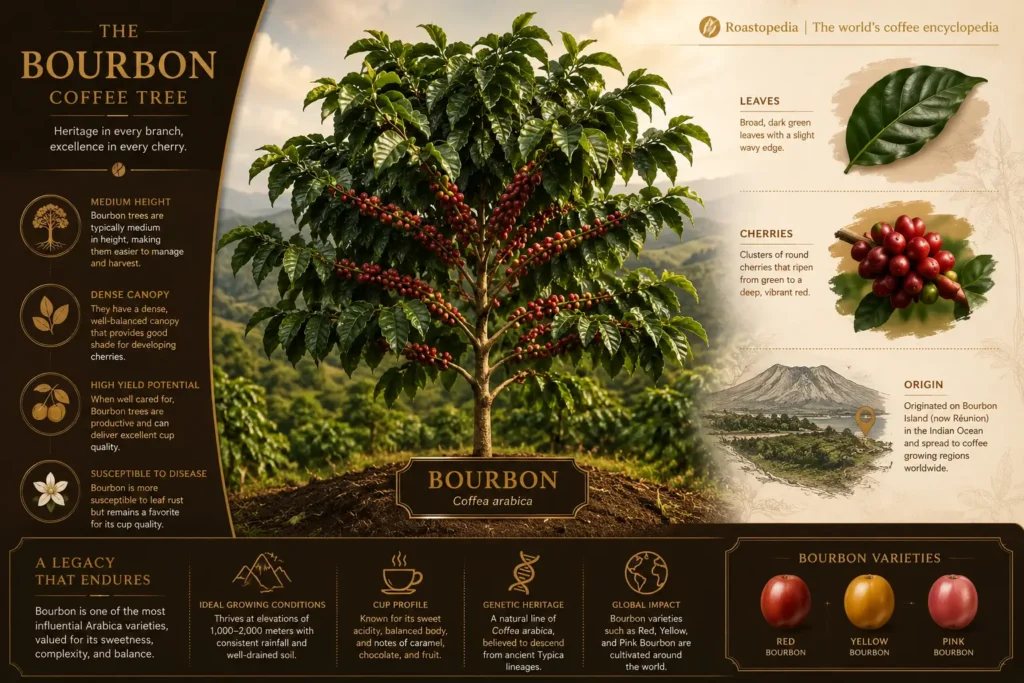
Bourbon trees are of medium height with a compact, upright branching structure. Compared to Typica, Bourbon exhibits denser foliage and produces cherries that are rounder in shape. The variety yields 20 to 30 percent more than Typica while producing coffee of broadly comparable quality.
Bourbon is considered to have a commercially viable yield potential and growth habit, though it is susceptible to coffee leaf rust, coffee berry disease, and various pest infestations. Properly dried green Bourbon beans typically maintain a moisture content of approximately 10 to 12 percent, with a lipid content in the range of 15 to 17 percent, figures broadly consistent with other Arabica varieties.
Variations
Bourbon has diversified into several recognized sub-varieties, primarily distinguished by cherry color and, in one case, caffeine content:
- Red Bourbon (Bourbon Rojo): Produces cherries that ripen to a deep red color; the beans present a full body with red-fruit sweetness and nutty undertones.
- Yellow Bourbon: A mutation producing cherries that ripen to yellow rather than red, generally associated with pronounced sweetness and low acidity.
- Pink Bourbon: A rare variety producing cherries of a pink hue, believed to result from a cross or mutation involving Red and Yellow Bourbon lines; noted for floral and strawberry-like flavor notes.
- Orange Bourbon: A natural mutation of Red Bourbon first documented in Central America, notably in El Salvador’s Apaneca-Lamatepec range; produces orange-colored cherries.
- Bourbon Pointu (Laurina): A dwarf mutation with a conical, “Christmas tree” growth habit and elongated, pointed beans. It is distinguished by naturally low caffeine content, approximately 0.4 to 0.6 percent by weight, roughly half that of standard Arabica varieties.
- Bourbon Sidra: A further cultivar within the broader Bourbon lineage, associated with distinct cup characteristics in select Central and South American origins.
Bourbon’s genetic lineage has also given rise, through natural mutation and cross-breeding, to several major derivative cultivars, including Caturra (discovered in Brazil in 1937), Mundo Novo (a natural cross of Bourbon and Typica discovered in São Paulo state in the 1940s), Pacas, and Villa Sarchi.
Growing Conditions
Bourbon is generally cultivated at altitudes between 1,000 and 2,000 meters above sea level, with some sources citing an optimal range extending to 1,100–2,000 meters. The variety favors annual rainfall between 1,500 and 2,500 millimeters distributed across the growing season and thrives within a temperature range of approximately 15°C to 24°C.
The variety is said to perform best in fertile, well-draining, nitrogen-rich volcanic soils. Major present-day growing regions include Brazil, Colombia, and Peru in South America; El Salvador, Guatemala, Costa Rica, and Nicaragua in Central America; and Rwanda, Burundi, and Tanzania in East Africa.
Harvesting
Bourbon cherries are typically harvested through selective picking, in which trained workers manually assess and remove only fully ripened cherries, leaving underripe and overripe fruit on the branch for later collection rounds. This approach is associated within the specialty coffee trade with higher achievable cup quality, as immature or overripe fruit is understood to introduce sour, astringent, or fermented off-flavors into the final beverage.
In regions producing Bourbon for the commodity market, strip harvesting, in which all cherries on a branch are removed simultaneously regardless of ripeness, may be employed to reduce labor costs, with quality sorting deferred to post-harvest processing.
Processing and Drying
Following harvest, Bourbon cherries are processed using methods common to Arabica production generally, including washed (wet) processing, natural (dry) processing, and honey or pulped-natural processing, depending on regional practice and available infrastructure. In washed processing, the cherry skin and mucilage are removed prior to drying.
In natural processing, the whole cherry is dried intact before hulling. Drying is typically conducted on raised beds or patios until the parchment or dried cherry reaches a target moisture content of approximately 10 to 12 percent, a threshold considered necessary for stable storage and transport.
Roasting
Bourbon beans are compatible with a broad range of roast levels, from light to dark, though many specialty roasters favor medium roast profiles to preserve the variety’s characteristic sweetness, balanced acidity, and floral or fruit-forward notes.
Darker roast levels tend to emphasize body and reduce perceived acidity, while lighter roasts are more commonly used to highlight origin-specific and varietal characteristics, particularly in single-origin lots.
Flavor Profile
Bourbon is broadly associated with a sweet, balanced, and complex cup. Commonly cited tasting notes include caramel, chocolate, brown sugar, and honey on the sweetness spectrum; citric and malic acidity described as bright yet gentle; and a smooth, often creamy body.
Additional descriptors reported across specialty coffee sources include nuts, stone fruit, and, in some lots, floral notes. Flavor expression varies according to the specific Bourbon sub-variety, growing region, altitude, and processing method applied.
Global Distribution
Bourbon is cultivated across a wide range of coffee-producing countries within the Coffee Belt. In South America, it is grown in Brazil, Colombia, and Peru. In Central America, principal producers include El Salvador, Guatemala, Costa Rica, and Nicaragua.
In East Africa, Bourbon is cultivated in Rwanda, Burundi, and Tanzania. Smaller, historically significant plantings persist on Réunion Island itself, where the rare Bourbon Pointu sub-variety continues to be produced on a limited scale for the specialty and connoisseur market.
See Also
- Coffee Cherry
- Coffee Plant
- Cultivar
- Java Coffee
- Green Coffee
- Terroir
- Estate Coffee
- Organic Coffee
- Single-Origin Coffee
- Specialty Coffee
References
- Wikipedia contributors. “Bourbon coffee.” Wikipedia, The Free Encyclopedia. https://en.wikipedia.org/wiki/Bourbon_coffee
- Wikipedia contributors. “Coffea arabica.” Wikipedia, The Free Encyclopedia. https://en.wikipedia.org/wiki/Coffea_arabica
- Royal Coffee. “Bourbon’s Botanical Origins And The Evolution Of Laurina.” https://royalcoffee.com/bourbons-botanical-origins-and-the-evolution-of-laurina/
- Lécolier, A., Besse, P., Charrier, A., Tchakaloff, T.-N., & Noirot, M. “Unraveling the origin of Coffea arabica ‘Bourbon pointu’ from La Réunion: a historical and scientific perspective.” Euphytica, 2009. Archive ouverte HAL. https://hal.science/hal-01199358/
- World Coffee Research. “Typica.” Variety Catalog. https://varieties.worldcoffeeresearch.org/varieties/typica
- Colipse. “Bourbon Coffee Beans: Red, Yellow, Pink, and Orange Varieties.” https://colipsecoffee.com/blogs/coffee/bourbon
- Colipse. “30 Coffee Varieties, Varietals, Cultivars and Hybrids.” https://colipsecoffee.com/blogs/coffee/varieties
- Femobook. “Bourbon Coffee Guide: Red, Yellow, Orange & Pink Bourbon.” https://www.femobook.com/blogs/coffee-knowledge/bourbon-coffee
- Indonesia Specialty Coffee. “Bourbon Coffee: A Legacy of Flavor and Diversity.” https://specialtycoffee.id/articles/bourbon-coffee/
- Omwani. “Réunion Island Coffee Production & Sourcing Guide.” https://www.omwani.com/post/r%C3%A9union-island-coffee-production-sourcing-guide
- Espresso & Coffee Guide. “Bourbon Coffee Beans.” https://espressocoffeeguide.com/all-about-coffee-2/coffee-plants/bourbon-coffee-beans/
- Hello5Coffee. “Overview of Bourbon Coffee Variety: The Queen of Arabica Coffee.” https://hello5coffee.com/overview-of-bourbon-coffee/