
Green coffee refers to the raw, unroasted seeds of the Coffea plant, harvested and processed from the coffee cherry but not yet subjected to the thermal transformation of roasting. In this state, the seeds—commonly referred to as “beans” due to their resemblance to legumes—retain their natural chemical composition, including chlorogenic acids, lipids, sugars, proteins, and alkaloids such as caffeine and trigonelline. Green coffee constitutes the fundamental traded commodity of the global coffee industry and serves as the universal starting material from which all roasted coffee products are derived.
The appearance of green coffee varies according to species, cultivar, geographic origin, altitude of cultivation, and post-harvest processing method. In general, healthy green coffee beans display hues ranging from pale straw-yellow and silvery-grey to deep olive-green and blue-green, with a characteristic herbal, grassy aroma markedly distinct from the familiar fragrance of roasted coffee.
Stale green beans, on the other hand, are characterized by a dull, lifeless aroma. Unlike fresh green coffee beans, which typically have a vibrant grassy, herbal, or plant-like scent, aged beans lose much of their aromatic freshness. Instead, they often develop dry, muted odors reminiscent of hay, straw, paper, or cardboard, indicating a decline in quality.
The average moisture content of properly stored green coffee ranges between 10 and 12.5 percent, a range considered optimal for preservation of quality and prevention of mold.
Origin and Early History
The botanical origin of green coffee is traced to the highland forests of southwestern Ethiopia, in the region historically known as Kaffa. Archaeological and ethnobotanical evidence, along with oral tradition, indicates that indigenous Oromo communities were consuming wild-harvested coffee fruits—including the seeds—as early as the 9th century CE, long before any deliberate cultivation or processing system was established. These early uses involved chewing the raw fruit or seeds, or mixing crushed seeds with animal fat for sustenance during long journeys.
The transition from wild foraging to systematic cultivation of the Coffea plant is generally dated to the 14th and 15th centuries on the Arabian Peninsula. Sufi monasteries in Yemen are documented as among the first institutions to deliberately cultivate Coffea arabica and to prepare infusions from its seeds, initially in a form more closely resembling the whole-fruit beverage known as qishr—made from the dried husk—than from roasted beans.
The concept of isolating, drying, and trading the inner seed as a commodity distinct from the surrounding fruit pulp represents the precursor to what is now understood as the global green coffee trade.
By the 15th and 16th centuries, the port city of Mocha (Al-Mukha) in Yemen had emerged as the dominant hub for the export of green coffee seeds across trade networks extending into Persia, Egypt, the Ottoman Empire, and eventually Europe.
Venetian merchants are recorded as among the earliest European importers of green coffee, with the commodity entering European ports by approximately 1600 CE. The Dutch East India Company (VOC) subsequently facilitated the dissemination of Coffea arabica plants—and therefore the supply chain of green coffee—to colonial territories in Java (Indonesia) by around 1699, dramatically expanding the geographic scope of green coffee production.
Botanical Classification
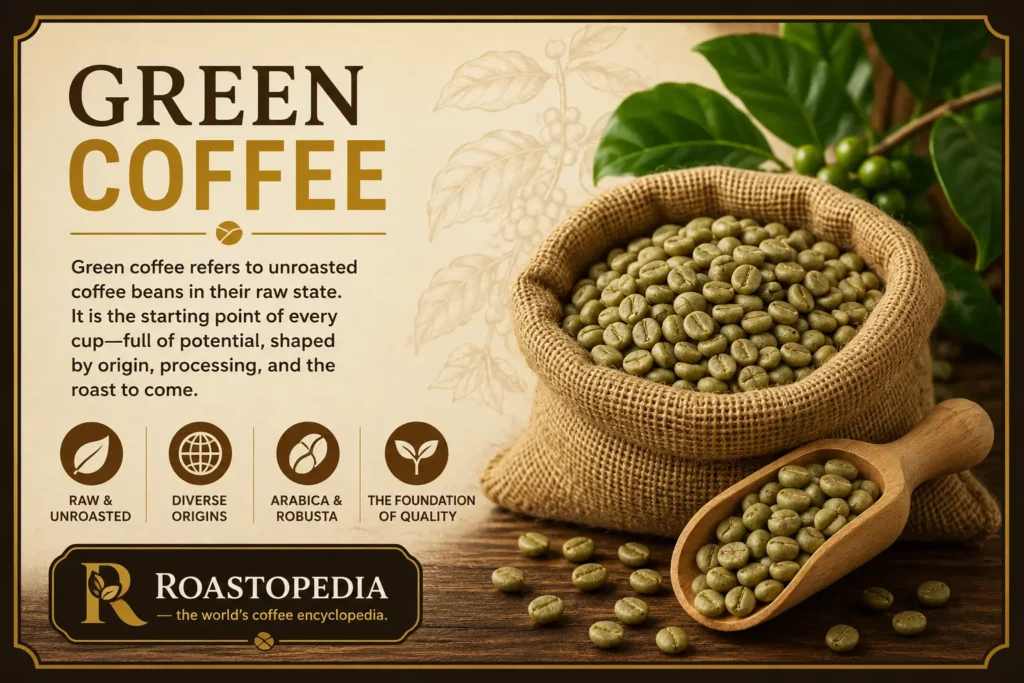
Green coffee is produced from plants belonging to the genus Coffea, a member of the family Rubiaceae. The genus comprises more than 120 recognized species, of which only a small number are cultivated at commercially significant scales:
- Coffea arabica — Accounts for approximately 60–70% of global green coffee production. Originated in the highlands of Ethiopia and South Sudan. Arabica green coffee is prized for its lower caffeine content (0.8–1.4%), greater complexity of flavor precursors, and higher acidity.
- Coffea canephora (Robusta) — Accounts for approximately 30–40% of global production. Native to sub-Saharan Africa, primarily the Congo Basin. Robusta green coffee contains higher caffeine (1.7–4.0%), exhibits greater resistance to pests and disease, and is cultivated at lower altitudes.
- Coffea liberica and Coffea excelsa — Represent a minor fraction of global supply, cultivated primarily in West Africa and parts of Southeast Asia. These species produce green coffee with distinctly different size, shape, and chemical profiles.
Cultivation
Geographic Distribution
Green coffee cultivation is geographically confined to the equatorial band known as the “Coffee Belt” or “Bean Belt,” which spans latitudes approximately 25° north and 25° south of the equator. This zone encompasses parts of Latin America, Sub-Saharan Africa, the Middle East, South Asia, and Southeast Asia. The primary producing countries, by volume, include Brazil, Vietnam, Colombia, Indonesia, Ethiopia, Honduras, India, Uganda, Mexico, and Guatemala.
Agroclimatic Requirements
Optimal cultivation conditions for Coffea arabica include mean annual temperatures between 18°C and 22°C (64°F–72°F), annual rainfall of 1,500–2,500 mm, and elevations between 600 and 2,200 meters above sea level (masl). Coffea canephora tolerates warmer temperatures (22°C–30°C), lower elevations (0–800 masl), and less consistent rainfall distribution.
Well-draining, slightly acidic soils (pH 6.0–6.5) rich in organic matter are preferred across both species. The combination of altitude, temperature variation between day and night, soil mineral content, and local microclimate—collectively referred to as terroir—substantially influences the chemical profile of green coffee produced in any given location.
Production Volume and Economics
According to the International Coffee Organization (ICO), global green coffee production in the 2022/2023 crop year totaled approximately 171.3 million 60-kilogram bags. Brazil alone accounted for roughly 35% of this total, confirming its status as the world’s largest producer for more than 150 consecutive years.
During the 2024/2025 crop year, global green coffee production was estimated at 175.3 million 60-kilogram bags, equivalent to approximately 10.5 million metric tons. Production was composed of roughly 57% Arabica and 43% Robusta coffee. Throughout the season, the global coffee market experienced significant price volatility, driven by supply shortfalls and weather disruptions associated with the El Niño climate pattern.
Green coffee is one of the most actively traded agricultural commodities in global markets, with futures contracts listed on the Intercontinental Exchange (ICE) under the arabica benchmark (“C” contract) and the Euronext robusta contract.
Post-Harvest Processing
The transformation of harvested coffee cherries into exportable green coffee is accomplished through several distinct processing methods, each of which imparts different characteristics to the resulting green bean and, subsequently, to the roasted and brewed product.
Washed (Wet) Process
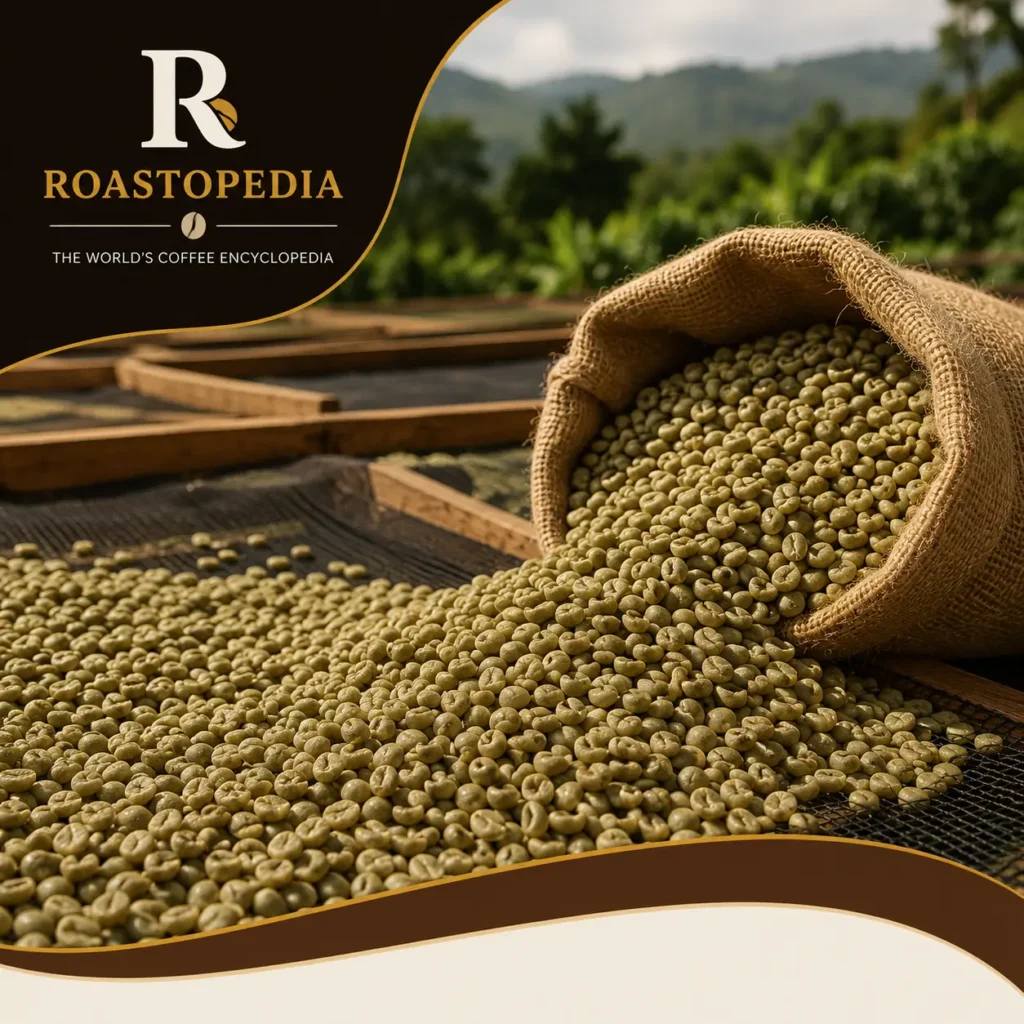
In the washed process, the outer skin (exocarp) of the cherry is mechanically removed immediately after harvest using a pulping machine. The mucilage-covered seeds are then fermented in water tanks for 12–72 hours to break down remaining fruit residue, followed by thorough washing with clean water. The seeds are subsequently dried on raised beds or patios to a target moisture content of 10–12%. The washed process is predominant in East Africa, Central America, and Colombia, and is associated with green coffee that exhibits clean, bright acidity and pronounced clarity of flavor in the cup.
Natural (Dry) Process
The natural process, historically the oldest method, involves drying the entire intact cherry—seed, pulp, mucilage, and skin—in direct sunlight for 3–6 weeks, with regular turning to prevent fermentation and mold. Once the cherry is fully desiccated, the dried fruit layers are mechanically hulled to reveal the green seed. This method is widely used in Ethiopia, Yemen, and Brazil, and produces green coffee with a higher concentration of sugars and fermentation-derived compounds, which often translate into pronounced fruit-forward and wine-like cup characteristics.
Honey Process
The honey process represents an intermediate technique in which the cherry skin is removed by pulping, but varying degrees of mucilage are intentionally left adhering to the seed during drying. Classified as yellow honey, red honey, or black honey according to the quantity of mucilage retained, this method originated in Costa Rica in the early 2000s and has since spread across Central America and select producers in other regions. Honey-processed green coffee typically exhibits flavor profiles that balance the clean brightness of washed coffees with some of the sweetness and body associated with naturals.
Wet-Hulled (Giling Basah) Process
Developed in Indonesia, the wet-hulled or Giling Basah process involves pulping, a brief fermentation or soak, and partial drying of the parchment coffee to approximately 35–40% moisture. The parchment layer (endocarp) is then removed while the bean is still at elevated moisture, resulting in a distinctly bluish-green coloration. Final drying continues until the target moisture is reached. This method accommodates the humid tropical climate of Sumatra, Sulawesi, and other Indonesian islands, and produces green coffee associated with heavy body, low acidity, and earthy or herbal flavor notes.
Anaerobic and Experimental Processes
Beginning in the 2010s, producers and researchers began exploring controlled anaerobic fermentation methods, in which depulped or whole cherries are sealed in oxygen-free vessels for defined periods before drying. Related experimental approaches include carbonic maceration (adapted from winemaking), extended lactic acid fermentation, and the inoculation of fermentation environments with specific yeast or bacterial cultures.
These methods gained broader commercial attention following their appearance at World Barista Championship competitions from approximately 2015 onward and have since generated a category of green coffees characterized by intensified and novel flavor profiles not achievable through conventional processing.
Milling, Grading, and Classification
Following drying, green coffee undergoes a series of milling operations to remove remaining parchment (in washed coffees) or dried fruit layers (in naturals), and to prepare the seed for grading and export. Dry milling typically includes hulling, polishing (optional), grading by size (screen size) and density, color sorting, and defect sorting.
Green coffee is graded and classified according to country-specific standards that incorporate screen size designations (e.g., Screen 15, Screen 18), defect counts per 300-gram sample (e.g., Ethiopia Grade 1–5), and altitude-based classifications (e.g., Guatemala SHB, Strictly Hard Bean; Costa Rica SHB).
The Specialty Coffee Association (SCA) maintains a widely used green coffee grading protocol in which a 350-gram sample is examined for primary defects (e.g., full black beans, full sour beans, pods, large stones) and secondary defects (e.g., partial blacks, floaters, shells).
Coffees achieving zero primary defects and no more than five secondary defects, with a minimum screen size of 15 and uniform coloration, qualify as specialty grade green coffee.
Storage and Transport
Green coffee is exported in jute or GrainPro-lined polypropylene bags of standard 60-kilogram weight, or, increasingly, in vacuum-sealed or hermetically sealed packaging to preserve quality during extended ocean transit. Conventional green coffee may be shipped in standard dry containers, while specialty and micro-lot coffees are more frequently transported in temperature-controlled environments.
Upon arrival at destination warehouses, green coffee is ideally stored in cool (15°C–20°C), dry environments with stable relative humidity between 50% and 60%, and away from exposure to odor-producing substances such as chemicals, spices, or petroleum products, as green coffee readily absorbs ambient odors.
The shelf life of green coffee under proper storage conditions is generally estimated at 12–24 months, during which the beans retain their essential chemical characteristics and roasting potential. Beyond this range, green coffee undergoes progressive degradation—commonly described as “going past crop” or “old crop”—marked by a loss of acidity, the development of papery or woodsy notes, and a reduction in soluble solids. Aged or “vintage” green coffees are, however, intentionally stored for extended periods by certain specialty producers and are valued in select markets for their distinct mellow profile.
Chemical Composition
Green coffee contains a complex array of chemical compounds that serve as precursors to the sensory attributes developed during roasting. Key constituents include:
- Chlorogenic acids (CGAs): Represent 6–12% of dry weight in arabica and up to 14% in robusta. CGAs are polyphenolic antioxidants that degrade during roasting to form various compounds including quinic and caffeic acids, contributing to cup acidity and perceived bitterness.
- Caffeine: Arabica green coffee contains 0.8–1.4% caffeine by dry weight; robusta contains 1.7–4.0%. Caffeine is heat-stable and survives roasting substantially intact.
- Trigonelline: A methylated form of niacin present at 0.6–1.0% in arabica, trigonelline degrades during roasting to form pyridines and nicotinic acid (niacin), contributing to roasted aroma.
- Sucrose: Comprising 6–9% of arabica dry weight (lower in robusta, at 3–7%), sucrose is a primary substrate for Maillard reactions (TDS) and caramelization during roasting, generating hundreds of aroma-active compounds.
- Lipids: Green coffee contains 15–17% lipids in arabica (and approximately 10% in robusta). The coffee oil fraction contains diterpenes (cafestol and kahweol), tocopherols, and fatty acids, which contribute to mouthfeel and aroma in the brewed cup.
- Proteins and free amino acids: At approximately 10–13% of dry weight, proteins participate in Maillard browning reactions during roasting.
Green Coffee Extract as a Health and Nutraceutical Product
Beginning in the early 2000s, green coffee bean extract (GCBE)—standardized for chlorogenic acid content—entered the nutraceutical and dietary supplement market.
Research, including a study published in the journal Diabetes, Metabolic Syndrome and Obesity in 2012 (Vinson et al.), suggested potential associations between GCBE supplementation and modest reductions in body weight and blood pressure, attributed in part to the inhibition of glucose absorption and the antioxidant activity of chlorogenic acids. These findings attracted broad popular attention, amplified by endorsements in mainstream media during the early 2010s.
Subsequent scrutiny of the evidence base led the U.S. Federal Trade Commission (FTC) to take action against several manufacturers and media figures for unsupported health claims. The Vinson et al. (2012) study was formally retracted by its publisher in 2014.
As of the date of this entry, no health authority, including the U.S. Food and Drug Administration (FDA) or the European Food Safety Authority (EFSA), has authorized specific health claims for green coffee extract relating to weight loss. Research into the physiological effects of chlorogenic acids and other green coffee constituents continues as an active area of study.
Green Coffee in the Specialty Coffee Movement
The emergence of the specialty coffee sector from the 1970s onward—pioneered by figures including Erna Knutsen, who first used the term “specialty coffee” in 1974—elevated green coffee from a largely undifferentiated bulk commodity to a carefully characterized agricultural product whose origin, variety, processing method, and physical quality are central to its commercial identity and price.
Green coffee importers and exporters engaged in the specialty trade operate within a system of direct trade relationships, cupping protocols, and quality evaluation frameworks established by organizations such as the Specialty Coffee Association (SCA) and the Coffee Quality Institute (CQI).
The Q Grader certification program, administered by the CQI, qualifies professional tasters to evaluate green coffee samples through standardized sensory analysis. Green coffee is evaluated for physical defects, moisture content, water activity, and cup quality before assignment of a score on the SCA’s 100-point scale; lots scoring 80 points or above are designated specialty grade. This framework has transformed green coffee purchasing practices and stimulated greater investment in quality at the production level.
Sustainability Challenges and the Future of Green Coffee
The global supply of green coffee faces a range of interconnected sustainability challenges as of the third decade of the 21st century. Climate change presents the most structurally significant threat.
Peer-reviewed modeling published in journals including Nature Plants and PLOS ONE projects that climate change could reduce the area suitable for arabica cultivation by 50% or more by 2050 under high-emissions scenarios, displacing production to higher elevations and higher latitudes while placing additional pressure on forest ecosystems.
Fungal diseases, particularly Coffee Leaf Rust (Hemileia vastatrix), have repeatedly caused catastrophic crop losses across Central America, South America, and Africa. Outbreaks in 2012–2013 devastated harvests across much of Latin America.
Research programs at institutions including the World Coffee Research organization and CABI are developing disease-resistant arabica hybrids intended to maintain cup quality standards while improving resilience.
Concurrently, the application of precision fermentation, genetic sequencing, and controlled-environment horticulture to green coffee production represents a nascent area of innovation. Molecular mapping of the arabica genome, completed in 2020 by a consortium of researchers, has opened pathways for the selective breeding of cultivars optimized for both quality and climate adaptability.
The future of green coffee as a global commodity rests substantially upon the ability of the industry, governments, and research institutions to address these compounding environmental and agronomic pressures while preserving the genetic diversity of wild Coffea species—many of which remain unstudied—as a resource for future crop improvement.
See Also
- Coffee Roasting
- Coffee Processing Methods
- Specialty Coffee
- Coffee Belt
- Coffee Terroir
- Q Grader
- Coffee Cultivars
References
- International Coffee Organization (ICO). (2023). Coffee Report and Outlook 2023. London: ICO. Retrieved from http://www.ico.org
- Specialty Coffee Association (SCA). (2015). SCA Green Coffee Grading Handbook. Santa Ana, CA: Specialty Coffee Association.
- Wintgens, J.N. (Ed.). (2009). Coffee: Growing, Processing, Sustainable Production (2nd ed.). Weinheim: Wiley-VCH.
- Clarke, R.J., & Vitzthum, O.G. (Eds.). (2001). Coffee: Recent Developments. Oxford: Blackwell Science.
- Farah, A. (2012). Coffee constituents. In Y.F. Chu (Ed.), Coffee: Emerging Health Effects and Disease Prevention (pp. 21–58). Oxford: Wiley-Blackwell.
- Campa, C., Doulbeau, S., Dussert, S., Hamon, S., & Noirot, M. (2005). Qualitative relationship between caffeine and chlorogenic acid contents among wild Coffea species. Food Chemistry, 93(1), 135–139.
- Bertrand, B., Guyot, B., Anthony, F., Lashermes, P., Guiraud, J., Dominici, M., & Lashermes, P. (2003). Impact of the Timor hybrid on the flavor of the Coffea arabica. Quality of the raw material and the extract. Plant Breeding, 122(4), 351–356.
- Krishnan, S. (2017). Sustainability of Coffee as a Crop in a Changing Climate. In B. Bharat (Ed.), Coffee: A Comprehensive Guide to the Bean, the Beverage, and the Industry (pp. 67–90). Rowman & Littlefield.
- Charrier, A., & Berthaud, J. (1985). Botanical classification of coffee. In M.N. Clifford & K.C. Willson (Eds.), Coffee: Botany, Biochemistry and Production of Beans and Beverage (pp. 13–47). Westport, CT: AVI Publishing.
- Salinas, R.A., & Rains, D.W. (Eds.). (2018). The Coffee Genome and Transcriptomics. Cambridge: Cambridge University Press.
- U.S. Federal Trade Commission (FTC). (2014). FTC and State Law Enforcers Crack Down on Companies Allegedly Selling Bogus Weight-Loss Products. Washington, D.C.: FTC. Retrieved from https://www.ftc.gov
- Davis, A.P., et al. (2012). The impact of climate change on indigenous arabica coffee (Coffea arabica): Predicting future trends and identifying priorities. PLoS ONE, 7(11), e47981.