
Grind size refers to the size of the coffee particles produced when roasted coffee beans are ground. Whether coffee is ground into large, coarse particles or a fine powder profoundly affects how water interacts with the coffee, how quickly soluble compounds are extracted, and ultimately how the beverage tastes.
Few brewing variables have as much influence over extraction as grind size. Alongside brew ratio, water temperature, contact time, and turbulence, grind size helps determine whether a coffee becomes balanced and flavorful or ends up under-extracted, over-extracted, weak, bitter, or sour. Coffee professionals often describe grind size as one of the primary tools for controlling extraction.
What Grind Size Is
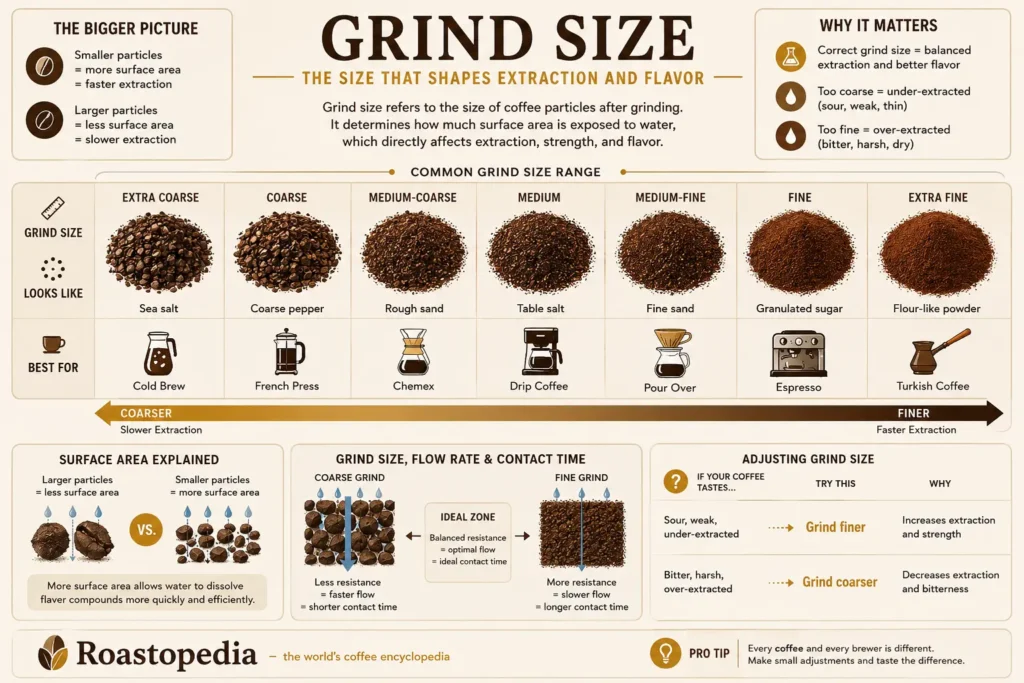
Grind size is the degree to which coffee beans are broken down during grinding. Coffee particles can range from extremely coarse fragments resembling cracked peppercorns to powder-fine particles used in Turkish coffee.
The chosen grind size determines how much surface area of the coffee is exposed to water during brewing. As particles become smaller, their total surface area increases dramatically. This increased surface area allows water to dissolve flavor compounds more rapidly.
Conversely, larger particles expose less surface area and therefore extract more slowly.
In simple terms:
- Coarser grinds extract more slowly.
- Finer grinds extract more quickly.
This relationship lies at the heart of coffee extraction theory.
The Science Behind Grind Size
Coffee contains hundreds of soluble compounds, including acids, sugars, lipids, melanoidins, aromatic molecules, and bitter substances. Brewing occurs when water dissolves these compounds from the coffee grounds.
The rate at which extraction occurs depends largely on the amount of surface area available.
Imagine a whole coffee bean dropped into water. Very little of the bean’s surface is exposed, making extraction extremely slow.
Now imagine the same bean ground into hundreds of particles. Water can access vastly more surface area, dramatically increasing extraction speed.
This principle explains why espresso requires finely ground coffee while immersion methods such as French Press use much coarser particles.
The smaller the particles:
- The greater the surface area.
- The faster extraction occurs.
- The easier it becomes to extract flavor compounds.
The larger the particles:
- The lower the surface area.
- The slower the extraction occurs.
- More contact time is required.
Why Grind Size Matters
Grind size directly influences extraction yield and flavor balance.
If coffee is ground too coarsely for a particular brewing method, water may not extract enough soluble material. The resulting cup often tastes:
- Sour
- Sharp
- Thin
- Weak
- Underdeveloped
This condition is commonly referred to as under-extraction.
If coffee is ground too finely, extraction may proceed too aggressively. The resulting cup can taste:
- Bitter
- Dry
- Harsh
- Hollow
- Astringent
This condition is associated with over-extraction.
An appropriate grind size helps achieve a balance between acidity, sweetness, bitterness, aroma, and body.
Common Grind Size Categories
Although there is no universal standard, coffee professionals typically classify grind sizes into several broad categories.
| Grind Size | Texture | Common Brewing Methods |
| Extra Coarse | Sea salt | Cold Brew |
| Coarse | Coarse pepper | French Press |
| Medium-Coarse | Rough sand | Chemex |
| Medium | Table salt | Drip Coffee |
| Medium-Fine | Fine sand | Pour Over |
| Fine | Granulated sugar | Espresso |
| Extra Fine | Flour-like powder | Turkish Coffee |
These categories provide useful guidelines, though ideal grind size often varies according to the coffee, equipment, and desired flavor profile.
Grind Size and Brewing Methods
Different brewing methods require different grind sizes because they rely on different extraction dynamics.
French Press
French Press uses long immersion times, often four minutes or more. A coarse grind helps prevent excessive extraction and reduces the amount of sediment passing through the metal filter.
Pour Over
Pour-over methods typically use medium to medium-fine grinds. These sizes balance extraction efficiency with water flow through the coffee bed.
Chemex
Chemex brewers usually perform best with a medium-coarse grind because their thick paper filters slow the brewing process.
AeroPress
AeroPress is highly versatile and can function with grind sizes ranging from medium-coarse to fine depending on the recipe.
Espresso
Espresso requires a fine grind because extraction occurs within a very short time frame, usually between 25 and 35 seconds. Fine particles provide sufficient resistance to water flow while enabling rapid extraction.
Turkish Coffee
Turkish coffee requires an extremely fine powder-like grind because the grounds remain in the beverage and extraction occurs directly in the brewing vessel.
Grind Size and Flow Rate
Grind size has a close relationship with flow rate.
Finer grounds create greater resistance to water movement. As a result, water passes through the coffee bed more slowly.
Coarser grounds create less resistance, allowing water to flow more quickly.
Because flow rate affects contact time, grind size indirectly influences how long water remains in contact with coffee particles.
This interconnected relationship explains why coffee professionals frequently adjust grind size when attempting to correct brewing problems.
Grind Size and Extraction Yield
Extraction yield refers to the percentage of coffee material dissolved into the brewed beverage.
Grind size strongly influences extraction yield because it controls how efficiently water accesses soluble compounds.
A grind that is too coarse may produce a low extraction yield and a sour cup.
A grind that is too fine may push extraction yield beyond desirable levels and introduce bitterness.
For this reason, grind size is often the first variable adjusted when brewers seek to improve extraction.
Particle Size Distribution
Although grind size is often discussed as a single setting, every grinder produces a range of particle sizes rather than perfectly uniform particles.
This range is known as particle size distribution.
High-quality grinders generally produce more uniform particles, resulting in more even extraction.
Poor-quality grinders may generate excessive amounts of:
- Boulders (large particles)
- Fines (tiny particles)
A wide particle distribution can lead to uneven extraction because some particles become under-extracted while others become over-extracted.
How to Adjust Grind Size
When troubleshooting coffee, grind size is often the most effective variable to modify.
If coffee tastes sour, weak, or under-extracted, a finer grind may increase extraction.
If coffee tastes bitter, harsh, or over-extracted, a coarser grind may reduce extraction.
Adjustments should be made gradually because even small changes can significantly alter brewing outcomes.
Is Grind Size the Same as Extraction?
No.
Grind size is a brewing variable, while extraction is the process by which water dissolves compounds from coffee.
Grind size influences extraction but does not define it.
A useful analogy is that grind size acts as a control mechanism. By altering particle size, brewers regulate how easily water accesses soluble compounds. Extraction is the resulting process.
What Experts Say
Grind size is the foundation upon which much of coffee brewing is built. By controlling particle size, brewers influence surface area, flow rate, contact time, extraction yield, and flavor development. Every brewing method—from French Press to espresso—depends on an appropriate grind size to achieve balanced extraction.
Because grind size affects nearly every aspect of brewing, it remains one of the most powerful and frequently adjusted variables in specialty coffee. Understanding how grind size interacts with extraction allows coffee professionals and enthusiasts alike to consistently produce better-tasting coffee and to diagnose brewing problems with greater precision.
References
- Illy, Andrea & Viani, Rinantonio. Espresso Coffee: The Science of Quality.
- Rao, Scott. The Coffee Brewer’s Handbook.
- Rao, Scott. Everything but Espresso.
- Maxwell Colonna-Dashwood & Christopher Hendon. Water for Coffee.
- Specialty Coffee Association (SCA) Brewing Standards.
- Lockhart, Ernest E. The Soluble Solids in Coffee as an Index of Extraction.
- Clarke, R.J. & Macrae, R. Coffee: Volume 2 – Technology.