
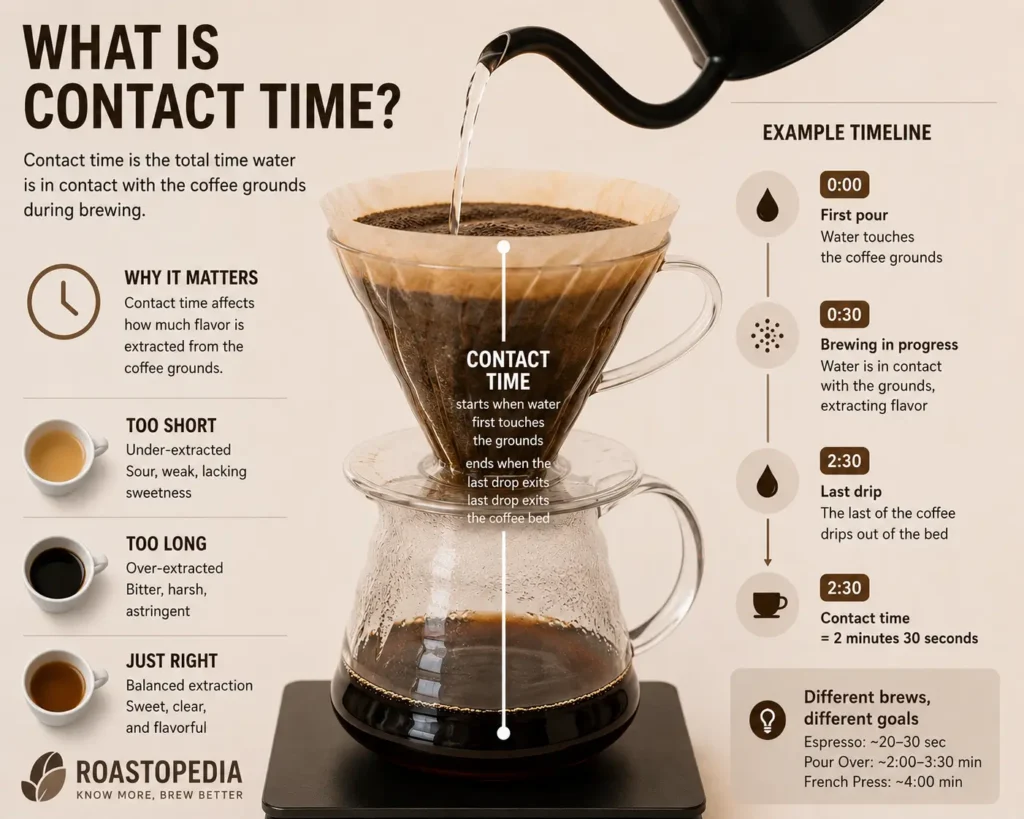
Contact Time (often referred to as brew time) is the period during which brewing water remains in direct contact with coffee grounds during the extraction process. It begins the moment water first wets the coffee bed and ends when extraction is complete, whether through filtration, immersion, pressure-driven brewing, or another extraction method.
Baristas and coffee enthusiasts see contact time as one of the most influential brewing variables because it directly affects the amount and types of soluble compounds extracted from coffee. Alongside grind size, water temperature, brew ratio, turbulence, and water chemistry, contact time helps determine whether a coffee tastes balanced, under-extracted, or over-extracted.
Other Names
Depending on where one is, contact time has different names. Some of these names include:
- Brew Time
- Infusion Time
- Brewing Duration
- Steep Time
- Steeping Time
- Soaking Duration
- Extraction Time
Overview
The concept of contact time emerged from the broader scientific understanding of extraction chemistry. Long before coffee professionals used the term formally, brewers recognized that the length of interaction between water and ground coffee significantly influenced beverage strength and flavor.
In modern specialty coffee, contact time is regarded as a foundational brewing parameter. It is measured in seconds for espresso and minutes for most manual brewing methods. Although often discussed independently, contact time does not operate in isolation. Instead, it interacts continuously with particle size distribution, water flow rate, turbulence, coffee density, roast level, and brewing equipment design.
The significance of contact time lies in its role as the temporal dimension of extraction. Water requires sufficient time to dissolve desirable compounds from coffee grounds, but excessive exposure can result in the extraction of less desirable compounds associated with bitterness, dryness, and astringency.
Origin and Evolution of the Term
The scientific basis for contact time can be traced to nineteenth- and twentieth-century studies of mass transfer and extraction kinetics. As coffee brewing became increasingly standardized during the twentieth century, researchers began quantifying the relationship between extraction yield and brewing duration.
Organizations such as the Coffee Brewing Institute, the Specialty Coffee Association (SCA), and academic researchers studying beverage extraction helped formalize brewing terminology. By the late twentieth century, “contact time” had become a standard term used by coffee educators, roasters, baristas, equipment manufacturers, and brewing scientists.
The rise of specialty coffee in the 1990s and 2000s further elevated the importance of contact time because brewers sought greater precision and repeatability. Modern brewing guides routinely specify target contact times for different methods, making the concept central to coffee education worldwide.
The Science of Contact Time
Coffee extraction is fundamentally a diffusion-driven process. When water comes into contact with coffee grounds, soluble compounds begin moving from the coffee particles into the surrounding liquid.
Extraction generally occurs in stages:
- Organic acids and fruit-like compounds dissolve rapidly.
- Sugars and sweetness-contributing compounds dissolve next.
- Caramelized compounds and complex flavor molecules follow.
- Bitter compounds and certain plant-derived substances dissolve later.
Because extraction is not uniform over time, contact time influences which compounds dominate the final cup.
Very short contact times tend to emphasize acidity and brightness while limiting sweetness and body. Longer contact times promote greater sweetness, balance, and complexity. Excessively long contact times increase the likelihood of extracting bitter compounds and drying sensations.
This progressive extraction explains why contact time remains one of the most effective tools for adjusting flavor.
Contact Time and Extraction Yield
Contact time is closely related to extraction yield but is not synonymous with it.
Extraction yield measures the percentage of coffee solids removed from the grounds during brewing, whereas contact time measures the duration of water-ground interaction.
A longer contact time often increases extraction yield, but the relationship is not always linear. Other variables may increase or decrease extraction independently of brewing duration.
For example:
- A fine grind can achieve high extraction within a relatively short contact time.
- A coarse grind may require significantly longer contact time.
- Increased turbulence can accelerate extraction without extending brew duration.
- Higher water temperatures can increase extraction rates even when contact time remains unchanged.
Thus, contact time should be viewed as one variable within a larger extraction system.
Contact Time in Different Brewing Methods
Espresso
Espresso typically has the shortest contact time of any brewing method.
Most espresso extractions occur within approximately 20–35 seconds. During this period, pressurized water passes through a compact bed of finely ground coffee.
Because espresso uses pressure and fine particles, extraction occurs rapidly. Small changes in contact time can produce noticeable flavor differences.
Short Espresso Contact Time
Common sensory characteristics include:
- Sourness
- Sharp acidity
- Thin body
- Reduced sweetness
- Under-extraction
Long Espresso Contact Time
Common sensory characteristics include:
- Increased bitterness
- Dry finish
- Heavy body
- Reduced clarity
- Potential over-extraction
Pour-Over Brewing
Pour-over methods such as V60, Kalita Wave, Origami, and Chemex typically involve contact times ranging from approximately 2 to 5 minutes.
In these methods, water continuously passes through the coffee bed under gravity.
Contact time depends on:
- Grind size
- Filter characteristics
- Pouring technique
- Bed depth
- Turbulence
- Coffee dose
An excessively fast drawdown often results in under-extraction, while an unusually slow drawdown may produce bitterness and muted flavors.
Immersion Brewing
Immersion methods include:
- French Press
- Cupping
- Clever Dripper (during immersion phase)
- Coffee steeping systems
In immersion brewing, coffee grounds remain submerged throughout most of the extraction process.
Because water and coffee remain in constant contact, immersion brewing generally uses longer contact times, often between 4 and 10 minutes.
Longer immersion allows extraction to approach equilibrium, producing fuller body and greater perceived sweetness.
AeroPress
The AeroPress is unique because it combines immersion and pressure.
Typical contact times range from approximately 1 to 3 minutes depending on recipe design.
The flexibility of the AeroPress allows brewers to manipulate contact time dramatically while maintaining desirable extraction through adjustments in grind size and agitation.
Cold Brew
Cold brew generally employs the longest contact times in coffee preparation.
Brewing durations commonly range between 8 and 24 hours.
The low brewing temperature slows extraction considerably, requiring extended contact time to achieve sufficient dissolved solids.
The resulting beverage is often characterized by:
- Lower perceived acidity
- Smooth texture
- High sweetness
- Reduced brightness
- Heavy body
Factors That Influence Effective Contact Time
The practical impact of contact time depends on numerous accompanying variables.
Grind Size: Smaller particles increase surface area and shorten the time required to achieve extraction. Coarser particles generally require longer contact times.
Water Temperature: Hotter water extracts compounds more quickly. Lower temperatures require extended contact times to reach similar extraction levels.
Agitation and Turbulence: Stirring, swirling, and pouring patterns accelerate extraction by increasing interaction between water and coffee particles. Greater agitation often reduces the contact time needed to achieve a target extraction.
Coffee Roast Level: Dark roasts tend to extract more readily than light roasts. Consequently, lighter coffees frequently benefit from slightly longer contact times.
Coffee Density: Dense coffees, particularly high-altitude specialty coffees, may require additional extraction time or increased energy input to achieve optimal results.
Contact Time and Flavor Development
Flavor changes associated with contact time generally follow recognizable patterns.
| Contact Time | Common Flavor Outcomes |
| Too Short | Sour, grassy, weak, thin, underdeveloped |
| Balanced | Sweet, complex, vibrant, balanced |
| Too Long | Bitter, drying, harsh, hollow, over-extracted |
These outcomes are tendencies rather than absolute rules. The ideal contact time depends on the coffee itself and the brewing system being used.
Contact Time Versus Brew Time
The terms “contact time” and “brew time” are often used interchangeably, but they are not always identical.
Brew time refers to the total duration of the brewing process.
Contact time specifically refers to the period during which water and coffee are actively interacting.
In some brewing systems, portions of the overall brew time may involve drainage, dripping, or settling phases that contribute minimally to extraction.
Therefore, contact time is generally considered the more scientifically precise term.
Measuring and Controlling Contact Time
Modern coffee professionals monitor contact time to ensure consistency and repeatability.
Methods include:
- Timers
- Espresso machine shot timers
- Brewing scales with integrated timers
- Automated brewing systems
- Data logging software
Controlling contact time allows brewers to reproduce successful recipes and systematically troubleshoot extraction issues.
Contact Time in Professional Coffee Evaluation
During cupping and sensory evaluation, contact time is carefully standardized.
Consistency ensures that differences between coffees arise from the coffees themselves rather than variations in extraction.
Professional roasting laboratories, quality-control departments, and coffee research facilities routinely treat contact time as a critical variable when assessing coffee quality.
Common Misconceptions About Contact Time
Longer Contact Time Always Means Better Extraction: Not necessarily. Excessive contact time can extract undesirable compounds and reduce cup quality.
Contact Time Is More Important Than Grind Size: Both variables are interconnected. Neither can be evaluated independently.
Every Coffee Has One Perfect Contact Time: Different coffees may require different contact times depending on roast level, density, processing method, and desired flavor profile.
Contact Time Only Matters in Espresso: Contact time affects every brewing method, from cold brew to cupping.
Why Contact Time Matters
Contact time serves as one of the most powerful controls available to coffee brewers. It determines how long water can dissolve flavor compounds from coffee grounds and therefore influences extraction efficiency, beverage strength, sweetness, acidity, bitterness, body, and overall balance. Whether brewing espresso in 25 seconds or cold brew over 18 hours, contact time remains a fundamental variable that shapes the sensory character of the final cup.
See Also
- Extraction
- Extraction Yield
- Under-Extraction
- Over-Extraction
- Grind Size
- Turbulence
- Agitation
- Drawdown Time
- Total Dissolved Solids (TDS)
- Refractometer
- Dialing In
- Water Temperature
- Coffee Bed
- Percolation Brewing
- Immersion Brewing
- Espresso
- Channeling
- Flow Rate
- Specialty Coffee
References
- Lockhart, E. E. The Soluble Solids in Beverage Coffee as an Index to Cup Quality. Coffee Brewing Institute.
- Illy, Andrea & Viani, Rinantonio. Espresso Coffee: The Science of Quality.
- Navarini, Luciano. Coffee Brewing Science.
- Specialty Coffee Association (SCA). Coffee Brewing Standards.
- Specialty Coffee Association. Brewing Foundation Resources.
- Lingle, Ted R. The Coffee Cupper’s Handbook.
- Rao, Scott. The Professional Barista’s Handbook.
- Rao, Scott. Everything but Espresso.
- Rao, Scott. Coffee Roasting Best Practices.
- Clarke, R. J., and Macrae, R. Coffee: Volume 2, Technology.
- Clarke, R. J., and Vitzthum, O. G. Coffee: Recent Developments.
- Sivetz, Michael. Coffee Processing Technology.
- Farah, Adriana. Coffee: Emerging Health Effects and Disease Prevention.
- Farah, Adriana. Coffee Constituents and Health Effects.
- Petracco, Massimo. “Technology IV: Beverage Preparation.”
- Illycaffè Research Centre Publications.
- Coffee Brewing Handbook, Specialty Coffee Association.
- Frost, Scott. The Craft and Science of Coffee.
- Brita Folmer (Ed.). The Craft and Science of Coffee.
- International Organization for Standardization (ISO). Sensory Analysis Standards.
- Coffee Quality Institute Educational Materials.
- Coffee Science Foundation Research Publications.
- National Coffee Association Technical Resources.
- University of California Food Science Publications on Extraction Kinetics.
- Journal of Food Engineering Studies on Coffee Extraction Dynamics.