
Clever Dripper is a full-immersion, paper-filtered coffee brewer manufactured by the Taiwanese company ABID Co. (Always Best in Design).
It uses a valve mechanism in its base that holds brewed coffee inside the cone during steeping and releases it only when the device is placed on a cup or carafe. It combines the steep-and-release logic of an immersion brewer with the sediment-free clarity of a paper filter — a hybrid that sits between the French Press and the pour-over in both character and execution.
Origin & History
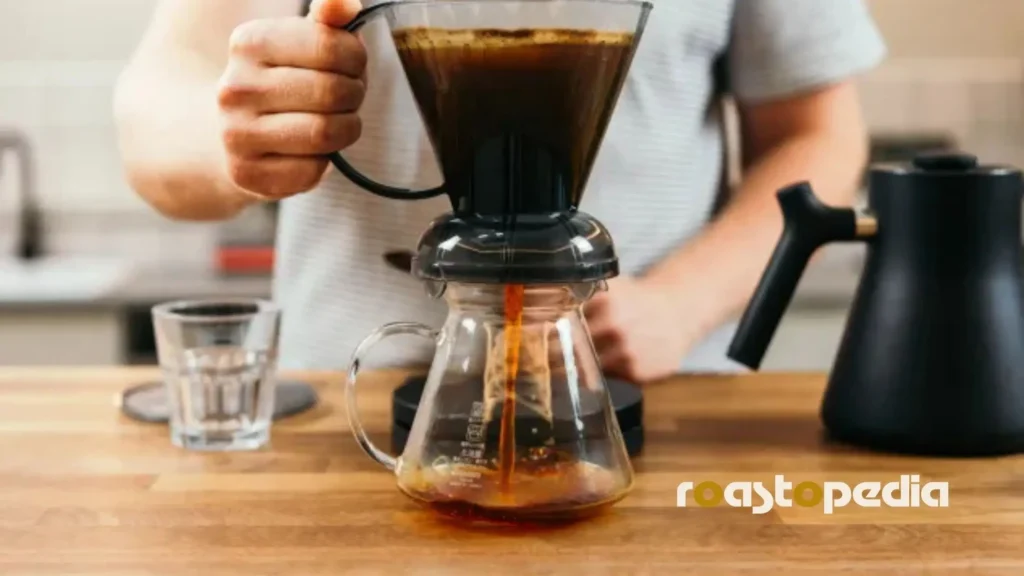
The Clever Dripper’s origin story is unclear. Documented reports indicate that it was produced by ABID Co., a Taiwanese manufacturer whose name stands for Always Best In Design.
The company also made similar tea brewers with fixed nylon mesh filters, and the Clever appears to have grown from that same product line.
The earliest traceable patent activity points to 1996 and 1997, with a Taiwanese married couple — Peo-Wu and Yu-Mei Tien — linked to the foundational design.
One version of the timeline places the invention as early as 1997; another attributes the commercial patent to 2008, when ABID filed for the specific valve mechanism that defines the modern device. The discrepancy likely reflects the gap between an initial concept and the refined, commercially viable version.
What is certain is that the Clever Dripper entered the American specialty coffee market in 2009, imported and introduced by Sweet Maria’s, a San Francisco-based home roasting and equipment retailer.
For many outside Taiwan, 2009 is when the Clever effectively began — Sweet Maria’s brought it into a specialty coffee conversation that was hungry for alternatives to the Hario V60 and Chemex that were dominating the pour-over space at the time.
The device never attracted the competition glory of the V60 or the cultural cachet of the Chemex. It has no championship wins attached to its name, no famous inventor with a known biography, no cinematic origin story. What it has is a loyal, quietly devoted following of brewers who appreciate what it actually does — and does better than most of its peers.
The Valve
Everything that makes the Clever Dripper interesting comes down to a single engineering detail: the valve in the base. It is a spring-loaded rubber stopper seated inside the drainage hole at the bottom of the cone. In its default state, it is closed. Coffee cannot drain out.
When the brewer is placed on top of a cup or carafe, the rim of the vessel pushes up against the valve mechanism, compressing the spring and opening the hole. Coffee drains through the paper filter and into the cup below. Lift the brewer off, and the valve closes again. The whole sequence is passive — no buttons, no levers, no manual timing required.
This is the Clever’s entire design premise: give the brewer control over contact time without requiring them to control flow rate. In a V60 or a Chemex, extraction time is partly governed by how fast the water drains, which is affected by grind size, pour speed, and filter porosity.
In the Clever, water doesn’t drain at all during steeping. Time is the only variable the brewer manages. Grind size still matters — finer grinds extract more in the same time — but flow rate is removed from the equation entirely.
The cone itself accepts a standard Melitta-style trapezoidal paper filter, which is a flat-bottomed, folded filter also used in Melitta drip brewers. This is not a proprietary filter format, which means the Clever is one of the few specialty brewers with wide filter availability at ordinary supermarkets.
How the Brew Works
Brewing with a Clever Dripper is closer to making tea than it is to traditional pour-over. A paper filter is placed in the cone, rinsed with hot water to remove papery flavor and preheat the vessel, and the rinse water is tipped out through the valve by setting the brewer briefly on a cup.
Ground coffee goes in next — medium to medium-coarse, in the range of what you’d use for a drip machine, though experimentation on either side is part of what makes the Clever forgiving.
Hot water is poured over the grounds in a single pour, filling the cone. The lid — if using one — goes on to retain heat during the steep. The brewer sits on a flat surface, valve closed, for a set period. Four minutes is the conventional baseline, though experienced brewers adjust based on grind size and desired strength.
When time is up, the brewer is placed on a cup or carafe, the valve opens, and the coffee drains through the paper filter in about a minute. What comes out is clean, without the sediment of a French Press, but with more body than a typical pour-over because the immersion process extracts a broader, slower profile of soluble compounds.
The consistency this method produces is its most underappreciated quality. Because contact time is fixed and controlled by a timer rather than by the brewer’s hands, two brews from the same recipe will taste nearly identical. For cafés, for training environments, and for home brewers who want reliable results without developing a precise pour technique, this is significant.
What the Cup Delivers
The Clever produces a cup that sits between the French Press and the pour-over in almost every dimension. The body is fuller than a V60 or Chemex, but lighter than a French Press, because the paper filter catches the oils and fine particles that a metal mesh lets through.
Clarity is higher than that of an immersion-only method, lower than that of a slow pour-over. Acidity is present but softer than a comparable V60 brew, because the immersion process extracts a wider range of compounds simultaneously rather than in the progressive wave of percolation.
The result is a balanced, accessible cup that doesn’t dramatically flatter or dramatically expose the coffee’s character. It doesn’t reach the brightness ceiling that a well-executed V60 can hit with the right single-origin coffee.
But it also doesn’t punish imprecision the way that brewer does. A Clever brew made slightly too fast or slightly too slow is still a good cup of coffee. A pour-over made carelessly can be something else entirely.
Coffees with natural sweetness and moderate acidity perform particularly well — Latin American lots, medium-roasted East Africans, anything with a clean, rounded profile. Delicate, high-acidity coffees at very light roasts tend to express better through a proper pour-over where the brewer can manage flow rate and turbulence.
The Size Question and Material Reality
ABID produced the Clever in two sizes: a 300ml version for a single serving and a 500ml version, roughly 18 ounces, for two cups or a generous single. Both are made from BPA-free plastic throughout. There is no ceramic version, no glass version, no premium material tier. The entire device — cone, lid, valve assembly — is plastic.
This has made the Clever one of the more affordable pieces of specialty brewing equipment available, and arguably one of the most durable. Unlike glass brewers that crack if dropped and ceramic cones that chip, the Clever survives falls without incident. For travel, for office use, for environments where breakage is a real concern, this matters.
The one material-related criticism sometimes leveled at the Clever is heat retention. Plastic doesn’t hold heat as well as ceramic or stainless steel, and because immersion brewing depends on a stable temperature throughout the steep, cold ambient conditions can cause the brew temperature to drop faster than ideal. Preheating with hot water before brewing — standard practice for most methods — mitigates this significantly.
Variations and the Hybrid Legacy
The Clever’s valve mechanism was novel enough that it influenced subsequent brewers. The Espro Bloom, a later pour-over with an integrated valve that holds water during a bloom phase and releases it after, borrows the same logical premise. The concept of a controlled-release dripper — pour-over cone with a valve — has since appeared in multiple forms from different manufacturers, none of which achieved the Clever’s market penetration.
The Clever also occupies an interesting position relative to the AeroPress. Both are immersion brewers with paper or metal filters. Both produce clean, full cups. The AeroPress uses pressure; the Clever uses gravity. The AeroPress requires active plunging; the Clever opens passively.
The AeroPress produces a more concentrated shot-like brew by default; the Clever produces a larger, more conventional cup volume. They share a philosophy — controlled immersion plus filtration — but arrive at it from different engineering directions.
Within specialty coffee training, the Clever has found an enduring role precisely because it eliminates so many variables. When a trainer wants a student to taste the difference between grind sizes or between two different coffees, without the interference of technique variation, the Clever is often the brewer of choice. It removes the human hand from the extraction equation to a degree that very few manual brewers can match.