
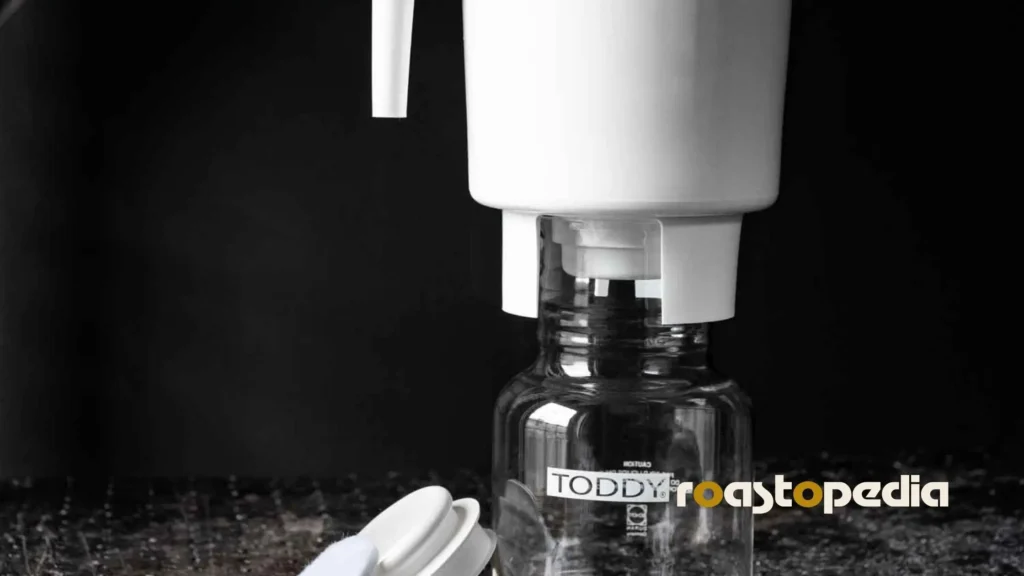
The Toddy Cold Brew System is the original commercially patented immersion cold brew device, developed in 1964 by Todd Simpson, a chemical engineering graduate of Cornell University.
It is a non-electric, gravity-fed brewing apparatus that produces a smooth, low-acid coffee concentrate through cold water immersion and is widely recognized as the product that standardized and popularized immersion cold brew as a modern brewing method.
Definition
The Toddy Cold Brew System is a patented cold water extraction device designed to steep coarsely ground coffee in cold water for 12 to 24 hours, producing a concentrated liquid coffee extract. The system operates without electricity, relying entirely on gravity and time to drive the extraction and subsequent filtration process.
The Toddy is classified as an immersion cold brew device. Ground coffee is fully submerged in cold water for the entire brew cycle, distinguishing it from percolation-based methods such as cold drip, where water moves continuously through the grounds. The Toddy does not drip water through coffee; it steeps coffee in water and then releases the concentrate through a stopper at the base of the brewing container.
The concentrate produced by the Toddy system is documented to contain 67% less acid than coffee brewed by conventional hot methods. This reduced acidity is a direct result of the cold water extraction process, in which certain bitter oils, fatty acids, ketones, esters, and amides — compounds that are soluble only at high temperatures — are not extracted.
Etymology
The name “Toddy” is derived from the given name of its inventor, Todd Simpson. The device takes its name directly from the first syllable of “Todd,” following a naming convention common to inventor-branded products of the mid-20th century. The name carries no prior association with the term “hot toddy,” an unrelated alcoholic beverage.
The full commercial designation is the “Toddy Cold Brew System,” a name that encapsulates both the inventor’s identity and the method it employs. The product has operated under this name since its patent and commercial launch in 1964, making it one of the longest-continuously-branded single coffee brewing devices in the American market.
The company operating the Toddy brand is Toddy LLC, a family-run business headquartered in Fort Collins, Colorado, with origins in Loveland, Colorado, where Todd Simpson first established the company following the product’s invention and patenting.
History & Origin
The Toddy Cold Brew System was born from a direct encounter with Peruvian cold brew coffee culture. In 1963 or 1964, Todd Simpson — then a chemical engineering graduate of Cornell University — traveled to Peru, where he encountered a local method of preparing coffee using a cold liquid concentrate derived from an ancient Peruvian extraction process. The smooth, low-acid character of that coffee made a lasting impression on Simpson.
Drawing on his background in chemical engineering, Simpson recognized that high temperature was the primary cause of the undesirable flavor compounds — bitter oils and biting fatty acids — that characterized conventionally hot-brewed coffee. He theorized that replacing heat with time as the extraction mechanism would yield a fundamentally different and more palatable beverage. This engineering insight became the founding principle of the Toddy system.
Simpson developed and patented the Toddy Cold Brew System in 1964. The original patent covered a cold water immersion brewing device designed to produce a concentrated coffee extract that, when reheated with hot water, would deliver a cup with significantly reduced acidity. The system was therefore conceived first as a tool for making better hot coffee, not as a cold coffee beverage device.
The product was initially manufactured and sold as a home brewing device. Over the following decades, the system gained commercial adoption by coffee shops and foodservice businesses across the United States and Canada. Leading coffee chains including Seattle’s Best Coffee, Gloria Jean’s, Barnie’s, Pret a Manger, Coffee Bean and Tea Leaf, Dunn Bros., CC’s Coffee House, and several hundred other establishments adopted the Toddy commercial model for large-batch cold brew production.
Since 1964, more than one million Toddy Cold Brew Systems have been sold at retail, according to Toddy LLC. The system is sold with a money-back guarantee and has remained in continuous commercial production for over six decades, making it the longest-running cold brew brewing device in the history of the American coffee market.
Description
The Toddy Cold Brew System produces a coffee concentrate that is chemically distinct from both hot-brewed coffee and cold drip coffee. During cold water immersion, only compounds soluble at low temperatures are extracted from the roasted coffee grounds.
Compounds soluble exclusively at high temperatures — including specific oils, fatty acids, ketones, esters, and amides — remain locked in the grounds and are never released into the brew.
The resulting concentrate is deep brown in color, fully opaque, and viscous relative to ready-to-drink hot coffee. Its body is heavier and silkier than that of cold drip coffee, a characteristic of immersion extraction where extended full-contact steeping draws out a broader range of lipid-soluble compounds than percolation-based methods.
In terms of aroma, Toddy cold brew concentrate is less volatile than hot-brewed coffee due to the absence of heat-driven evaporation of organic volatile compounds. The aroma profile is typically described as chocolatey, malty, and subtly sweet, with origin notes that vary depending on the coffee used.
The taste profile of Toddy cold brew is smooth, full-bodied, and notably low in bitterness. Research confirms that immersion cold brew exhibits higher sweetness, nutty, caramel, and malt flavor attributes compared to cold drip brews, which register higher bitterness and roasted character. The Toddy system, as the defining commercial device of the immersion method, produces a cup consistent with these immersion-specific characteristics.
The Equipment: Components of the Toddy System
The Toddy Cold Brew System home model consists of six primary components. The brewing container is a BPA-free plastic vessel with a handle, a lid, and a hole at its base through which concentrate drains after steeping. The brewing container is the central vessel of the system and is designed to hold up to one pound (approximately 340 grams) of coarsely ground coffee.
The silicone stopper is inserted into the hole at the outside base of the brewing container before brewing begins. It seals the container during the steep phase, preventing concentrate from draining prematurely.
The stopper is removed after steeping is complete to release the concentrate into the glass decanter below.
The reusable felt filter is a disc-shaped filter inserted into the inside bottom of the brewing container before coffee and water are added. It sits above the stopper and serves as the primary filtration layer, straining out coffee grounds and fine particles as the concentrate flows through during the drain phase.
Each felt filter is rated for approximately 10 to 12 uses with proper care. After each use, the filter is rinsed and stored damp in a freezer to preserve its structure and filtration capacity.
Paper filter bags are a secondary filtration option used in conjunction with the felt filter. Coffee grounds are loaded directly into the paper filter bag, which is then placed inside the brewing container on top of the felt filter. This two-stage filtration system produces a cleaner, more sediment-free concentrate. Each paper filter bag is single-use and is discarded with the spent grounds after draining.
The glass decanter is a sealed collection vessel positioned beneath the brewing container during the drain phase. It holds the finished concentrate and is fitted with an airtight lid for refrigerated storage. The decanter is dishwasher-safe. The home system’s glass decanter holds approximately 7 cups (56 fluid ounces or 1.65 liters) of cold brew concentrate per batch.
Preparation & Process
The Toddy brewing process begins with inserting the silicone stopper into the outside base of the brewing container. The reusable felt filter is then dampened with cold water and placed into the inside bottom of the container. If paper filter bags are being used, an open bag is placed inside the container on top of the felt filter before any coffee or water is added.
The recommended starting recipe for the home system calls for 340 grams (12 ounces) of coarsely ground coffee and 8 cups (64 fluid ounces or approximately 1.9 liters) of cold filtered water. A coarse grind — equivalent to a French press grind — is mandatory. Finer grinds risk clogging the felt filter, slowing or blocking drainage entirely, and introducing over-extracted, bitter compounds into the concentrate.
Water and coffee are added in two stages to ensure even saturation. Approximately one cup of cold water is added first to wet the filter base. Half the coffee (170 grams) is added, followed by three cups of water poured in a slow, circular motion over the grounds.
The remaining 170 grams of coffee are added, followed by the remaining four cups of water, again poured in a circular motion. The grounds are then gently pressed with the back of a spoon to ensure complete saturation. Toddy’s official instructions advise against vigorous stirring, as this can disturb the filter and cause clogging.
The brewing container is covered with its lid and left to steep for 12 to 24 hours. The Toddy system can be steeped at room temperature or in the refrigerator. Room temperature steeping produces a slightly stronger, more developed concentrate; refrigerator steeping produces a cleaner, lighter result. A 12-hour steep at room temperature is a widely used standard.
After steeping, the brewing container is positioned directly over the open glass decanter. The stopper is removed from the base of the container, and the concentrate flows through the felt filter and into the decanter below.
Full drainage takes approximately 10 to 15 minutes. After draining, the paper filter bag and spent grounds are discarded. The felt filter is rinsed, placed in a resealable bag, and stored in the freezer for subsequent use.
The finished concentrate is capped with the decanter lid and stored in the refrigerator. It remains fresh for up to two weeks. When serving, Toddy recommends diluting the concentrate with cold or hot water, milk, oat milk, or soy milk at a starting ratio of 1 part concentrate to 2 or 3 parts liquid, adjustable to taste. One standard home batch yields approximately 14 ready-to-drink servings when diluted at a 1:1 ratio.
Key Characteristics
Acidity: The Toddy system produces concentrate with 67% less acid than conventionally hot-brewed coffee, as documented by Toddy LLC and corroborated by independent scientific research on immersion cold brew. This reduction results from the absence of heat, which prevents the extraction of certain oils and fatty acids that are soluble only at elevated temperatures.
Extraction Mechanism: The Toddy operates as a full immersion device. Coffee grounds remain in complete, static contact with cold water for the full duration of the brew cycle. This is distinct from the Kyoto-style cold drip method, where fresh cold water moves continuously through the grounds in a percolation process.
Brew Ratio: The standard home system recipe uses 340 grams of coffee to 1.9 liters of water — a ratio of approximately 1:5.6 by weight. This produces a concentrate intended for dilution before consumption. The commercial model scales this ratio upward: 5 pounds of coffee to produce approximately 2.5 gallons of extract per batch.
Filtration: The Toddy uses a two-stage filtration system consisting of a reusable felt filter and optional single-use paper filter bags. The felt filter removes grounds and sediment; the paper filter bag provides an additional layer of clarity. This dual filtration produces a sediment-free concentrate with a clean mouthfeel.
Capacity: The home model produces approximately 7 cups (56 fluid ounces) of concentrate per batch, equivalent to 14 ready-to-drink servings when diluted 1:1. The commercial model produces approximately 2.5 gallons (9.5 liters) of concentrate per batch from 5 pounds of coffee.
Shelf Life: Concentrate stored in the sealed glass decanter in a refrigerator remains fresh for up to two weeks, though peak flavor quality is generally maintained within the first seven days of storage.
Electricity: The Toddy system requires no electricity at any stage of the brewing or filtration process. Gravity drives both the saturation of grounds during steeping and the drainage of concentrate after steeping is complete.
Home Model and Commercial Model
The Toddy Cold Brew System is available in two primary configurations. The home model is designed for personal and small-scale use, accommodating up to 340 grams of coffee and producing approximately 7 cups of concentrate per batch. It is sold as a complete kit including the brewing container, glass decanter, two reusable felt filters, three paper filter bags, a silicone stopper, and an instruction guide.
The commercial model is a scaled-up version of the same immersion brewing principle, designed for cafes, restaurants, roasters, and foodservice operations requiring high-volume cold brew production. It accommodates 5 pounds of coffee per batch and yields approximately 2.5 gallons (9.5 liters) of concentrate. The commercial model is NSF certified, constructed from BPA-free plastic, and measures 12 inches wide by 12 inches deep by 18 inches tall.
The commercial model incorporates a lift plate, a component added to improve drainage efficiency and eliminate the need for baristas to manually press or squeeze the filter bag after steeping. It employs a two-stage filtration system using large paper filters contained within a reusable cloth outer strainer, designed for high-throughput clarity and minimal cleanup time between batches.
The commercial model has been adopted by hundreds of coffeehouses and cafes across the United States and Canada, including Seattle’s Best Coffee, Gloria Jean’s, Barnie’s, Pret a Manger, Coffee Bean and Tea Leaf, Dunn Bros., CC’s Coffee House, It’s A Grind, Deidrich, Full City Coffee, and many others. The system is also sold internationally through specialty coffee distributors.
Cultural Significance
The Toddy Cold Brew System occupies a foundational position in the history of modern cold brew coffee. It was the first commercially patented device to standardize immersion cold brew as a repeatable, scalable method, and its invention in 1964 is recognized across the coffee industry as the beginning of the modern cold brew era.
Without the Toddy, the proliferation of commercial cold brew products in the 21st century would have lacked an established technical foundation.
Todd Simpson’s application of chemical engineering principles to coffee brewing — specifically his identification of temperature as the driver of unwanted compound extraction — represents a scientifically grounded contribution to beverage science.
His core finding, that certain bitter oils and fatty acids are soluble only at high temperatures and can be excluded from the cup by brewing cold, has been corroborated by peer-reviewed research in food science literature published decades after the system’s invention.
The Toddy system democratized cold brew by making it accessible to home brewers without specialized equipment, technical knowledge, or significant expense. Its straightforward design — a plastic container, a stopper, a felt filter, and a glass decanter — removed barriers to entry that had previously confined cold brew production to commercial operations or technically skilled enthusiasts. More than one million units sold at retail since 1964 reflect its sustained relevance across six decades of evolving coffee culture.
The system’s dual functionality — producing concentrate usable for both hot and cold coffee — addressed a consumer need that no prior cold brew device had served. For individuals with acid sensitivity, the ability to consume hot coffee brewed cold represented a significant quality-of-life benefit. This application remains one of the Toddy system’s most documented use cases in consumer coffee culture.
Common Misconceptions
Misconception 1 — The Toddy is a drip device: The Toddy is an immersion device, not a drip device. Water is combined with coffee grounds in a sealed container and left in full static contact for the duration of the steep. No water drips through the grounds during extraction. Drainage only occurs after steeping is complete and the stopper is removed.
Misconception 2 — The Toddy was invented to make cold coffee: The Toddy was originally developed to produce a low-acid concentrate for making superior hot coffee. Todd Simpson’s initial goal was to improve the quality of hot-brewed coffee for individuals with acid sensitivity, not to create a cold beverage. The system’s application to cold coffee beverages was developed as a secondary use case.
Misconception 3 — Any grind size can be used in the Toddy: The Toddy system requires a coarse grind equivalent to a French press grind. Fine or medium grinds clog the felt filter, prevent proper drainage, and produce over-extracted, bitter concentrate. Blade grinders are considered acceptable for the Toddy system only when grounds are processed to a coarse consistency of approximately 9 to 11 seconds.
Misconception 4 — The felt filter does not need special care: It requires specific maintenance to preserve its filtration capacity and longevity. After each use, it must be rinsed with cold water — not soap — and stored damp in a sealed bag in the freezer. Improper storage causes the felt to dry out, deform, and lose its ability to filter sediment effectively. Each felt filter is rated for approximately 10 to 12 uses under proper care conditions.
Misconception 5 — Toddy concentrate must always be served cold: Toddy concentrate is fully compatible with hot service. Diluting the concentrate with steaming-hot water at the standard serving ratio produces a hot coffee beverage that retains the low-acid, smooth character of the cold-extraction process. This was, in fact, the system’s original intended application.
Related Terms
Cold Brew | Immersion Cold Brew | Cold Drip (Kyoto-style Cold Brew) | Brew Ratio | Extraction Yield | Coffee Concentrate | Felt Filter | Titratable Acidity | Chlorogenic Acids | Fatty Acids | Cold Water Extraction