
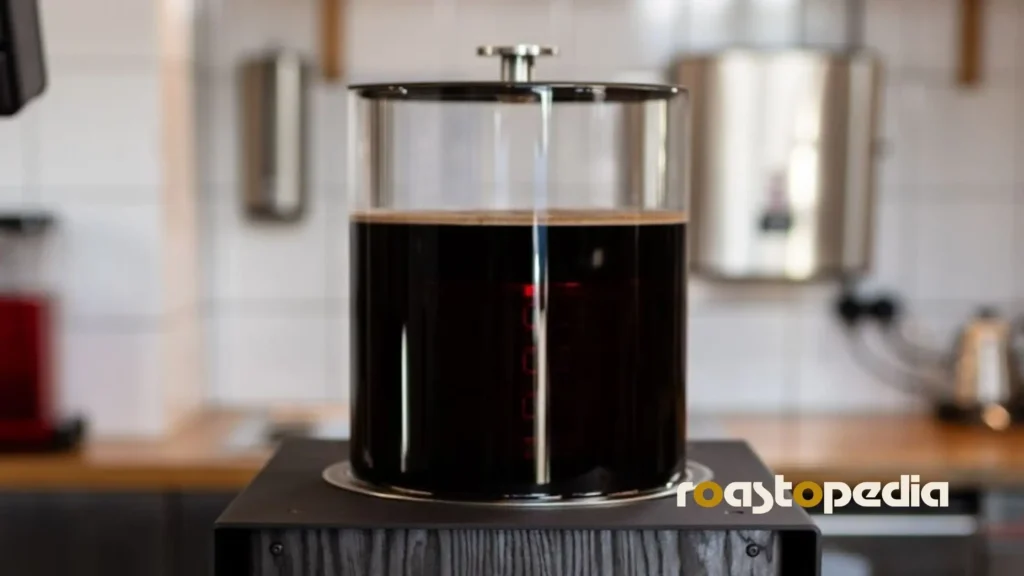
Cold Brew refers to both a coffee brewing method and the finished cold brew coffee drink it produces. As a technique, it describes the process of steeping coarsely ground coffee in room-temperature or cold water for an extended period, typically 12 to 24 hours, without ever applying heat. As a beverage, Cold Brew is the smooth, naturally sweet, low-acid concentrate (or ready-to-drink cup) that results from this process. The drink is also known as cold-water extraction or cold-pressed coffee, and it forms the base for related preparations such as Nitro Cold Brew and other iced coffee styles.
At Cold Brew At a Glance
| Type | Brewing method & finished coffee drink |
| Also known as | Cold-water extraction, cold-pressed coffee |
| Origin | Disputed; linked to Japan, the Dutch East India trade, and Latin America |
| Primary ingredients | Coarsely ground coffee, cold or room-temperature water |
| Brewing time | 12–24 hours |
| Water temperature | Room temperature to cold (no heat applied) |
| Serving temperature | Cold, usually over ice |
| Typical brew ratio | 1:8 to 1:15 (coffee to water, by weight) |
| Caffeine content | Generally higher per volume than hot-brewed coffee |
| Related methods | Immersion brewing, Kyoto-style slow drip |
Etymology
The term “Cold Brew” is a straightforward compound of “cold,” describing the water temperature used, and “brew,” the general English word for steeping a beverage from a base ingredient. Unlike many coffee terms that trace back to Italian, Arabic, or Amharic roots, Cold Brew is a modern, descriptive English label that emerged alongside the practice itself in twentieth-century America, distinguishing it from “iced coffee,” a separate category in which hot-brewed coffee is simply chilled or poured over ice.
History
Cold-water coffee extraction is often traced to Kyoto-style slow-drip brewing in Japan, where cold water is dripped, drop by drop, over grounds to create a concentrate, a technique some historians connect to earlier Dutch trading routes through Asia. Separately, cold coffee concentrates have long histories in Latin America, including Peru, where travelers reported encountering cold-steeped coffee generations before it became a commercial product in the West.
The modern American Cold Brew category is usually credited to Todd Simpson, a Cornell-trained chemical engineer who, after tasting a cold coffee concentrate on a trip through Latin America in 1964, developed and patented the Toddy Cold Brew System, an immersion brewer built around a filtered steeping bucket.
The device popularized cold brewing as a way to produce a smoother, notably less acidic cup than hot extraction, and it remains closely associated with the practice today, much as the Moka Pot is associated with Italian stovetop brewing.
Cold Brew stayed a niche specialty-coffee item for decades before exploding in popularity in the 2010s, driven partly by the rise of canned and kegged Nitro Cold Brew at third-wave cafés. According to the National Coffee Association, cold brew consumption in the United States climbed roughly 300% between 2016 and 2023, and it has continued to gain share among younger, specialty-focused drinkers since.
Traditional Preparation
Cold Brew is typically made through immersion brewing: coarsely ground coffee is fully submerged in cold or room-temperature water and left to steep, undisturbed or with light initial agitation to ensure the grounds are evenly saturated. After 12 to 24 hours, the liquid is strained through a paper filter, fine mesh sieve, or cloth to remove the spent grounds, producing a concentrate that is diluted with water, milk, or ice before serving.
A slower, related technique, sometimes called Kyoto-style or slow-drip cold brew, passes cold water through the grounds one drop at a time over several hours rather than steeping them in a single batch.
Because no heat is involved, extraction proceeds far more slowly than in hot brewing methods, and precise dosing of coffee to water matters more than in many other preparations, since there is no thermal energy to accelerate solubility.
Ingredients
- Coarsely ground coffee — a coarse grind is essential; finer grinds tend to over-extract and produce a cloudy, sediment-heavy brew
- Cold or room-temperature water — filtered water is generally preferred, since off-flavors are more noticeable without heat to mask them
- Optional dilutants — additional water, milk, cream, or plant-based milk, added at serving time to adjust strength
Characteristics
Cold Brew coffee is known for its smooth, low-acid, naturally sweet profile. Because cold water extracts fewer bitter compounds and oils than hot water, the finished drink tends to taste mellower and less sharp than an equivalent hot-brewed or iced coffee, with muted acidity and pronounced chocolate, nutty, or caramel-like notes rather than bright or fruity ones.
This same slow, cool extraction also means that some flavor compounds tied to heat-driven reactions are extracted less intensely than in hot brewing, which is part of why Cold Brew is often described as smoother but less complex than a fresh hot cup of the same beans. Because it is typically brewed as a concentrate, caffeine content per serving can be higher than hot coffee unless diluted generously.
Regional Variations
- United States — the dominant commercial form, popularized by the Toddy system and now widely sold as bottled, canned, and on-tap café concentrate
- Japan — the slow-drip Kyoto style, using towers that release cold water over grounds drop by drop across several hours
- Vietnam and Southeast Asia — cold coffee traditions favor sweetened condensed milk poured over ice, a related but distinct iced-coffee lineage rather than true cold brew
- Nitro Cold Brew — a widespread modern variant in which cold brew concentrate is infused with nitrogen gas and served on tap, giving it a cascading, creamy, stout-like head
Cultural Significance
Cold Brew has become closely tied to modern café culture and the broader “third wave” and specialty coffee movements, prized for offering a gentler, lower-acid alternative to traditional hot coffee that suits warm-weather and all-day drinking occasions. Its rise has also reshaped how coffee is retailed: ready-to-drink canned and bottled cold brew is now a major supermarket category, and the format has become a signature summer offering across major coffee chains.
Industry surveys from the National Coffee Association show cold coffee formats, including cold brew, now account for roughly a third of coffee consumed by Americans during warmer months, reflecting its shift from a niche specialty item to a mainstream daily habit.
Comparison with Similar Drinks
- Iced Coffee — brewed hot and then cooled or poured over ice; generally more acidic and lighter-bodied than Cold Brew, which is never exposed to heat
- Nitro Cold Brew — Cold Brew concentrate infused with nitrogen gas for a creamy texture and cascading foam
- Cappuccino — an espresso-based, hot-extracted drink built on steamed milk and foam, contrasting sharply with Cold Brew’s slow, heat-free process
- Lungo and Café Solo — espresso-based hot preparations that rely on pressure and heat rather than time and cold water for extraction
- Macchiato — a small, espresso-forward hot drink, illustrating the opposite end of the extraction spectrum from Cold Brew’s long, gentle steep
Typical Specifications
- Grind size: coarse
- Brew ratio: commonly 1:8 for concentrate, diluted to around 1:1 with water or milk at serving; café recipes often fall between 1:10 and 1:15 coffee to water
- Steep time: 12–24 hours
- Water temperature: room temperature to refrigerator-cold
- Filtration: paper filter, cloth, or fine mesh
- Shelf life: concentrate typically keeps for up to two weeks refrigerated
See Also
References
- Wikipedia — “Cold brew coffee”
- Wikipedia — “Nitro cold brew coffee”
- Wikipedia — “Iced coffee”
- Tea & Coffee Trade Journal — “Cold Brew Coffee: From a Historically Niche Category to Global Phenomenon”
- MTPak Coffee — “Cold brew coffee: What is the best roast profile?”
- Breville — “What is nitro cold brew coffee?”
- Trade Coffee — “What is Nitro Cold Brew?”
- Starbucks — “Nitro Cold Brew Coffee”
- Hardtank — “RTD, nitro, cold brew: A cold coffee glossary”
- Hardtank — “Global market analysis: where is cold brew growth happening around the world?”
- WebstaurantStore — “What Is Nitro Coffee? A Guide to Nitrogen Infused Drinks”
- Brew N Bottle — “Our History”
- Daily Coffee News — “Cold Coffee Ruled This Summer, New NCA Market Report Finds”
- Daily Coffee News — “Two-Thirds of Americans Said They Drank Coffee Yesterday, NCA Report Finds”
- SupplySide Food & Beverage Journal — “Cold brew coffee popularity surges 300% since 2016”