
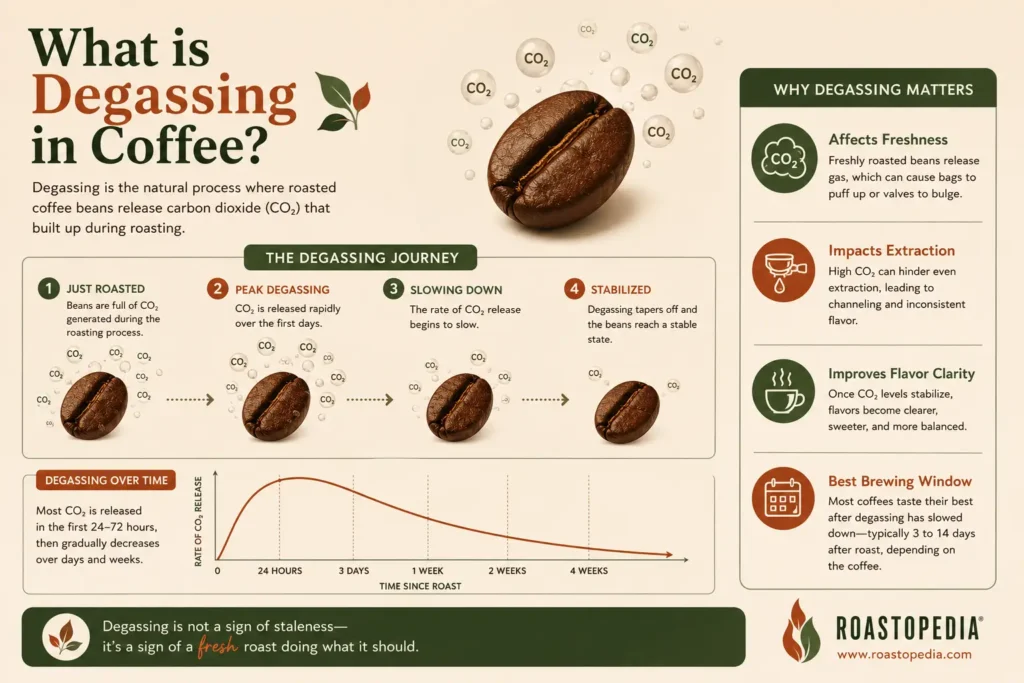
Degassing is the spontaneous release of carbon dioxide (CO2) from coffee beans after roasting. During the roasting process, complex chemical reactions break down carbohydrates into gas. This carbon dioxide remains trapped within the microscopic, honeycomb-like cell structure of the bean. It must escape gradually over several days to ensure an optimal and balanced extraction.
Roasters and baristas prioritize this phase to prevent flavor interference during brewing. Excess gas creates bubbles that physically repel water from the coffee grounds. This repulsion leads to uneven saturation and unpleasant sour or metallic notes. Proper rest (degassing before brewing) ensures the water can fully penetrate the particles for a transparent cup.
Optimal Varieties for Rapid Degassing
Darker roasts are the most efficient candidates for quick degassing. Their prolonged exposure to intense heat causes significant structural damage to the cell walls. This damage creates large, open pores that allow gas to escape very rapidly. Most dark roasts reach their peak flavor within three to five days.
Low-altitude beans also tend to degas with greater overall speed. Coffee grown at lower elevations possesses a less dense and more porous cellular structure. These “soft” beans offer little resistance to the migration of internal gases. This makes them ideal for high-volume production where quick turnaround is required.
Natural process coffees often exhibit a faster initial gas release. The fermentation of fruit sugars during drying softens the bean’s exterior cellulose. This organic breakdown facilitates an easier path for carbon dioxide to exit. Such coffees are excellent for those who prefer vibrant profiles early on.
Challenging Varieties for Degassing
Lightly roasted coffee is notorious for being difficult to degas. Roasters stop the heat before the cell walls become brittle or porous. This leaves the CO2 trapped inside a very dense and tight matrix. These beans often require two to three weeks of rest to peak.
High-altitude beans present another significant challenge to the degassing timeline. Coffees grown above 1,500 meters develop extremely compact and hard structures. This density acts as a natural seal against rapid gas migration. Patience is required to unlock the complex acidity of these beans.
Washed process coffees generally degas more slowly and predictably than naturals. The removal of the mucilage creates a cleaner and more intact bean surface. This intact surface provides a consistent and firm barrier to gas release. Such stability is valued by roasters seeking long-term flavor preservation.
The Chemistry of Internal Pressure
Carbon dioxide formation is primarily driven by a process called Strecker degradation. This reaction occurs as a specific subset of the larger Maillard process. Amino acids react with dicarbonyl compounds to create essential volatile aromas. Each reaction cycle releases a single molecule of CO2 gas.
Approximately 80% of all coffee gas originates from this pathway. Roasting also triggers the thermal decomposition of various organic acids. This process continues until the beans are removed from the roaster. Once cooled, the internal pressure exceeds the external atmospheric pressure.
Gas then migrates through the porous cellulose walls of the bean. This migration is the fundamental engine of the entire degassing phenomenon. Scientific study of these kinetics helps roasters predict accurate shelf life. Understanding the pressure gradient is key to mastering final flavor.
The Importance of the Waiting Period
Flavor clarity is the primary reason for managing the degassing phase. Carbon dioxide itself has a slightly sour and carbonic acid bite. High concentrations of gas mask the delicate floral notes of the coffee. Resting allows these sharp, masking gases to dissipate into the air.
Consistency in the café environment depends on stable degassing levels. Super-fresh coffee changes its extraction rate every few hours. A barista would have to adjust their grinder constantly to compensate. Proper resting provides a “flat” period of chemical stability for recipes.
Repeatable recipes and reliable taste profiles are only possible through patience. Every specialty bean has a unique window of aromatic excellence. Identifying this window is the mark of a professional coffee program. Master the wait to master the final result.
Methods and Technical Implementation
Bulk degassing usually takes place in large, climate-controlled steel silos. Roasters may also use specialized bins for smaller, artisanal batches. The goal is to protect beans from oxygen during the release. Exposure to air triggers oxidation and rapid, undesirable staleness.
One-way valves are the most common industrial solution for packaging. These small plastic components sit on the surface of the coffee bag. Internal pressure pushes a rubber diaphragm to open the vent. Once the pressure equalizes, the valve seals shut again automatically.
This technology keeps the internal coffee environment inert and fresh. It allows gas to leave while blocking the entry of oxygen. Nitrogen flushing is often combined with this method for maximum preservation. Such systems are standard in the global specialty coffee trade.
Stages of the Degassing Cycle
Stage one occurs within the first 24 hours after roasting. This is the most volatile and rapid phase of the cycle. The coffee loses nearly half of its total gas volume. Beans at this stage are too unstable for professional service.
Initial discharge often produces a dry, metallic sensation in the cup. Stage two spans from day two to day seven. The release rate slows down significantly during this middle window. Aromas begin to integrate with the bean’s natural oils.
Most filter coffees reach their peak during this specific timeframe. Flavor profiles become rounded, sweet, and more balanced. Stage three is the long-term stabilization phase for the coffee. This can last up to three weeks for certain roast styles.
Historical Context and the Goglio Patent
Industrial coffee packaging faced a major crisis during the 1960s. Roasters could not seal fresh coffee without bags bursting. They were forced to let coffee sit in the open air. This led to massive flavor loss through rapid oxidation.
Luigi Goglio revolutionized the industry in Milan in 1970. He patented the first functional one-way degassing valve for coffee. This invention allowed for immediate, high-speed packaging after the roast. It effectively birthed the modern specialty coffee supply chain.
Roasters could finally ship fresh coffee across the globe safely. The Goglio valve remains the industry standard for quality preservation. It transformed coffee from a stale commodity into a fresh luxury. History honors this innovation as a turning point for taste.
Degassing Procedure
Degassing is a complex process that requires time.
How Long Does Coffee Take to Degas Completely?
The complete degassing of coffee is not a single moment but a graduated process influenced by roast level, grind state, storage conditions, and bean origin. Understanding this timeline helps both roasters and consumers make informed decisions about when coffee is at its peak.
Step 1: The Initial Outgassing Burst (0–24 Hours Post-Roast)
The most dramatic phase of degassing occurs within the first 24 hours after roasting. During this window, freshly roasted beans release the bulk of their carbon dioxide — sometimes so aggressively that it can visibly inflate sealed packaging. This is why most specialty roasters build one-way valve bags into their packaging: to allow CO₂ to escape without allowing oxygen in. Coffee brewed during this phase tends to produce uneven extraction and an overly acidic, harsh flavor profile, as the escaping gas physically disrupts water contact with the grounds.
Step 2: The Rapid Stabilization Phase (1–7 Days Post-Roast)
Between days one and seven, CO₂ continues to leave the bean at a measurable but decelerating rate. For espresso applications, many roasters consider this window too early — the gas still interferes with proper crema formation and pressure dynamics. For filter or pour-over brewing, however, some lightly roasted single-origin coffees may begin showing desirable clarity and brightness as early as day three or four. The rate of release during this phase is heavily influenced by roast degree: darker roasts degas faster because roasting has broken down more of the cellular structure, leaving fewer sites where CO₂ can remain trapped.
Step 3: The Optimal Brewing Window (7–21 Days Post-Roast)
For most specialty coffees, the sweet spot for brewing falls between one and three weeks after roasting. By this point, enough CO₂ has left the bean that water can make full, even contact with soluble compounds — but the coffee retains enough residual gas to protect it from oxidative staling. Light roasts may sit closer to the two-to-three week mark before fully opening up, while medium and dark roasts typically peak earlier in this window. This phase is where experienced baristas and home brewers observe the fullest expression of aromatic complexity and balanced flavor.
Step 4: Extended Degassing in Whole Bean Form (21–30 Days and Beyond)
Whole beans degas more slowly than ground coffee due to the reduced surface area exposed to the surrounding atmosphere. In whole bean form stored in sealed, valve-equipped bags at room temperature, trace amounts of CO₂ can persist for up to 30 days or longer. Some ultra-light or very dense high-altitude beans — such as certain Ethiopian or Colombian naturals — may hold residual gas even further beyond this point. While this extended retention can be advantageous for preservation, it also means that brewing very dense whole beans without adequate rest can still yield underdeveloped results even three weeks post-roast.
Step 5: Accelerated Degassing When Ground (Minutes to Hours)
Grinding dramatically accelerates the degassing process by shattering the bean’s cellular structure and exponentially increasing the surface area in contact with air. A freshly ground dose of coffee can release most of its remaining CO₂ within 15 to 30 minutes of grinding. This is why grinding immediately before brewing is the gold standard in specialty coffee — the window between grinding and extraction is narrow, and delaying brewing by even an hour can result in meaningfully flat, lifeless shots or a diminished pour-over cup.
Step 6: Temperature and Storage Effects on Degassing Rate
Environmental temperature has a direct effect on how quickly CO₂ escapes. Warmer storage conditions accelerate molecular activity and therefore speed up degassing, while cooler temperatures — such as refrigeration or freezing — significantly slow the process. This is the scientific basis for the practice of freezing freshly roasted coffee: when properly sealed and frozen immediately after roasting, coffee can be preserved in a near-roast-fresh state for weeks or even months, with degassing essentially paused until the beans are thawed and exposed to ambient temperatures.
Step 7: The Point of Complete Degassing and Staleness
Complete degassing — the point at which virtually no CO₂ remains in the bean — marks the beginning of accelerated oxidative degradation. For whole beans stored at room temperature without a valve bag, this typically occurs somewhere between 4 and 8 weeks post-roast. For pre-ground coffee, complete degassing can occur within 24–48 hours of grinding, which is why pre-ground coffee stales so rapidly. Once fully degassed, coffee is no longer protected from oxygen, and the lipids and aromatic compounds responsible for its flavor begin to degrade at an increasing rate.
Common Mistakes Baristas Commit
Using coffee that is “too fresh” is a frequent error. Baristas often mistake high gas volume for a sign of quality. In reality, it prevents the water from performing a full extraction. The resulting espresso will have large, unstable bubbles in the cup.
This “mock crema” disappears within seconds of being poured. Pre-grinding coffee to accelerate degassing is equally problematic for flavor. Grinding increases the surface area by several thousand times instantly. This causes an immediate and total loss of delicate aromatics.
The coffee doesn’t just degas; it essentially dies on the counter. Always grind your beans just before the extraction begins. Tracking the roast date is the only way to ensure success. Establish a strict resting schedule for every bag of coffee.
How to Avoid Quality Defects
Every bag should have a clear “Roasted On” label. Establish a strict “FIFO” (First In, First Out) system for inventory. This ensures that no bag is opened prematurely by staff. It also prevents coffee from sitting too long and becoming stale.
Cupping the coffee at different intervals is essential for roasters. A roaster should taste batches on day three and day ten. This helps identify the unique peak for each specific origin. Every coffee variety behaves differently under the pressure of degassing.
Testing small samples identifies the exact window of flavor excellence. Professional shops maintain detailed logs of these degassing observations. Data-driven resting leads to a superior customer experience. Consistency is the foundation of a successful coffee brand.
Regional Degassing Profiles
The following table outlines expected degassing timelines based on regional characteristics and typical processing methods:
| Region | Bean Density | Process | Peak Window (Days) |
| Ethiopia (Highland) | High | Washed | 10–18 |
| Brazil (Lowland) | Low | Natural | 3–6 |
| Colombia | Medium | Washed | 5–10 |
| Sumatra | Medium | Giling Basah | 4–8 |
| Kenya | Very High | Washed | 12–21 |
| Vietnam | Medium | Natural | 3–5 |
The Future of Degassing Research
Precision degassing is the next frontier of the specialty industry. Some roasters are experimenting with nitrogen-flushed resting environments. This removes all oxygen during the critical first week of aging. It potentially extends the peak flavor window by several months.
Modern tools can now measure CO2 levels directly in the bean. Ultrasonic degassing is another emerging area of scientific study. Some researchers use sound waves to purge gas from the grounds. This could theoretically prepare coffee for brewing in seconds.
The impact on delicate aromas remains unknown and highly debated. For now, time remains the best tool for the professional barista. Master the gas, and you master the final flavor profile. True coffee knowledge lives in these technical details.
Summary of Best Practices
Resting your coffee is not a passive act of waiting. It is a vital part of the roasting process itself. Respect the chemical timeline of the bean and the roast. Give your coffee the time it needs to reach peak sweetness.
Your patience will be rewarded with clarity and complexity. Degassing is one of those hidden variables of great brewing. Consistency is the mark of a true coffee professional. Always consult the archive for more data on extraction.
See Also
- Roasting
- Degassing
- Blooming
- Grind Size
- Extraction
- First Crack
- Second Crack
- Maillard Reaction
- Coffee Roast Level
- Pre-infusion
References
Specialty Coffee Association. (2018). Water for Coffee: Technical Standards Document. SCA Publications.
Illy, A., & Viani, R. (Eds.). (2005). Espresso Coffee: The Science of Quality (2nd ed.). Elsevier Academic Press.
Schwartzberg, H. G., & Hartel, R. W. (Eds.). (1992). Physical Chemistry of Foods. Marcel Dekker.
Yeretzian, C., Jordan, A., Badoud, R., & Lindinger, W. (2002). From the green bean to the cup of coffee: investigating coffee roasting by on-line monitoring of volatiles. European Food Research and Technology, 214(2), 92–104.
Schenker, S., Heinemann, C., Huber, M., Pompizzi, R., Perren, R., & Escher, F. (2002). Impact of roasting conditions on the formation of aroma compounds in coffee beans. Journal of Food Science, 67(1), 60–66.
Buffo, R. A., & Cardelli-Freire, C. (2004). Coffee flavour: an overview. Flavour and Fragrance Journal, 19(2), 99–104.
Pittia, P., Nicoli, M. C., & Sacchetti, G. (2007). Effect of moisture and water activity on textural properties of raw and roasted coffee beans. Journal of Texture Studies, 38(1), 116–134.
Clarke, R. J., & Macrae, R. (Eds.). (1987). Coffee: Volume 1 — Chemistry. Elsevier Applied Science.
Mwithiga, G., & Jindal, V. K. (2003). Physical changes during coffee roasting in rotary conduction-type heating units. Journal of Food Engineering, 74(3), 389–396.
Smrke, S., Opitz, S. E. W., Vovk, I., & Yeretzian, C. (2013). How grinding and environmental conditions affect the shelf life of roasted coffee. Food Research International, 61, 181–190.
Geiger, R., Perren, R., Kuenzli, R., & Escher, F. (2005). Carbon dioxide evolution and moisture evaporation during roasting of coffee beans. Journal of Food Science, 70(3), E169–E175.
Anderson, B. A., Shimoni, E., Liardon, R., & Labuza, T. P. (2003). The diffusion kinetics of carbon dioxide in fresh roasted and ground coffee. Journal of Food Engineering, 59(1), 71–78.
Baggenstoss, J., Poisson, L., Kaegi, R., Perren, R., & Escher, F. (2008). Coffee roasting and aroma formation: application of different time-temperature conditions. Journal of Agricultural and Food Chemistry, 56(14), 5836–5846.
Cardelli, C., & Labuza, T. P. (2001). Application of Weibull hazard analysis to the determination of the shelf life of roasted and ground coffee. LWT — Food Science and Technology, 34(5), 273–278.
Jokanović, M. R., Džinić, N. R., Cvetković, B. R., Grujić, S., & Odžaković, B. (2012). Changes of physical properties of coffee beans during roasting. APTEFF, 43, 321–331.
Radtke, R. (1975). Significance of CO₂ for the quality of roasted coffee. Proceedings of the 7th International Colloquium on the Chemistry of Coffee. ASIC, Paris.
Labuza, T. P. (1982). Shelf-Life Dating of Foods. Food & Nutrition Press.