
Dibek Kahvesi is a traditional Turkish coffee variety originating in the rural Anatolian heartland, with a particular historical concentration in Gaziantep and southeastern Turkey.
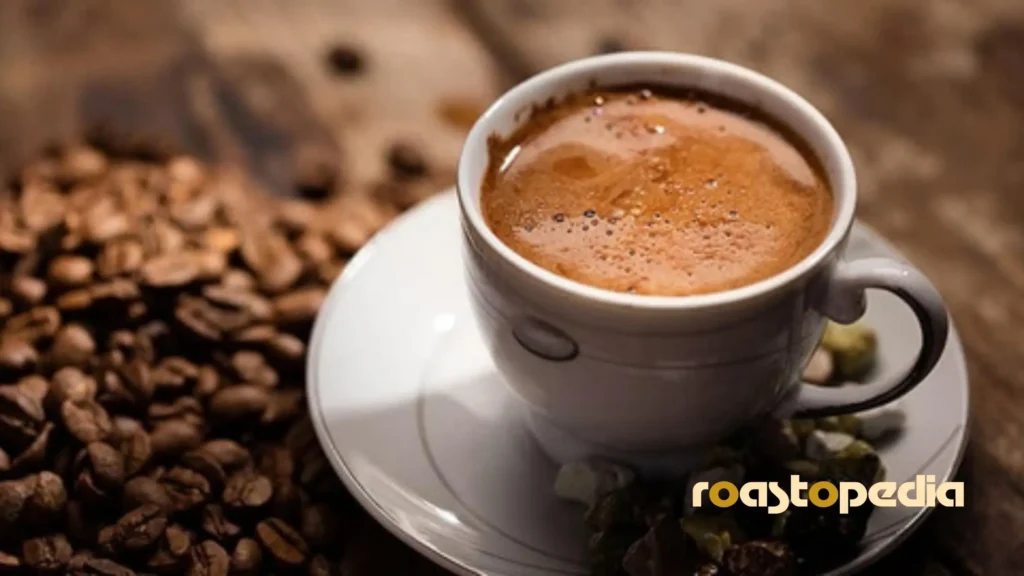
Its production method predates the commercialization of coffee grinding equipment: coffee beans were ground not in a mill but in a stone mortar called a dibek — a communal apparatus found in village squares and courtyards.
The practice of stone-pounding coffee is believed to have been widespread across Anatolia during the Ottoman period and to have persisted in rural communities well into the 20th century.
Today, Dibek Kahvesi has experienced a commercial revival, with specialty brands marketing it as an artisanal, heritage product distinct from standard Turkish coffee.
Etymology
Dibek is a Turkish word for a large stone mortar, typically hollowed from a single block of granite or basalt. The term derives from older Anatolian usage referring to any large communal grinding vessel.
The word appears in Ottoman records describing both coffee preparation and grain milling, reflecting its dual agricultural function. In some dialects, dibek also refers specifically to the act of pounding, making Dibek Kahvesi essentially “pounded coffee.”
The stone mortar itself has symbolic weight in Turkish rural culture, representing communal labor and pre-industrial food preparation.
The Science of the Brew
The critical distinction of Dibek Kahvesi lies in the milling action. A metal blade grinder generates localized friction heat (sometimes exceeding 60°C), which volatilizes aromatic compounds and oxidizes delicate oils before brewing.
Stone mortars, by contrast, crush and shear beans at ambient temperature through repeated impact, preserving a broader spectrum of volatile aromatic esters and terpenes. The resulting particle size distribution is irregular — ranging from fine powder to small fragments — which creates a unique extraction profile.
Many commercial Dibek blends also incorporate additives: mastic resin, salep (orchid starch), cocoa powder, or cream, which modify the texture and flavor profile significantly beyond standard Türk Kahvesi.
Taste & Sensory Profile
Dibek Kahvesi is notably smoother and creamier than standard Türk Kahvesi, largely due to the additives present in most commercial formulations.
A pure stone-ground version without additives exhibits a more aromatic, slightly rougher character with pronounced floral and woody notes absent in blade-ground coffee.
Blended versions with mastic have a mild pine-resin sweetness; versions with salep develop a thick, almost gelatinous consistency.
Bitterness is generally lower than in standard Türk Kahvesi due to reduced thermal damage during grinding. The foam tends to be denser and more stable, prized for its visual presentation.
Variations
Pure Dibek (only stone-ground coffee), Dibek with Mastic (adds resin for piney sweetness), Dibek with Salep (adds orchid starch for density and a mild vanilla flavor), Dibek with Cocoa (chocolatey, closer to mocha-style), and Sütlü Dibek (made with milk rather than water).
Commercial blends vary widely — some contain as many as seven additives, and labeling is not always transparent about what percentage of the product is actually stone-ground.
Notable Facts
Village dibekler (plural of dibek) were often communal property, maintained by village councils, and their use was scheduled among households during harvest seasons.
The rhythmic sound of the dibek — the thudding pound of the pestle — was an ambient feature of Anatolian morning life for centuries, serving as an informal signal that coffee preparation was underway.
Ethnobotanical surveys in Anatolia have identified over a dozen plant additives historically blended into stone-ground coffee, ranging from dried figs to wild mountain thyme, reflecting local agricultural availability.
Modern stone-ground specialty producers in Gaziantep export Dibek Kahvesi to European and North American markets, often at 3–5 times the price of standard Turkish coffee.
Related Drinks
Türk Kahvesi, Osmanlı Kahvesi, Mastic Turkish Coffee, Salep (as a standalone drink), Arabic Qahwa with spices, Ethiopian stone-ground Buna.