
Geisha coffee (also spelled Gesha) is a rare and highly distinguished variety of Coffea arabica originating in the forests of southwestern Ethiopia. Widely regarded as one of the most prized and expensive coffees in the world, it is celebrated for an extraordinary flavor profile defined by jasmine, bergamot, tropical fruit, and tea-like qualities unlike virtually any other coffee cultivar. Its journey from an obscure wild forest specimen to the most auctioned and expensive coffee on the global specialty market spans nearly a century and multiple continents.
What is Geisha Coffee Exactly?
The name “Geisha” derives from a transliteration of the Amharic name for the Gesha region of southwestern Ethiopia, written in Amharic script as ጌሻ. The local Kafa language in the Gesha area did not have a written form until the 1990s, which contributed to inconsistencies in the variety’s romanized spelling.
British colonial officials who collected samples in the 1930s recorded the name phonetically as “Geisha,” a rendering that has persisted widely, particularly in the Latin American coffee trade and competitions. The spelling “Gesha” is considered by many linguists and Ethiopian coffee authorities to more accurately reflect the original place name, and it is the preferred spelling among producers sourcing directly from Ethiopia.
In practice, both spellings are used interchangeably in the global specialty coffee industry, and neither refers to Japan’s traditional geisha entertainers — despite the identical spelling in English.
Chronological History
1930s — Discovery in Ethiopia
The Geisha variety of Coffea arabica was first identified and collected in the 1930s in the Gori Gesha Forest, located in the Bench Maji Zone of southwestern Ethiopia. The region is part of one of the world’s most biodiverse wild coffee ecosystems, and Ethiopia is broadly recognized as the primary center of genetic diversity for Arabica coffee.
British colonial agronomists and consular officials exploring the area collected seeds and specimens from wild coffee trees growing in the highland forest, initially drawn to the variety for its observed resistance to coffee leaf rust (Hemileia vastatrix), a devastating fungal disease.
A 1936 letter from the British Consulate in Ethiopia references a trip to the “Geisha coffee area” and documents sample collection for further study. At this stage, the variety attracted attention primarily as a disease-resistant specimen, not for its flavor.
1936–1953 — Movement Through Africa
Following collection in Ethiopia, seeds were transported to the Tengeru Research Station — later known as the Lyamungu Coffee Research Station — in Tanzania, where the variety was cultivated and studied. At Lyamungu, the accession was catalogued under the code VC-496.
In 1936, seeds were also shared with Kenya, where the variety was recorded under the names “Abyssinian” and “Geisha.” Over the following years, Tanzania distributed seeds to Uganda and other regional stations as part of broader disease-resistance research programs.
1953 — Arrival at CATIE, Costa Rica
In July 1953, progeny trees successfully cultivated at Lyamungu were transferred to the Centro Agronómico Tropical de Investigación y Enseñanza (CATIE) in Turrialba, Costa Rica. CATIE is home to one of the largest Arabica germplasm banks in the world. The Geisha variety was logged into CATIE’s collection as accession T2722. From this central repository, the variety was distributed to research programs and farms throughout Central America. Every celebrated Geisha lot grown in the Western Hemisphere is genetically traceable to this single accession.
1960s — Introduction to Panama
In 1963, a farmer by the name Pachi Serracín brought Geisha seeds from CATIE to Panama and planted them in the volcanic highland soils of Boquete, in the Chiriquí Province. Around the same time, the Panamanian government and CATIE collaborated to distribute the variety more broadly across Panamanian farms as part of a disease-resistance initiative targeting coffee leaf rust, which was damaging coffee crops in the region. While the variety did demonstrate tolerance to the fungus, it was not widely adopted. Geisha plants proved difficult: they were tall and brittle-branched, produced low cherry yields, required more time to ripen, and were not economically competitive with higher-yielding commercial varieties like Caturra and Catuai. The variety was largely set aside and, on many farms, forgotten in the undergrowth.
1970s–1990s — Dormancy and Neglect
For roughly three decades, Geisha plants persisted on several Panamanian farms without significant commercial attention. Coffee production in Panama during this period centered on Bourbon, Typica, Catuai, and Caturra cultivars. Geisha’s unusual plant morphology — tall stature, long internode spacing, and elongated leaves — made it an outlier in most plantation settings. The plant’s very low productivity meant that few farmers saw economic incentive to cultivate it deliberately. On Hacienda La Esmeralda, owned by the Peterson family in Boquete, Geisha plants had been growing at high-altitude plots, quietly awaiting rediscovery.
Early 2000s — Rediscovery by Hacienda La Esmeralda
In 2003, the Peterson family of Hacienda La Esmeralda, while investigating the source of unusual cupping anomalies across their farm lots, isolated the Geisha variety into its own separate micro-lot. Sensing something markedly different about its flavor, they chose to submit it as a standalone entry to the Best of Panama (BoP) competition — the country’s most prestigious specialty coffee event, organized by the Specialty Coffee Association of Panama (SCAP).
2004 — The Breakthrough: Best of Panama
At the 2004 Best of Panama competition, Hacienda La Esmeralda’s Geisha lot astonished the international jury of Q graders and coffee experts. It scored 94.1 out of 100 — an unprecedented result at the time — and its flavor profile, described as an explosion of jasmine florals, bergamot, tropical fruit, and honey, was unlike anything previously encountered in competition. The coffee not only won the competition but went on to sell at auction for $21 per pound, shattering the previous record high of $4.80 per pound for auctioned specialty coffee. The result sent shockwaves through the global specialty coffee industry.
2005–2013 — Rising Prices and Global Curiosity
News of the Esmeralda Geisha spread rapidly throughout the specialty coffee world. Roasters and buyers from Japan, the United States, Europe, and South Korea competed eagerly at subsequent Best of Panama auctions. Prices at BoP climbed each year as demand grew. Other farms in Boquete and across Panama began investing in Geisha cultivation, isolating it into dedicated high-altitude plots and refining their processing methods to maximize its distinctive characteristics. By 2013, a Hacienda La Esmeralda Gesha lot fetched $350.35 per pound — a sixteen-fold increase over its 2004 debut price.
2014–2018 — Luxury Market Status
Over this period, Geisha transitioned from a competition curiosity to an established luxury commodity in the global specialty coffee market. Prominent roasters and cafés in Japan (notably Saza Coffee Company, a consistent BoP auction winner), the United States, South Korea, and across Europe began featuring Geisha prominently, often at retail prices of $50 to $200 per pound. Lamastus Family Estates — operators of Elida Estate in the Volcán highlands of Panama — emerged as a significant Geisha producer alongside Hacienda La Esmeralda. In 2017, a Hacienda La Esmeralda lot sold for $601 per pound. In 2018, Elida Estate’s Natural Geisha sold for $803 per pound, pushing the record higher.
2019 — The $1,000-Per-Pound Milestone
On July 16, 2019, the Lamastus Family Estates shattered all previous records at the Best of Panama auction when their Elida Natural Geisha — nicknamed “Elida Natural Geisha 1029” — sold for $1,029 per pound. It was the first time any coffee had broken the $1,000-per-pound threshold. One hundred pounds of the coffee sold for a combined $100,000, eclipsing the next closest lot at auction by $80,000. The milestone was widely reported in international media and marked a turning point in how coffee was perceived as a luxury product.
2020–2022 — Into the Stratosphere
Auction prices continued their upward trajectory. By 2020, select lots exceeded $1,300 per pound. By 2022, certain micro-lots crossed the $2,000-per-pound mark, placing Geisha in the same luxury pricing tier as rare whiskies and high-end caviar. Lamastus Family Estates’ Elida Estate produced a honey-processed Gesha that sold for $6,034 per pound at their private 2022 auction. The buyers were primarily roasters and collectors from Asia — particularly Japan, South Korea, and China — as well as the Middle East and Europe.
2023 — Five-Figure Kilograms
At the 2023 Best of Panama auction, 6,081 bids were placed across 50 lots, with an average price of $868.22 per kilogram. The highest bid reached $10,005 per kilogram for a washed Gesha from Carmen Estate, scoring 96.5 points with notes of jasmine, sweet orange, lemongrass, and sugarcane. This represented the first time a coffee had crossed the five-figure-per-kilogram mark at BoP.
2024 — New World Record
In September 2024, Lamastus Family Estates surpassed all existing records at their private auction. A honey-processed Elida Aguacatillo Gesha sold for $13,518 per kilogram — breaking the previous world record by $1,450. South Korea’s Cupping Post purchased the entire 3-kilogram lot for $40,554.
2025 — The $30,000-Per-Kilogram Era
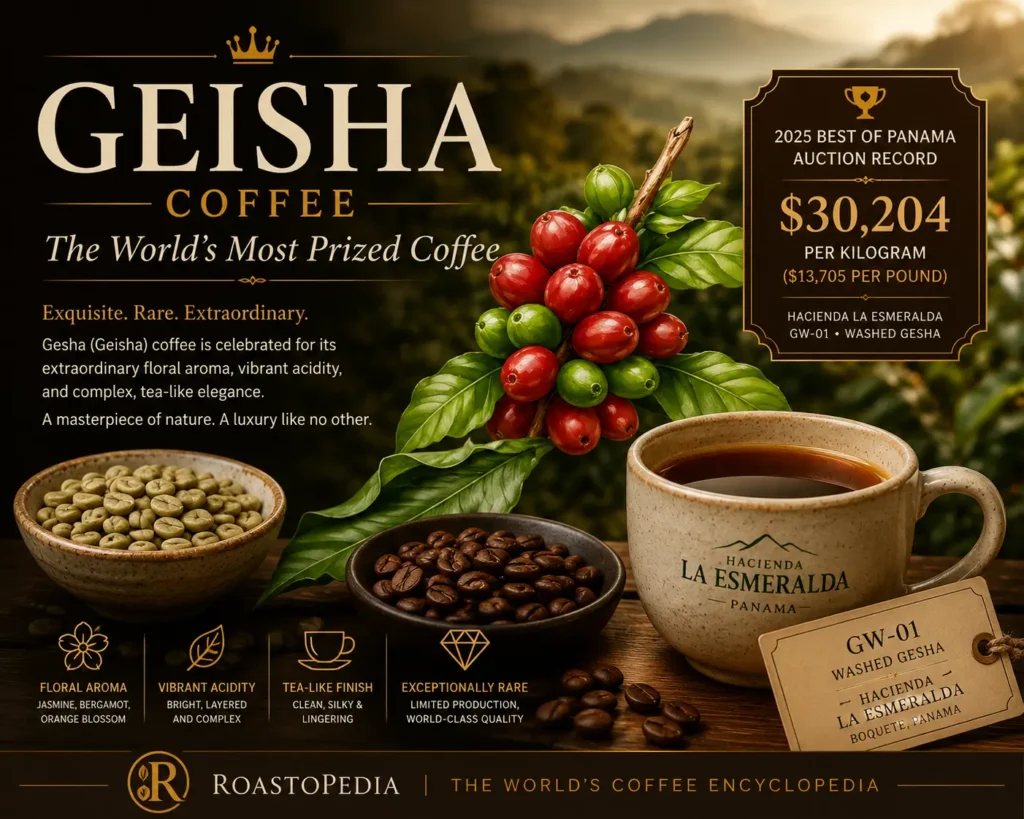
At the 2025 Best of Panama auction — themed “Canvas of Terroir” — a washed Gesha lot from Hacienda La Esmeralda, designated GW-01, sold for a record-breaking $30,204 per kilogram ($13,705 per pound). The 20-kilogram lot, which scored 98 out of 100 and was harvested on April 7, 2025, was purchased entirely by Julith Coffee of Dubai for a total of $604,080. The lot underwent a 48-hour cold-temperature fermentation followed by climate-controlled drying.
The total 2025 BoP auction closed at over $2.8 million in combined sales, with a weighted average of $2,861.20 per kilogram across 40 Gesha lots. Panamanian President José Raúl Mulino publicly congratulated the producers, and Hacienda La Esmeralda’s Rachel Peterson described the result as “a recognition of the effort of our entire team and the dedication Panama has put into cultivating excellence.”
Botany and Plant Characteristics
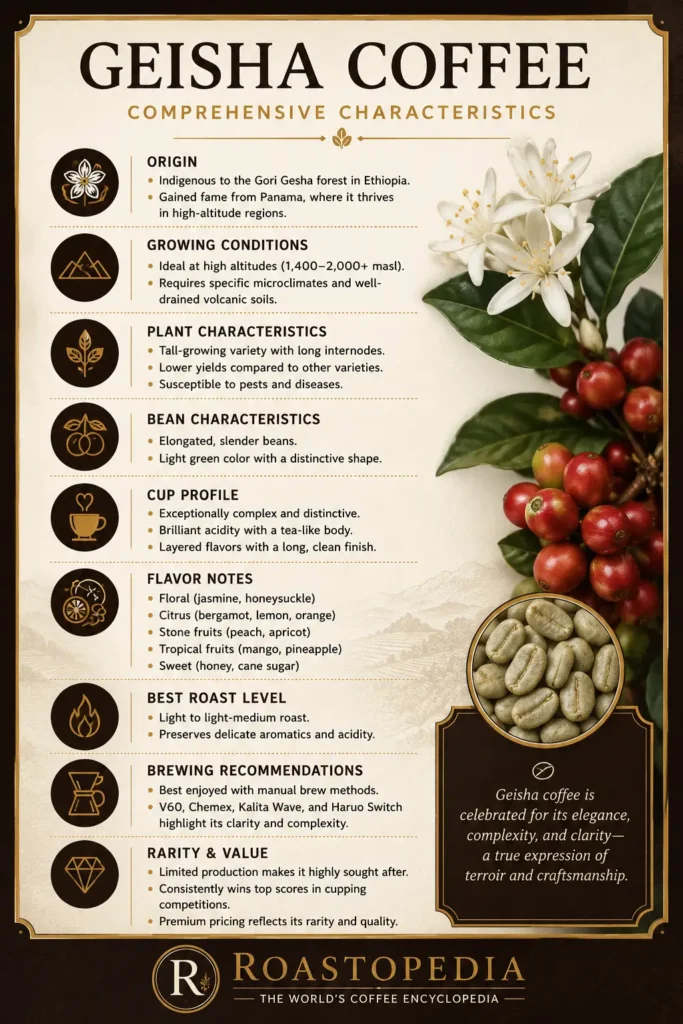
Geisha is a variety of Coffea arabica with several distinctive morphological traits that set it apart from more common commercial cultivars. The plants grow exceptionally tall — often reaching heights of four meters or more — with elongated internodes, long and narrow leaves, and a slender branch structure. This architecture makes the plants susceptible to wind damage and relatively difficult to harvest compared to more compact varieties. Geisha produces fewer cherries per plant than cultivars such as Caturra or Catuai, and its cherries require a longer maturation period to reach peak ripeness. This slower development is considered a key contributor to the concentration and complexity of its flavor compounds. The Panamanian Geisha (T2722) has a distinct and verifiable genetic fingerprint that distinguishes it from other varieties carrying the Geisha or Gesha label.
Growing Conditions and Terroir
Geisha thrives at high altitudes, typically between 1,500 and 2,100 meters above sea level (masl), where cooler temperatures slow cherry development and allow sugars and aromatic compounds to accumulate. The most celebrated Geisha origins share volcanic soils rich in minerals, well-distributed rainfall, and distinct wet and dry seasons that stress the plant productively. Panama’s Boquete and Volcán regions in Chiriquí Province are considered the benchmark growing zones. Key farms include Hacienda La Esmeralda, Elida Estate (Lamastus Family Estates), Finca Sophia, and Carmen Estate. Beyond Panama, Geisha is now cultivated with notable success in Ethiopia (its native homeland), Colombia (particularly Huila and Nariño), Costa Rica (Tarrazú and West Valley), Guatemala, Hawaii (Kona and Ka’ū), Thailand, and Taiwan.
Processing Methods
Geisha cherries are almost universally harvested by hand-picking, with strict selection for fully ripe, red cherries. Only the ripest cherries produce the sweetest and most complex cup profiles. After picking, cherries undergo rigorous quality sorting — either manually or by optical sorting machines — before processing.
Washed (Wet) Process: The most common processing method for Geisha, yielding a cleaner, brighter cup with well-defined acidity and delicate florals. The mucilage is fully removed by fermentation and washing before drying.
Natural (Dry) Process: Cherries are dried whole with the fruit intact, producing a fuller body, increased sweetness, and more pronounced fruit-forward flavors.
Honey Process: An intermediate method in which the skin is removed but varying amounts of mucilage are retained during drying, producing a cup profile between washed and natural.
Anaerobic Process: Increasingly used by innovative producers, this method involves fermenting cherries in sealed, oxygen-deprived vessels. It can intensify specific flavor compounds and produce more exotic or wine-like profiles.
Flavor Profile
Geisha’s flavor profile is widely regarded as unique within the world of coffee. Common tasting notes include:
- Floral: Jasmine, white rose, orange blossom
- Fruit: Bergamot, lychee, mango, peach, passionfruit, papaya, citrus
- Body and texture: Tea-like, light to medium, silky
- Sweetness: Honey, caramel, tropical sugarcane
- Acidity: Bright, vibrant, wine-like
Ethiopian Geisha tends toward more wine-like fruit and floral notes with pronounced acidity. Panamanian Geisha typically expresses jasmine-bergamot-citrus profiles. Colombian Geisha sits between the two. Processing method significantly alters the expression of these notes, with natural processing amplifying fruit sweetness and washed processing emphasizing clarity and florals.
Roasting
Geisha coffee is typically roasted light to medium-light to preserve its delicate aromatic compounds. Dark roasting is widely considered counterproductive, as it suppresses the floral and fruit-forward notes that define the variety’s appeal. Roasters approach Geisha with careful temperature profiling to avoid scorching the thin-walled beans while allowing the Maillard reactions that develop sweetness.
Brewing Recommendations
Given its rarity and price, Geisha is typically prepared using precision pour-over methods that allow full expression of its delicate flavor profile. The Hario V60 and April Brewer are widely recommended by specialty baristas. Chemex is generally discouraged as it is designed for larger batch brewing. Espresso preparation is possible but is considered wasteful given the quantity of beans required for dial-in. A standard cup of Geisha at a specialty café typically ranges from $15 to $25; at home using premium beans, a single cup may cost $5 to $15.
Market, Auctions, and Economics
The Best of Panama (BoP) competition, organized by the Specialty Coffee Association of Panama (SCAP), is the primary auction venue for world-record Geisha lots. Key auction milestones:
| Year | Price | Seller | Notes |
| 2004 | $21/lb | Hacienda La Esmeralda | First BoP record; previous record was $4.80/lb |
| 2013 | $350.35/lb | Hacienda La Esmeralda | 16× price increase over 9 years |
| 2017 | $601/lb | Hacienda La Esmeralda | — |
| 2018 | $803/lb | Elida Estate (Lamastus) | — |
| 2019 | $1,029/lb | Elida Estate (Lamastus) | First $1,000/lb coffee in history |
| 2022 | $6,034/lb | Elida Estate (Lamastus) | Private auction |
| 2023 | $10,005/kg | Carmen Estate | First five-figure BoP price per kg |
| 2024 | $13,518/kg | Elida Estate (Lamastus) | Private auction; purchased by Cupping Post, South Korea |
| 2025 | $30,204/kg | Hacienda La Esmeralda | World record; purchased by Julith Coffee, Dubai |
As of 2025, SCAP has begun the process of trademarking “Panama Geisha” as a protected geographic and varietal designation in multiple jurisdictions, including the United Kingdom, to safeguard the authenticity and origin-linked value of the variety.
Global Expansion
Following Panama’s landmark success, Geisha cultivation has expanded worldwide. Ethiopia — the variety’s native origin — has experienced a renaissance of Geisha cultivation, with Ethiopian producers emphasizing heirloom genetics. Colombia has become a significant producer, with farms in Huila, Nariño, and other highland regions achieving high scores at Cup of Excellence competitions.
Costa Rica, Guatemala, Hawaii, Thailand, and Taiwan have all produced competition-level Geisha lots. Japan’s Saza Coffee Company has been a consistent top buyer at Best of Panama auctions for over a decade. The global buyers’ market for auction-level Geisha is concentrated in Asia — particularly Japan, South Korea, China — as well as the Middle East and select European markets.
See Also
References
- Wikipedia. “Geisha (coffee).” Wikipedia, The Free Encyclopedia. https://en.wikipedia.org/wiki/Geisha_(coffee)
- Best of Panama “Past Auctions” https://app.bestofpanama.auction/auction/canvas-of-terroir
- World Coffee Research. “Geisha, Panama.” Varieties — World Coffee Research Catalog. https://varieties.worldcoffeeresearch.org/varieties/geisha-panama
- Perfect Daily Grind. “Panama, Colombia, Ethiopia: There Is No ‘Best’ Origin for Gesha Coffee.” January 13, 2024. https://perfectdailygrind.com/2024/01/best-origin-for-gesha-coffee/
- Perfect Daily Grind. “A New World Record Price for Gesha Isn’t What the Coffee Industry Needs Right Now.” October 3, 2024. https://perfectdailygrind.com/2024/10/world-record-price-for-gesha-coffee-economic-disparity/
- Hayman Coffee. “The History of Panama Geisha Coffee: Origins to Present Day.” October 11, 2023. https://www.haymancoffee.com/blogs/coffee-blog/the-history-of-panama-geisha-coffee-origins-to-present-day
- Hayman Coffee. “What Is the Story Behind Geisha Coffee?” July 12, 2024. https://www.haymancoffee.com/blogs/coffee-blog/story-behind-panama-geisha-coffee
- Klatch Coffee. “What Is Geisha Coffee?” July 24, 2024. https://www.klatchcoffee.com/blogs/knowledgebase/what-is-geisha-coffee
- Sprudge. “A Panama Gesha Broke Price Records (Again).” August 12, 2025. https://sprudge.com/a-panama-gesha-broke-price-records-again-390362.html
- Global Coffee Report. “Best of Panama Auction Sees World-Record Price.” August 8, 2025. https://www.gcrmag.com/best-of-panama-auction-sees-world-record-price/
- Global Coffee Report. “Regions on the Rise: Panama.” April 2, 2026. https://www.gcrmag.com/regions-on-the-rise-panama/
- The Pourover. “Panama’s Specialty Coffee Association Moves to Brand and Trademark ‘Panama Geisha’ as Auction Prices Soar.” November 22, 2025. https://www.thepourover.coffee/panama-coffee-association-brand-trademark-panama-geisha/
- VinePair. “Why a Pound of Panama Geisha Coffee Sold for $1,029 — and Was Worth It.” April 2, 2020. https://vinepair.com/articles/panama-geisha-coffee-winner/
- Headcount Coffee. “The Panama Geisha Auction Wars: How Coffee Hit $2,000+ Per Pound.” November 29, 2025. https://www.headcountcoffee.com/blogs/food-drink/the-panama-geisha-auction-wars-how-coffee-hit-2-000-per-pound
- Foster Coffee. “The Alluring World of Gesha Coffee: Everything You Need to Know.” January 14, 2025. https://fostercoffee.co/blogs/news/the-alluring-world-of-gesha-coffee-everything-you-need-to-know-about-this-rare-and-exquisite-varietal
- Cafe Tico. “Costa Rica Gave Geisha Coffee to the Americas.” https://www.cafetico.io/blogs/news/costa-rica-gave-geisha-coffee-to-the-americas
- Crop Trust Interactive Stories. “Seventy Years On, a Global Garden Keeps the Coffee Hot.” https://stories.croptrust.org/story/70-years-on
- Sweet Maria’s Coffee Library. “Origins of Gesha Coffee … I Mean Gecha, I Mean Gorei.” January 23, 2024. https://library.sweetmarias.com/origins-of-gesha-coffee-i-mean-gecha-i-mean-gorei/
- Opus Coffee. “The Geisha Coffee Variety: Coveted and World-Renowned.” April 10, 2025. https://opuscoffee.com/the-geisha-coffee-variety-coveted-and-world-renowned/
- Japanese Coffee Co. “What Is Geisha Coffee? Why It’s So Rare & Expensive.” November 29, 2023. https://japanesecoffeeco.com/blogs/japanese-coffee-blog/what-is-geisha-coffee
- Paradise Coffee Roasters. “Geisha Coffee Explained: Flavor, Origins & Why It Commands $1,000/lb.” October 10, 2025. https://paradiseroasters.com/blogs/news/buying-geisha-coffee-everything-you-need-to-know