
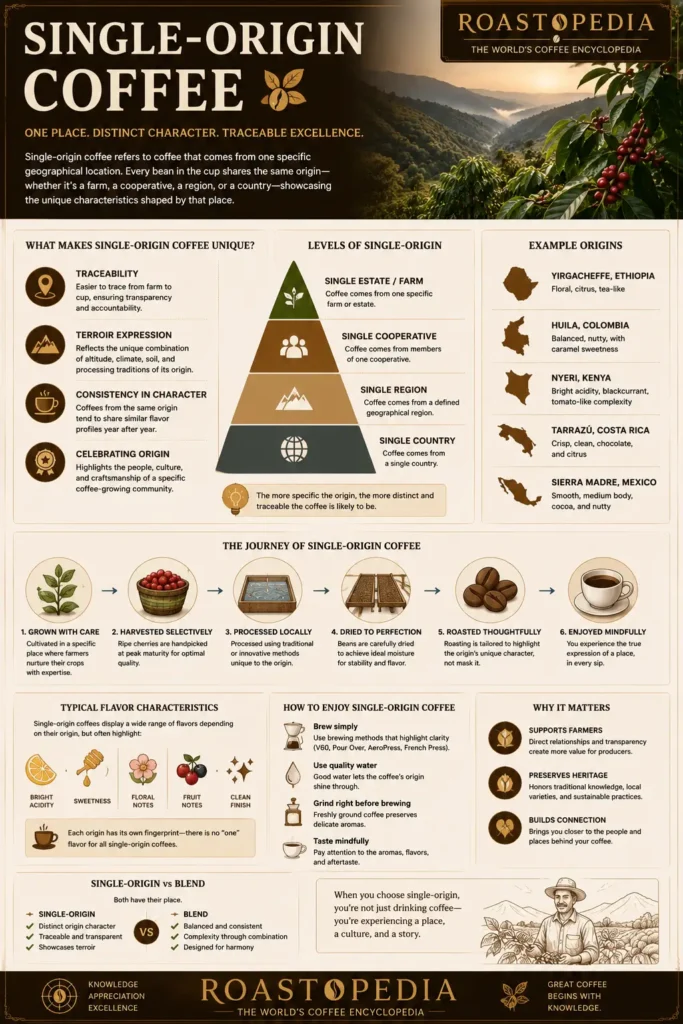
Single-origin coffee is coffee sourced exclusively from a single, known geographic location — ranging in specificity from an entire producing country to a single farm, estate, cooperative, or discrete micro-lot within a farm.
The term distinguishes such coffee from blended coffee, which combines beans from multiple origins to produce a consistent, composite flavor profile. Because all beans in a single-origin lot share the same growing environment, they reflect the accumulated influence of that environment’s soil composition, climate, altitude, and cultivation practices on their flavor, aroma, and chemical structure.
There are no universally enforceable rules governing the labeling of single-origin coffee or its market, and no global governing body mandates or audits such claims. Some producing countries maintain domestic regulatory frameworks — Brazil, for example, has governmental bodies that regulate coffee market standards — but international definitions remain informal and industry-driven. The term’s meaning therefore varies across the supply chain, from country-level designation to farm-gate specificity.
Classification and Taxonomy
Within the broader category of single-origin coffee, several subcategories are recognized by industry practitioners:
- Country-of-origin coffee: Beans from a single producing nation, such as Colombia, Ethiopia, or Vietnam, without specification of farm or sub-region.
- Regional coffee: Beans traceable to a defined geographic or administrative sub-region within a country, such as Yirgacheffe (Ethiopia), Huila (Colombia), or Nyeri (Kenya).
- Estate or farm coffee: Beans produced on a single named farm or estate, or on a collection of farms that share a common processing mill. Estate coffees are common across Central and South America, including Colombia, Brazil, Costa Rica, and Mexico.
- Micro-lot coffee: The most granular designation, referring to beans from a specific field or plot within a farm, often from a defined altitude band and a particular harvest date. Micro-lots are frequently used in specialty coffee production and command premium prices.
History and Development
Pre-industrial Period
Prior to the industrialization of the global coffee trade, single-origin coffee was, in effect, the default commercial form. Colonial and post-colonial trade routes were organized around isolated production zones, with beans shipped from individual ports and marketed by geographic descriptor. Coffee from Yemen (traded as “Mocha”) and from the island of Java was among the earliest to achieve named-origin recognition in European markets, and their combination gave rise to the Mocha-Java blend — historically significant as one of the first documented intentional blends, recorded as early as the late 17th century.
Following Brazilian independence in 1822, coffee from that country’s southeastern regions — including Rio de Janeiro and São Paulo — rose to dominate global supply. By the mid-19th century, Brazil accounted for more than 50 percent of world coffee production, with Brazilian origin-specific designations, such as Santos, in regular commercial use. In Central America, countries including Guatemala and Costa Rica established coffee as a primary export crop by the 1830s to 1850s; highland estate beans from regions such as Antigua and Tarrazú were exported largely unadulterated, reinforcing regional identity in international trade.
Industrialization and Blending (Late 19th – Mid-20th Century)
The industrialization of roasting and packaging in the late 19th and early 20th centuries shifted commercial coffee production toward large-scale blending. Roasters developed commodity blends that used lower-cost beans as a base, masked by darker roast profiles that reduced varietal differentiation. Under fully developed, dark roast (see Coffee Roast Level) conditions, origin-specific acids and aromatic compounds are substantially diminished, enabling producers to blend across origins without obvious sensory contradiction. This model dominated Western consumer markets through the mid-20th century, effectively suppressing single-origin identity in mainstream commerce.
The Specialty Coffee Movement (1974 – 2000)
The conceptual groundwork for the modern single-origin category was established in 1974, when Norwegian-American green coffee buyer Erna Knutsen used the term “specialty coffee” in an issue of Tea & Coffee Trade Journal to describe beans that exhibited distinctive flavors attributable to specific growing microclimates. Knutsen’s formulation emphasized geographic origin as a determinant of flavor quality, directly anticipating the single-origin framework.
The Specialty Coffee Association of America (SCAA) was founded in 1982 by professionals, including Donald Schoenholt, Ted Lingle, John Randall, and Phyllis Baldenhofer. The SCAA established quality standards, organized trade education, and created a professional framework within which origin-specific sourcing could be systematically recognized and evaluated. The equivalent European body, the Specialty Coffee Association of Europe (SCAE), was established in 1998. In January 2017, the two organizations merged to form the Specialty Coffee Association (SCA), which operates today as the largest global trade association dedicated to specialty coffee.
Third Wave and Contemporary Period (2000 – Present)
The term “single origin” entered widespread industry use in the early 2000s, coinciding with the emergence of what industry practitioners designate the Third Wave of coffee culture — a period characterized by emphasis on quality, traceability, ethical sourcing, and direct trade relationships between roasters and producers. The proliferation of specialty coffee shops offering alternative brewing methods — including pour-over and AeroPress preparation — provided a commercial context in which single-origin flavor differentiation could be perceptibly communicated to consumers. These methods, unlike espresso, do not require blending for consistency and allow origin-specific attributes to be experienced with minimal interference.
Direct trade practices, in which roasters source beans by establishing direct relationships with individual farms or cooperatives rather than purchasing through commodity brokers, became integral to the single-origin supply chain during this period. Direct trade facilitates transparency, traceability, and, frequently, quality premiums paid to producers. It also enabled origin visits, in which roasters and green buyers travel to farms to cup and evaluate beans alongside producers — a practice that became increasingly normalized among specialty roasters in the 2010s.
Terroir and Flavor Profile
The distinctive sensory characteristics of single-origin coffee are produced by the interaction of environmental variables collectively referred to as terroir — a term borrowed from viticulture. The principal terroir variables in coffee production are altitude, soil composition, climate (including temperature, rainfall, and humidity), and microclimate. These variables influence the rate of cherry development, the concentration of sugars and organic acids, and the density of the bean.
Altitude exerts a particularly significant influence. Coffee grown at high elevations — typically above 1,200 meters — matures more slowly due to lower ambient temperatures and reduced atmospheric oxygen, producing a denser bean with higher concentrations of sugars and complex aromatic precursors. Coffee from Ethiopian and Kenyan growing regions at 1,500 to 2,200 meters above sea level is characterized by pronounced citrus and floral notes, a function of this elevated, slow maturation. Conversely, lower-altitude coffees from regions such as Brazil’s Minas Gerais tend toward a softer acidity and fuller body, reflecting faster cherry development.
Soil composition also directly affects bean chemistry. Volcanic soils, found in regions including Guatemala’s Antigua valley, Colombia’s Nariño department, and parts of Rwanda, are rich in minerals and produce coffees characterized by bright, complex acidity. Clayey or sedimentary soils produce different mineral uptake profiles and, accordingly, different cup characteristics.
Processing method — the technique used to remove the coffee cherry’s fruit layers from the seed — interacts with terroir to further define the flavor profile of a single-origin lot. Washed Process (wet), in which the fruit is pulped and the bean fermented and dried without the surrounding mucilage, produces a clean, bright cup that emphasizes the bean’s origin-specific acidity and floral or fruit notes. Natural Process (dry), in which whole cherries are dried with the fruit intact, imparts additional sugars and produces more pronounced fruity or wine-like characteristics. Honey processing, which retains some mucilage during drying, yields intermediate results combining elements of both.
Countries That Have Single-Origin Coffee
Not all coffee-producing countries within the Coffee Belt grow single-origin coffee. Small and large-scale farmers in these countries have single-origin coffee:
Ethiopia
Recognized as the center of origin of Coffea arabica, Ethiopia produces single-origin coffees from a diversity of heirloom varietals across regions, including Yirgacheffe, Sidamo, Harrar, and Kaffa. Yirgacheffe coffees grown at high altitude are particularly noted for delicate floral aromas and citrus brightness. Sidamo coffees are associated with berry-like sweetness and vivid acidity; Harrar coffees, commonly processed by the natural method, exhibit bold, fruity, and wine-like characteristics.
Colombia
Colombia’s Andean geography provides diverse high-altitude microclimates across producing departments, including Huila, Nariño, and Antioquia. Colombian single-origin coffees are commonly described as well-balanced, with medium body, bright acidity, and flavor notes of caramel, citrus, and red fruit. The country harvests twice annually due to its equatorial position and the altitude diversity of its terrain.
Kenya
Kenyan single-origin coffees, particularly from the Nyeri and Kirinyaga counties on the slopes of Mt. Kenya, are known for their bold, distinctive character, high clarity, and complex acidity. Kenyan coffees commonly exhibit blackcurrant, tomato, and citrus flavor notes. The country’s wet-milling cooperative system and the widespread cultivation of high-yielding varietals such as SL28 and SL34 have shaped a consistent regional identity in the specialty market.
Guatemala
Guatemala’s volcanic soils and mountainous terrain support distinct sub-regions, including Antigua, Huehuetenango, and Cobán. Antigua coffees, grown in a valley surrounded by volcanoes, are associated with full body, chocolate and spice notes, and moderate acidity. Huehuetenango coffees, grown at high altitudes with dry trade winds protecting crops from frost, tend to exhibit more pronounced fruit notes and bright acidity.
Brazil
As the world’s largest coffee producer, Brazil offers single-origin coffees primarily from the states of Minas Gerais and São Paulo. Brazilian coffees are generally lower in acidity, with full body and flavor notes of nuts, chocolate, and caramel — characteristics consistent with the country’s lower-altitude growing conditions and predominant use of the natural processing method.
Costa Rica
Costa Rica’s Tarrazú region is among the most recognized single-origin designations in Central America. Costa Rican coffees are produced under strict quality regulations — the country has historically prohibited the cultivation of robusta — and are characterized by clean, bright acidity and citrus or stone fruit notes. The country’s micro-mill (beneficio) system has supported growth in small-lot, traceable production.
Quality Standards and Grading
Single-origin coffee does not inherently denote a specific quality grade. However, a substantial proportion of commercially marketed single-origin coffees fall within the specialty coffee category as defined by the Specialty Coffee Association (SCA), which evaluates coffee on a 100-point scale through a standardized cupping protocol.
Coffees scoring 80 points or above on this scale qualify as specialty grade; those scoring 85 to 89.99 are graded Excellent, and those scoring 90 to 100 are graded Outstanding. The protocol evaluates ten attributes: fragrance/aroma, flavor, aftertaste, acidity, body, balance, uniformity, clean cup, sweetness, and an overall score, with deductions for defects.
The Q Grader certification, administered by the Coffee Quality Institute (CQI), an SCA-affiliated body, is the principal professional credentialing for coffee sensory evaluation. Obtaining Q Grader certification requires passing 22 examinations over six days; approximately 7,000 Q Graders are active worldwide. The cupping and grading process is the primary mechanism through which single-origin coffees are evaluated, priced, and differentiated in the specialty market.
In 2024, the SCA officially adopted the Coffee Value Assessment (CVA) as its updated cupping standard, replacing the 2004 protocol. The CVA is designed to provide a more nuanced framework for evaluating diverse coffee types and processing styles.
Traceability and Authentication
The value proposition of single-origin coffee rests significantly on traceability — the capacity to verify the precise geographic, agronomic, and temporal provenance of a coffee lot. In the specialty trade, this is typically supported through documentation of the farm or cooperative, the harvest season, the processing method, and the lot number. Digital tracking platforms, including MultiTrace (used by Rainforest Alliance-certified supply chains), enable lot-level identity preservation from harvest to export.
Authentication of single-origin claims through chemical or genomic analysis remains an area of active research. Genomic studies have demonstrated that it is possible to identify a DNA fingerprint of Coffea arabica varieties, a technique that could enable buyers of unroasted green coffee to authenticate origin claims. Research published in the Journal of AOAC International in 2020 by Pruvot-Woehl et al. documented the authentication of C. arabica varieties through DNA fingerprinting and assessed its significance for the commercial coffee sector.
Market and Economic Context
The global single-origin coffee market was valued at approximately USD 14.82 billion in 2025 and is projected to reach USD 23.19 billion by 2034, reflecting a compound annual growth rate (CAGR) of approximately 5.10 percent over that period. North America holds the largest regional share, accounting for approximately 42.9 percent of the global market value in 2024. Europe represents the second-largest market, contributing approximately 30 percent of global sales. The Asia-Pacific region is projected to record the fastest growth over the forecast period, driven by an expanding middle class and growing urban café culture in countries including China, Japan, and South Korea.
Within the broader coffee market, single-origin and specialty products collectively account for a minority share of volume — blended coffees represented 79.88 percent of global coffee revenue in 2025 — but are growing faster than the commodity segment, with projected CAGRs of 6.86 to 8.25 percent from 2025 to 2030 depending on methodology and scope. Single-origin coffee typically commands a price premium over blended commercial coffee, reflecting the higher cost of small-batch production, selective harvesting, quality-control infrastructure, and the shorter, more relationship-intensive supply chains associated with direct trade.
Single-origin coffee’s seasonality — each origin produces one or two crops per year at defined harvest windows — distinguishes it from blended commercial coffees, which are formulated to maintain consistent availability year-round through substitution across origins.
Limitations and Criticisms
The absence of enforceable standards governing the “single-origin” label has created conditions for inconsistent or misleading application of the term. A coffee marketed as single-origin may represent an entire country’s production (aggregated across thousands of farms and processors) or a single field harvested on a single day — representing vastly different levels of traceability, flavor specificity, and producer accountability. Industry critics have noted that the term can be applied liberally, with the primary effect of adding symbolic or marketing value rather than substantive information.
Single-origin coffee’s higher cost relative to blended alternatives limits its accessibility to price-sensitive consumers. Its seasonal availability means that specific lots cannot be repurchased year-round, which presents challenges for both retail consistency and consumer loyalty.
See Also
- Terroir — The environmental conditions — soil, altitude, climate, and microclimate — that collectively influence the flavor characteristics of coffee grown in a specific location.
- Specialty Coffee — Coffee scoring 80 points or above on the Specialty Coffee Association’s 100-point cupping scale, often associated with single-origin sourcing and traceability.
- Cupping — The standardized professional method of evaluating brewed coffee’s sensory attributes, including fragrance, aroma, flavor, aftertaste, acidity, and body.
- Q-Grader — A professional credential administered by the Coffee Quality Institute (CQI) for certified coffee sensory evaluators, required for formal specialty coffee assessment.
- Cultivar — A cultivated variety of the coffee plant, selected for specific agronomic or sensory traits; cultivar identity is a key variable in single-origin flavor profiling.
- Extraction Yield — The percentage of soluble material extracted from ground coffee into a brewed beverage; particularly relevant to the evaluation of single-origin coffees across different brew methods.
- Coffee Flavor Wheel — The Specialty Coffee Association’s standardized reference tool for identifying and communicating flavor descriptors in brewed coffee, used in single-origin cupping evaluation.
References
- Wikipedia. “Single-origin coffee.” Wikipedia, The Free Encyclopedia. https://en.wikipedia.org/wiki/Single-origin_coffee (accessed June 2026).
- Fischer, Edward F. “Quality and inequality: creating value worlds with Third Wave coffee.” Socio-Economic Review 19, no. 1 (2021): 111–131. doi:10.1093/ser/mwz044.
- Pruvot-Woehl, Solène, Sarada Krishnan, William Solano, Tim Schilling, Lucile Toniutti, Benoit Bertrand, and Christophe Montagnon. “Authentication of Coffea arabica Varieties through DNA Fingerprinting and its Significance for the Coffee Sector.” Journal of AOAC International 103, no. 2 (2020): 325–334. doi:10.1093/jaocint/qsz003. PMID 33241280.
- Grokipedia. “Single-origin coffee.” Grokipedia.com. https://grokipedia.com/page/Single-origin_coffee (January 2026).
- Specialty Coffee Association. “Standards.” SCA.coffee. https://sca.coffee/research/coffee-standards/ (accessed June 2026).
- Buno Coffee Co. “Specialty Coffee Association (SCA): What Is It and How Does It Work?” Buno.com.ua. https://buno.com.ua/en/articles/specialty-coffee-association-sca-what-is-it-and-how-does-it-work/ (2025).
- Günter Coffee Roasters. “What is the Specialty Coffee Association?” Guentercoffee.com. https://guentercoffee.com/en/blogs/coffee-knowledge/was-ist-die-specialty-coffee-association (2025). [The phrase ‘specialty coffee’ is credited to Erna Knutsen, Tea & Coffee Trade Journal, 1974; SCAA founded 1982.]
- Wikipedia. “Specialty coffee.” Wikipedia, The Free Encyclopedia. https://en.wikipedia.org/wiki/Specialty_coffee (accessed June 2026).
- Grokipedia. “Specialty coffee.” Grokipedia.com. https://grokipedia.com/page/Specialty_coffee (March 2026). [SCA 100-point protocol; SCAA founded 1982 by Schoenholt, Lingle, Randall, Baldenhofer; SCAE founded 1998; merged to SCA 2017.]
- Carolina Coffee Works. “The Ultimate Guide to Coffee Grading.” Carolinacoffeeworks.com. https://carolinacoffeeworks.com/blogs/news/the-ultimate-guide-to-coffee-grading-1 (2025). [SCA specialty grade: 80+ points, ≤5 defects per 300g sample.]
- Roasters.app. “The Specialty Coffee Association (SCA) — What It Is and Why It Matters.” https://roasters.app/about/specialty-coffee-association/ (2026). [Q Grader: 22 exams over 6 days; ~7,000 active worldwide.]
- Precedence Research. “Single Origin Coffee Market Size to Hit USD 23.19 Billion by 2034.” Precedenceresearch.com. https://www.precedenceresearch.com/single-origin-coffee-market (November 2025). [Global market: USD 14.82 billion 2025; CAGR 5.10%; projected USD 23.19 billion 2034.]
- Mordor Intelligence. “Global Coffee Market Size, Share & Trends.” Mordorintelligence.com. https://www.mordorintelligence.com/industry-reports/coffee-market (accessed June 2026). [Single-origin/specialty CAGR 6.86% 2026–2031; blended coffees 79.88% of 2025 revenue.]
- Dataintelo. “Single Origin Coffee Market Research Report 2033.” Dataintelo.com. https://dataintelo.com/report/single-origin-coffee-market (2025). [Global market USD 12.4 billion 2024; CAGR 8.2%; North America 36% share; Europe 30% share.]
- Market Research Future. “Global Single-Origin Coffee Market.” Marketresearchfuture.com. https://www.marketresearchfuture.com/reports/single-origin-coffee-market-41901 (2026). [North America 42.9% share; market USD 14.74 billion 2025.]
- Perfect Daily Grind. “Everything You Need to Know About Single Origin Coffees.” Perfectdailygrind.com. https://perfectdailygrind.com/2015/09/everything-you-need-to-know-about-single-origin-coffee/ (September 2015). [Jeremy Torz, Union Hand-Roasted Coffee; Andrew Hetzel, CafeMakers; direct trade practices; origin visits.]
- Butler, Nickolas. “The Trouble With Micro-Lots?” Roast Magazine (September/October 2007). Archived: https://web.archive.org/web/20080906115424/http://www.roastmagazine.com/backissues/septoct2007/troublewmicrolots.html
- Coffee Review. “Coffee Language: Farm, Mill, and Estate Names.” Coffeereview.com. http://www.coffeereview.com/reference.cfm?ID=22 (accessed June 2026). [Estate coffees: single farm or collection of farms sharing a mill.]
- Mowery, Lauren. “Here’s Why Single Origin Coffee Is More Expensive But Worth Your Dollars.” Forbes, February 28, 2017. https://www.forbes.com/sites/lmowery/2017/02/28/heres-why-single-origin-coffee-is-more-expensive-but-worth-your-dollars/
- Wogan Coffee. “What is Single Origin Coffee and How is it Better?” Wogancoffee.com. https://wogancoffee.com/blogs/news/what-is-single-origin-coffee-and-how-is-it-better (2023).