
In manual filter coffee preparation, drawdown time refers to the terminal phase of the brewing process in which the liquid continues to flow through the coffee bed and filter after water addition has ended. It is typically measured from the period after the final pour until the brewer stops dripping.
The concept is most frequently associated with pour-over brewing methods such as the V60, Kalita Wave, and Chemex, but it is also relevant in immersion-percolation systems, batch brewers, and other filtration-based brewing techniques. While brew recipes often specify a target drawdown time, the parameter is not an independent brewing variable; rather, it is the result of numerous interacting factors, including grind size, coffee dose, bed depth, filter characteristics, pouring technique, and coffee freshness.
For example, a V60 recipe may involve:
- A 45-second bloom.
- Two subsequent pours were completed by 2:15.
- Final drawdown ending at 3:00.
In such a case, the total brew time is three minutes, while the final drawdown phase takes approximately forty-five seconds.
Historical Development
The importance of drawdown time became more widely recognized during the specialty coffee movement of the late twentieth and early twenty-first centuries. As brewers adopted increasingly precise methods involving scales, timers, and controlled pouring techniques, drawdown time emerged as a practical metric for recipe development and quality control.
Organizations such as the Specialty Coffee Association and numerous coffee researchers have incorporated measurements of brewing time into broader discussions of extraction science, brewing control, and sensory evaluation.
Why Drawdown Time Matters
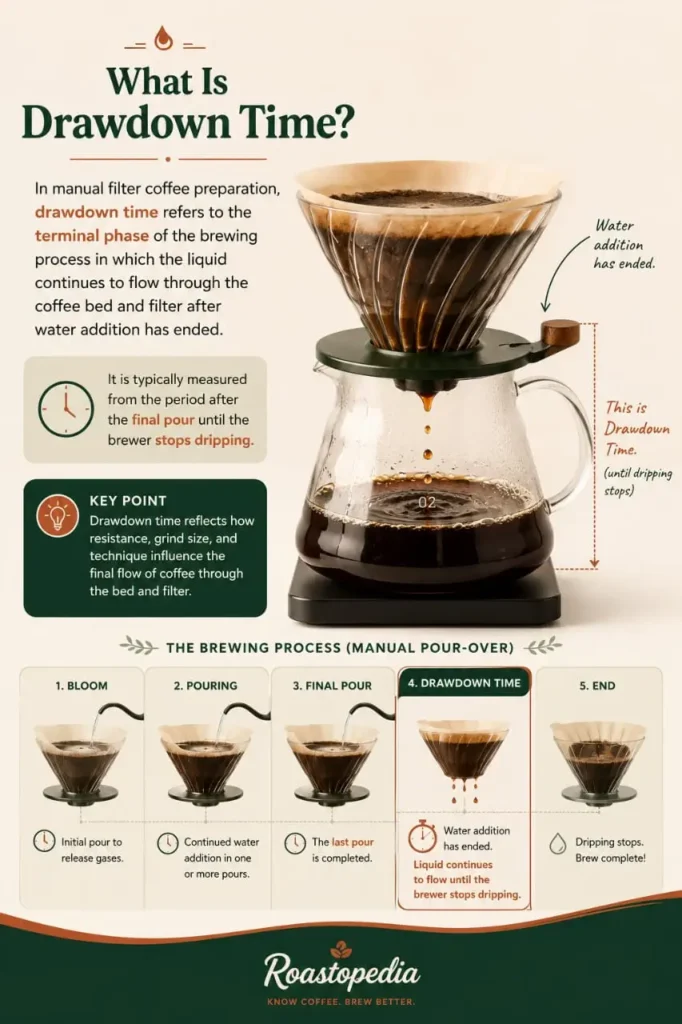
Drawdown time matters because it provides insight into the permeability of the coffee bed and the efficiency of water flow through the brewer. Unlike total brew time, which measures the overall duration of extraction, drawdown time isolates the drainage phase and therefore serves as a useful indicator of how grind size, particle distribution, filter characteristics, and pouring technique are affecting the brewing process.
An unusually rapid drawdown may indicate that water is moving through the coffee bed too easily, potentially reducing extraction and producing a beverage that tastes sour, thin, or underdeveloped. Conversely, an excessively slow drawdown often suggests increased resistance within the coffee bed, which may contribute to over-extraction, bitterness, or muddled flavor characteristics.
For this reason, many experienced brewers monitor drawdown time not as a target in itself but as a diagnostic tool. Consistent drawdown times from brew to brew can indicate stable grinder performance, repeatable pouring technique, and predictable extraction conditions. Significant deviations, on the other hand, often signal changes in grind quality, coffee freshness, agitation, or filter behavior.
Role in Coffee Extraction
Drawdown time influences extraction because it governs how long water remains in contact with soluble coffee compounds.
When drawdown occurs too rapidly, water may pass through the coffee bed before sufficient soluble material is dissolved. The resulting beverage often exhibits characteristics associated with under-extraction, including:
- Sourness
- Sharp acidity
- Thin body
- Limited sweetness
- Short finish
Conversely, excessively slow drawdown may increase extraction beyond desirable levels, potentially contributing to:
- Bitterness
- Astringency
- Dry mouthfeel
- Muted acidity
- Reduced flavor clarity
However, drawdown time alone does not determine extraction quality. Two brews with identical drawdown times may produce significantly different flavor outcomes if grind distribution, water chemistry, temperature, or agitation differ.
Factors Affecting Drawdown Time
Grind Size
Grind size is generally the most influential determinant of drawdown time.
Finer particles create smaller spaces between coffee grounds, increasing resistance to water flow and slowing drainage. Coarser particles create larger pathways that allow water to pass more quickly.
A brewer experiencing an unusually slow drawdown will often adjust by grinding coarser, while an excessively fast drawdown may be corrected with a finer grind.
Particle Distribution and Fines
Coffee grinders produce particles of varying sizes rather than perfectly uniform grounds.
The smallest particles, commonly known as fines, can migrate within the coffee bed and accumulate near the filter surface. This accumulation increases resistance and may substantially prolong drawdown time even when the average grind size remains unchanged.
High-quality grinders are often valued partly because they generate fewer fines and therefore produce more predictable flow rates.
Coffee Dose and Bed Depth
Increasing the amount of coffee in a brewer generally creates a deeper coffee bed.
A deeper bed presents greater resistance to water movement and often results in a longer drawdown time. Conversely, reducing the dose can shorten drainage time.
Filter Characteristics
Different filter materials and designs affect water permeability.
Thicker paper filters may slow flow rates compared with thinner alternatives. Likewise, differences in paper density, manufacturing process, and brewer geometry can alter drawdown behavior.
For this reason, changing filter brands can sometimes affect brew times even when all other variables remain constant.
Pouring Technique and Agitation
The manner in which water is introduced to the coffee bed influences particle movement and bed structure.
Aggressive pouring can disturb the bed, redistribute fines, and compact certain regions of the slurry. Excessive agitation may therefore increase resistance and lengthen drawdown time.
Gentler pouring often promotes a more stable flow path through the coffee bed.
Coffee Freshness
Freshly roasted coffee frequently exhibits greater carbon dioxide release during brewing.
The escaping gases can influence bed structure and flow dynamics, occasionally contributing to longer or less predictable drawdown times. As coffee ages and degasses, drawdown behavior may become more stable.
Typical Drawdown Times by Brewing Method
Although ideal values vary according to recipe and brewer design, common ranges include:
- Active Pouring Phase (initial pour → final pour)
- Drawdown Time (final pour → drainage complete)
- Total Brew Time (sum of the two)
Something like this:
| Brewing Method | Typical Pouring Phase | Typical Drawdown Time | Typical Total Brew Time |
| V60 | 1:45–3:00 min | 0:30–1:30 min | 2:30–4:00 min |
| Kalita Wave | 2:00–3:15 min | 0:45–1:30 min | 2:45–4:30 min |
| Chemex | 2:30–4:00 min | 1:00–2:00 min | 3:30–6:00 min |
| Automatic Drip Brewer | Continuous automated water delivery | Not typically measured separately | 4–8 min |
| Clever Dripper | 2:00–4:00 min immersion phase | 0:45–1:30 min | 3:00–5:30 min |
| Hario Switch | 2:00–4:00 min immersion phase | 0:30–1:30 min | 2:30–5:30 min |
Note on Interpretation
The values above represent typical ranges rather than fixed standards. Drawdown time varies according to grind size, coffee dose, filter characteristics, pouring technique, and brewer geometry.
In percolation methods such as the V60, Kalita Wave, and Chemex, drawdown time is often measured from the completion of the final pour until liquid flow effectively ceases.
In immersion-percolation brewers such as the Clever Dripper and Hario Switch, drawdown begins when the valve is opened or the brewer is placed on a vessel, allowing the brewed coffee to drain through the filter.
Drawdown Time as a Diagnostic Tool
Experienced brewers frequently use drawdown time as an indicator of brewing performance.
A sudden change in drawdown behavior may suggest:
- Grinder inconsistency
- Excessive fines production
- Filter blockage
- Changes in pouring technique
- Variations in coffee age
- Differences in roast development
Because drawdown time is easily measured, it serves as one of the most accessible metrics for evaluating brew consistency.
Relationship to Flow Rate
Drawdown time is closely related to the concept of flow rate.
Flow rate describes the speed at which water moves through the coffee bed at a given moment, whereas drawdown time measures the total duration of the process. A brewer with a slower average flow rate will generally exhibit a longer drawdown time.
Modern coffee research increasingly examines flow dynamics as a means of understanding extraction uniformity and brew reproducibility.
Drawdown Time vs. Contact Time (Brew Time)
| Characteristic | Drawdown Time | Contact Time (Brew Time) |
| Definition | The period during which brewed coffee drains through the coffee bed and filter after or during brewing. | The total time water remains in contact with the coffee grounds. |
| What It Measures | Water flow and drainage behavior. | Overall extraction duration. |
| Start Point | Often measured from the completion of the final pour. | Begins when water first contacts the coffee grounds. |
| End Point | Ends when dripping effectively stops. | Ends when brewing is complete. |
| Primary Significance | Indicates flow resistance and bed permeability. | Determines the overall opportunity for extraction. |
| Most Relevant To | Pour-over and other percolation brewing methods. | All brewing methods, including immersion and percolation. |
| Influenced By | Grind size, fines, filter type, bed structure, agitation, and pouring technique. | Grind size, water temperature, brew ratio, and brewing method. |
| Example | A V60 may finish pouring at 2:15 and complete drawdown at 3:00, resulting in a 45-second drawdown phase. | The same V60 would have a total contact time of approximately 3:00 minutes. |
The Key Distinction
A useful way to think about the two concepts is that contact time measures extraction, whereas drawdown time measures drainage.
In a pour-over brew lasting three minutes, the coffee may experience three minutes of contact time but only forty-five seconds of drawdown time after the final pour. The latter reveals how efficiently water is moving through the coffee bed, while the former reflects the total extraction period.
NOTE: Drawdown time is not synonymous with brew time. Brew time (or contact time) measures the entire period during which water and coffee interact, whereas drawdown time refers specifically to the drainage phase after the final pour in which brewed coffee passes through the coffee bed and filter after water addition has ceased.
See Also
- Contact Time
- Extraction
- Extraction Yield
- Percolation Brewing
- Grind Size
- Coffee Bed
- Blooming
- Total Dissolved Solids (TDS)
References
- Rao, S. Everything but Espresso. Scott Rao Publishing.
- Rao, S. The Coffee Roaster’s Companion. Scott Rao Publishing.
- Hendon, C. H. Water for Coffee. Huddersfield Press.
- Hendon, C. H., Colonna-Dashwood, M. The Physics of Filter Coffee. Maxwell Colonna-Dashwood.
- Specialty Coffee Association. Coffee Brewing Handbook.
- Lockhart, E. E. The Soluble Solids in Coffee Beverages.
- Lingle, T. R. The Coffee Cupper’s Handbook.
- Illy, A., Viani, R. Espresso Coffee: The Science of Quality.
- Clarke, R. J., Macrae, R. Coffee: Volume 2 – Technology.
- Clarke, R. J., Vitzthum, O. G. Coffee: Recent Developments.
- Petracco, M. “Technology IV: Beverage Preparation.”
- Navarini, L., Rivetti, D. “Water Quality and Coffee Extraction.”
- Andueza, S., de Peña, M. P., Cid, C. “Chemical and Sensorial Characteristics of Espresso Coffee.”
- Gloess, A. N., Schönbächler, B., Klopprogge, B., et al. “Comparison of Nine Common Coffee Extraction Methods.”
- Fuller, M., Rao, N. Z. “The Effect of Time, Roasting and Grind Size on Coffee Extraction.”
- Moroney, K. M., Lee, W. T., O’Brien, S. B. G., et al. “Modelling of Coffee Extraction During Brewing.”
- Frost, S. C., Ristenpart, W. D. “Flow Dynamics in Pour-Over Coffee Brewing.”
- King, E. S., Ahrné, L., Ristenpart, W. D. “Mechanisms of Coffee Bed Permeability.”
- Specialty Coffee Association. Brewing Foundation Courses.
- Specialty Coffee Association. Coffee Skills Program Brewing Modules.
- Coffee Brewing Center Research Reports.
- Coffee Quality Institute Technical Publications.
- National Coffee Association Technical Resources.
- International Organization for Standardization (ISO). Coffee-related standards.
- Ristenpart, W. D. Research publications on coffee extraction physics.
- University of California, Davis Coffee Center Publications.
- Journal of Food Engineering studies on beverage extraction.
- Food Research International studies on coffee brewing dynamics.
- Journal of Agricultural and Food Chemistry studies on coffee extraction.
- International Journal of Food Science and Technology studies on coffee brewing and filtration.