
Café con Leche (Spanish for “coffee with milk”) is a traditional coffee beverage originating in Spain and widely consumed throughout the Spanish-speaking world. Consisting primarily of coffee and milk served in roughly equal proportions, it occupies a central place in Spanish coffee culture and is among the most recognizable coffee preparations associated with the Iberian Peninsula. Although often compared to the café au lait of France or the latte of Italy, Café con Leche possesses a distinct historical identity rooted in Spanish culinary traditions and daily social life.
For centuries, the drink has been a staple of Spanish breakfasts, afternoon refreshments, and café culture. Its enduring popularity stems from its simplicity, accessibility, and ability to balance the strength of coffee with the sweetness and body of milk. Today, Café con Leche remains one of the most frequently ordered coffee beverages in Spain and continues to influence coffee traditions across Latin America, the Caribbean, and Spanish communities worldwide.
Etymology
The term Café con Leche translates directly from Spanish as “coffee with milk.” The phrase is descriptive rather than proprietary, referring to the combination of brewed coffee and milk. While similar expressions exist in many languages, the Spanish term became associated with a specific style of preparation that developed within Spain’s café tradition.
The phrase has appeared in Spanish culinary literature for generations and remains universally understood throughout the Spanish-speaking world, although preparation methods and proportions may vary by region.
Historical Background

Coffee arrived in Spain during the eighteenth century, a period in which coffeehouses were becoming important social institutions across Europe. Spanish ports and commercial networks facilitated the importation of coffee beans from colonial territories and international trading partners, allowing coffee consumption to expand among urban populations.
During the eighteenth and nineteenth centuries, Spanish cafés emerged as centers of political discussion, literary activity, and social interaction. These establishments served a variety of coffee preparations, including black coffee and coffee mixed with milk. As milk became increasingly available in urban areas through advances in transportation and dairy production, combining coffee with milk grew more common.
By the late nineteenth and early twentieth centuries, Café con Leche had become firmly established as a daily beverage in Spanish households and cafés. Unlike stronger preparations such as Café Solo, which consisted solely of coffee, Café con Leche provided a milder and more approachable experience suitable for breakfast and extended social gatherings.
The drink subsequently spread throughout Latin America and the Caribbean through Spanish cultural influence, where it evolved into numerous regional forms while retaining its fundamental identity.
Traditional Preparation
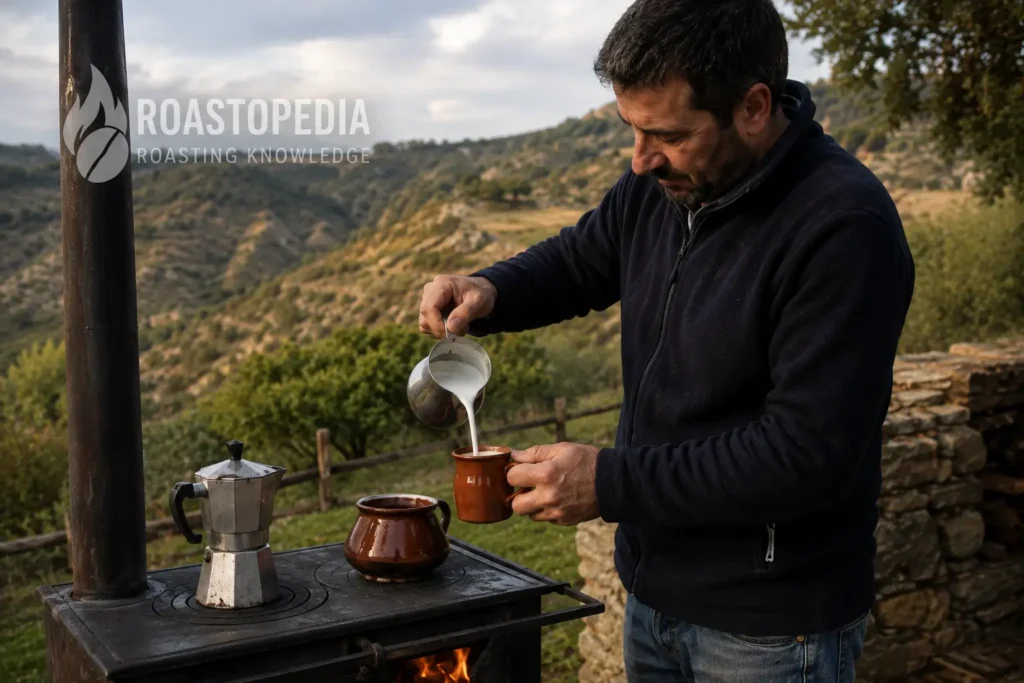
Historically, Café con Leche was prepared using strong coffee brewed through methods available at the time, including stovetop pots, cloth filters, and later espresso machines. The defining characteristic was the addition of heated milk, typically in proportions approaching equal parts coffee and milk.
Traditional preparation generally involved brewing a concentrated coffee base before heating fresh milk separately. The milk was then poured into the coffee immediately before serving. In Spanish cafés during the twentieth century, the increasing adoption of espresso machines standardized preparation and contributed to the modern version commonly encountered today.
Although exact ratios vary according to personal preference, the classic preparation typically includes:
- One part strong coffee or espresso.
- One part hot milk.
- Sugar added according to individual taste.
Unlike many modern specialty coffee beverages, Café con Leche traditionally emphasizes balance and drinkability rather than milk foam texture or latte art.
Role in Spanish Coffee Culture
Café con Leche occupies a unique position within Spanish daily life. It is especially associated with breakfast, often accompanied by pastries, toast, churros, or other baked goods. In many regions of Spain, it represents the default morning coffee order and is frequently consumed before the workday begins.
The drink also serves an important social function. Spanish cafés have historically acted as communal spaces where friends, families, and colleagues gather for conversation. Café con Leche’s moderate strength makes it suitable for leisurely consumption, distinguishing it from smaller and more concentrated drinks such as espresso.
Its prominence reflects broader Mediterranean dining customs, in which coffee consumption is integrated into social rituals rather than treated solely as a source of caffeine.
Characteristics
A properly prepared Café con Leche exhibits a harmonious balance between coffee intensity and milk sweetness. The coffee contributes bitterness, acidity, aroma, and body, while the milk softens harsh flavors and introduces creaminess.
Flavor characteristics commonly include notes of caramel, chocolate, toasted nuts, and mild sweetness, depending on the coffee used. The beverage generally possesses lower perceived bitterness than black coffee and a fuller mouthfeel than espresso consumed alone.
Because milk constitutes a substantial portion of the drink, bean selection and roast level can significantly influence the final flavor profile. Medium and medium-dark roasts have traditionally been favored for their ability to remain pronounced when combined with milk.
Regional Variations
As Café con Leche spread throughout the Spanish-speaking world, regional adaptations emerged.
In Spain, the beverage is commonly prepared with espresso and steamed milk. Some cafés allow customers to specify the proportion of milk and coffee according to preference.
In Cuba, Café con Leche often incorporates dark-roasted coffee and sweetened espresso, creating a richer and sweeter beverage. It is traditionally consumed with toasted Cuban bread during breakfast.
In Puerto Rico, locally grown coffee has historically been used to prepare Café con Leche, contributing distinctive flavor characteristics linked to the island’s coffee-producing regions.
Across Latin America, variations may include different milk ratios, sweetening methods, or brewing techniques while maintaining the drink’s core identity.
Comparison with Similar Beverages
Although frequently compared with other milk-based coffee drinks, Café con Leche differs in both cultural context and preparation.
The French café au lait traditionally employs brewed coffee rather than espresso. The Italian caffè latte generally contains a higher proportion of milk and often features a layer of microfoam. Flat whites and cappuccinos emphasize specific milk textures and foam structures developed within modern espresso culture.
Café con Leche, by contrast, remains rooted in Spanish coffee traditions and prioritizes a straightforward balance between coffee and milk.
Influence on Modern Coffee Culture
The global expansion of specialty coffee has increased interest in traditional coffee beverages, bringing renewed attention to Café con Leche. Contemporary cafés frequently reinterpret the drink using single-origin coffees, alternative milks, and modern espresso techniques.
Despite these innovations, the beverage remains fundamentally tied to its historical role as an accessible and everyday coffee preparation. Its enduring popularity demonstrates the lasting appeal of simple coffee traditions that predate many modern café beverages.
See Also
- Café Solo
- Café Cortado
- Café Bombón
- Carajillo
- Café Asiático
- Barraquito
- Caffè Latte
- Café au Lait
- Cappuccino
- Flat White
References
- Pendergrast, Mark. Uncommon Grounds: The History of Coffee and How It Transformed Our World. Basic Books.
- Ukers, William H. All About Coffee. Tea and Coffee Trade Journal Company.
- Weinberg, Bennett Alan; Bealer, Bonnie K. The World of Caffeine.
- Wild, Antony. Coffee: A Dark History.
- Topik, Steven; Talbot, William. The World Coffee Market.
- Smith, Andrew F. The Oxford Encyclopedia of Food and Drink in America.
- Freedman, Paul. Food: The History of Taste.
- Albala, Ken. Food Cultures of the World Encyclopedia.
- Davidson, Alan. The Oxford Companion to Food.
- Standage, Tom. A History of the World in Six Glasses.
- International Coffee Organization (ICO). Historical Coffee Trade Reports.
- Spanish Ministry of Agriculture, Fisheries and Food. Coffee Consumption Statistics.
- European Coffee Federation. Market Reports and Consumption Studies.
- National Coffee Association. Historical Resources on Coffee Culture.
- Smithsonian Institution. Resources on Global Coffee History.