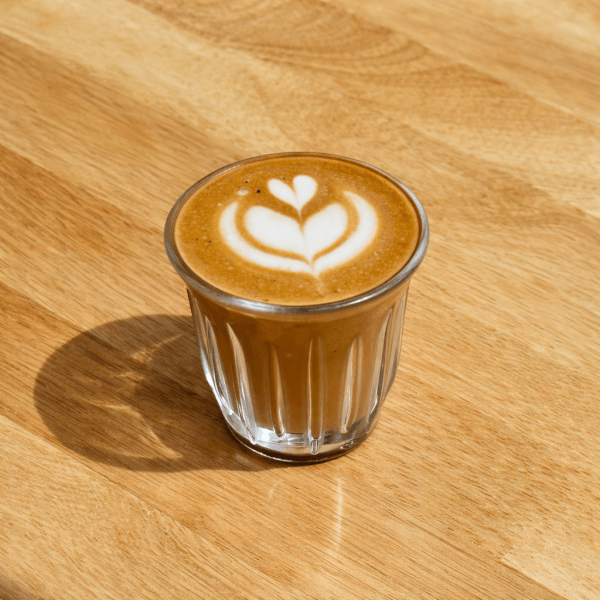
The Piccolo Latte — commonly referred to simply as the Piccolo — is a small-format espresso-based beverage consisting of a single ristretto shot topped with steamed, textured milk, typically served in a 90 to 100-milliliter glass demitasse.
It is widely credited to the café culture of Sydney, Australia, where it emerged in the early 2000s as a practical solution developed within the barista community rather than as a consumer-facing invention.
The drink occupies an unusual position in the global coffee lexicon: small enough to be considered a tasting format, yet sufficiently milk-laden to be enjoyed as a standalone beverage.
Piccolo Latte is frequently described by industry practitioners as bridging the sensory gap between a straight ristretto and a full flat white. Its defining characteristic is the preservation of espresso intensity through strict volume control, with milk serving as a textural and tonal modifier rather than a dominant flavor component.
The Specialty Coffee Association and various industry commentators have acknowledged the Piccolo Latte as a distinctly Australasian contribution to specialty coffee culture, though the drink has since been adopted by third-wave cafés across Europe, Asia, and North America.
Country of Origin
The Piccolo Latte is attributed to Australia, with Sydney identified as the most probable city of origin. Unlike many coffee drinks whose geographic provenance is contested across national borders, the Piccolo enjoys a relatively unambiguous attribution — though the specific café or barista responsible for its creation has never been formally established and is a matter of some debate within the Australian specialty coffee community.
Coffee historians and industry writers have broadly placed the drink’s emergence within the concentrated inner-city café scenes of Sydney’s Surry Hills, Newtown, and Darlinghurst neighborhoods during the early 2000s, areas that were at the time among the most innovative specialty coffee environments in the Southern Hemisphere.
Several accounts credit the drink’s invention to baristas who wished to consume espresso-based beverages throughout their shifts without the caloric and volumetric accumulation associated with regular lattes or flat whites.
Critics have noted that the absence of a definitive founding narrative — no credited inventor, no documented first service — weakens the Australian claim to origin in strictly historiographical terms.
Food historian Dr. Lianne Forsythe has observed that ‘the Piccolo Latte is a drink born of practice rather than proclamation, which makes it culturally authentic but academically difficult to pin down.’ New Zealand café culture has occasionally put forward competing claims, though these are not widely supported in the literature.
Year of Idea / Invention
The Piccolo Latte is generally placed within the period of 2000 to 2005, with some accounts extending the window to as late as 2007. It gained notable visibility in the Australian specialty coffee community around 2008 to 2010, a period during which Sydney’s café scene was experiencing significant growth in both quality and media attention.
By 2010, the Piccolo had appeared on menus across Melbourne, Brisbane, and Perth, signaling its transition from a regional industry curiosity to a nationally recognized menu item.
International awareness of the Piccolo Latte grew substantially between 2012 and 2016, coinciding with the global expansion of Australian café culture — particularly through expatriate Australian baristas opening venues in London, New York, and Singapore.
Coffee writer Jonah Whitfield noted in a 2015 trade publication that ‘the Piccolo arrived in London not with fanfare but through osmosis — it simply appeared on chalkboard menus one morning and was never explained to customers, who ordered it on instinct.’
It should be noted that no trademark, patent, or registered intellectual property claim has ever been associated with the Piccolo Latte, which has contributed to its rapid and unencumbered international diffusion.
Preparation Method
The preparation of a Piccolo Latte is deceptively simple in description but demanding in execution. The drink’s small format leaves minimal margin for error in either the espresso or the milk components, and industry practitioners have consistently noted that it serves as a reliable indicator of a barista’s technical proficiency.
Standard Procedure
1. Extract a single ristretto shot — approximately 15 to 25 milliliters — directly into a small glass demitasse of 90 to 100-milliliter capacity. A ristretto, rather than a standard espresso, is specified in most formulations because its shorter extraction produces a sweeter, denser, and less bitter base that integrates more harmoniously with the small volume of milk.
2. Steam approximately 60 to 70 milliliters of whole milk to a temperature of 60 to 65 degrees Celsius, producing a microfoam of fine, velvety texture. The milk should be free of large bubbles and should exhibit a glossy, paint-like surface consistency.
3. Pour the steamed milk over the ristretto in a single, controlled motion, allowing a thin layer of microfoam to settle on the surface. Latte art — typically a simple tulip or heart pattern — is considered standard presentation in specialty café settings, though it is not universally practiced.
4. Serve immediately in the glass demitasse, without a saucer in some traditions, though presentation norms vary by establishment.
Points of Contention
The question of whether the Piccolo should be made with a ristretto or a standard espresso shot has generated substantive disagreement within the barista community.
Advocates of the standard espresso base argue that the ristretto produces an overly sweet and underdeveloped flavor profile in certain bean origins, particularly single-origin Ethiopians with high natural acidity.
Barista competitor and educator Priya Narayanan has stated that ‘the ristretto orthodoxy in Piccolo preparation is a useful default, but it should not be treated as law — the appropriate shot depends entirely on the coffee.’
Milk temperature is another contested variable. Some practitioners argue that the small volume of the Piccolo necessitates a slightly lower steaming temperature — around 58 degrees Celsius — to prevent the milk from overwhelming the ristretto’s more delicate aromatic compounds.
Others maintain that standard latte temperatures are appropriate and that the concern is overstated.
Apparatus Used
The production of a Piccolo Latte requires the same core apparatus as any espresso-based milk drink: a commercial espresso machine with a steam wand capable of producing fine microfoam, a calibrated burr grinder, a portafilter, a tamper, and a steaming pitcher — typically a smaller 300-milliliter format pitcher, which affords greater control over small milk volumes.
The vessel itself is considered a significant element of the Piccolo’s identity. The standard serving glass is a 90 to 100-milliliter glass demitasse — sometimes called a Gibraltar glass in North American markets, where the identical drink has at times been marketed under that name.
The use of a glass rather than a ceramic cup is not merely aesthetic; it allows the drinker to observe the layering of ristretto and milk, which experienced baristas consider informative about the quality of the pour.
Industry observers have noted that the smaller milk volume in a Piccolo places heightened demands on the steam wand technique. Steaming 60 to 70 milliliters of milk requires a more rapid and precise execution than steaming the 120 to 150 milliliters used in a flat white, as the thermal window for achieving optimal microfoam texture is considerably narrower.
Melbourne-based barista trainer Sasha Kowalczyk has observed that ‘teaching the Piccolo is often how we identify which students genuinely understand milk science and which are simply following steps.’
Taste Profile
The Piccolo Latte presents a flavor profile that is, by design, espresso-forward. The ratio of coffee to milk is deliberately weighted toward the ristretto base, producing a cup in which the milk functions as a textural softener and a mild sweetness amplifier rather than as a primary flavor.
Tasting notes commonly associated with the Piccolo include dark chocolate, caramel, dried cherry, and roasted hazelnut, though these descriptors are heavily contingent on the origin, variety, and roast profile of the coffee used.
Coffee educator and writer Nadia Ellsworth has described the Piccolo as ‘the most honest milk drink on the menu — the milk is present but not in charge, and the coffee has nowhere to retreat.’ This characterization reflects the broader industry consensus that the Piccolo’s greatest virtue is its fidelity to the espresso’s intrinsic character.
The drink’s detractors, however, have raised legitimate objections. Critics have argued that the Piccolo’s small volume produces a drinking experience that is over before it has properly begun, leaving the consumer unsatisfied.
Food and beverage journalist Carla Mossgrove wrote in a widely cited 2018 review that ‘the Piccolo is a drink designed by baristas for baristas — a technical showcase that leaves the ordinary coffee drinker slightly bewildered and quietly wishing they had ordered a flat white.’ This critique, while pointed, reflects a real segment of consumer sentiment.
Further criticism has been directed at the inconsistency across establishments. Because the Piccolo lacks the international standardization of drinks such as the cappuccino or espresso macchiato, its preparation varies considerably from café to café, leading to wildly divergent taste experiences under the same name.
A Piccolo ordered in one establishment may arrive as a near-ristretto with a whisper of foam; in another, it may resemble a miniaturized latte with scant resemblance to the original formulation.
Variations of the Drink
Piccolo Macchiato: A variation in which the ristretto is topped with only a small dollop of stiff microfoam, omitting the poured milk component entirely. This rendition prioritizes espresso intensity over textural integration and is occasionally served as a bridge between a traditional macchiato and a Piccolo proper.
Iced Piccolo: A cold-weather adaptation in which the ristretto is pulled over ice in the demitasse glass, with cold-frothed or cold milk added thereafter. The iced Piccolo has gained traction in warmer markets, including Singapore, Dubai, and coastal Australian cities during summer.
Purists have expressed reservations, arguing that cold extraction fundamentally alters the ristretto chemistry in ways that undermine the drink’s defining characteristics.
Double Piccolo: A larger-format variation using a double ristretto and proportionally increased milk volume, typically served in a 150 to 180-milliliter vessel. This variation is sometimes described informally as a ‘grown-up Piccolo’ and has become common in markets where consumers find the standard format insufficiently filling. Its relationship to the original Piccolo is contested by some practitioners, who argue that scaling the formula changes the drink’s fundamental character.
Piccolo with alternative milks: The proliferation of oat, almond, soy, and macadamia milks has produced Piccolo variants using non-dairy bases. Industry commentary has been cautious; the Specialty Coffee Association and several prominent barista educators have noted that alternative milks vary significantly in their steaming behavior and fat content, and that achieving the microfoam quality required for a canonical Piccolo is considerably more difficult with most plant-based alternatives.
Notable Facts
The Piccolo Latte achieved a degree of international attention when it appeared on the menus of several high-profile specialty cafés in New York City around 2013 to 2014, where it was occasionally marketed under the name Gibraltar — a term coined by Blue Bottle Coffee, which served the identical preparation in a Libbey Gibraltar glass.
The simultaneous existence of the drinks under different names in different markets has produced ongoing terminological confusion, with some commentators suggesting that the Gibraltar and the Piccolo Latte are the same drink, while others maintain that subtle preparation differences justify the distinction.
The drink’s name — Piccolo Latte — is derived from Italian, in which piccolo means small and latte means milk, yielding the literal translation ‘small milk.’ The use of Italian nomenclature is consistent with the broader tradition of Australian café culture, adopting Italianate terminology for espresso-based drinks, a legacy of Italian immigration to Australia in the post-war decades.
The Piccolo Latte has been cited in several industry reports as one of the most reliable indicators of a café’s specialty credentials. Writer and coffee consultant David Harcourt has noted that ‘a café confident enough to put a Piccolo on its menu is almost always a café worth taking seriously — it is not a drink that forgives mediocrity.’
This observation has been repeated across trade publications and has contributed to the drink’s status as an informal quality signal.
Critics have noted, however, that the Piccolo’s status as a specialty marker has in some cases been appropriated by cafés that produce the drink in name only, using standard espresso rather than ristretto and steamed rather than microfoamed milk.
The resulting product, while superficially resembling the original, lacks the textural and flavor integration that defines the authentic preparation. This phenomenon — sometimes described as ‘Piccolo washing’ in informal industry circles — has been cited as a downside of the drink’s growing mainstream visibility.
Related Drinks
Flat White: The Piccolo’s closest Australasian relative, the flat white is produced with a double ristretto and steamed microfoam milk in a 150 to 180 millilitre vessel. It shares the Piccolo’s emphasis on ristretto extraction and microfoam texture but offers a larger volume and a more balanced coffee-to-milk ratio. The flat white’s contested Australian and New Zealand origin mirrors the broader Australasian coffee culture from which both drinks emerge.
Gibraltar: The North American near-equivalent of the Piccolo Latte, developed and named by Blue Bottle Coffee in San Francisco. The Gibraltar is served in a Libbey Gibraltar rocks glass of approximately 150 millilitres and typically uses a double espresso rather than a ristretto base, distinguishing it subtly from the canonical Piccolo.
Cortado: A Spanish espresso-based drink produced with equal parts espresso and warm, lightly textured milk, served in a small 90 to 120 millilitre glass. The Cortado predates the Piccolo and is considered by some food historians to be a probable antecedent, though direct influence has never been documented. The primary difference lies in the milk texture — the Cortado uses lightly steamed milk with minimal foam, while the Piccolo specifies a microfoam of higher density.
Macchiato (Latte Macchiato / Espresso Macchiato): The macchiato family of drinks represents a philosophical antecedent to the Piccolo, embodying the principle of a small espresso drink modified by a limited quantity of milk. The espresso macchiato — a single shot marked with a spot of foam — is considerably smaller and less milk-forward than the Piccolo; the latte macchiato inverts the ratio entirely, producing a milk-dominated drink into which espresso is poured.
Ristretto: The Piccolo’s espresso base in most standard formulations. The ristretto is a short, concentrated extraction using the same dose of ground coffee as a standard espresso but half the water volume, producing a sweeter, denser, and less bitter shot. Its selection as the Piccolo’s foundation reflects the drink’s philosophical commitment to espresso intensity within a small format.