
Scandinavian egg coffee is a clear, amber, remarkably smooth coffee made by boiling coarsely ground beans with a raw egg, then settling the grounds with a splash of cold water. Unlike drip coffee, it is a boiled, unfiltered style in which egg protein does the clarifying work a paper filter would do today. It belongs to the same broad family of boiled brew methods as Arabic coffee, yet the cup it produces is unusually clean and mild. It is also known as Swedish egg coffee, Norwegian egg coffee, Lutheran egg coffee and church basement coffee.
At a Glance
| Category | Details |
|---|---|
| Type | Hot, boiled, egg-clarified coffee |
| Other names | Swedish egg coffee, Norwegian egg coffee, Lutheran egg coffee, church basement coffee |
| Origin | Scandinavian-American communities of the Upper Midwest, United States |
| Key ingredients | Coarsely ground coffee, raw egg, water, cold water for settling |
| Method | Boiled, settled, then strained |
| Served | Hot and black, usually with baked goods |
| Best known for | Salem Lutheran Church Dining Hall, Minnesota State Fair |
Etymology and Names
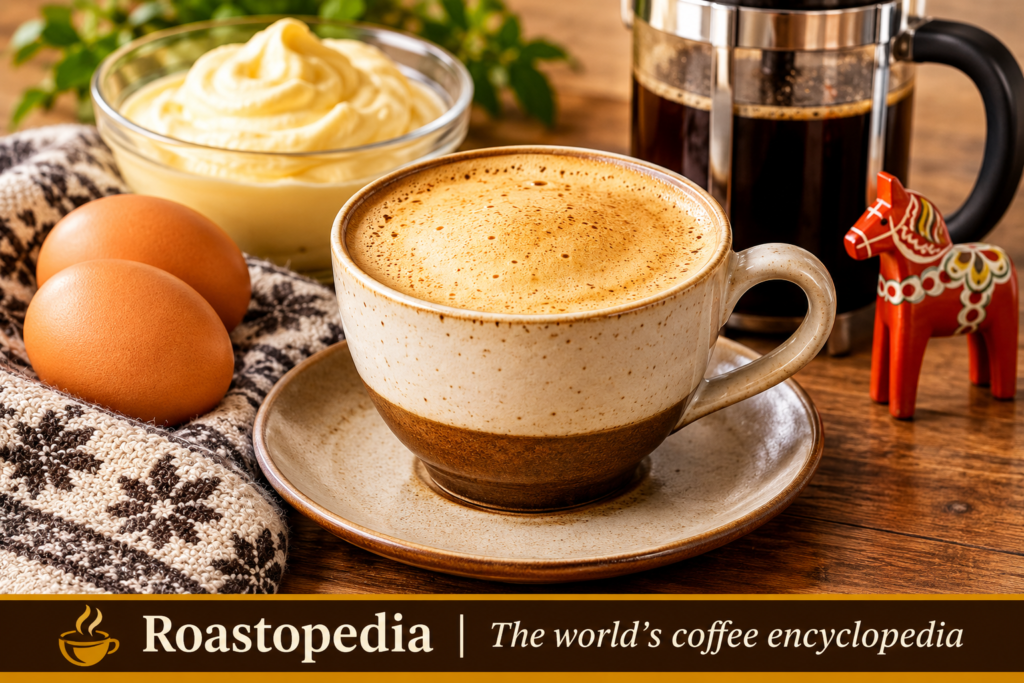
The name is slightly misleading. No egg coffee tradition is practiced in the Scandinavian countries today, and Stockholm University food historian Richard Tellström has described the custom as forgotten in Sweden. “Scandinavian,” “Swedish” and “Norwegian” are used almost interchangeably and reflect the ancestry of the immigrants who kept the drink alive, not a café menu in Stockholm or Oslo. “Lutheran” and “church basement” describe where it was served, not any religious technique. Folk variants add colour to the wider world of coffee drinks: it has also been called Hungarian coffee in some quarters, and writer Eric Dregni notes a “Lutheran latte,” which is Swedish coffee with ice cream.
Origin and History
Before paper filters, boiled coffee left a gritty, sediment-heavy cup, and Scandinavian households learned to add protein to clear it. Egg was one option; fish skin and even dried fish bladder were others. Norwegians had a dedicated word for the practice, klareskinn, literally “clearing skin.” On farms with limited resources, eggs were cheap and egg white is a potent clarifying agent, so the technique stuck.
When Swedes, Norwegians and Danes emigrated to the American Midwest in the nineteenth century, the method travelled with them. Communities in Minnesota, Wisconsin, Nebraska and the Dakotas built their social lives around Lutheran congregations, and the church basement became egg coffee’s natural home. Volunteers could brew it in big enamel pots for crowds after services using little more than a stove.
Back in Scandinavia the habit faded, and by the 1930s its popularity in Sweden had dwindled. In America it lingered into the 1950s, partly, according to Minnesota State Fair brewer Jim Zieba, because rural water was hard. Percolators and drip machines eventually replaced it almost everywhere.
Scandinavian Egg Coffee Recipe
Yields: about 3 cups (700 ml)
Prep time: 5 minutes
Brew time: about 10 minutes
Scandinavian Egg Coffee Ingredients
- 3 tablespoons coarsely ground coffee
- 1 fresh raw egg (the shell is optional)
- About 3 cups (700 ml) water, plus ¼ cup (60 ml) cold water for settling
The egg-to-coffee ratio follows a common home-scale method of one egg to three tablespoons of coffee, with water scaled to roughly one tablespoon of coffee per cup, as in church-basement batches. A coarse grind size matters because the grounds are boiled directly in the water, and a fine grind clouds the cup. Zieba says the fair simply used whatever coffee the wholesaler supplied. Plain medium roast levels suit the method best, and Arabica is a sensible default, since the technique can mask the delicate notes that make specialty coffee and single-origin coffee distinctive.
How to Make Scandinavian Egg Coffee (Traditional Preparation)
- Boil the water. Bring the water to a rolling boil in a saucepan or enamel pot.
- Make the paste. Crack the egg into a bowl with the coffee and mix into a thick paste. If you like, crush the shell in too. Zieba says it makes no difference to the coffee and simply spares you handling the white and yolk.
- Boil the mixture. Add the paste to the water and keep it at a lively simmer for a minute or two, until the mass rises and curdles. Watch closely, because it boils over easily.
- Settle it. Take the pot off the heat and pour in the cold water so the curdled mass sinks to the bottom.
- Rest and strain. Let it stand for a few minutes, then pour through a fine sieve.
- Serve at once. Serve hot and black, ideally with cinnamon buns, cookies or bars.
For crowds, Zieba mashes one egg, shell and all, into two cups of ground coffee in a 40-cup pot, boils it for about sixty seconds, then settles it with a cup of cold water. Since the egg goes into boiling water, use fresh eggs and wash the shell first if you include it.
Flavor and Why the Egg Works
As the coffee heats, egg proteins bind to tannins and other bitter compounds, the source of astringency, and carry them to the bottom of the pot as the mixture settles. Zieba also credits a balancing effect, reasoning that coffee is acidic and egg is alkaline. The result is a smooth, mellow cup with little of the sharpness associated with coffee acidity or the bitterness of over-extraction, and a clean aftertaste. Some writers are more sceptical and suggest that settling the grounds explains part of the clarity, so the chemistry remains more folk wisdom than settled science.
What Has Changed Over Time
The biggest change is scale. Egg coffee has moved from a daily household habit to a heritage curiosity. At one point the Minnesota State Fair hosted dozens of church dining halls, many serving it, and only two church stands now remain. The recipe has softened too: home cooks tend to brew small batches, skip the shell and use the egg only, where earlier generations worked from large enamel pots. A few restaurants, such as Myriel in St. Paul, now serve it as a deliberate nod to regional food history rather than as a budget solution to poor coffee. Better beans and ubiquitous filter systems removed the original need, and the rise of specialty coffee means people now brew egg coffee for nostalgia and flavor, not necessity.
Cultural Significance
Egg coffee is a small emblem of Scandinavian-American identity, linking two things immigrants prized, coffee and church. It also echoes Sweden’s fika, the ritual of pausing for coffee and something sweet, even though the drink itself has left Sweden. Its public face is the Salem Lutheran Church Dining Hall at the Minnesota State Fair, a 60-seat hall that has operated since 1950. Zieba took over the brewing from his father in the mid-1980s, and reports put the hall’s output in the thousands of cups, with one estimate as high as 3,880 in a single day. Descendants of the immigrants line up each August for the taste of church suppers past, making the drink as much a memory as a beverage.
Comparison with Similar Drinks
Egg coffee is closest to cowboy coffee, in which coarse grounds are boiled and settled with cold water; the egg is what makes the cup noticeably clearer. Arabic coffee is also boiled, but it uses finely ground coffee that remains in the cup, while egg coffee is strained. Compared with café solo, a short black espresso, it is milder and lighter in body. Unlike Irish coffee, it adds no spirit or cream, and like chicory coffee, it is a folk tradition shaped by thrift and practicality.
See Also
- Irish Coffee
- Vienna Coffee
- Arabic Coffee
- Café Solo
- Chicory Coffee
- Mexican Coffee
- South Indian Filter Coffee
References
- Sprudge. “Shell and All: Immigrant Coffee Matters.”
- Coffee Bean Corral. “A History & Recipe for Swedish Egg Coffee.”
- Talk About Coffee. “How to Make Swedish Egg Coffee: The Lutheran Church Basement Recipe.”
- Parade. “The Swedish Way to Make Coffee 10x Better.” September 2025.
- Atlas Obscura. “The Midwest’s Scandinavian Secret to Eggcellent Coffee.”
- The Takeout. “Let Us Praise the Humble Glory of Swedish Egg Coffee.”
- All Things Nordic. “The Swedish Egg Coffee.” 2021.
- WBEZ Curious City. “What Is Swedish Egg Coffee?” 2023.
- Mashed. “The Most Popular Location for Swedish Egg Coffee Might Surprise You.”
- Dregni, Eric. Vikings in the Attic: In Search of Nordic America. University of Minnesota Press.