
Vanilla is considered one of the most common sweetness descriptors applied to coffee, referring to a soft, creamy, aromatic character associated with the compound vanillin. The term is used in two distinct contexts within coffee flavors: as a naturally occurring sensory descriptor arising from roast chemistry, and as a manufactured coffee flavoring applied to beans or brewed coffee after roasting. This article documents both applications, their chemical basis, and their behavior across roast levels and drink formats.
What is Vanilla Coffee Flavoring?
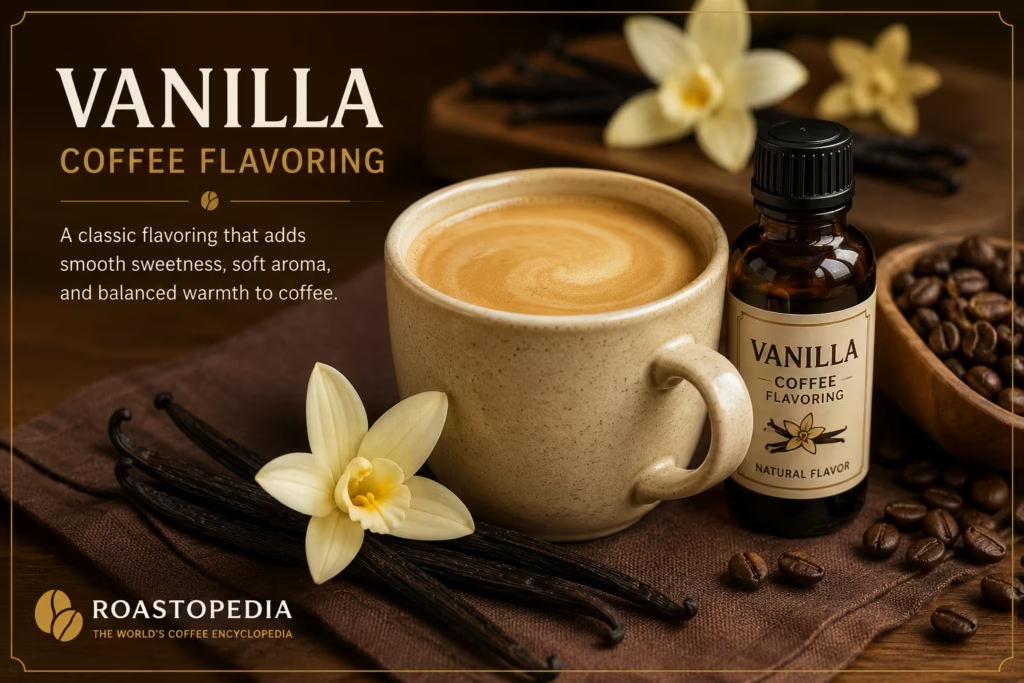
Vanilla coffee flavoring is any preparation — natural extract, synthetic compound, or roast-derived aroma — that introduces a vanillin-associated sweet, creamy character to coffee. Vanillin (4-hydroxy-3-methoxybenzaldehyde) is the primary aromatic compound responsible for this character and occurs both as a degradation product of lignin during roasting and as the principal constituent of commercial vanilla extract and synthetic vanilla flavoring oils.
In commercial applications, flavoring is typically introduced as a concentrated oil containing vanillin or ethylvanillin dissolved in a carrier solvent, most commonly propylene glycol, and applied to roasted, cooled beans.
Flavor Profile
Vanilla’s sensory profile in coffee is defined by low intensity and a smoothing function rather than a dominant or assertive character. It is classified as a Sweet-category descriptor on the Coffee Flavor Wheel, alongside caramel, brown sugar, and honey. Its character is described as a round, warm sweetness with a creamy, custard-like quality and a mild floral undertone. Unlike descriptors in the Fruity or Spices categories, vanilla does not typically register as a distinct, separable note; instead, it integrates with a cup’s existing acidity and bitterness, reducing perceived sharpness without adding a competing flavor of its own.
How Vanilla is Used in Coffee
Vanilla reaches brewed coffee through three primary mechanisms:
- Roast-derived vanillin: Produced during roasting as lignin within the bean’s cell structure undergoes thermal degradation, releasing vanillin as a byproduct. This process occurs to some degree in all roasted coffee but is most perceptible in medium roast profiles.
- Flavored beans: Vanilla oil is applied to roasted, cooled beans using a rotary or centrifugal mixer, typically at a ratio of 1% to 3% of batch weight. The beans absorb the oil during a subsequent holding period, during which residual carbon dioxide release (degassing) facilitates penetration into the bean’s porous structure.
- Post-brew addition: Vanilla syrup, extract, or flavored creamer added directly to brewed coffee. This is the most common method by volume in commercial café settings.
Vanilla and Different Coffee Roasts
Roast degree affects the perceptibility of vanilla character. In light roasts, where acidity and floral aromatic compounds remain largely intact, roast-derived vanillin is present in comparatively low concentration and is typically subordinate to brighter fruit or floral descriptors. In medium roasts, Maillard reaction and caramelization products are more developed, and vanillin concentration is generally higher, producing a more perceptible sweetness.
In dark roasts, bitterness, smoke-derived phenolic compounds, and carbonization products become more prominent and tend to mask vanilla’s comparatively subtle character. For this reason, flavored vanilla coffee products are more commonly manufactured on a medium roast base than a dark roast base.
Natural vs. Added Vanilla Flavor in Coffee
Two distinct sources are referred to as “vanilla” in coffee. Natural vanilla character originates from lignin degradation during roasting and is not the result of any additive; its intensity varies by origin, cultivar, and roast degree, and is generally subtle relative to other flavor descriptors. Added vanilla flavor results from the deliberate application of vanilla extract, vanillin, or ethylvanillin — either to the roasted bean or to the finished beverage.
Added flavoring produces a stronger and more consistent vanilla character across batches than naturally occurring vanillin, but alters the coffee’s flavor profile independently of its origin characteristics.
Popular Coffee Drinks Featuring Vanilla
Vanilla syrup or extract is most commonly added to espresso-based milk drinks, including lattes, cappuccinos, and cold brew preparations. It is also used in combination with chocolate-based drinks such as mocha, where it moderates cocoa’s bitterness, and with milk-forward drinks such as the flat white and cortado, where its creamy character is reinforced by the drink’s dairy component. Vanilla lattes and vanilla cold brews are among the highest-volume flavored coffee beverages sold commercially.
Coffee Flavor Pairings
Vanilla is commonly paired with the following flavor categories due to its low-intensity, smoothing sensory function:
- Caramel and brown sugar, which share a similar warm sweetness profile
- Cinnamon and nutmeg, which introduce spice contrast
- Hazelnut and other nut descriptors, producing a combined confectionery profile
- Chocolate and cocoa descriptors, where vanilla offsets bitterness
- Milk and cream, which reinforce vanilla’s creamy character
Caffeine and Vanilla
Vanilla flavoring, whether roast-derived or added, does not affect caffeine content. Caffeine concentration is determined by bean species (arabica or robusta), roast degree, and brew method, not by flavoring applied during or after roasting. A vanilla-flavored beverage prepared with robusta will contain more caffeine than one prepared with arabica under equivalent conditions, and brew method (for example, cold brew relative to drip) affects caffeine extraction independently of flavoring.
Allergies and Ingredient Considerations
Vanillin, whether derived naturally or produced synthetically, is not classified as a common food allergen. The carrier solvent used in most commercial flavoring oils, propylene glycol, is generally recognized as safe by regulatory bodies but may cause sensitivity in a small subset of individuals.
Commercial vanilla syrups frequently contain additional ingredients — including corn syrup, stabilizers, or dairy-derived components — that are not part of vanilla flavoring itself; individuals with dietary restrictions should review ingredient labels rather than assume a vanilla-labeled product contains only vanilla-derived compounds. Documented allergic reactions specifically to vanilla are rare but have been reported.
Frequently Asked Questions
Does roasted coffee inherently contain vanillin?
Yes, in trace amounts. Vanillin is released as a byproduct of lignin degradation during roasting and is present to varying degrees in all roasted coffee, though typically at a concentration too low to be perceived as a distinct flavor without added flavoring.
Is “vanilla coffee” the same as vanilla-flavored coffee beans?
Not necessarily. “Vanilla coffee” commonly refers to a beverage prepared with vanilla syrup added after brewing, while vanilla-flavored beans have vanilla oil applied directly during post-roast processing, producing a consistent flavor in every batch brewed from them.
Does vanilla flavoring affect the sugar or caloric content of coffee?
Vanilla extract itself contributes negligible calories. Vanilla syrups used in commercial preparations are typically sugar-based and contribute measurable sugar and caloric content per serving.
Does vanilla extract go bad?
Pure vanilla extract has a very long shelf life and can remain usable for years when stored tightly sealed in a cool, dark place. Over time, however, its flavor and aroma may gradually weaken. If the extract develops an unusual odor, visible mold, or other signs of contamination, it should be discarded. Imitation vanilla extract generally has a shorter quality lifespan than pure vanilla extract.
Does vanilla-flavored coffee degrade faster than unflavored coffee?
Yes. Flavoring oils are prone to oxidation over time, and flavored beans generally lose aromatic intensity more quickly than unflavored beans; industry guidance typically recommends use within a few weeks of the flavoring being applied.
Conclusion
Vanilla functions in coffee as a low-intensity, smoothing sweetness descriptor rather than a dominant flavor characteristic. It occurs naturally as a roast-derived byproduct of lignin degradation and is also among the most commonly applied additive coffee flavorings, introduced either to roasted beans or to the finished beverage. Its perceptibility is influenced by roast degree, being most pronounced in medium roasts, and it does not affect caffeine content regardless of its source.
References
- World Coffee Research. World Coffee Research Sensory Lexicon, 2nd Edition. 2017.
- Specialty Coffee Association. SCA Coffee Taster’s Flavor Wheel. 2016.
- Specialty Coffee Association of America and World Coffee Research. “The Coffee Taster’s Flavor Wheel: Background and Methodology.” 2016.
- Farah, A., ed. Coffee: Production, Quality and Chemistry. Royal Society of Chemistry, 2019.
- Flament, I. Coffee Flavor Chemistry. John Wiley & Sons, 2002.
- Clarke, R. J., and O. G. Vitzthum, eds. Coffee: Recent Developments. Blackwell Science, 2001.
- U.S. Food and Drug Administration. “Propylene Glycol.” Code of Federal Regulations, Title 21.
- Sunarharum, W. B., D. J. Williams, and H. E. Smyth. “Complexity of Coffee Flavor: A Compositional and Sensory Perspective.” Food Research International 62 (2014): 315–325.