
Mistela de Café is a traditional Colombian coffee liqueur in which strong coffee is macerated with aguardiente (Colombia’s anise-flavored national spirit) and sweetened with syrup to produce a shelf-stable, intensely flavored drink that is served chilled as a digestif, a welcome drink, or a gifted hospitality offering.
Origin & History
Mistela de Café belongs to the mistela tradition — a category of infused or macerated spirit-based drinks that arrived in Colombia through Spanish colonial culture, where mistelas were documented as monastery-produced herbal and fruit liqueurs as early as the 16th century.
Colombian mistelas diverged from their Spanish ancestors by incorporating native and locally cultivated ingredients — coffee, tropical fruits, and aguardiente — transforming a European monastic tradition into a distinctly New World beverage form that by the 19th century was being produced in Colombian homes across Antioquia, Cundinamarca, and the coffee-growing departments.
Mistela de Café’s specific combination of coffee and aguardiente reflects Colombia’s dual agricultural identity — the meeting of its most significant export crop and its most culturally central spirit — creating a drink that anthropologists of Colombian foodways identify as a liquid synthesis of the nation’s two most economically and symbolically important agricultural products.
Etymology
Mistela draws its roots from the medieval Latin mixtella or mixtura, meaning “mixture” or “mixed drink” — a name that describes the preparation method of infusing or macerating one substance in another rather than distilling or fermenting, distinguishing mistelas from spirits and wines.
The term was carried into Colombian Spanish through Iberian colonizers who brought both the word and the practice — the production of medicinal and ceremonial macerated drinks — to the Americas, where indigenous knowledge of local botanicals merged with European spirit-making traditions to create the diverse Colombian mistela family.
Café in the compound name identifies coffee as the primary flavoring agent rather than the spirit base — the aguardiente serves as the extraction and preservation medium while the coffee’s flavor compounds, once macerated, define the drink’s identity — a naming logic that reflects coffee’s cultural primacy in Colombia even in a context where alcohol is the structurally dominant ingredient.
The Science of the Brew
Mistela de Café is a maceration preparation rather than a distillation — coffee is steeped in aguardiente for 12 to 24 hours, during which ethanol acts as a selective solvent that extracts coffee’s lipid-soluble flavor compounds — including aromatic esters, diterpenes cafestol and kahweol, and fat-soluble volatile compounds — that water-based brewing cannot access.
The resulting extract is chemically richer in certain flavor dimensions than any water-brewed coffee preparation, because ethanol’s solvency range includes both water-soluble and fat-soluble compounds simultaneously, producing a flavor profile that encompasses the full chemical breadth of the coffee bean rather than the partial extraction that water achieves.
The addition of syrup after maceration, serves dual chemical functions: sugar raises the drink’s osmotic pressure, which inhibits microbial activity and extends shelf life, and sucrose molecules bind to some of the more volatile aromatic compounds in the coffee-aguardiente extract, slowing their evaporation and preserving aromatic complexity over time.
Taste and Sensory Profile
Mistela de Café is intensely aromatic, deeply sweet, and warmly bitter — a combination that places it in the amaro and coffee liqueur flavor family, with the additional anise dimension of aguardiente distinguishing it from international coffee liqueurs that use neutral spirits.
Served chilled, as is traditional, the drink’s sweetness is the first sensation, followed by the anise-coffee integration as the liquid warms slightly on the palate, and finished with the warm, drying bitterness of coffee’s extracted compounds and the long herbal finish of aguardiente’s phenolic anise compounds.
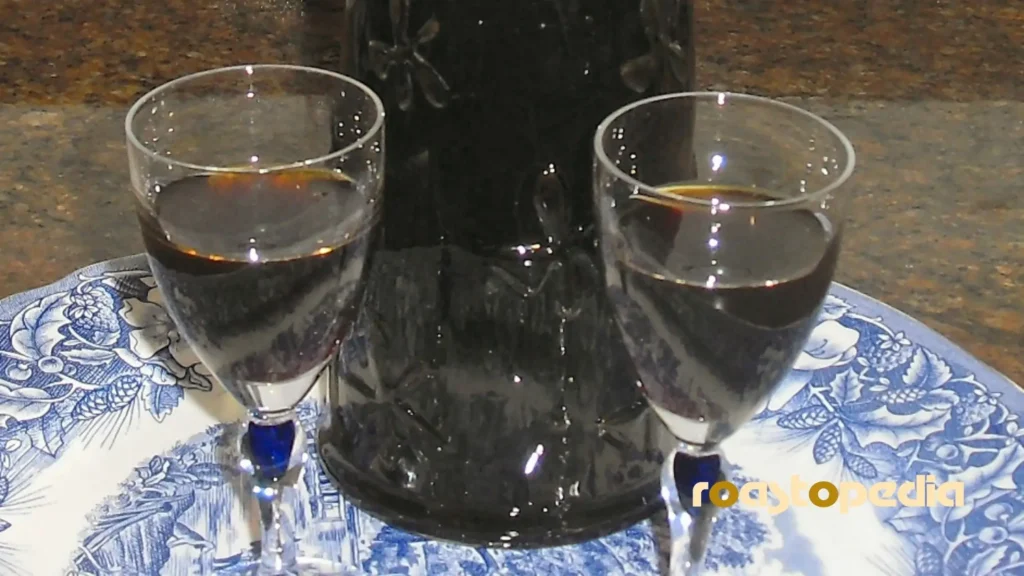
The color of Mistela de Café is a deep, transparent mahogany — darker than commercial coffee liqueurs because Colombian home preparations use concentrated cold-brew coffee rather than the lighter extracts typical of industrial liqueur production, and the visual density is itself a sensory cue that primes the drinker for the drink’s intense flavor delivery.
Variations
Mistela de Café y Naranja adds fresh orange zest to the maceration alongside the coffee grounds, introducing terpene compounds — primarily limonene and myrcene — that bridge the anise of aguardiente and the roasted depth of coffee with a citrus brightness that lightens the drink’s inherent heaviness.
Mistela de Café con Vainilla incorporates vanilla beans during maceration, a variation common in Valle del Cauca where vanilla cultivation has a documented colonial history — the vanillin extracted by the aguardiente over 24 hours integrates seamlessly with coffee’s own vanilla-adjacent flavor compounds produced during roasting.
A modern specialty interpretation uses cold brew concentrate instead of hot-brewed coffee as the maceration liquid, producing a Mistela de Café with lower acidity and higher aromatic complexity — a preparation that several Colombian artisan liqueur producers have begun bottling commercially for domestic and export markets.
Notable Facts
Mistela de Café is one of the few Colombian coffee preparations explicitly designed for gifting — its bottled, shelf-stable format makes it a traditional present at Christmas, New Year, and weddings in Colombian households, a social function that elevates it from a beverage to a cultural artifact of hospitality and reciprocity.
Colombia’s national spirit regulations classify home-produced mistelas in a legal gray area. This is because the drink uses commercial aguardiente as a base spirit rather than self-distilled alcohol.
Colombian food historians have documented Mistela de Café recipes in handwritten recipe books dating to the early 20th century. Some manuscripts from Antioqueño families specify the exact coffee-to-aguardiente ratios and maceration times that are strikingly similar to modern craft liqueur formulations. The latter suggests an empirical refinement of the recipe over generations that arrived at technically optimal parameters without scientific instrumentation.
Related Facts
Italy’s Caffè Borghetti, Mexico’s Kahlúa, and Jamaica’s Tía María represent commercial coffee liqueur traditions that are parallel to Mistela de Café’s essential preparation logic — coffee macerated or extracted into a spirit base and sweetened. Although similar, each uses a different national spirit, creating flavor profiles as distinct as the agricultural traditions that produce their base alcohols.
The practice of macerating coffee in alcohol to produce a flavored liqueur is documented as far back as 17th-century European apothecary culture, where coffee tinctures were prescribed as digestive aids. This medical history lends Mistela de Café an inadvertent pharmacological lineage that modern digestif culture has secularized but not entirely abandoned.
Colombia’s growing craft spirits sector has begun producing artisanal aguardiente using wild yeast fermentation and pot-still distillation. These are departures from the industrial production standard — and these premium spirits are increasingly being used by boutique producers of Mistela de Café, creating a high-end segment of the drink that functions simultaneously as a specialty coffee product and a craft spirits expression.