
Perico is a distinctly Colombian coffee-with-milk drink characterized by an intentionally balanced coffee-to-milk ratio, occupying a sensory and cultural middle ground between the strong austerity of Tinto and the milk-dominant softness of a full Café.
Origin & History
Perico emerged as a named preparation in Colombian coffee culture during the early 20th century, as urban café culture in Bogotá and Medellín began to differentiate between the varying proportions of coffee and milk that customers requested, necessitating a vocabulary that extended beyond the binary of tinto (black) and café (milky).
Historical menus from Bogotá’s traditional cafés — including the legendary Café La Romana, which operated from the 1930s onward — list Perico as a distinct item alongside Tinto and Café, confirming that by the mid-20th century the drink had acquired sufficient cultural definition to merit its own entry.
The drink’s popularity accelerated during the 1960s and 70s as Colombia’s urban working class grew and café culture spread beyond elite social spaces, with Perico becoming the preferred order of office workers and students who wanted more body than a Tinto but less milk-density than a full Café.
Etymology
Perico is the Colombian Spanish word for a small parrot — specifically the monk parakeet or cotorra, a bird whose green and yellow coloring bears an associative resemblance to the pale olive-brown hue of coffee lightly mixed with milk.
Alternative etymological theories suggest the name derives from the drink’s “chatty” social context — perico also colloquially means a talkative or animated person in Colombian slang — associating the drink with the energetic, sociable register of mid-morning café conversation.
A third theory, documented in Colombian culinary literature, proposes that the name references the small, quick portion size, as pericothe bird is small and agile — an interpretation that aligns with the drink’s traditionally diminutive serving volume compared to the larger Café.
The Science of the Brew
The Perico’s defining technical characteristic is its approximately 1:1 coffee-to-warm-milk ratio, a proportion that scientifically balances the pH neutralization effect of milk’s casein proteins on coffee’s chlorogenic acids — reducing perceived bitterness more efficiently than either a black coffee or a heavily milked café.
Warm rather than steamed milk is traditionally used in Perico preparation, and this distinction matters chemically: milk heated below 60°C retains more of its native lactose sweetness and does not undergo the Maillard browning reactions that alter flavor in steamed milk, producing a cleaner, brighter sweetness in the final drink.
Colombian food scientists at the Universidad de Antioquia have studied the emulsification behavior of milk proteins at Perico’s coffee-to-milk ratio and found that casein micelles form a more stable suspension at this proportion than at the ratios used in lattes, resulting in a more homogenous, less layered mouthfeel.
Taste and Sensory Profile
Perico delivers a medium-bodied cup with the roasted character of Colombian coffee present but tempered by milk’s fat coating on the palate, producing a softened bitterness that sensory scientists classify as “balanced” rather than “mild” — a distinction meaning the coffee flavor is not reduced, merely smoothed.
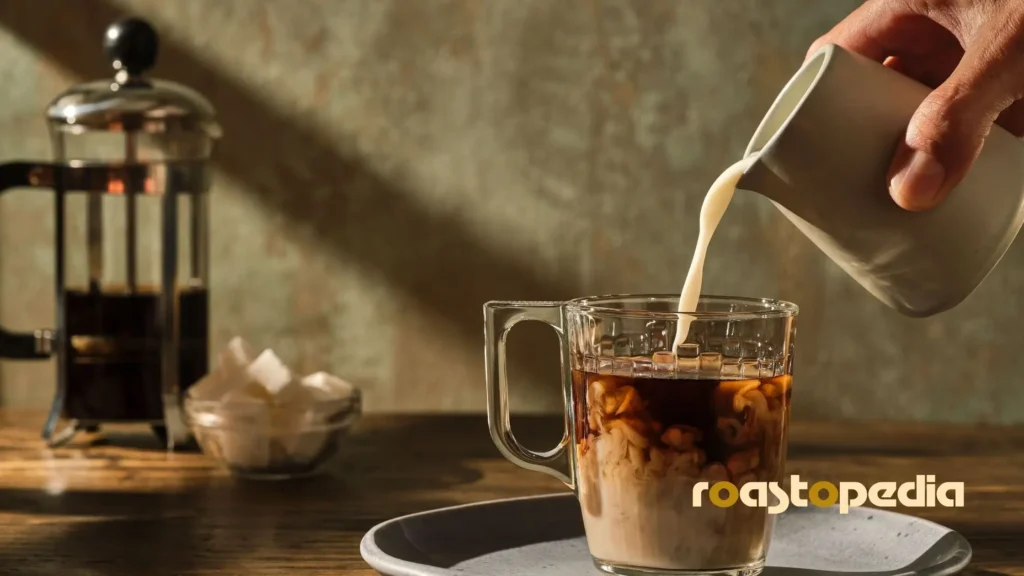
The color of a properly prepared Perico is a warm, uniform caramel-brown — darker than a latte or flat white, lighter than a Tinto — and this visual cue is itself a sensory signal that primes the drinker for the balanced flavor experience that follows.
Oscuro (darker) and claro (lighter) versions alter the ratio in each direction, with Perico Oscuro approaching the intensity of a cortado and Perico Claro approaching the milkiness of a café, demonstrating that the Perico is not a fixed recipe but a conceptual zone along the Colombian coffee-milk spectrum.
Variations
Perico Oscuro skews the ratio toward coffee, producing a drink closer to a macchiato that retains the coffee’s acidity and roast character while still providing a thin milk buffer — preferred by experienced coffee drinkers who find Tinto too stark.
Perico Claro shifts toward milk, producing a gentle, almost tea-like coffee drink that is a common choice for Colombian adolescents being introduced to coffee or for adults who prefer their morning cup without the stimulatory intensity of a standard Tinto.
Some modern Colombian specialty cafés have introduced Perico de Especialidad, prepared with single-origin pour-over coffee and microfoamed milk at a precise 1:1 ratio — a high-craft interpretation that preserves the cultural ratio while elevating the ingredient quality.
Notable Facts
The Perico is the only traditionally named Colombian coffee preparation that explicitly encodes ratio as its defining characteristic — all other Colombian coffee names describe ingredients, methods, or sweeteners, while Perico describes a relational proportion of coffee to milk.
Colombian waitstaff in traditional restaurants use the terms oscuro and claro as shorthand ratio adjustments across multiple drink categories, not just Perico — a linguistic flexibility that originated in the Perico ordering system and spread into broader café vocabulary.
Sensory research comparing consumer preferences between Perico, Tinto, and Café found that Perico ranked highest in overall satisfaction among first-time Colombian coffee drinkers from countries where espresso-milk drinks dominate, suggesting its balanced ratio naturally aligns with global palate preferences.
Related Facts
The concept of a balanced coffee-milk ratio drink appears in Italian culture as the cortado or macchiato, in Australian culture as the flat white, and in Cuban culture as the cortadito — all representing independent cultural solutions to the same sensory problem of mitigating black coffee’s bitterness while preserving its flavor integrity.
Colombia’s coffee-with-milk tradition differs fundamentally from European café au lait traditions in its use of warm rather than steamed milk, a preparation difference rooted in the historical absence of espresso machines in Colombian homes and rural cafés before the mid-20th century.
The Federación Nacional de Cafeteros’ domestic coffee promotion campaigns have featured Perico prominently as a “gateway” drink for Colombians moving from commercial instant coffee toward brewed coffee culture, positioning it as a bridge between mass-market and quality coffee consumption.