
Aguapanela con Café is a uniquely Colombian beverage in which freshly brewed or instant coffee is added to a base of aguapanela — hot water dissolved with panela — inverting the conventional logic of coffee preparation by making sweetened water the canvas rather than the additive.
Origin & History
Aguapanela con Café evolved from aguapanela itself — a pre-coffee-era Colombian staple drink that indigenous and later colonial communities consumed as a hydration and energy source, long before coffee cultivation reached the New World.
When coffee arrived in Colombia in the 18th century and gradually penetrated rural households, farmers with limited coffee supplies discovered that adding small amounts of coffee to their existing daily aguapanela was a practical way to incorporate the beverage without sacrificing the filling quality of the cane drink.
20th-century accounts from coffee-growing families in Nariño and Huila describe Aguapanela con Café as the preferred morning drink of children and elderly family members, for whom full-strength Tinto was considered too bitter or too stimulating.
Etymology
Aguapanela is a compound of agua (“water”) and panela, the unrefined cane sugar block — literally “panela water” — a name that describes the preparation method rather than a flavor or cultural association.
The addition of con café (“with coffee”) transforms the drink name into an explicit instruction: the base drink comes first, the coffee second — a grammatical structure that reflects the actual preparation sequence and signals aguapanela’s primacy in the beverage’s identity.
Linguistically, the drink’s name positions it as an augmented aguapanela rather than a sweetened coffee, a subtle distinction that carries significant implications for how Colombians categorize it culturally — as a hydration drink enhanced by coffee, not a coffee drink softened by sugar.
The Science of the Brew
Preparing aguapanela before adding coffee means the panela is fully dissolved and chemically integrated into the water before any coffee compounds are introduced — a sequence that allows panela’s mineral ions to act as a pH buffer during the subsequent coffee extraction or dilution.
The resulting liquid has a higher mineral content than coffee brewed with plain water, and research in beverage chemistry suggests that calcium and magnesium ions from panela enhance the solubility of coffee’s aromatic compounds, potentially producing a more complete flavor extraction even from small quantities of coffee.
Because coffee is added to hot aguapanela rather than brewed independently, the ratio of coffee to liquid can be modulated without affecting the drink’s fundamental sweetness — giving the preparer precise control over caffeine and flavor intensity in a way that traditional brewing does not easily permit.
Taste and Sensory Profile
Aguapanela con Café is softer and more yielding on the palate than Tinto or Café con Panela — the high water-to-coffee ratio produces a lighter body, and the pre-dissolved panela creates a smooth, enveloping sweetness that arrives before any coffee bitterness registers.
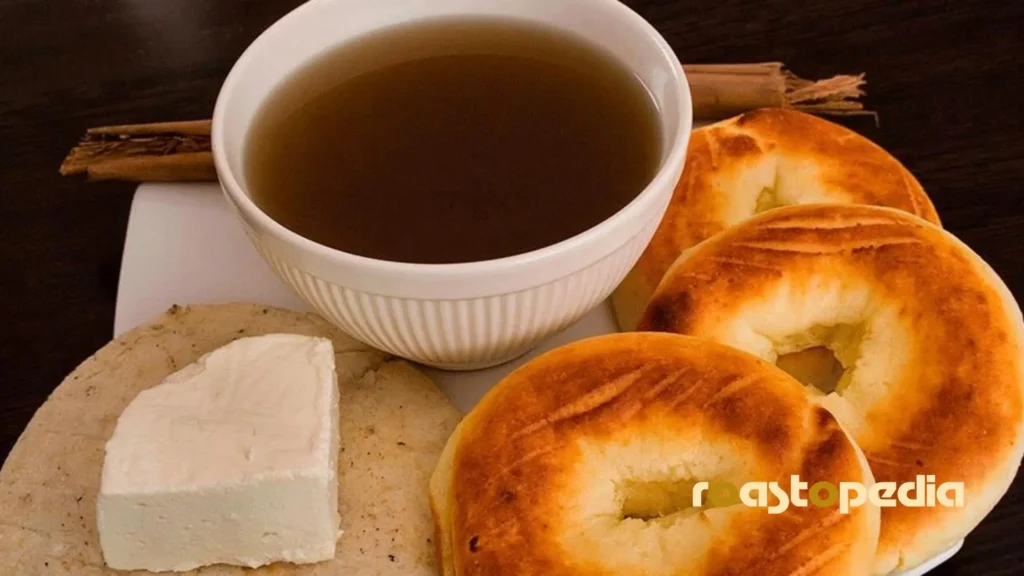
The drink carries a warm, golden color somewhere between pale tea and dark caramel, and its aroma is dominated by the grassy, cane-green scent of hot aguapanela with coffee’s roasted notes present as a secondary layer.
Tasters with no previous exposure to the drink frequently describe it as unexpectedly comforting and mild — a sensory assessment rooted in its low astringency, absence of acidity, and the particular sweetness of aguapanela, which triggers warm-flavor sensory receptors differently from refined sugar.
Variations
A lime version — aguapanela con café y limón — adds a squeeze of fresh citrus to the finished cup, a coastal variation that introduces brightness and a mild sourness that balances the drink’s inherent sweetness while enhancing the perception of coffee’s aromatic compounds.
Some highland communities in Boyacá add grated ginger to the aguapanela during preparation, producing a gently spiced base that, once coffee is added, creates a three-layered flavor experience of cane sweetness, ginger heat, and roasted bitterness.
Contemporary Colombian cafés have experimented with cold versions using cold-pressed aguapanela and cold brew coffee concentrate, presenting the traditional combination in a format that appeals to younger urban consumers without altering its essential ingredient logic.
Notable Facts
Aguapanela without coffee is Colombia’s most widely consumed non-alcoholic hot beverage after coffee itself, and in departments like Boyacá and Cundinamarca, it is drunk more frequently than plain water at mealtimes — contextualizing Aguapanela con Café as a natural evolution of an already ubiquitous base drink.
Colombian sports nutrition research has identified aguapanela as a more effective oral rehydration solution than commercial isotonic drinks under certain conditions, owing to panela’s naturally occurring electrolyte profile — a quality that makes Aguapanela con Café a post-exercise drink in some rural athletic communities.
The drink is one of the few Colombian coffee preparations explicitly designed for scalability of coffee content, meaning it can be made with as little as a teaspoon of coffee per liter and remain culturally recognizable — a flexibility that made it ideal during periods of scarcity or economic hardship.
Related Facts
Aguapanela’s role as a base drink rather than a secondary ingredient aligns it with masala chai from India and atay from Morocco, both of which function as culturally primary beverages to which other elements — milk, coffee, mint — are added as modifiers.
Ethnobotanical records from Andean communities in pre-Columbian Colombia document the ritual consumption of raw sugarcane juice during agricultural ceremonies, suggesting that the cultural significance of sweetened cane water predates Spanish colonial influence by centuries and that Aguapanela con Café represents a living continuity of that tradition.
Colombia’s national health ministry includes aguapanela in dietary guidelines for infants transitioning from breast milk, indicating that the base liquid of this drink occupies a position of deep nutritional and cultural trust within Colombian society that extends well beyond coffee culture.